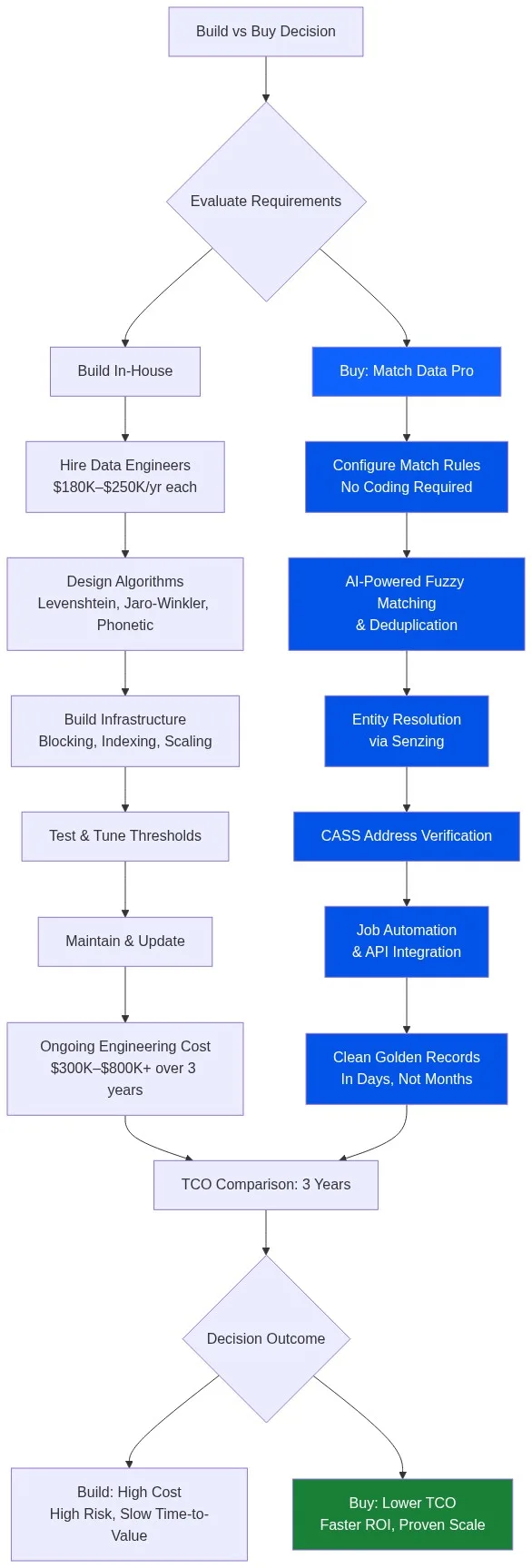
Building a data matching solution in-house costs most teams between $300,000 and $800,000 over three years once you account for engineering salaries, algorithm development, infrastructure, and ongoing maintenance. Buying a proven platform cuts that timeline from months to days and shifts the burden of algorithm accuracy, scale, and updates to the vendor.
Explore Match Data Pro’s fuzzy matching algorithms — then keep reading to understand exactly where the build path breaks down.
What You Actually Have to Build
Teams that choose to build quickly discover that “data matching” is not one problem — it is at least six:
- Tokenisation and normalisation of raw field values
- Blocking logic to reduce the comparison space from O(n²) to something tractable
- Multiple similarity algorithms (Levenshtein, Jaro-Winkler, Soundex, token-sort ratio)
- Weighted scoring and threshold calibration per field type
- Survivorship rules to produce a golden record from matched pairs
- A review UI for human-in-the-loop decisions on borderline matches
Each layer requires a specialist. A senior data engineer who can implement a production-grade Levenshtein distance pipeline costs $180,000 to $250,000 per year. That person will spend two to four months on algorithm selection alone before writing a single line of production code.
The Blocking Problem
Blocking — partitioning records into candidate pairs before scoring — is the hardest part of a custom build. Without it, a dataset of 1 million records requires 500 billion comparisons. With naive blocking (exact prefix match on surname), you miss “Smith” vs “Smyth” entirely. Sorted Neighbourhood Method and LSH-based blocking work, but implementing them correctly at production scale takes months, not weeks.
Algorithm Tuning Is Never Finished
Every new data source introduces edge cases: international name formats, unit suffixes (“Suite 400” vs “Ste 400”), transposed phone digits, merged company names. A custom build accumulates these as bugs. Each fix requires a code review, regression test, and redeployment. Teams that build their own matching engine report spending 30 to 40 percent of ongoing engineering time on maintenance rather than new features.
The Real Cost Breakdown
The table below models a realistic three-year total cost of ownership (TCO) for a mid-market data team that processes 2 million records per run.
| Cost Component | Build (3 Years) | Match Data Pro (3 Years) |
|---|---|---|
| Engineering salaries (2 FTE) | $900,000 | $0 |
| Infrastructure (cloud compute) | $60,000 | Included |
| Algorithm R&D and tuning | $120,000 | $0 |
| Platform / SaaS subscription | $0 | $36,000–$72,000 |
| Ongoing maintenance (est. 35% FTE time) | $315,000 | $0 |
| 3-Year TCO | $1,395,000+ | $36,000–$72,000 |
These numbers exclude opportunity cost: every month your team spends building matching logic is a month they are not building the data products your business actually needs.
What “Buy” Gets You on Day One
A commercial data matching platform ships the full stack out of the box. Match Data Pro delivers:
- AI-powered fuzzy matching with configurable algorithms (Levenshtein, Jaro-Winkler, phonetic, token-based) and field-level weights
- Deduplication across single or multiple sources, with survivorship rules to produce clean golden records
- Entity resolution via Senzing — graph-based probabilistic linking across siloed systems without a shared identifier
- CASS-certified address verification that standardises and validates US postal records before they enter the match pipeline
- Job automation to schedule recurring match runs without manual intervention
- Import/export connectors for CSV, Excel, databases, and API endpoints
- A live fuzzy search API for real-time lookups against a deduplicated master dataset
Configuration, not code. A data analyst can set up a match definition — fields, algorithms, thresholds — in an afternoon without writing a single line of Python or SQL.
When Building Might Still Make Sense
There are scenarios where a custom build is justified. Be honest about whether any of these actually apply to your situation.
Proprietary Algorithm Requirements
If your use case demands a matching algorithm that no commercial platform supports — for example, a domain-specific phonetic encoder for a non-Latin script — building a targeted module may be necessary. But this is a narrow exception, not the norm. Most enterprise matching problems fit within the algorithm set that mature platforms already provide.
Embedded Product Requirement
If matching logic must be embedded inside a product you are shipping to customers — white-labelled and isolated from any third-party dependency — then a custom engine or a licensable SDK may be the right call. Even here, starting with a matching API and abstracting it behind your own interface is faster than building from scratch.
Highly Regulated Data That Cannot Leave Your Perimeter
Air-gapped or on-premise requirements used to be a reason to build. Today most serious data quality vendors offer private cloud or on-premise deployment. Verify deployment options before assuming you must build.
The Hidden Costs Teams Consistently Underestimate
Beyond the direct TCO, four hidden costs sink custom matching projects.
- Threshold calibration debt. Setting a match threshold of 85 seems reasonable — until production data reveals that “Johnson” and “Jonson” score 84.6 and 250 valid matches are dropped. Recalibrating thresholds requires labelled ground truth and iterative testing. This is a continuous process, not a one-time exercise.
- New source onboarding. Each new data source has different field names, encoding conventions, and quality levels. A custom build requires engineering effort for every new source. A configured platform adds a new data definition in minutes.
- Audit and explainability. Compliance teams need to know why two records were matched or not. A custom build rarely ships with a match explanation layer. Building one is a separate project. Match Data Pro provides field-by-field scoring and explainable entity resolution out of the box.
- Staff turnover. When the engineer who built your matching engine leaves, institutional knowledge walks out with them. A documented, configured platform survives personnel changes.
Ready to see how fast you can go from raw data to clean, matched records? Start a free trial of Match Data Pro — no contract, no commitment.
Evaluation Criteria: How to Make the Decision Objectively
Use these five criteria to frame your build-vs-buy decision before it becomes a political debate.
1. Time to First Match
How long before you can run your first test match on real data? Build teams typically need three to six months. A configured platform can deliver results in a single day.
2. Algorithm Coverage
List the field types you need to match: names, addresses, phone numbers, company names, email addresses. Does the build team have expertise in every algorithm those fields require? Most do not.
3. Scale Requirements
How many records per run? 100,000 is manageable with a naive approach. 10 million requires serious blocking optimisation. 100 million requires distributed compute. Verify that the build plan accounts for your actual volume, not your current volume.
4. Maintenance Ownership
Who owns the matching engine in 18 months? If the answer is “whoever we can find,” that is a risk that belongs in your build cost estimate.
5. Total Cost Over 36 Months
Run the TCO calculation honestly. Include salaries, infrastructure, R&D, tuning, maintenance, and the opportunity cost of engineering time diverted from your product roadmap. Compare that number to three years of Match Data Pro subscription pricing.
Want to walk through this evaluation with a technical expert? Book a demo and we will model the TCO for your specific data volume and use case.
Frequently Asked Questions
How long does it take to build a data matching system from scratch?
Most teams need three to six months to reach a working prototype and six to twelve months before the system handles production edge cases reliably. That estimate assumes experienced engineers, defined requirements, and no competing priorities — conditions that rarely hold in practice.
What is the minimum team size needed to build a production data matching engine?
A realistic minimum is two senior engineers: one for algorithm development and one for infrastructure and scaling. You will also need a data analyst to build and label ground-truth test sets for threshold calibration. That is effectively a dedicated team for a six-to-twelve-month project.
Can a SaaS data matching platform handle the same volume as a custom build?
Yes. Enterprise SaaS matching platforms are built on distributed compute and handle hundreds of millions of records. Match Data Pro runs large-scale batch jobs and exposes a real-time fuzzy search API for live queries. Volume alone is not a reason to build.
What happens when our data schema changes — do we have to rebuild our matching rules?
With a configured platform, schema changes mean updating a match definition — typically a 15-minute task. With a custom build, schema changes may require code changes, regression testing, and redeployment. This is one of the most significant ongoing maintenance costs teams underestimate at the outset.
Is it possible to start with a platform and migrate to a custom build later?
Yes, and many teams do. Starting with a platform lets you understand your actual matching requirements from real data before committing to a custom build. In most cases, teams find the platform handles all their needs — and the migration never happens. Use the platform to prototype, then decide.