
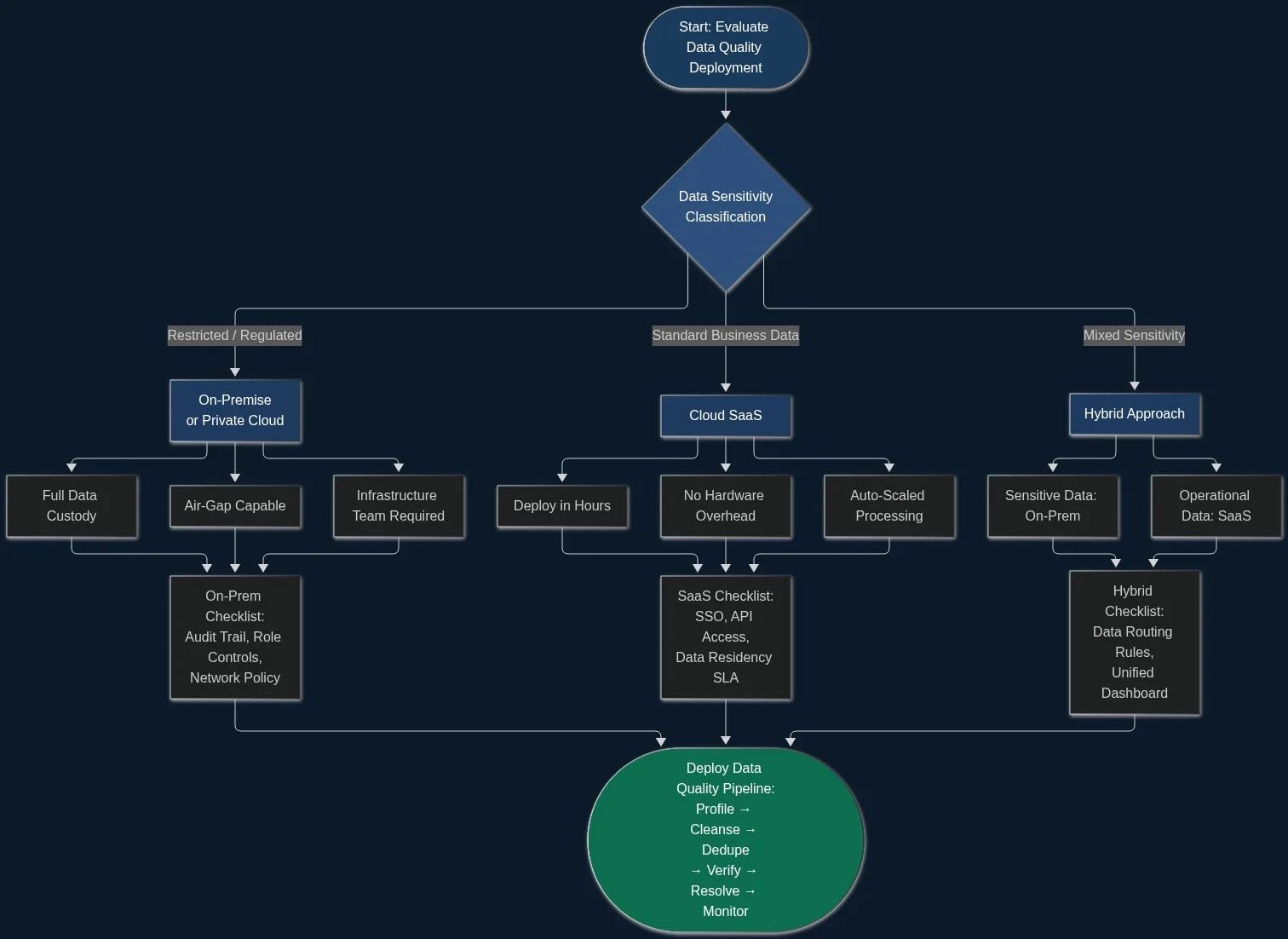
The right deployment model for data quality software depends on three factors: data sensitivity, infrastructure capacity, and how fast you need to be operational. Cloud SaaS delivers a full data quality pipeline — profiling, cleansing, deduplication, entity resolution, and address verification — in hours, with no hardware to manage. On-premise keeps sensitive data inside your own perimeter and suits regulated industries where data cannot leave the building. Most teams can answer the deployment question in a single afternoon using the structured framework below.
Not sure which model fits your organisation? Book a 30-minute deployment consultation with the Match Data Pro team and walk away with a clear recommendation.
Why Deployment Model Matters for Data Quality
Data quality software is not a reporting tool you install once and forget. It runs continuously — scanning inbound records, scoring quality, correcting formats, deduplicating entities, and verifying addresses. That continuous workload has real infrastructure implications. Choose the wrong deployment model and you end up paying for capacity you do not use, waiting months for a procurement cycle, or worse, running your pipeline in a cloud environment your security team has not approved.
The three viable deployment options are:
- Cloud SaaS — the platform vendor hosts and operates the software. You connect via browser or API.
- On-premise — the software runs on your own servers inside your network perimeter. You manage the infrastructure.
- Private cloud / hybrid — the software runs in a cloud environment you control (your own AWS VPC, Azure subscription, or GCP project), or sensitive data is processed on-premise while operational data flows through SaaS.
Each has a different cost profile, time-to-value, and security posture. The decision framework below walks through the five questions that determine the right choice.
The Five-Question Decision Framework
Answer these questions in order. The first “hard stop” answer determines your deployment model.
Question 1: Does your data contain regulated personal information?
If you process protected health information (PHI), payment card data (PCI-DSS), or data subject to sovereign data residency requirements, your options narrow immediately. Cloud SaaS from a vendor whose infrastructure is in a jurisdiction your compliance team has not approved is a non-starter. The practical choices are on-premise, air-gapped deployment, or a private cloud environment you control in an approved region. If the answer is no — standard business data, vendor records, operational contacts — cloud SaaS is fully viable and usually the fastest path to value.
Question 2: How large is your data quality infrastructure team?
On-premise deployments require someone to manage the server, OS patching, database maintenance, and software upgrades. For a team of one or two data engineers, that overhead is significant — often 20 to 30 percent of their available time. If you do not have dedicated infrastructure capacity, cloud SaaS removes that burden entirely. The vendor handles uptime, scaling, and software versions. You focus on configuring match rules, reviewing profiling results, and running jobs.
Question 3: What is your time-to-value requirement?
A cloud SaaS data quality platform can be provisioned and processing its first dataset within a single working day. On-premise procurement — hardware specification, procurement approval, rack and stack, OS configuration, software installation — typically runs 6 to 12 weeks even in well-resourced IT environments. If you are preparing data for a CRM migration or ERP go-live with a fixed deadline, the deployment timeline alone may determine your choice.
Question 4: Do you need a live fuzzy search API for application integration?
Real-time deduplication at the point of data entry — checking a new contact record against 5 million existing ones in under 200 milliseconds — requires either a horizontally scalable cloud API or a substantial on-premise investment in load-balanced infrastructure. Cloud SaaS platforms expose a live fuzzy search API that application developers can call directly, with no infrastructure design required. On-premise equivalents are possible but need dedicated hardware sizing and ongoing capacity management.
Question 5: What is your three-year total cost tolerance?
On-premise software typically requires a larger upfront licence fee, plus hardware, plus ongoing maintenance contracts. A mid-market organisation processing 10 million records per month might spend $120,000 to $250,000 over three years on on-premise data quality infrastructure. Cloud SaaS on a monthly subscription model — with no long-term contract — converts that capital expenditure to a predictable operational expense and scales with actual usage. For teams with variable processing volumes, SaaS is almost always more economical.
Cloud SaaS: What You Get and What to Verify
A cloud SaaS data quality platform delivers the full pipeline — AI data profiling, automated data cleansing, fuzzy matching, deduplication, CASS address verification, and entity resolution — without any infrastructure to manage. The key questions to verify before signing up:
| Requirement | What to verify |
|---|---|
| Data residency | Which region(s) is data processed in? Can you pin to a specific region? |
| Encryption | TLS 1.2+ in transit, AES-256 at rest. Ask for the encryption policy document. |
| SSO / MFA | SAML 2.0 or OIDC integration with your identity provider. |
| API access | REST API with API key auth and rate-limit documentation. |
| Audit logs | Every job run, match decision, and record change logged and exportable. |
| Uptime SLA | 99.9% minimum for production data quality pipelines. |
| Data deletion | Confirmed deletion within 30 days of contract end, with written confirmation. |
Match Data Pro’s cloud SaaS platform meets all of these requirements. It runs on a monthly subscription with no long-term contract. You can start a free trial and process your first dataset today — no procurement cycle, no hardware, no waiting.
On-Premise: When It Is the Right Choice and What It Demands
On-premise deployment is the right choice when data cannot leave your network under any circumstances. Healthcare organisations processing PHI under HIPAA, defence contractors with classified data requirements, and financial institutions operating in jurisdictions with strict data localisation laws are the clearest cases. See the full data quality software buyer’s guide for security-first organisations for a detailed checklist.
Infrastructure requirements
A production data quality pipeline processing 1 million records per hour requires:
- Compute: minimum 16 vCPUs and 64 GB RAM for the application tier; more for parallel entity resolution jobs.
- Storage: fast SSD-backed storage for staging tables and match index — plan for 3x the compressed source data size.
- Network: low-latency internal network if the application and database tiers are on separate hosts.
- Backup: scheduled backups of configuration, match rules, and golden record outputs — separate from source data backups.
Operational overhead
Beyond hardware, on-premise deployments require ongoing operational discipline: OS and security patching (typically monthly), software version upgrades (quarterly in most vendor release cycles), capacity monitoring as data volumes grow, and disaster recovery testing. Teams that underestimate this overhead find their data quality platform becoming a maintenance burden that competes with actual data work. Factor in 0.25 to 0.5 FTE of infrastructure time when calculating the true cost of on-premise deployment.
Hybrid Deployment: Routing Data by Sensitivity
Many organisations have both regulated data and standard operational data. A hybrid model routes each dataset to the appropriate environment. The pattern works as follows:
- PHI, PII, or classified records are profiled, cleansed, and deduplicated in the on-premise environment.
- Anonymised or non-sensitive operational data — vendor records, public contact lists, product catalogues — is processed through the cloud SaaS pipeline.
- Golden records from both environments are referenced through a unified data quality dashboard that shows health metrics across both deployments.
The hybrid approach adds routing logic and coordination complexity, but it is often the most practical solution for large organisations where blanket on-premise deployment would slow down non-sensitive data operations significantly.
Comparing the Three Models: A Side-by-Side Summary
| Dimension | Cloud SaaS | On-Premise | Hybrid |
|---|---|---|---|
| Time to first job | Hours | 6-12 weeks | Weeks (SaaS portion immediate) |
| Infrastructure overhead | None | High (0.25-0.5 FTE) | Medium |
| Data residency control | Vendor-managed region | Full control | Split by sensitivity |
| Upfront cost | Low (monthly subscription) | High (licence + hardware) | Medium |
| Scalability | Automatic | Manual (capacity planning) | Automatic for SaaS portion |
| API access | Native, documented | Requires configuration | Native for SaaS portion |
| Audit trail | Included, exportable | Requires setup | Unified dashboard needed |
| Best for | Most teams | Regulated, air-gapped | Mixed sensitivity datasets |
How Match Data Pro Supports Both Models
Match Data Pro is a cloud SaaS platform built for teams that need a full data quality pipeline without infrastructure overhead. It covers every stage: AI-powered data profiling surfaces null rates, format violations, and anomaly distributions before cleansing runs. Automated cleansing and standardisation normalise names, addresses, phone numbers, and free-text fields. Configurable fuzzy matching algorithms — Levenshtein, Jaro-Winkler, phonetic, token-based — score record pairs across multiple fields simultaneously. Senzing-powered entity resolution resolves complex identity graphs across millions of records. CASS-certified address verification appends ZIP+4 codes and corrects deliverability errors. Import/export connectors and job automation let you schedule recurring pipeline runs without manual intervention.
Every match decision is logged with field-level scores and algorithm weights, producing data audit trails that satisfy governance and compliance requirements without additional tooling.
For security-first teams evaluating alternatives to on-premise deployment, the Match Data Pro architecture includes data residency options, role-based access controls, SSO integration, and API key management. See the detailed cloud deployment options and tradeoffs guide for a full technical breakdown.
Ready to evaluate Match Data Pro against your deployment requirements? Start a free trial — no contract, no commitment, no infrastructure required. Or book a demo and walk through your specific data sensitivity, volume, and integration requirements with the team.
Frequently Asked Questions
What is the main difference between on-premise and cloud SaaS data quality software?
On-premise software runs on your own servers inside your network, giving you full data custody but requiring your team to manage infrastructure, patching, and upgrades. Cloud SaaS is hosted and operated by the vendor, deploys in hours, and scales automatically — but data leaves your network and is processed in the vendor’s infrastructure. The right choice depends on your data sensitivity classification, infrastructure capacity, and time-to-value requirements.
Can cloud SaaS data quality platforms meet healthcare or financial services compliance requirements?
Yes, but only if the vendor’s infrastructure is in a compliant region and the platform provides the required security controls: encryption at rest and in transit, role-based access controls, MFA, SSO integration, immutable audit logs, and a Business Associate Agreement (for HIPAA). Always request the vendor’s SOC 2 Type II report and data processing agreement before provisioning sensitive data in a cloud environment.
How long does it take to deploy an on-premise data quality platform?
Typically 6 to 12 weeks from procurement approval to first production job, assuming hardware is already available. The timeline breaks down as: hardware procurement and delivery (2-4 weeks), OS and network configuration (1-2 weeks), software installation and licensing (1 week), and pipeline configuration and testing (2-4 weeks). Teams with pre-approved cloud infrastructure can compress this to days using a private cloud deployment model.
What is a hybrid data quality deployment and when does it make sense?
A hybrid deployment routes sensitive data through an on-premise or private cloud environment and non-sensitive operational data through a cloud SaaS pipeline. It makes sense when an organisation has both regulated datasets — PHI, PII, classified records — and standard business data that do not carry the same restrictions. The tradeoff is added routing complexity and the need for a unified monitoring layer across both environments.
Does Match Data Pro offer on-premise deployment?
Match Data Pro is a cloud SaaS platform. For organisations with strict on-premise requirements, the team can discuss private cloud deployment options — running the platform inside your own cloud subscription — which preserves full data residency control while eliminating infrastructure management overhead. Contact sales@matchdatapro.com to discuss your specific requirements.