

Address data cleansing is the process of parsing, standardising, correcting, and verifying postal address records so that every entry in your database is deliverable, consistently formatted, and free of duplicates. A clean address record does more than reduce returned mail: it is the foundation for reliable customer matching, accurate analytics, and compliant data operations. Without a structured cleansing pipeline, address errors compound across every system that consumes that data.
According to a 2025 IBM Institute for Business Value report, over a quarter of organisations estimate they lose more than $5 million annually due to poor data quality. Address data is one of the most frequently corrupted fields in any CRM, ERP, or customer database. This guide covers every stage of a production-grade address cleansing pipeline — from raw input to a verified, deduplicated master record.
Ready to clean your address data now? Start a free trial of Match Data Pro and run your first address cleansing job in minutes.
Why Address Data Degrades — and What It Costs
Address data has a natural decay rate of roughly 10–15% per year. People move, businesses relocate, municipalities rezone streets, and ZIP code boundaries shift. At the point of entry, data entry errors introduce a further layer of noise: transposed digits in ZIP codes, missing suite numbers, abbreviated street types that don’t match USPS standards, and city names that conflict with the stated state.
The downstream cost is concrete. Undeliverable addresses cause returned mail, failed deliveries, and wasted postage. In CRM systems, address variants create duplicate records for the same customer — “123 Main St” versus “123 Main Street Suite 400” may represent the same location but will not match on a string-equality check. As part of a broader data quality framework, address cleansing is typically the highest-ROI remediation step because its impact is immediate and measurable.
Common Address Data Problems
- Misspelled street names: “Pensylvannia Ave” instead of “Pennsylvania Ave”
- Inconsistent abbreviations: “Street”, “St”, “St.”, “ST” used interchangeably
- Missing secondary address data: apartment, suite, or unit numbers omitted
- Incorrect ZIP codes: transposed digits (e.g., “10291” entered as “10921”)
- City/state mismatches: “Brooklyn, NJ” when the ZIP belongs to “Brooklyn, NY”
- Concatenated fields: full address stored in a single text column with no parsing
- Outdated addresses: records that were valid three years ago but are no longer deliverable
The Address Data Cleansing Pipeline: Stage by Stage
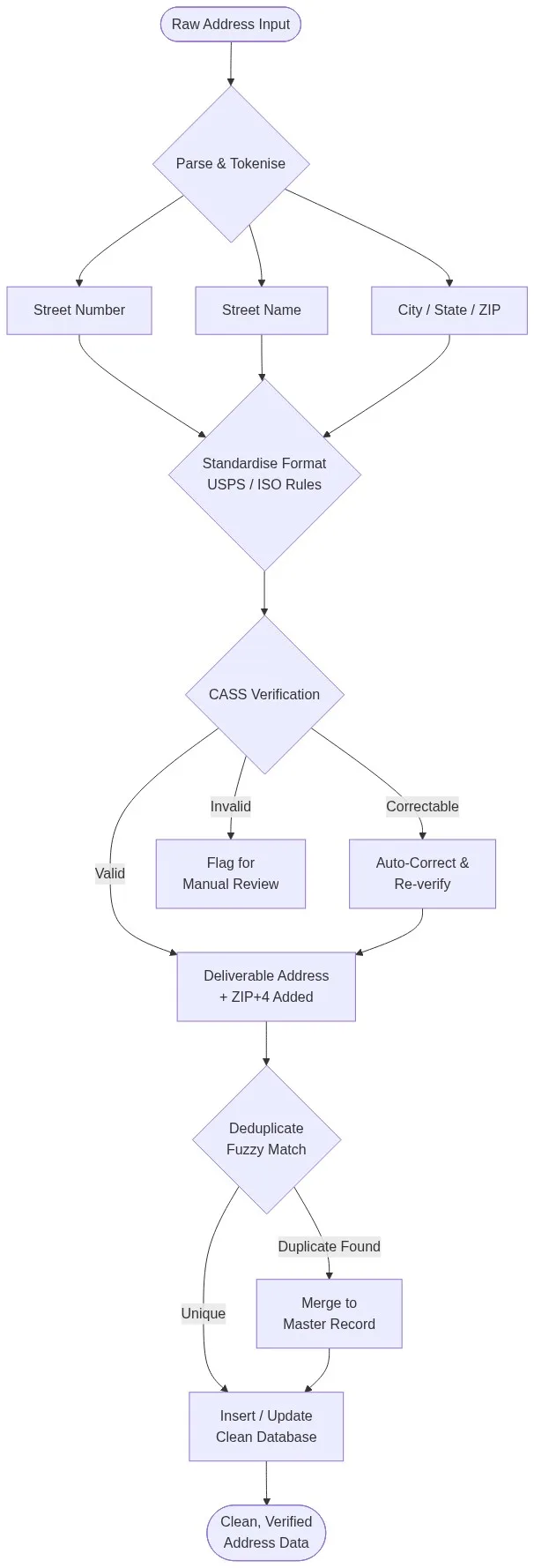
A production address cleansing pipeline runs through five distinct stages. Each stage catches errors the previous one cannot. Skipping a stage means errors pass through to your verified output.
Stage 1: Parse and Tokenise
Before any correction can happen, the raw address string must be split into its constituent components: house number, pre-directional, street name, street suffix, post-directional, unit type, unit number, city, state, and ZIP. A concatenated address like 123 N Main St Apt 4B, Springfield, IL 62701 needs to be decomposed so each token can be validated independently.
Parsing is harder than it looks. Addresses such as 1234 St. James Blvd NW Suite 200 contain a saint abbreviation in the street name, a compass directional, and a secondary unit — all of which need separate handling rules. A regex-only parser will fail on these. A production parser uses a combination of grammar rules and reference lookups against USPS address data.
Stage 2: Standardise to USPS Format
Once tokenised, each component is normalised to its official USPS abbreviated form. “Street” becomes “ST”, “Avenue” becomes “AVE”, “Northwest” becomes “NW”. State names are converted to their two-letter postal codes. City names are verified against the USPS City State file for the given ZIP code.
This is also the stage where deterministic matching rules are applied to correct known variations. A lookup table maps common misspellings (“Pensylvannia” → “Pennsylvania”) and non-standard abbreviations (“Blvrd” → “BLVD”) to their canonical equivalents. The output of this stage is a consistently formatted but not yet verified address.
Stage 3: CASS Certification and ZIP+4 Assignment
CASS (Coding Accuracy Support System) is the USPS certification standard for address matching software. A CASS-certified engine verifies each standardised address against the USPS Delivery Point Validation (DPV) database, confirms it is a real, deliverable location, and appends the full ZIP+4 code plus the two-digit delivery point barcode.
The CASS process returns a result code for each record:
| CASS Result | Meaning | Action |
|---|---|---|
| Y | Address confirmed deliverable | Accept, append ZIP+4 |
| S | Address standardised but not DPV-confirmed | Accept with warning flag |
| D | Deliverable building, unit not confirmed | Accept with missing unit flag |
| M | Multiple addresses matched | Flag for manual disambiguation |
| N | Not a valid USPS address | Flag for manual review or discard |
Match Data Pro’s address cleansing module runs CASS verification in batch or real-time API mode, returning the result code, the corrected address, and the full ZIP+4 in a single response. Records that return “N” are quarantined for review rather than silently passed downstream.
Stage 4: Fuzzy Matching for Duplicate Detection
Even after CASS verification, two records can refer to the same physical location. Consider these two records in a CRM:
| Record ID | Name | Address (Raw) | After CASS |
|---|---|---|---|
| A-001 | Acme Corp | 123 Main St, Chicago IL 60601 | 123 MAIN ST, CHICAGO IL 60601-1234 |
| A-002 | ACME Corporation | 123 Main Street Suite 100, Chicago, Illinois 60601 | 123 MAIN ST STE 100, CHICAGO IL 60601-1234 |
Both verify successfully via CASS. But they may represent the same legal entity at the same building — one record just omits the suite number. A string equality check will not detect this. A fuzzy match using Levenshtein distance or token-based similarity against the standardised address string will score these records at approximately 92% similarity. Combined with name matching (Acme Corp vs ACME Corporation scores ~88%), a match rule can confidently flag these as duplicates.
Stage 5: Merge to Master Record
Once duplicates are identified, a survivorship rule determines which field values survive into the golden record. For address data, the survivorship logic typically prioritises the CASS-verified address over the raw input, the most recently updated record for contact details, and the most complete record for secondary address fields. The full merge purge process is covered in depth in our separate guide.
Address Cleansing vs. Address Verification: Key Differences
These terms are often used interchangeably, but they describe different operations. Understanding the distinction matters when scoping a data quality project.
| Operation | What It Does | Output | CASS Involved? |
|---|---|---|---|
| Address Parsing | Splits address string into components | Structured tokens | No |
| Address Standardisation | Normalises abbreviations and format | Consistent format | No |
| Address Verification | Confirms address exists and is deliverable | DPV result + ZIP+4 | Yes |
| Address Cleansing | All of the above plus deduplication | Clean, merged master record | Yes |
| Address Enrichment | Appends additional data (county, CBSA, lat/long) | Enriched record | Optional |
A complete address cleansing pipeline performs all four operations in sequence. Stopping at verification without deduplication leaves duplicate records in the database. Stopping at standardisation without verification leaves undeliverable addresses in the output.
International Address Cleansing: Additional Considerations
CASS applies only to US domestic addresses. International address cleansing requires a different approach for each country or postal authority:
- Canada: SERP (Software Evaluation and Recognition Program) certification covers Canadian address validation using Canada Post data
- UK: PAF (Postcode Address File) from Royal Mail is the authoritative reference for UK address verification
- Australia: AMAS (Address Matching Approval System) from Australia Post covers Australian addresses
- EU: No single certification standard; individual national postal authority data is used. Address formats vary significantly — German addresses put the house number after the street name; French addresses use cedex codes for business delivery
For global datasets, the parsing stage must handle address format variations by country before standardisation can occur. A record with “Rue de Rivoli 75001 Paris” requires a different parse grammar than “1600 Pennsylvania Ave NW Washington DC 20500”.
The golden record creation process for international datasets must account for these format differences when defining survivorship rules — a UK postcode and a US ZIP code cannot be compared using the same validation logic.
Integrating Address Cleansing Into Your Data Pipeline
Address cleansing can run at three points in a data pipeline, each with different trade-offs:
- Point of entry (real-time): Validate and standardise addresses as they are entered in a web form or CRM UI. Catches errors before they reach the database. Adds 50–200ms latency per record via API call. Best for customer-facing data capture.
- Batch processing (scheduled): Run the full cleansing pipeline against an existing database on a schedule — weekly, monthly, or before a campaign send. Handles high volumes without latency constraints. Best for existing dirty datasets.
- ETL / pipeline integration: Embed address cleansing as a transformation step in an ETL job that runs when data is ingested from external sources — CSV imports, API feeds, or database migrations. Best for ongoing multi-source data ingestion.
Match Data Pro supports all three modes. The live fuzzy search and matching API handles real-time address verification at the point of entry. Batch jobs run against full database exports using configurable cleansing rules. Import/export connectors support Salesforce, HubSpot, SQL databases, and flat files — no custom ETL code required.
If your organisation is building an AI or LLM-based application on top of customer data, address cleansing is a prerequisite. Dirty address data corrupts geocoding, territory assignment, and personalisation models in ways that are difficult to debug once they reach a trained model.
Frequently Asked Questions
What is address data cleansing?
Address data cleansing is the end-to-end process of parsing raw address strings into components, standardising them to USPS or postal authority format, verifying deliverability via CASS or equivalent certification, detecting duplicate records using fuzzy matching, and merging duplicates into a single master record. The output is a database of clean, deliverable, non-duplicated address records.
How often should I run address data cleansing?
Address data degrades at approximately 10–15% per year due to people moving, businesses relocating, and postal authority updates. For most organisations, a quarterly batch cleanse is the minimum. High-volume CRM or marketing databases benefit from monthly cleansing plus real-time validation at the point of entry to prevent new dirty records from being added between batch runs.
What is CASS certification and why does it matter?
CASS (Coding Accuracy Support System) is the USPS standard for address matching accuracy. CASS-certified software has been tested by the USPS and confirmed to meet accuracy thresholds for address standardisation and delivery point validation. Using a CASS-certified engine means your output addresses are matched against the official USPS delivery point database, giving you confident deliverability confirmation rather than a best-guess match.
Can fuzzy matching find address duplicates that CASS misses?
Yes. CASS verifies that an address is real and deliverable, but it does not compare records against each other to detect duplicates. Two records for the same building — one with a suite number, one without — will both pass CASS independently. Fuzzy matching compares the standardised address strings across all records and scores their similarity, flagging records that exceed a configured threshold as probable duplicates. The combination of CASS and fuzzy matching is required for a complete cleansing pipeline.
How does Match Data Pro handle address cleansing at scale?
Match Data Pro processes address cleansing jobs in parallel batch mode with configurable thread counts, handling millions of records per job. The platform applies parsing, CASS verification, fuzzy deduplication, and survivorship-based merging in a single automated pipeline. Jobs can be scheduled, triggered via API, or run on-demand. Results are returned as a clean export file or written directly to a connected CRM or database via the available connectors.
Start Cleaning Your Address Data Today
Address errors accumulate silently and cost real money in returned mail, failed campaigns, and duplicated customer records. A structured cleansing pipeline stops that accumulation at the source.
Start your free trial of Match Data Pro and run address cleansing, CASS verification, and deduplication against your own data — no contract, no setup fee.
Want a guided walkthrough of the platform? Schedule a demo with our data team or contact us directly at sales@matchdatapro.com.