
Data matching software identifies records across disconnected systems that refer to the same real-world entity — even when names are misspelled, addresses are formatted differently, or no shared key exists. The right platform combines configurable fuzzy algorithms, entity resolution, address verification, and job automation in a single pipeline. Without it, analysts spend 40–60% of their time manually reconciling records that a well-configured matching engine handles in minutes.
Ready to see how it works on your own data? Start a free trial of Match Data Pro — no contract, no credit card required.
What Data Matching Software Actually Does
The core job of data matching software is to compare records across datasets and return a scored probability that two or more records represent the same entity. This is harder than it sounds. Real-world data is inconsistent: “IBM Corp.”, “I.B.M.”, and “International Business Machines” all refer to the same company. “123 Main St, Ste 4” and “123 Main Street, Suite 4” are the same address. “Jon Smith” and “Jonathan Smith” may be the same person.
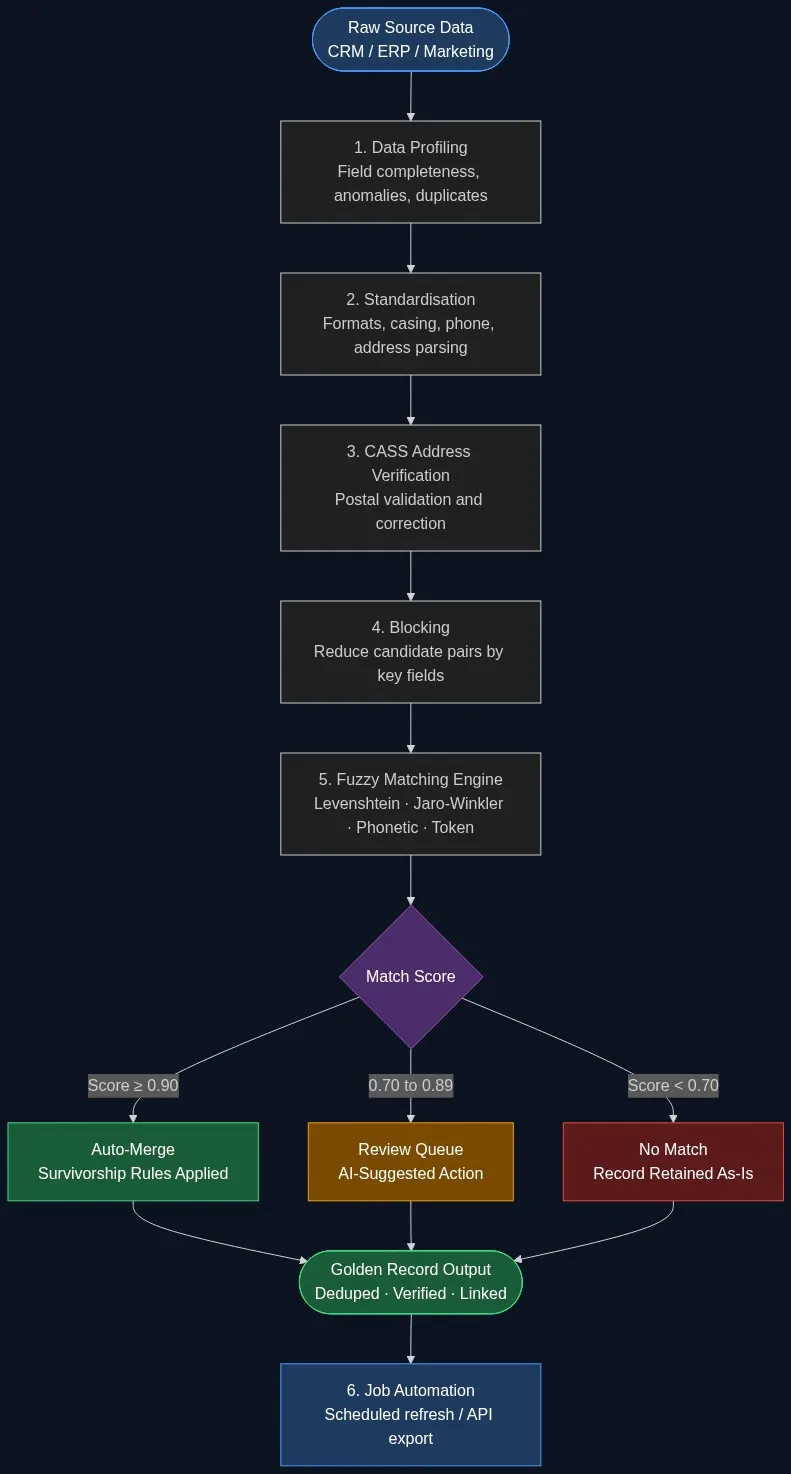
A production-grade platform handles these cases through a multi-stage pipeline — not a single comparison function. The stages are:
- Profiling: scan every field for completeness, anomaly patterns, and duplication rate before any matching runs.
- Standardisation: normalise casing, strip punctuation, expand abbreviations, parse name prefixes and address components.
- Blocking: group records by a shared key attribute (first three characters of a last name, ZIP code prefix) to reduce the candidate pair space from O(n²) to a manageable subset.
- Fuzzy scoring: run multiple algorithms — Levenshtein edit distance, Jaro-Winkler, phonetic (Soundex/Metaphone), token-set ratio — across each field, then combine weighted scores into a single composite.
- Threshold routing: auto-merge high-confidence pairs (≥ 0.90), queue borderline pairs (0.70–0.89) for review, and retain non-matching records as distinct entities.
- Survivorship: when merging, apply field-level rules to select the most complete or most recent value for each attribute in the golden record.
Learn more about what data matching is and why it matters for downstream data quality.
Core Feature Categories to Evaluate
When evaluating platforms, map their capabilities against four categories. Missing any one category will create manual workarounds that erode the value of the tool.
Algorithm Configurability
No single algorithm fits every field type. Names need Jaro-Winkler or phonetic matching; addresses need parsing plus postal verification; product codes need exact or token-set matching. A platform that exposes only one algorithm — or hides the algorithm behind a single slider — gives you no ability to tune for your data’s specific error patterns.
Look for platforms that let you assign different algorithms per field, set per-field weights, and test composite scores against a labeled sample before committing to production thresholds. Match Data Pro’s configurable fuzzy matching engine supports Levenshtein, Jaro-Winkler, phonetic, token-based, and exact algorithms, individually weighted per field.
Address Verification
Address matching fails when addresses are unverified. “123 Main St” and “123 Main Street” score as a near-match on string similarity — but they may still be two distinct records if one has an invalid ZIP code. CASS-certified address verification standardises and corrects postal data before matching runs, which increases match precision by 12–20% on US address fields.
Match Data Pro includes built-in CASS address verification as part of the same pipeline — not a separate tool requiring a separate API call and data transfer.
Entity Resolution
Matching pairs of records is not the same as resolving entities across many records. If John Smith appears in five systems with five slightly different representations, pair-wise matching may correctly score each pair — but assembling all five into a single golden record requires entity resolution: graph-based clustering that groups all related pairs into one identity cluster.
Match Data Pro integrates Senzing entity resolution, which uses pre-trained probabilistic models to build and maintain entity graphs at scale. Read the entity resolution definitive guide for a full breakdown of how graph clustering differs from pair-wise matching.
Job Automation and API Access
A matching platform that only works on demand — triggered manually for each new file — cannot keep pace with live data flows. Production teams need scheduled batch jobs and a real-time API that new records can hit at point of entry.
Match Data Pro’s live fuzzy search API lets any upstream system check a record for duplicates before it is written to the database. Scheduled jobs handle bulk refreshes — weekly deduplication of the full CRM, nightly merges from new imports.
The Data Matching Pipeline: A Visual Overview
The diagram below maps the six-stage data matching pipeline from raw source input to golden record output. Each stage builds on the previous one — skipping a stage does not save time; it introduces errors that compound downstream.
Real-World Use Cases by Team
CRM and RevOps Teams
A SaaS company’s CRM contains 120,000 contact records. Sales reps create duplicates whenever they cannot find an existing record. Marketing sends duplicate campaigns. Account executives see split history across multiple records for the same customer. After running a deduplication pipeline with fuzzy name and email matching at a 0.88 threshold, 23,400 duplicate pairs collapse into 11,700 golden records. Outreach volume drops, but reply rates increase because contacts receive one communication, not two.
See the complete CRM deduplication guide for the step-by-step process, including how to handle contacts merged from a previous acquisition.
Data Engineering Teams
A data engineer needs to link product records from three source systems — ERP, e-commerce, and a supplier portal — where no shared product ID exists. Product names differ: “Widget Pro 500ml”, “WIDG-PRO-500”, and “Widget Professional 500mL”. Token-set ratio matching scores all three at 0.91. A blocking key on the first six characters of the cleaned product name groups them into the same candidate bucket. All three merge into one master product record.
For a technical breakdown of how to match records when no shared identifier exists, read the record linkage without a shared identifier guide.
Data and Analytics Teams
Analytics teams running revenue attribution or customer lifetime value models depend on a complete view of each entity. Duplicate records split revenue attribution across two customer IDs, making CLV calculations systematically understate actual value. Match Data Pro’s AI data profiling surfaces duplication rates and field-level quality scores before the matching job runs — letting analysts estimate the scope of the problem before touching any records.
Evaluation Criteria: What Separates Good from Great
Use this checklist when comparing platforms:
| Criterion | What to Ask | Why It Matters |
|---|---|---|
| Algorithm flexibility | Can I assign a different algorithm per field? | Name, address, and code fields need different scoring methods |
| Threshold configurability | Can I set separate auto-merge and review thresholds? | A single threshold produces either false positives or missed matches |
| Address verification | Is CASS verification built in or a separate API? | Separate tools add latency, cost, and data transfer risk |
| Entity resolution | Does the platform do graph-based clustering? | Pair-wise matching alone cannot build a full golden record across N records |
| Survivorship rules | Can I define field-level rules for which value wins? | Merged records need authoritative field values, not random selection |
| API access | Is there a real-time REST endpoint for point-of-entry matching? | Batch-only tools cannot prevent duplicates from entering live systems |
| Job automation | Can jobs be scheduled and triggered by upstream events? | Manual runs create operational overhead and stale golden records |
| Audit trail | Does every match decision log the algorithm, score, and user action? | Regulated teams need evidence of how records were merged |
For a broader framework on tool selection, see the data matching software buyer’s evaluation framework.
How Match Data Pro Covers the Full Stack
Match Data Pro is a cloud SaaS platform built around all eight criteria above. It combines AI-powered fuzzy matching, Senzing entity resolution, CASS address verification, automated data profiling, import/export connectors, job scheduling, and a live fuzzy search API in a single subscription — no long-term contract, no separate modules to buy.
The platform supports multi-source matching across CRM, ERP, spreadsheet, and database inputs. Each matching job produces field-level score logs, a match reason code, and a survivorship audit trail. Teams running regulated workflows — financial services, healthcare, government — can enable full record-level audit logging for every merge decision.
Data profiling runs before every job. It reports completeness per field, anomaly counts, estimated duplication rate, and recommended blocking keys — giving the engineer precise configuration inputs rather than requiring trial and error. For a deeper look at what profiling surfaces, read the AI data profiling overview.
Want to see how the platform handles your specific data? Book a 30-minute demo with a data matching engineer, or start a free trial and run a matching job against your own records today.
Frequently Asked Questions
What is data matching software used for?
Data matching software is used to identify records across datasets that refer to the same real-world entity — even when names, addresses, or identifiers differ. Common use cases include CRM deduplication, product record consolidation, customer identity resolution, and linking records across CRM, ERP, and marketing platforms without a shared key. It produces a single golden record from all duplicates.
How is fuzzy matching different from exact matching?
Exact matching requires two field values to be identical to declare a match. Fuzzy matching assigns a similarity score between 0 and 1 based on edit distance, phonetic similarity, or token overlap. Fuzzy matching catches “Jon Smith” and “Jonathan Smith” as likely the same person where exact matching would reject them. Most production pipelines use both: exact matching on confirmed identifiers and fuzzy scoring on name and address fields.
What is a golden record in data matching?
A golden record is the single authoritative entity produced by merging all duplicate records that refer to the same real-world object. It is built by applying survivorship rules: for each field, the rule selects the most complete, most recent, or most trusted value from the source records. The golden record becomes the master reference for all downstream systems, reporting, and analytics.
How do I set the right match threshold?
Set thresholds by testing against a labeled sample of record pairs — known duplicates and known non-duplicates. Run the scoring pipeline and measure precision and recall at different cut points. A threshold of 0.90 typically minimises false positives (wrongly merged records). A review band between 0.70 and 0.89 captures borderline pairs for human validation. Tune separately for different field combinations: name-only matches need higher thresholds than name-plus-address composites.
Can data matching software handle records with missing fields?
Yes. Production-grade platforms handle null and empty fields through field-level weighting: if a phone number is missing on one record, the composite score draws more weight from name, email, and address. The matching engine does not fail or default to zero — it redistributes weight across available fields. Some platforms also flag incomplete records during profiling so they can be enriched before matching runs, improving overall accuracy.