

Data cleansing — also called data cleaning — is the process of detecting and correcting errors, inconsistencies, duplicates, and structural defects in raw datasets so that every downstream system consumes accurate, trustworthy records. It is not a one-time batch job; it is a repeatable, automated pipeline stage that sits between data ingestion and analytics, AI training, or operational reporting. Without it, every insight, model, and business decision built on that data is built on sand.
According to a 2025 report by the IBM Institute for Business Value, 43% of chief operations officers identify data quality issues as their most significant data priority — and over a quarter of organisations estimate they lose more than USD $5 million annually from poor data quality. For data engineers and CDOs managing modern pipelines, data cleansing is not a cost centre. It is a revenue-protection mechanism.
This guide covers the full technical anatomy of a data cleansing pipeline: the six stages, the algorithms behind each stage, concrete workflow examples, a tool comparison, and how AI is accelerating every step.
Why Data Cleansing Is a First-Class Engineering Concern
Raw data arrives from CRM exports, API integrations, third-party feeds, web forms, and legacy system migrations. Every one of these sources introduces a different class of quality problem. The compounding effect is severe: a CRM with 15% duplicate contacts, inconsistent address formats, and missing postcode fields does not just produce bad marketing reports — it corrupts customer segmentation, inflates campaign spend, and breaks entity resolution pipelines downstream.
Data cleansing resolves problems at six levels:
- Completeness: Missing values, null fields, empty strings where data should exist.
- Validity: Values that violate a domain rule — a US ZIP code with letters, a negative invoice amount, a birth date in the future.
- Consistency: The same entity represented differently across systems — “IBM Corp”, “I.B.M.”, and “International Business Machines” all referring to the same organisation.
- Accuracy: Values that are present and validly formatted but factually wrong — a transposed phone number, an outdated address.
- Uniqueness: Duplicate records that cause inflated counts, double-shipping, or double-billing.
- Timeliness: Records that were accurate at ingestion but have since decayed — moved addresses, changed names, deactivated email accounts.
Addressing all six dimensions in a structured pipeline is what separates enterprise-grade data cleansing from ad-hoc spreadsheet fixes.
The Six-Stage Data Cleansing Pipeline
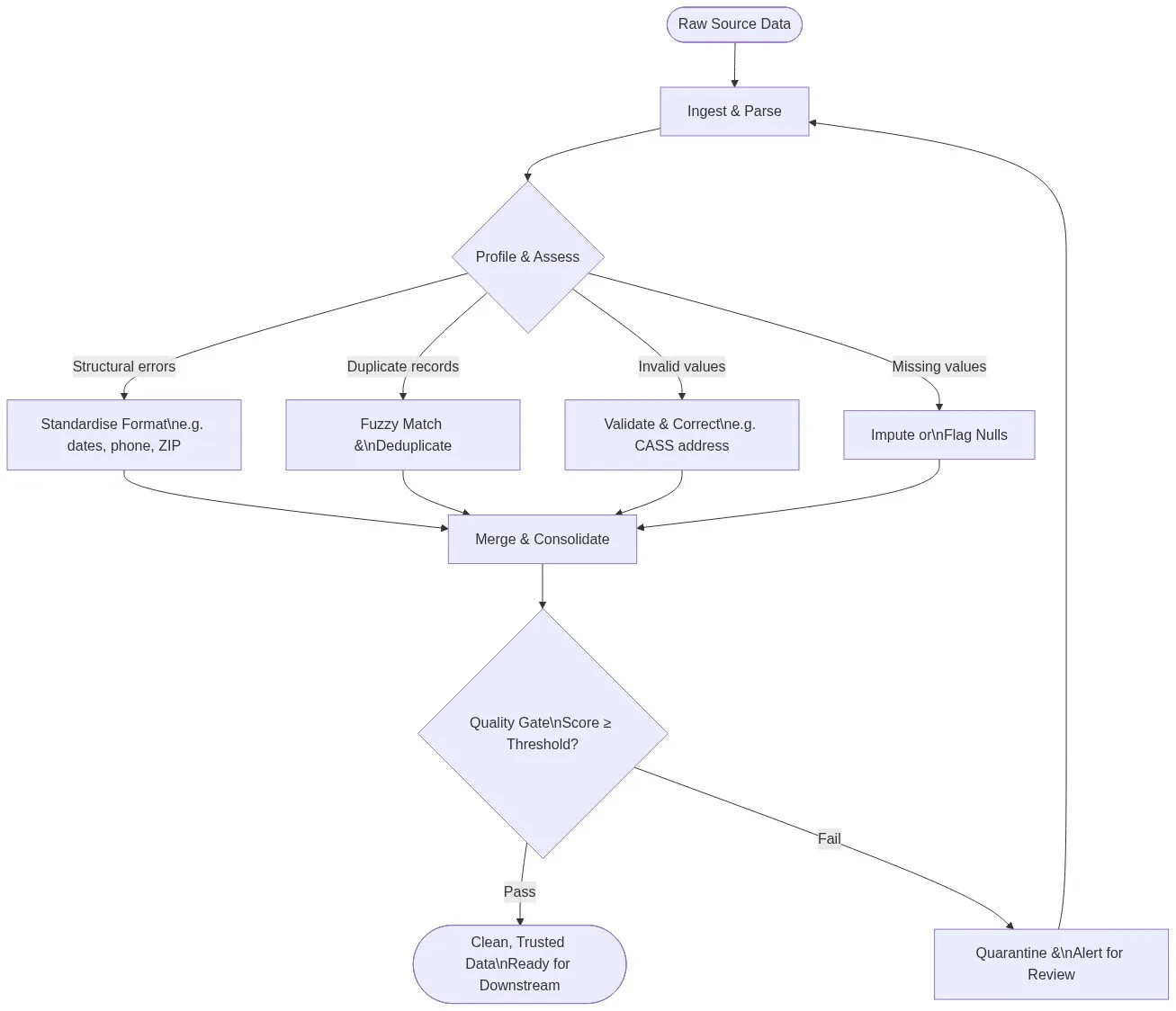
Every robust data cleansing implementation follows a reproducible pipeline. The diagram below illustrates the end-to-end flow from raw source data to a clean, quality-gated output ready for downstream consumption.
Stage 1 — Ingest and Parse
Data is loaded from source systems via connectors: flat file (CSV, Excel), database (SQL, NoSQL), API, or streaming feed. At this stage the goal is structural integrity — confirming that column delimiters are correct, encoding is consistent (UTF-8 vs. Latin-1 conflicts are common in legacy migrations), date formats are parseable, and numeric fields are not storing mixed types. Match Data Pro’s import/export connectors support all major source formats and flag parsing anomalies before any cleansing logic is applied.
Stage 2 — Profile and Assess
Before correcting anything, you must measure what you have. AI data profiling generates a quality scorecard across all six dimensions above: null rates per column, value distribution, pattern frequency, cross-field dependency violations, and duplicate density estimates. This profiling output drives the cleansing rules applied in subsequent stages — rather than applying blanket transformations, you target the exact defect classes present in that dataset.
Stage 3 — Standardise Format
Standardisation resolves representation inconsistencies without changing underlying meaning. Typical transformations include:
- Name normalisation: “DR. JOHN A. SMITH JR” → structured fields: title=”Dr”, first=”John”, middle=”A”, last=”Smith”, suffix=”Jr”
- Phone formatting: “(800) 555-1234”, “8005551234”, “+1-800-555-1234” → E.164 canonical form
+18005551234 - Date standardisation: “03/04/26”, “April 3 2026”, “2026-04-03” → ISO 8601
2026-04-03 - Address parsing: Splitting free-text address fields into structured components (street number, street name, unit, city, state, ZIP+4), with CASS certification to validate deliverability against USPS data.
Match Data Pro’s CASS address verification engine standardises and validates US postal addresses at batch scale, correcting street abbreviations, verifying ZIP+4 codes, and flagging undeliverable records before they reach your CRM or fulfilment system.
Stage 4 — Fuzzy Match and Deduplicate
After standardisation, near-duplicate records must be identified and resolved. Exact matching alone is insufficient — “Jon Smith” and “Jonathan Smith” at the same address will never produce an exact match on name, yet they almost certainly represent the same person. Fuzzy matching algorithms — Levenshtein edit distance, Jaro-Winkler similarity, phonetic codes (Soundex, NYSIIS), and token-sort ratio — score record pairs by similarity across multiple fields simultaneously.
In a practical workflow: a B2B SaaS company merging two CRM exports (Salesforce + HubSpot) for a single customer view runs a composite match on company_name (Jaro-Winkler ≥ 0.85), domain (exact), and phone (normalised exact). Records exceeding a configured composite threshold are flagged as duplicates; those in a grey-zone threshold band are routed for AI-assisted human review before merge.
For high-volume or complex entity scenarios, Match Data Pro integrates Senzing entity resolution — a probabilistic graph-based engine that resolves entities across millions of records without requiring pre-defined match rules, learning relationship patterns from the data itself.
Stage 5 — Validate and Correct
Validation applies domain-specific business rules to confirm data fitness. Examples:
- Email addresses must match RFC 5322 pattern AND pass MX record lookup
- US ZIP codes must be 5 or 9 digits and exist in the USPS master ZIP file
- Tax IDs (EIN/SSN) must match expected format and check-digit logic
- Revenue figures must be positive and within plausible range for the company size
Records failing validation are either auto-corrected (if a deterministic rule applies), flagged for manual review, or quarantined and excluded from downstream loads with a full audit trail.
Stage 6 — Quality Gate and Load
Before clean data is written to the target system, a quality gate scores the post-cleansing dataset against configured thresholds (e.g., null rate < 2%, duplicate rate < 0.5%, address deliverability ≥ 95%). If the dataset passes, it loads to the destination. If it fails, the pipeline halts and alerts the data engineering team. This prevents partially-cleansed or regression-degraded data from ever entering production. Match Data Pro’s job automation engine executes this full six-stage pipeline on a configurable schedule, with email and webhook alerting on quality gate failures.
Data Cleansing Techniques: A Comparison
Not all cleansing techniques are appropriate for every problem. The table below maps common data defect types to the recommended technique and its limitations.
| Defect Type | Technique | Strength | Limitation |
|---|---|---|---|
| Duplicate records | Fuzzy matching + deduplication | Catches near-duplicates exact matching misses | Requires threshold tuning; risk of false positives |
| Inconsistent formats | Regex-based standardisation | Fast, deterministic, scalable | Brittle against novel formats; requires rule maintenance |
| Invalid values | Rule-based validation | Precise for known domains (ZIP, phone, email) | Cannot catch plausible-but-wrong values |
| Missing values | Imputation / flagging | Preserves record count for analysis | Imputed values may introduce bias |
| Entity ambiguity | Probabilistic entity resolution (Senzing) | Resolves complex multi-source identity graphs | Computationally intensive; requires data profiling first |
| Address errors | CASS address verification | USPS-certified deliverability validation | US addresses only; international requires separate engine |
| Stale/decayed data | Change-data-capture + scheduled re-validation | Keeps records current over time | Requires ongoing pipeline maintenance |
How AI Is Transforming Data Cleansing in 2026
Traditional data cleansing relied on hand-crafted rules: a data engineer would write regex patterns, define threshold values, and maintain a growing library of transformation scripts. This approach does not scale. As data volumes grow and source system diversity increases, rule libraries become unmaintainable and miss edge cases that a human analyst would immediately recognise.
AI-Powered Match Suggestions
Modern AI cleansing engines — including Match Data Pro’s AI-powered fuzzy matching — use machine learning to suggest match rules and similarity thresholds based on the actual distribution of your data, rather than requiring manual configuration. The model analyses field entropy, co-occurrence patterns, and historical confirmation decisions to surface the most likely duplicate clusters first, dramatically reducing the manual review queue.
Automated Anomaly Detection
Statistical outlier detection flags values that are technically valid but contextually suspicious — a US customer record with a UK-format phone number, a B2B contact with a consumer email domain (gmail.com) in a field mapped to corporate email, or a transaction amount three standard deviations above the account’s historical mean. These are not rule violations; they are signals that only pattern-aware AI can reliably surface.
Self-Healing Pipelines
In mature data architectures, AI-assisted remediation can close the loop: when the model is confident in a correction (e.g., a clearly transposed US ZIP code, a recognisable phone number missing its country code), it applies the fix automatically, logs the transformation, and updates the quality scorecard without human intervention. Human review is reserved for low-confidence or high-stakes corrections.
For a deeper look at how AI profiling identifies quality issues before cleansing begins, see our guide to AI data profiling for data engineers.
Data Cleansing vs. Data Matching vs. Data Merging
These three operations are often conflated but serve distinct purposes in a data quality pipeline. Understanding the relationship is essential for designing the correct processing order.
- Data cleansing corrects defects within individual records — it does not create relationships between records.
- Data matching identifies records across one or more datasets that refer to the same real-world entity, producing match pairs or clusters.
- Data merging consolidates matched record clusters into a single golden record, applying survivorship rules to select the best value for each field.
The correct sequence is always: cleanse → match → merge. Running fuzzy matching on unclean data produces degraded results because format inconsistencies reduce similarity scores for records that should match. A phone number stored as “(800) 555-1234” and another stored as “8005551234” will score poorly on string similarity unless both are first standardised to the same canonical form. Standardisation during Stage 3 of the cleansing pipeline is the prerequisite for accurate matching.
For a full walkthrough of the matching and merging phases, see our guides: What Is Fuzzy Matching? and Data Matching and Merging Guide 2026.
Data Cleansing Tools: What to Look For in 2026
When evaluating data cleansing platforms, data engineering teams and CDOs should assess the following capabilities against their stack requirements:
- Automated profiling before cleansing: The tool should measure what it is about to fix, not just apply blanket transformations.
- Configurable fuzzy algorithms: Different datasets require different similarity metrics. A tool that only supports one algorithm (e.g., Levenshtein) will underperform on phonetic or token-based matching scenarios.
- Address verification integration: CASS-certified address cleansing is a requirement for any US mailing, fulfilment, or compliance workflow.
- Entity resolution at scale: For multi-source customer data, probabilistic entity resolution (not just pairwise deduplication) is necessary for accurate golden record creation.
- Job automation and scheduling: Cleansing cannot be a manual trigger. The platform must support scheduled, event-driven, or pipeline-integrated execution.
- Audit trail and lineage: Every transformation must be logged with before/after values, the rule that fired, and the operator or model that confirmed it — for compliance and debugging.
- Deployment flexibility: SaaS for fast time-to-value; on-premise or private cloud for regulated industries where data cannot leave the network perimeter.
Match Data Pro delivers all of the above in a single platform. Compare it against alternatives in our Data Quality Software Comparison 2026.
Frequently Asked Questions About Data Cleansing
What is the difference between data cleansing and data validation?
Data cleansing actively detects and corrects errors, inconsistencies, and duplicates in an existing dataset. Data validation is a rule-based check that confirms whether incoming data meets defined quality criteria before it is accepted into a system. Validation is preventive (applied at the point of entry); cleansing is corrective (applied to data already in the system). In a mature pipeline, both operate together: validation gates prevent new errors at ingestion while cleansing pipelines remediate historical defects.
How often should data cleansing be run?
The appropriate frequency depends on data velocity and business impact. High-velocity operational data (CRM contacts, transaction records) should be cleansed continuously or on a daily schedule. Lower-velocity reference data (product catalogues, supplier directories) may tolerate weekly or monthly cleansing cycles. The critical principle is that cleansing should run before any major downstream event: a campaign launch, a data migration, an AI model retrain, or a regulatory audit. Match Data Pro’s job automation allows scheduling at any frequency — from real-time streaming to quarterly batch jobs.
What is the correct order for a data cleansing pipeline?
The recommended sequence is: (1) ingest and parse, (2) profile and assess, (3) standardise format, (4) fuzzy match and deduplicate, (5) validate and correct, (6) quality gate and load. Profiling must precede all other stages — you cannot write effective cleansing rules without first knowing the shape of the defects. Standardisation must precede matching — inconsistent formats will suppress similarity scores and produce missed duplicates.
Can AI fully automate data cleansing without human review?
AI can automate the majority of high-confidence transformations — format standardisation, obvious duplicate detection, deterministic field corrections — without human review. However, low-confidence match pairs, ambiguous entity resolutions, and business-context-dependent decisions (e.g., should two contacts at the same company be merged into one record?) still benefit from human confirmation. The practical architecture is a tiered system: AI auto-applies high-confidence fixes, routes borderline cases to a review queue, and learns from confirmed decisions to improve future auto-approval rates.
How does data cleansing relate to GDPR and data compliance?
Data cleansing is directly relevant to several GDPR obligations. The accuracy principle (Article 5(1)(d)) requires that personal data be accurate and kept up to date — which requires active cleansing pipelines, not static snapshots. The right to erasure (Article 17) requires that deletion requests propagate across all duplicate records and merged entities, which is only reliable if your data has been properly deduplicated. Incomplete deduplication means a contact’s erasure request may only delete one of three duplicate records, leaving personal data in the system and creating regulatory exposure.
Start Cleansing Your Data with Match Data Pro
Match Data Pro delivers a complete data cleansing platform: AI-powered profiling, configurable fuzzy matching, CASS address verification, Senzing entity resolution, automated deduplication, and job scheduling — all available as SaaS (no contract, instant free trial) or on-premise deployment for regulated environments.
- Compare Match Data Pro vs. alternatives →
- Learn how fuzzy matching works →
- Explore Senzing entity resolution →
Ready to clean your data at scale? Start your free trial today — no contract, no credit card required. Or contact our team at sales@matchdatapro.com to book a technical demo tailored to your data environment.