
Data deduplication identifies and eliminates duplicate records across a dataset by scoring record similarity, applying merge rules, and producing a single authoritative golden record per entity. A well-structured six-stage pipeline resolves 95% or more of duplicates automatically, leaving only ambiguous edge cases for human review.
Start a free trial of Match Data Pro and run your first deduplication job in under an hour.
Why Duplicate Records Form and Why They Compound
Duplicates enter datasets through three primary channels: manual data entry (typos, name variants, transposed digits), system integrations that merge sources without a shared key, and user behaviour (re-registrations, multiple CRM entries for the same company). Once formed, duplicates compound. A 2% duplication rate on a 1 million-record CRM grows to 12–15% within three years as new data lands on top of dirty old data.
The cost is measurable. Gartner estimates poor data quality costs organisations an average of $12.9 million per year. At the record level, each duplicate creates double-counted metrics, wasted marketing spend on duplicate outreach, and compliance risk when regulated identities are split across records.
Common Duplication Patterns
Data engineers encounter four recurring patterns:
- Name variants: “International Business Machines” vs. “IBM Corp” vs. “IBM Corporation”
- Transposition errors: “Jhn Smith” vs. “John Smtih” vs. “Jon Smith”
- Address inconsistencies: “123 Main St Apt 4B” vs. “123 Main Street #4B”
- Cross-system fragmentation: A customer in CRM with email, the same customer in ERP with account number, no shared identifier linking them
None of these patterns are catchable with exact-match SQL joins. They require fuzzy matching algorithms that score similarity rather than checking for identity.
The Six-Stage Data Deduplication Pipeline
A production deduplication pipeline is not a single operation. It is a sequence of six discrete stages, each reducing the problem space before the next stage runs.
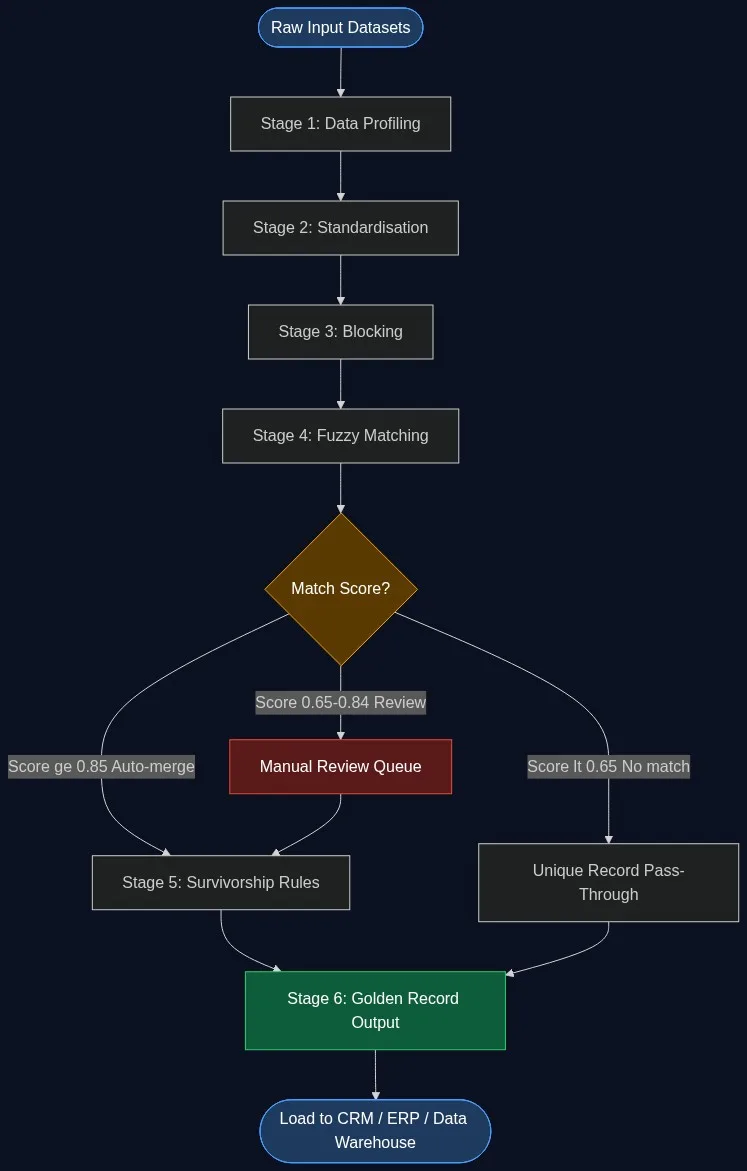
Stage 1: Data Profiling
Data profiling scans every field in the dataset before any cleaning begins. It produces null rates, format distributions, value cardinality, and an estimated duplicate rate based on common-key clustering. A profile report showing an 18% null rate on the phone field and a 6% duplicate estimate tells you exactly where to focus and which thresholds to set.
Stage 2: Standardisation
Data standardisation normalises every field to a canonical format before matching runs. This includes: uppercasing names, stripping punctuation, expanding abbreviations (“St” to “Street”), normalising phone formats to E.164, and parsing composite address fields into structured components. Standardisation alone reduces match misses by 30–40% by collapsing obvious variants before scoring begins.
Stage 3: Blocking
Comparing every record pair in a 10 million-record dataset produces 50 trillion comparisons. Blocking reduces that to a tractable set by grouping records that share a common token: first three characters of surname, ZIP code, or a phonetic key like Soundex. Only records within the same block are compared. A well-configured blocking strategy retains 99%+ of true duplicates while reducing comparison volume by 99.9%.
Stage 4: Fuzzy Matching and Scoring
Within each block, the platform computes a composite match score across multiple fields. Different algorithms serve different field types:
- Levenshtein / edit distance — best for short strings like codes and IDs where transposition is the main error mode
- Jaro-Winkler — best for names, weights prefix agreements more heavily
- Token-set ratio — best for company names where word order varies (“IBM Corp” vs. “Corp IBM”)
- Phonetic (Metaphone, Double Metaphone) — best for name variants by sound (“Smith” vs. “Smythe”)
Scores from each field are weighted and combined into a single composite score between 0 and 1. Match Data Pro’s AI-powered fuzzy matching engine lets you configure algorithm selection and field weights per project, so a CRM deduplication job weights name and email differently than a supplier master deduplication job that weights company name and address.
Stage 5: Survivorship Rules
When two records match, the system must decide which field values survive into the merged record. Survivorship rules encode that logic explicitly. Common strategies include: most-recently-updated wins, most-complete record wins, source-priority hierarchy (CRM beats ERP beats spreadsheet import), and field-level overrides (always use the CRM phone number, always use the ERP account number). Misconfigured survivorship rules are the leading cause of post-merge data quality complaints.
Stage 6: Output and Load
The final stage produces the golden record: a single, merged, verified record per entity. The output includes a match confidence score, the contributing source records, and a full audit trail of which fields came from which source. The golden record is then loaded back to the target system via automated export connectors.
Threshold Configuration: The Decision That Determines Everything
Threshold misconfiguration is the most common deduplication failure mode. Set the auto-merge threshold too high (e.g., 0.95) and you miss real duplicates. Set it too low (e.g., 0.60) and you merge distinct records.
The standard three-zone model works as follows:
- Auto-merge zone (0.85 and above): Records are merged without review. At this score, precision is typically 97–99%.
- Review zone (0.65–0.84): Records are queued for manual review. An analyst sees both records side by side and confirms or rejects the match.
- No-match zone (below 0.65): Records are treated as distinct and pass through unchanged.
Thresholds should be set by running a labelled sample of 200–500 record pairs through the scoring pipeline and measuring precision and recall at each threshold level before running the full job.
Deduplication in CRM, ERP, and Data Warehouse Contexts
CRM Deduplication
CRM deduplication focuses on contact and account records. The primary match fields are full name, email, phone, and company name. CRM data is especially prone to duplicates because multiple users enter the same customer from different contexts: a form fill, a list import, a manual entry after a trade show. Match Data Pro integrates directly with CRM systems via import/export connectors, runs the six-stage pipeline, and writes golden records back without disrupting active users.
ERP and Supplier Master Deduplication
Supplier master deduplication prioritises company name, VAT number, and address. The challenge here is that company names vary significantly across procurement, AP, and logistics: “Acme Industries Ltd” in procurement may appear as “Acme Ind.” in AP and “ACME INDUSTRIES” in logistics. A token-set ratio algorithm handles this class of variation most reliably.
Data Warehouse Deduplication
In a data warehouse context, deduplication typically runs as part of the staging-to-production pipeline. Records arrive in staging, the deduplication job runs as a batch process, and only golden records land in the production schema. Match Data Pro’s job automation supports scheduled batch runs with configurable triggers and alerting on match rate anomalies.
Preventing New Duplicates After the Initial Cleanse
A one-time deduplication run degrades within months if no prevention layer exists. Two mechanisms prevent re-contamination:
- Real-time API matching at entry point: Match Data Pro’s live fuzzy search API checks incoming records against the deduplicated master in real time. If a new record scores above 0.85 against an existing one, the system flags the potential duplicate before it is written.
- Periodic scheduled batch jobs: For systems where point-of-entry prevention is not feasible, scheduled weekly or monthly deduplication jobs catch duplicates before they compound. Match Data Pro’s agentic deduplication pipelines automate this without manual scheduling overhead.
The combination of real-time prevention and periodic batch cleanup reduces ongoing duplication rates to under 0.5% in most production environments.
What to Look For in a Deduplication Platform
When evaluating data deduplication software, prioritise these five capabilities:
- Configurable multi-algorithm matching: No single algorithm works for all field types. The platform must let you assign algorithms per field and configure weights.
- Blocking controls: Without blocking, deduplication does not scale beyond a few hundred thousand records.
- Survivorship rule editor: You need to define merge logic explicitly, not accept a black-box default.
- Review workflow: A structured queue for borderline matches, with accept/reject controls and an audit trail.
- Job automation and scheduling: One-time runs are not enough. You need scheduled, monitored, alertable batch jobs.
Match Data Pro covers all five. It also adds AI-powered match suggestions that learn from your review decisions over time, and Senzing-powered entity resolution for complex multi-source identity graphs.
Book a 30-minute demo to see the full pipeline run on a sample from your own dataset.
Register now for a free trial — no contract, no credit card required.
Frequently Asked Questions
What is data deduplication and why does it matter?
Data deduplication is the process of identifying and merging duplicate records in a dataset to produce one authoritative record per entity. It matters because duplicates inflate metrics, waste operational spend, and create compliance risk when regulated entities appear multiple times across systems.
How does fuzzy matching improve deduplication accuracy?
Fuzzy matching scores record similarity rather than requiring identical strings. This catches typos, name variants, and formatting differences that exact-match joins miss entirely. In production datasets, fuzzy matching typically increases duplicate detection rates by 40–60% compared with exact-match rules alone.
What is a survivorship rule in deduplication?
A survivorship rule defines which field value is retained when two matching records are merged into a single golden record. Common rules include: most-recently-updated wins, most-complete record wins, and source-priority hierarchy. Without explicit survivorship rules, merged records often contain the wrong field values from lower-quality source systems.
How long does a deduplication project take?
A focused deduplication project on a single system — CRM, ERP, or supplier master — typically completes in 2–6 weeks with a dedicated platform. Profiling and standardisation take 1–2 weeks; threshold calibration and a test run take another week; full batch processing and review runs in parallel with daily work. Enterprise multi-system projects typically run 6–12 weeks.
Can deduplication run in real time, or only as a batch process?
Deduplication can run both ways. Batch deduplication cleans an existing dataset in one job. Real-time deduplication uses an API to check each incoming record against the master at point of entry and flag or block duplicates before they are written. Most teams run an initial batch cleanse followed by real-time prevention and periodic scheduled batch jobs to catch anything that slips through.