
AI hallucinates because its training and retrieval data is dirty. Duplicate records, inconsistent entity names, and unstandardised formats create conflicting signals that force a language model to interpolate rather than retrieve. Fixing the data quality problem upstream is the only reliable way to reduce hallucination rates in production AI systems.
Ready to clean the data feeding your AI? Start a free trial of Match Data Pro and run your first data quality job in minutes.
What Actually Causes AI Hallucinations
The term “hallucination” implies a model failure. In practice, the root cause is almost always an input data failure. A language model generates the most statistically plausible output given its context. When that context contains contradictory, duplicated, or incomplete records, plausible becomes wrong.
Consider a retrieval-augmented generation (RAG) pipeline pulling customer records to answer an account query. If the CRM contains three records for “Acme Corp”, “ACME Corporation”, and “Acme Corp Inc” — all referring to the same company but with different revenue figures, contact names, and contract dates — the model receives three contradictory signals. It cannot resolve them. It either picks one arbitrarily, averages them silently, or generates a confident-sounding blend of all three. Each outcome is a hallucination from the user’s perspective.
The Three Data Quality Failure Modes That Drive Hallucinations
Data quality problems map to hallucination patterns in predictable ways:
- Duplicate records with conflicting values: The model receives multiple “true” answers for the same question. It cannot distinguish which is authoritative, so it blends them. Example: two customer records with different phone numbers for the same entity. The model returns one at random.
- Inconsistent entity names: “IBM”, “I.B.M.”, “International Business Machines” all refer to the same entity but are treated as three separate ones. Any downstream lookup or aggregation fails silently.
- Sparse or incomplete records: Missing fields trigger the model to fill gaps with plausible-sounding fabrications. A 40% null rate on a key field is a direct hallucination risk factor.
How Dirty Data Enters AI Pipelines
Most enterprise AI pipelines pull from source systems that were never designed for AI consumption. CRM platforms accumulate duplicates at 10–25% annually. ERP vendor tables contain legacy abbreviations and inconsistent formats. Marketing databases merge lists from multiple campaigns without deduplication. Each of these feeds becomes context for your AI system, carrying every format inconsistency and duplicate record it has accumulated over years of operation.
RAG Pipelines Are Especially Vulnerable
Retrieval-augmented generation amplifies data quality problems rather than hiding them. Unlike a fine-tuned model that averages its training data, a RAG system retrieves specific records and passes them verbatim into the prompt context. If those records are duplicated or contradictory, the contradiction lands directly in the model’s input window.
A financial services team running a RAG system over their client database found that 18% of client queries returned contradictory context — two records for the same client with different AUM figures. The model’s accuracy on those queries was statistically indistinguishable from random. The fix was not a better model. It was entity resolution and deduplication applied to the retrieval corpus before any query ran.
Fine-Tuned Models Inherit Training Data Defects
Fine-tuned models bake data quality problems into model weights. Duplicate training examples with inconsistent labels teach the model that both answers are correct for the same question. Inconsistent entity names in training data reduce the model’s ability to reliably refer to the same real-world object. These defects are hard to detect post-training and nearly impossible to patch without retraining the model from scratch.
The Data Quality Pipeline That Reduces AI Hallucination Risk
Addressing AI hallucination at the data layer requires a structured pipeline applied before data reaches any AI system — whether for RAG retrieval, fine-tuning, or agentic workflows. Match Data Pro’s AI data profiling starts this process by scanning every field for completeness gaps, format inconsistencies, and value anomalies before any downstream step runs.
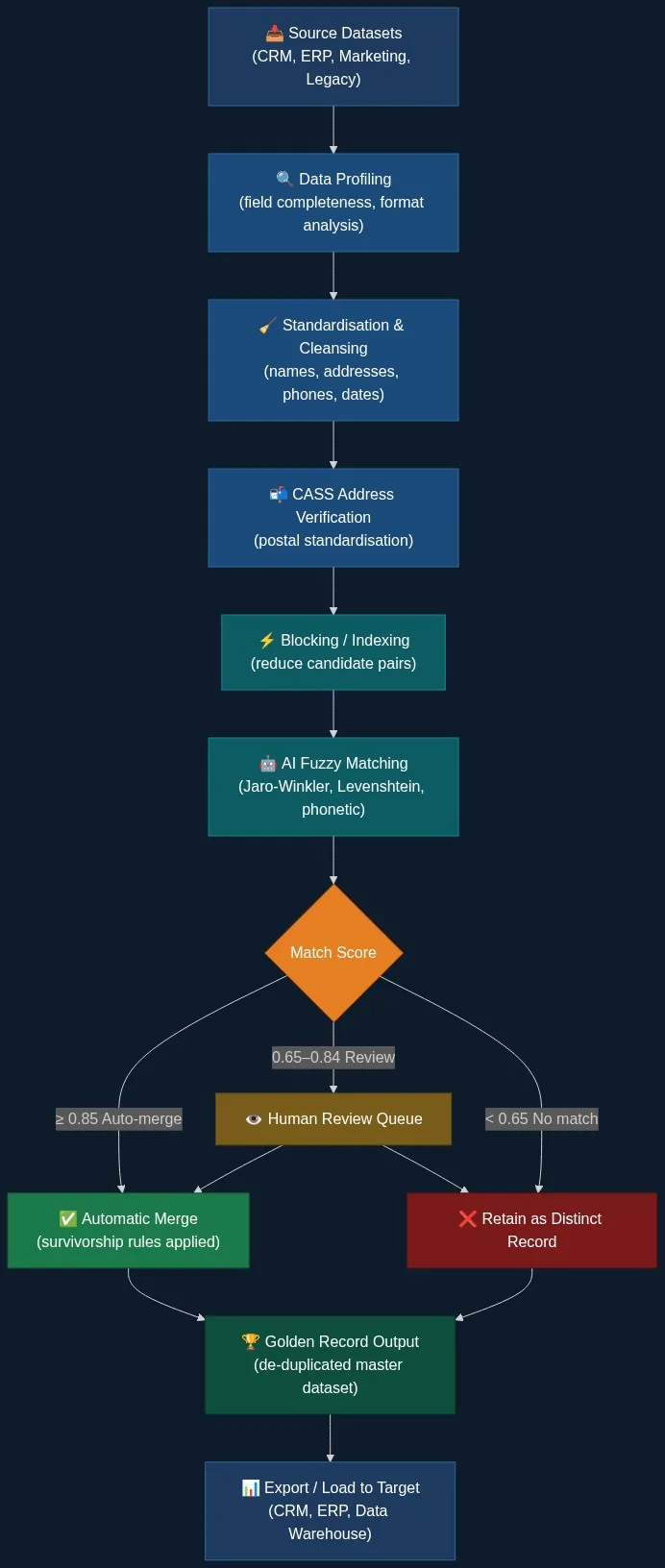
Stage 1: Profile Every Source Dataset
Before fixing anything, measure it. AI-powered data profiling scans field completeness, value distributions, and format consistency across every source. A profile of a 500K-record CRM typically surfaces 15–30 distinct data quality issues before cleansing begins. Knowing which fields have 40% nulls, which have five format variants, and which entity names appear in 12 different spellings gives you a precise remediation plan rather than a guessing game.
Stage 2: Standardise and Cleanse
Standardisation converts variant forms to a canonical representation. “IBM”, “I.B.M.”, and “International Business Machines” become a single token. Phone numbers normalise to E.164. Dates resolve to ISO 8601. Company suffixes (“Inc”, “Inc.”, “Incorporated”) collapse to one form. Match Data Pro’s data cleansing and standardisation handles these transforms with configurable rules across all field types, reducing variant-induced hallucination risk before any matching runs.
Stage 3: Verify Addresses with CASS
Address fields are among the highest-variance data elements in enterprise systems. CASS address verification standardises every postal record against the USPS database, resolving “123 Main St” vs “123 Main Street” vs “123 Main St NW” to a single verified form. This is critical for AI systems that use location as a matching signal or for geographic reasoning tasks where address inconsistencies create silent failures.
Stage 4: Deduplicate with Fuzzy Matching
Deduplication eliminates the duplicate records that generate contradictory context. Match Data Pro’s AI-powered fuzzy matching applies Jaro-Winkler, Levenshtein, phonetic, and token-based algorithms in a weighted composite score. Records scoring above a configurable threshold (typically 0.85) merge automatically under survivorship rules. Records in the 0.65–0.84 range route to a human review queue. Below 0.65, they remain distinct.
A typical enterprise deduplication run on a 1M-record dataset finds an 8–22% duplicate rate. Removing those duplicates eliminates an equivalent proportion of contradictory context from any AI retrieval corpus — a direct reduction in hallucination exposure.
Stage 5: Resolve Entities Across Source Systems
Deduplication handles near-duplicate records within a single dataset. Entity resolution links records across multiple source systems into a verified golden record. Match Data Pro’s entity resolution, powered by Senzing, clusters all records referring to the same real-world entity — across CRM, ERP, marketing, and third-party sources — into a single authoritative record. That golden record becomes the retrieval corpus for your AI system, not the raw source data with all its inherited contradictions.
Stage 6: Automate and Monitor Continuously
Data quality is not a one-time project. CRM records decay at 2–3% per month. New records enter from every source continuously. Match Data Pro’s job automation schedules profiling, cleansing, deduplication, and entity resolution jobs on any cadence — daily, weekly, or event-triggered. Quality scores feed a monitoring dashboard so your AI’s retrieval corpus stays clean over time, not just at launch.
What a Clean Data Foundation Changes for AI
Teams that fix the data quality layer before deploying AI systems see measurable improvements across three dimensions:
- Retrieval precision: A deduplicated, entity-resolved corpus returns one record per entity instead of three contradictory ones. RAG accuracy improves in direct proportion to corpus deduplication rate.
- Confidence calibration: Models hallucinate more when context is ambiguous. Clean, consistent records reduce context ambiguity, which improves the model’s ability to signal appropriate uncertainty rather than confidently generating wrong answers.
- Audit trails: Regulated industries need to explain AI outputs. A clean golden record with full provenance — which source records contributed, which fields were corrected, which duplicates were merged — gives you the audit trail that raw AI outputs alone cannot provide.
Want to see this pipeline run on your own data? Book a demo and we will walk through your specific AI data quality challenges.
Practical Thresholds: How Clean Is Clean Enough for AI?
There is no universal threshold, but experience across enterprise deployments gives useful benchmarks:
- Duplicate rate below 3% is the target for RAG retrieval corpora. Above 10%, hallucination rates in retrieval tasks increase measurably.
- Field completeness above 85% on key matching fields (name, email, company, phone) before deduplication runs. Below 60%, match precision degrades significantly and null-filling hallucinations increase.
- Entity name standardisation should achieve fewer than 3 variant forms per entity before fine-tuning data is assembled.
- Address standardisation above 90% CASS-verified before any location-sensitive AI task runs.
Run AI data profiling against your current corpus to see where you stand on each of these metrics before any AI project begins. Register for a free trial — no contract required.
Frequently Asked Questions
Why does AI hallucinate even when the data looks correct?
Hallucination often comes from data that looks correct at the record level but is contradictory at the entity level. Two records for the same customer with different phone numbers are individually valid but together create ambiguity. Entity resolution and deduplication remove that ambiguity before it reaches the AI system, giving the model a single authoritative answer to retrieve.
How does deduplication reduce AI hallucination rates?
Deduplication removes duplicate records that supply contradictory values for the same entity. When a RAG system retrieves context and finds one clean record instead of four conflicting ones, the model receives unambiguous input. Unambiguous input produces more reliable, verifiable output with lower hallucination rates across retrieval tasks.
Does data quality matter more for RAG or fine-tuned models?
Both are affected, but in different ways. RAG systems amplify individual record-level errors because those records land directly in the model’s context window. Fine-tuned models average their training data, so data quality problems manifest as statistical biases rather than one-off errors. Both require clean data before deployment, but the remediation pipeline is the same: profile, standardise, deduplicate, resolve entities.
What data quality metrics should I check before deploying an AI system?
Check duplicate rate (target below 3%), field completeness on key fields (target above 85%), entity name variant count (target fewer than 3 per entity), and address standardisation rate (target above 90% CASS-verified). Run an automated data profiling job across every source dataset feeding your AI before the first query runs or training begins.
Can Match Data Pro process data at the scale needed for enterprise AI projects?
Match Data Pro processes millions of records per job and runs as cloud SaaS with no infrastructure overhead. Profiling, cleansing, deduplication, entity resolution, and address verification all run in a single automated pipeline. Jobs can be scheduled on any cadence and results exported directly to your AI retrieval corpus or training data pipeline via import/export connectors.