

Address cleansing is the process of parsing, standardising, verifying, and correcting postal address records so they conform to deliverable, carrier-route-validated formats. A well-designed address cleansing pipeline reduces undeliverable mail rates to under 1%, appends ZIP+4 codes and delivery point barcodes, and feeds downstream deduplication and entity resolution stages with records that match accurately. Without it, every join, deduplication run, and campaign mailing operates on a degraded data foundation.
If your CRM holds 500,000 customer records and 15% carry address errors — a conservative industry estimate — that is 75,000 records sending mail to wrong addresses, failing geocoding, and producing false non-matches during deduplication. The fix is a structured cleansing pipeline, not a one-time scrub. Start a free trial of Match Data Pro’s address cleansing engine and run your first batch in minutes.
What Address Cleansing Actually Fixes
Raw address data breaks in predictable ways. Understanding the failure modes tells you exactly what your pipeline must handle. The table below maps the most common error classes to their downstream consequences and the cleansing operation that resolves each one.
| Error Class | Example (Raw) | Example (Cleansed) | Downstream Impact if Uncorrected |
|---|---|---|---|
| Missing secondary unit | 123 Main St | 123 Main St Apt 4B | Undeliverable mail; dedup false non-match |
| Misspelled street type | 45 Oak Avnue | 45 Oak Avenue | Geocoding failure; fuzzy match score drops |
| Wrong city for ZIP | Chicago IL 60601 (Los Angeles) | Los Angeles CA 90001 | USPS reject; campaign bounce |
| Abbreviated direction missing | 100 State St | 100 N State St | Wrong delivery point; duplicate record survives |
| Non-standard state code | Calif | CA | Sort failure; analytics grouping error |
| Stale ZIP code | 75201 (old boundary) | 75202 (current boundary) | Carrier route mismatch; mis-routed mail |
These errors compound. A record with a misspelled street type AND a missing direction will score below 60 on most fuzzy matchers, meaning it escapes deduplication and inflates your apparent customer count. This is why addressing data quality issues in priority order always puts address standardisation before deduplication — not after.
The Address Cleansing Pipeline: Stage by Stage
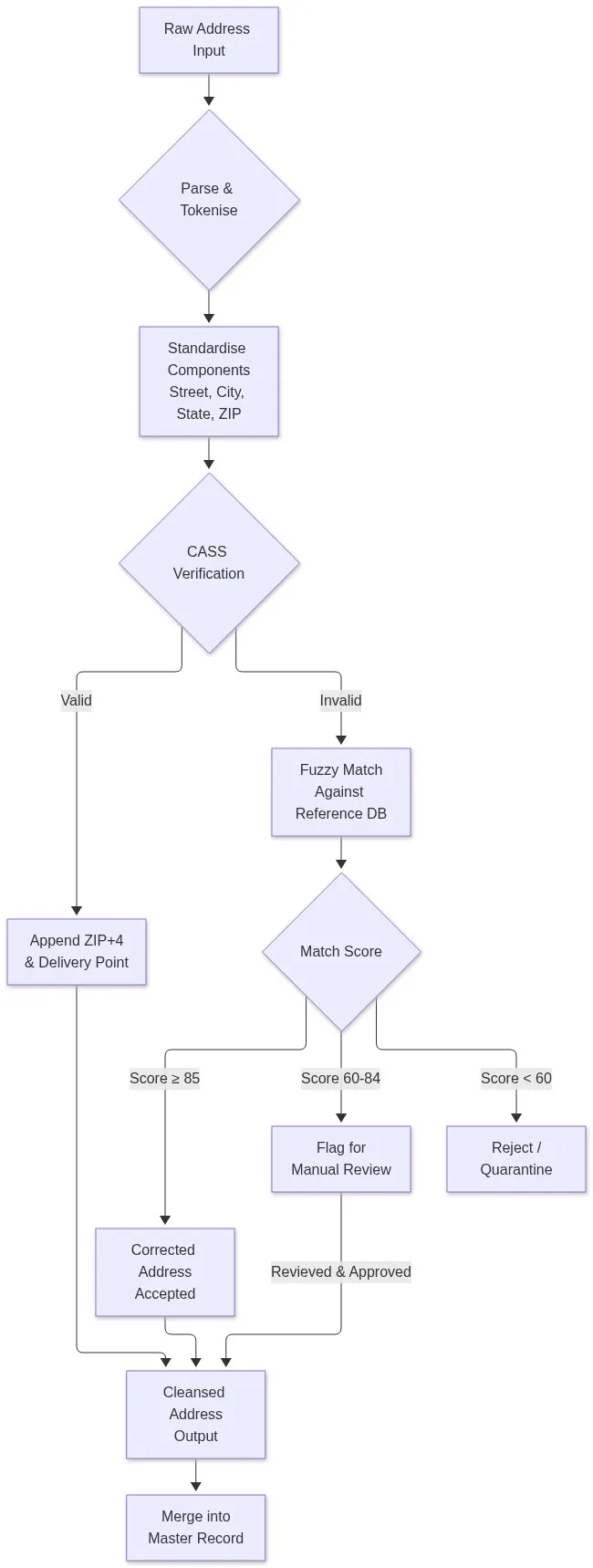
A production-grade address cleansing pipeline has six distinct stages. Each stage is a dependency for the next. Skipping stage two (standardisation) before CASS verification means the USPS reference database cannot match your tokens, inflating your false-invalid rate.
Stage 1: Parse and Tokenise
Parsing splits a free-text address string into structured components: house number, pre-directional, street name, street type, post-directional, secondary designator, secondary number, city, state, and ZIP. The parser must handle both single-line inputs (“123 N Oak Ave Ste 200, Chicago IL 60601”) and multi-line CRM exports where components are already in separate fields but inconsistently populated.
Edge cases the parser must handle: P.O. Box variants (“PO Box”, “P O Box”, “Post Office Box”), rural route formats (“RR 2 Box 45”), military addresses (APO/FPO/DPO), and Canadian postal codes mixed into US datasets.
Stage 2: Standardise Components
Standardisation converts every component to USPS Publication 28 format. Street types are expanded to their official abbreviations (“Avenue” becomes “AVE”, “Boulevard” becomes “BLVD”). State names are converted to two-letter codes. Directionals are standardised (“North” becomes “N”, “Northeast” becomes “NE”). Secondary unit designators are normalised (“Apartment” becomes “APT”, “Suite” becomes “STE”).
This stage is where most pipelines fail. Teams apply regex-based replacements but miss edge cases: “SUITE” vs “STE” vs “STE.”, “ST” resolving to “Saint” vs “Street” depending on context, and two-word city names like “New York” being split across columns. A rules engine with a full USPS abbreviation table is required.
Stage 3: CASS Certification
CASS (Coding Accuracy Support System) is the USPS program that certifies address matching software. A CASS-certified engine matches your standardised address against the USPS Delivery Sequence File (DSF2) and returns a DPV (Delivery Point Validation) result code. DPV codes tell you whether the address is deliverable at the full house-number level, not just whether the street exists.
- DPV Footnote Y: Full match — address is deliverable exactly as submitted.
- DPV Footnote S: Primary number match only — secondary number is missing or invalid. Trigger secondary-number lookup.
- DPV Footnote D: Primary and secondary match — deliverable, but secondary could not be confirmed at unit level.
- DPV Footnote N: No match — route to fuzzy matching stage.
- DPV Footnote M: Military match — apply APO/FPO formatting rules.
CASS certification also appends ZIP+4 codes and delivery point barcodes. These are what printers need for presort discounts and what logistics systems use for route optimisation. IBM’s data quality research consistently identifies address accuracy as one of the top drivers of enterprise data quality ROI, particularly for direct mail and logistics operations.
Stage 4: Fuzzy Matching Against Reference Data
Addresses that return DPV Footnote N from CASS are not necessarily invalid. The street name may be misspelled, the house number may be transposed, or the city name may reference a local colloquialism rather than the official USPS name. These records go into the fuzzy matching stage.
The fuzzy match compares the unverified address against a reference dataset using a composite score built from multiple algorithms. Match Data Pro applies the following by default:
- Jaro-Winkler on street name — weighted toward prefix matches, effective for misspellings in the first three characters.
- Levenshtein distance on city name — handles transpositions and missing characters.
- Exact match on state code — no fuzzy tolerance; state must match exactly after standardisation.
- Range check on house number — validates the number falls within the valid range for that street segment.
Composite scores above 85 are auto-accepted and corrected. Scores between 60 and 84 are flagged for manual review. Scores below 60 are quarantined. This three-tier scoring model is the same approach used in automated deduplication workflows — high-confidence auto-resolve, medium-confidence human review, low-confidence quarantine.
Stage 5: ZIP+4 Append and Delivery Point Barcode
Once an address is verified or corrected, the pipeline appends the full ZIP+4 code and an 11-digit delivery point barcode (DPBC). The ZIP+4 narrows delivery to a specific block face or building. The DPBC is the 5-digit ZIP plus the last two digits of the primary number plus the last two digits of the secondary number plus a check digit. Mail printed with a valid DPBC qualifies for USPS automation discounts of up to 20% on first-class postage.
Stage 6: Merge to Master Record
The cleansed address feeds back into the master record via survivorship rules. If the same entity has multiple address records at different cleanliness levels — common after CRM imports from multiple sources — the highest-DPV-confidence address wins. This is part of a broader data deduplication and golden record process where the best version of each field is selected from across source records.
Address Cleansing in a Broader Data Quality Pipeline
Address cleansing does not operate in isolation. It sits at stage four of a seven-stage data quality framework: after profiling, standardisation, and initial cleansing — but before deduplication and entity resolution. The order matters. Deduplication that runs on uncleansed addresses will produce false non-matches at scale: “123 N Oak Ave” and “123 North Oak Avenue” are the same address but will score below the match threshold without prior standardisation.
Similarly, entity resolution that links people across systems depends on address as a secondary identifier. If two records have different names but the same address, that address signal contributes to the resolution decision. Address errors corrupt that signal and either over-resolve (linking different people who share a building) or under-resolve (missing the connection between the same person at two variants of the same address).
For teams building a Data as a Service pipeline, address cleansing quality directly determines the reliability of every downstream consumer. A DaaS layer serving five internal teams with dirty address data multiplies the impact of every address error by five.
Address Cleansing Software: What to Evaluate
Not all address cleansing tools are equivalent. The table below compares the key capabilities you should evaluate when selecting a solution.
| Capability | Why It Matters | Match Data Pro |
|---|---|---|
| CASS certification | Required for USPS delivery point validation and ZIP+4 appending | Yes — CASS-certified engine |
| Fuzzy street name matching | Recovers records that fail exact CASS match due to misspellings | Yes — configurable Jaro-Winkler + Levenshtein |
| Batch processing at scale | Must handle millions of records without timeout or memory failure | Yes — job automation with parallel workers |
| API access | Real-time address validation at point of entry in web forms | Yes — live fuzzy search API |
| International address support | Non-US address formats require country-specific parsing rules | Yes — multi-country format library |
| Audit trail | Compliance and lineage require logging of every change made | Yes — per-record change log |
| On-premise deployment | Data residency requirements prevent cloud-only solutions | Yes — SaaS or on-premise |
When evaluating address cleansing software, also check whether it integrates with your existing data virtualisation layer or ETL pipeline. Address cleansing run as a standalone batch job outside your main data pipeline creates synchronisation problems: records cleansed in the batch may be overwritten by the next CRM sync.
Common Address Cleansing Edge Cases
Production pipelines encounter edge cases that textbook implementations miss. Here are the ones that cause the most support tickets in real deployments:
- Dual addresses: Some commercial buildings have both a street address and a P.O. Box on the same record. USPS delivers to the last line before the city-state-ZIP. If both appear, the wrong line wins.
- Urbanisation codes: Puerto Rico addresses require an URB (urbanisation) code before the street address. Standard US parsers drop this component and produce an unverifiable address.
- Identical building, different units: “100 Main St” with no unit number will DPV-verify at the building level (Footnote S) but is effectively undeliverable to a specific tenant. The pipeline must flag these for secondary unit append.
- Gridded city names: Salt Lake City uses a compass-grid naming system where “400 N 300 W” is a valid street address. Parsers that do not recognise this pattern split the components incorrectly.
- Hyphenated house numbers: Queens, New York uses hyphenated house numbers like “72-45 Main St”. A parser expecting a simple integer house number will reject these as invalid.
- Non-printing characters: CRM exports sometimes include tab characters, non-breaking spaces, or Unicode directional marks inside address fields. These must be stripped before parsing or the tokeniser splits on the wrong character.
Frequently Asked Questions
What is address cleansing and why do organisations need it?
Address cleansing is the automated process of parsing, standardising, and verifying postal address records against a reference dataset such as the USPS Delivery Sequence File. Organisations need it because raw address data accumulated through web forms, CRM imports, and manual entry contains errors that cause undeliverable mail, failed geocoding, and inaccurate deduplication. Industry benchmarks suggest 10-20% of enterprise address records contain at least one material error.
What is the difference between address cleansing and address verification?
Address verification confirms that a given address exists and is deliverable as submitted. Address cleansing goes further: it corrects the address if it does not verify, standardises all components to official formats, and appends enrichment data such as ZIP+4 codes and delivery point barcodes. Verification is a yes/no check; cleansing is a correction-and-enrichment pipeline. Most production systems require both, with cleansing running before verification so the verifier receives well-formed input.
How does CASS certification work and why does it matter?
CASS (Coding Accuracy Support System) is a USPS program that tests address matching software against a standard reference dataset and certifies it meets accuracy thresholds. A CASS-certified engine can produce a Form 3553 that qualifies mailings for presort discounts and certifies the address file has been processed to USPS standards. Without CASS certification, address software cannot officially validate deliverability or append ZIP+4 codes from the USPS reference database.
Can address cleansing handle international addresses?
Yes, but international address cleansing requires country-specific parsing rules and reference datasets. Address formats vary significantly by country: UK addresses use postcode at the end with no state equivalent; Canadian addresses use a six-character alphanumeric postal code; Australian addresses use a four-digit postcode and state abbreviation. A production-grade system must maintain a separate parsing grammar and reference dataset for each supported country. Match Data Pro supports multi-country address cleansing with country-specific validation rules.
How often should address data be re-cleansed?
Address data degrades over time. The USPS estimates that approximately 40 million Americans move each year, meaning a CRM with 500,000 records accumulates roughly 60,000-80,000 stale addresses annually if not maintained. The National Change of Address (NCOA) database, updated monthly, is the standard mechanism for catching movers. Best practice is to run NCOA processing quarterly and full CASS re-verification annually, with real-time validation at every point of data entry to prevent new errors from entering the system.
Start Cleansing Your Address Data Today
Match Data Pro’s address cleansing engine is CASS-certified, supports batch and real-time API modes, and integrates directly with your deduplication and entity resolution pipeline. No contract required. No IT project needed to start.
- Start a free trial — upload your first address file and see cleansed results in minutes.
- Book a demo — walk through the pipeline with a data quality engineer.
- Email sales@matchdatapro.com with your record volume and we will scope the right deployment for your environment.