
The best fuzzy matching software for data teams combines configurable algorithms, multi-field weighted scoring, and automated deduplication into a single platform. Match Data Pro delivers all of these in a cloud SaaS deployment with no long-term contract and a free trial at members.matchdatapro.com. This guide explains what to evaluate, which capabilities matter most, and how to run a proof of concept before committing.
Ready to see it in action? Start a free trial and load your own data in minutes.
What fuzzy matching software actually does
Fuzzy matching software identifies records that refer to the same real-world entity even when the data is spelled differently, abbreviated, or entered inconsistently. A customer entered as “Jon Smith” in one system and “Jonathan R. Smith” in another shares no common key. Exact matching returns zero results. Fuzzy matching scores the similarity and surfaces the pair for merging or linking.
The core task is similarity scoring across multiple fields simultaneously. A platform weights each field independently — name might carry 0.40, company 0.25, address 0.20, phone 0.15 — then sums the weighted scores to produce a composite match score between 0 and 1. Records above a configured threshold are auto-merged. Records in a review band go to a human queue. Records below the lower bound are left unmatched.
Why single-algorithm tools fall short
No single algorithm handles every data type well. Levenshtein edit distance works for short strings with typos — “Smyth” vs “Smith” scores 0.83. But it fails on word-transposed company names: “Global Tech Corp” vs “Corp Global Tech” scores 0.44 even though the records are identical. Token-based algorithms handle that case correctly. A production-grade fuzzy matching tool uses multiple algorithms per field and selects the best-fit scorer based on field type.
Learn more about how individual algorithms behave in our guide to how fuzzy matching algorithms work and when to use each one.
The seven capabilities that separate enterprise tools from basic utilities
Evaluating fuzzy matching software on feature lists alone misses the engineering that makes the difference at scale. These seven capabilities determine whether a platform handles real-world enterprise data or collapses under it.
1. Multi-algorithm field scoring
The platform must apply different algorithms to different fields automatically. Names need Jaro-Winkler or Double Metaphone. Addresses need token overlap plus CASS verification. Phone numbers need numeric normalisation plus exact comparison. A single algorithm applied across all fields produces too many false positives in name fields and too many false negatives in address fields.
2. Configurable blocking
Blocking reduces the candidate pair space before scoring begins. Without blocking, matching one million records against one million records produces one trillion comparisons — computationally impossible. Blocking groups records by a shared attribute (first three characters of surname, ZIP code, or industry code) so the engine only scores plausible pairs. The blocking strategy directly controls recall: too aggressive and you miss matches; too loose and the job never finishes.
3. Threshold configuration with a review band
Good platforms expose three threshold parameters: auto-merge above X, human review between X and Y, reject below Y. Teams set these based on their tolerance for false positives versus false negatives. A financial services team tolerating zero false merges sets a high auto-merge threshold and routes more pairs to review. A marketing team optimising for coverage sets a lower threshold and accepts occasional manual cleanup. Static thresholds with no review band are a sign of an immature platform.
4. Survivorship rules and golden record output
Matching without merging is incomplete. Once duplicates are identified, the platform must apply survivorship rules to decide which field values survive in the merged golden record. Common rules: most recent value wins, most complete wins, most trusted source wins. Match Data Pro’s survivorship and golden record engine supports all three rule types, per-field configuration, and conflict flagging for human review.
5. API access for real-time matching
Batch deduplication cleans existing datasets. But new records arrive every day. A platform without a real-time matching API means every new CRM entry bypasses the deduplication logic until the next batch run. The Match Data Pro REST API accepts a single record as a POST request, scores it against the existing dataset, and returns match candidates with scores in milliseconds. That enables point-of-entry deduplication in CRM forms, import pipelines, and webhook flows.
6. Data profiling before matching
Running fuzzy matching on un-profiled data produces unreliable results. If 30% of a name field contains company names — a common CRM data entry error — the matching engine will produce false positives at scale. AI data profiling scans every field for null rates, format violations, value distributions, and suspect entries before the matching job runs. Profiling output directly informs algorithm selection and threshold calibration.
7. Job automation and scheduling
Enterprise data is not static. New records arrive from CRM, ERP, third-party enrichment, and import files daily. Fuzzy matching must run on a schedule — nightly, weekly, or triggered by ingestion events. Platforms without job automation require a data engineer to manually trigger each run. Match Data Pro’s job automation layer schedules any matching workflow, sends alerts on completion or failure, and maintains a full run history for governance audit.
Fuzzy matching pipeline: how it works end to end
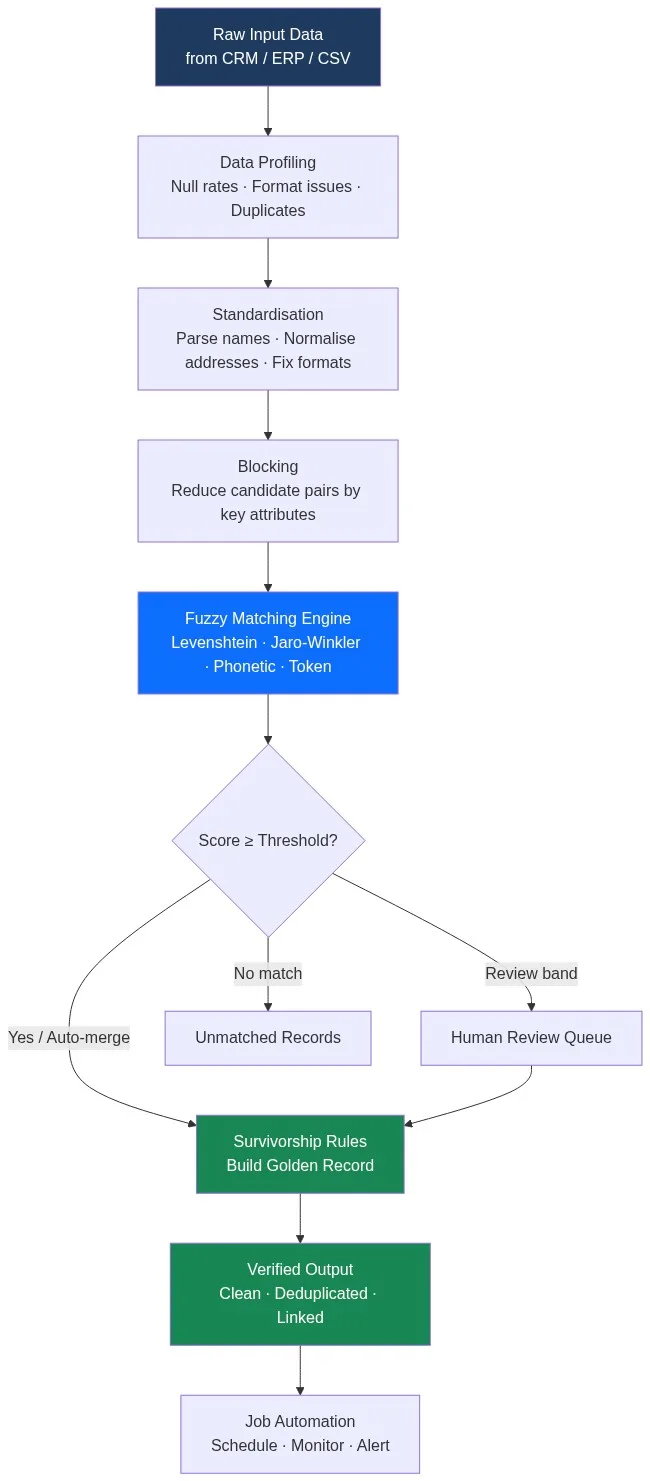
The diagram below shows the full fuzzy matching pipeline from raw input data through to verified, deduplicated output and automated scheduling.
Fuzzy matching use cases by team
CRM and RevOps teams
The most common use case: duplicate customer records across CRM, marketing automation, and support platforms. A RevOps team at a mid-market SaaS company typically finds an 8–15% duplicate rate in Salesforce after two years of growth. Running CRM deduplication with fuzzy matching on name, email, company, and phone fields consolidates the database, improves territory assignment accuracy, and removes inflated pipeline counts from sales reports.
Data engineers and integration teams
Post-merger integration, ERP migrations, and data lake ingestion all require record linkage across datasets that share no common identifier. A data engineer loading three customer databases into a unified warehouse needs to detect that “Acme Corp” in System A, “ACME Corporation” in System B, and “Acme” in System C are the same entity. Record linkage without a shared identifier requires fuzzy scoring on name, address, and company attributes simultaneously.
Financial services and compliance teams
KYC, AML screening, and sanctions list matching all depend on name matching accuracy. A counterparty entered as “Mohammed Al-Rashid” must match “Mohamed Alrashid” on a watchlist. Character substitution, transliteration variants, and missing diacritics require phonetic algorithms and token-based matching alongside standard edit distance. Entity resolution in financial services applies these techniques with a full audit trail for regulatory reporting.
Healthcare IT teams
Patient matching across EHR, pharmacy, lab, and claims systems has direct clinical consequences. A missed match means a clinician sees an incomplete record. A false match merges two patients’ records. The matching pipeline must balance precision and recall carefully, with every match decision logged. Entity resolution in healthcare through Match Data Pro uses Senzing’s graph-based probabilistic engine for clinical-grade patient linking.
How to run a proof of concept
A proof of concept on your own data is the only reliable evaluation method for fuzzy matching software. Follow this four-step approach:
Step 1: Extract a representative sample. Pull 50,000–100,000 records from your production dataset. Include records you know are duplicates (ground truth positives) and records you know are not (ground truth negatives). A minimum of 500 known pairs in each category gives statistically meaningful precision and recall measurements.
Step 2: Run profiling first. Upload the sample, run data profiling, and review the field quality report. This identifies which fields are reliable enough to use as matching attributes and which need standardisation before scoring. Skipping this step produces misleading POC results.
Step 3: Configure thresholds iteratively. Start with default weights and thresholds. Review the scored pairs. Adjust field weights and thresholds based on the false positive and false negative patterns you observe. Three to five iterations are typical before reaching a stable configuration above 90% precision and recall on your ground truth set.
Step 4: Measure, not just inspect. Calculate precision (of auto-merged pairs, what percentage were correct matches?) and recall (of all known true matches, what percentage did the engine find?). A production-ready configuration should reach at least 92% precision and 88% recall on a representative sample.
Book a guided demo and our team will walk through a POC on your data with you.
The Match Data Pro platform
Match Data Pro is a cloud SaaS data quality platform that covers the full pipeline: AI data profiling, data cleansing and standardisation, fuzzy matching, deduplication, entity resolution via Senzing, CASS address verification, import/export connectors, and job automation. Every capability is accessible through the UI, through the REST API, or through scheduled jobs — no infrastructure to manage, no long-term contract required.
The platform’s fuzzy matching engine supports Levenshtein edit distance, Jaro-Winkler, Double Metaphone, Soundex, and token-based algorithms. Each field in a matching rule can use a different algorithm with independent weight and threshold configuration. The review queue surfaces borderline pairs with field-level score breakdowns so reviewers understand exactly why the engine flagged each pair.
Teams evaluating a switch from spreadsheet-based manual deduplication or from legacy ETL-based matching typically complete their first clean run within one working day of signing up. Register now and start a free trial — no credit card required.
Frequently Asked Questions
What is fuzzy matching software used for?
Fuzzy matching software identifies records that refer to the same real-world entity despite spelling variations, abbreviations, or data entry errors. Common use cases include CRM deduplication, post-merger database consolidation, patient record matching in healthcare, KYC and AML name screening in financial services, and ERP data migration record linkage. It is used anywhere two datasets must be linked without a shared unique identifier.
How accurate is fuzzy matching software?
Accuracy depends heavily on data quality and configuration. Well-configured fuzzy matching on clean, standardised data typically reaches 92–96% precision and 88–94% recall. On raw, unstandardised data, precision can drop to 70–80% without profiling and standardisation as a pre-processing step. Running data profiling before matching and tuning thresholds iteratively on a ground truth sample is the fastest path to reliable accuracy.
What algorithms do enterprise fuzzy matching tools use?
Enterprise fuzzy matching tools use a combination of algorithms applied by field type. Levenshtein edit distance handles short strings with typos. Jaro-Winkler is optimised for name fields where transpositions are common. Double Metaphone and Soundex match phonetically similar names. Token-based algorithms handle word-order variations in company names and addresses. Production platforms combine these with configurable field weights to produce a composite match score.
Can fuzzy matching software handle real-time deduplication?
Yes, platforms that expose a REST API can perform real-time deduplication at the point of data entry. A CRM form submits a new contact record to the API, which scores it against the existing dataset and returns match candidates before the record is saved. This prevents new duplicates from entering the system rather than cleaning them up later in a batch run. Match Data Pro’s live fuzzy search API supports this pattern.
How long does a fuzzy matching implementation take?
With a cloud SaaS platform and a prepared dataset, a first matching run typically takes one to three working days from sign-up to results. That includes data upload, profiling, algorithm configuration, threshold tuning, and review of the scored output. Larger implementations with complex multi-source record linkage and custom survivorship rules take two to four weeks. On-premise deployments take longer due to infrastructure provisioning.