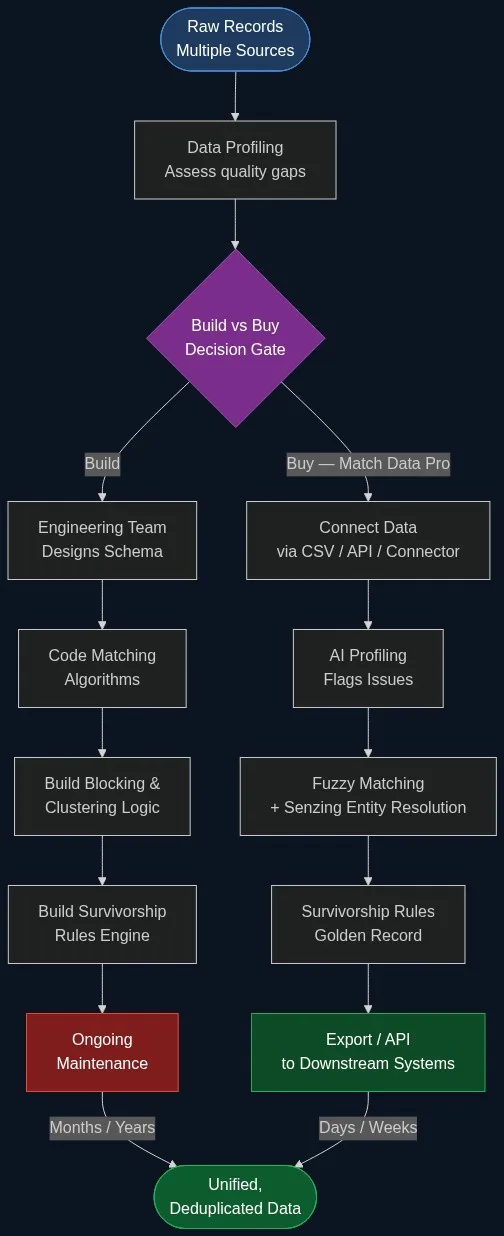
For most data teams, the answer is buy — unless you have a dedicated engineering team, 12+ months of runway, and a unique matching problem no existing tool can solve. Building entity resolution from scratch costs far more than the license fees suggest when you account for algorithm development, blocking logic, survivorship rules, ongoing maintenance, and the opportunity cost of engineers not working on your core product.
Want to see entity resolution in action on your own data? Start a free trial of Match Data Pro — no contract, no infrastructure setup required.
What Entity Resolution Actually Requires You to Build
Entity resolution is the process of determining which records across multiple datasets refer to the same real-world entity — a customer, company, supplier, or patient. It sounds straightforward. In practice, it involves at least six distinct engineering workstreams:
- Data profiling and ingestion. You need to understand what you have before you can match it. Field cardinality, null rates, format variance — all must be catalogued. See how AI-powered data profiling accelerates this step.
- Standardisation and cleansing. “Robert Smith”, “Bob Smith”, “R. Smith” are the same person. “123 Main St” and “123 Main Street, Ste 4” may be the same address. Your pipeline must normalise all of this before comparison.
- Blocking and indexing. Comparing every record to every other record at a million-record scale requires quadrillions of comparisons. You need a blocking strategy — phonetic keys, n-gram indexes, or sorted neighbourhood — to reduce this to a tractable candidate set.
- Similarity scoring. Levenshtein distance, Jaro-Winkler, Soundex, token-set ratio — different field types need different algorithms. A name field and a phone number field should not use the same comparison function.
- Survivorship and golden record logic. Once two records are matched, which field values win? Most recent? Most complete? From the most trusted source? These rules have to be designed, coded, and tested. Read how survivorship rules and golden records work in practice.
- Audit trail and explainability. Compliance and data governance teams need to know why two records were merged. Your system must log every match decision with field-level evidence.
Each workstream is its own engineering project. And each one has to be maintained as your data volumes grow and your source systems change.
The True Cost of Building Entity Resolution In-House
Engineering costs dominate the build option. A team of two mid-senior data engineers building a credible entity resolution pipeline typically needs 6 to 18 months to reach production readiness. At $150,000 per engineer per year, that is $150,000 to $450,000 in salary alone — before infrastructure, QA, and documentation.
These costs compound after launch. Every new data source requires re-tuning. Every schema change in a source system risks breaking your blocking logic. Every business rule change — a merger, a rebrand, an international expansion — requires engineering hours to update matching thresholds and standardisation routines.
The hidden costs are where build projects most often derail:
- False positive remediation. Incorrectly merged records create downstream errors in CRM, billing, and analytics. Human review queues are expensive to operate.
- Algorithm drift. A threshold that worked on 500,000 records may produce 3x more false positives at 5,000,000 records. Retuning requires expertise.
- Talent dependency. If the engineer who designed your blocking schema leaves, you have a critical knowledge gap. Documentation rarely captures the full reasoning.
A realistic total cost of ownership for a homegrown entity resolution system over three years: $500,000 to $1.5 million, including personnel, infrastructure, and error remediation.
What a Dedicated Entity Resolution Platform Gives You
A purpose-built platform ships with the engineering infrastructure already solved. Fuzzy matching and entity resolution in Match Data Pro combines configurable fuzzy algorithms with Senzing — a graph-based probabilistic entity resolution engine used by intelligence and financial services organisations.
What that means in practice:
- Configurable algorithms out of the box. Levenshtein, Jaro-Winkler, phonetic matching, token-set ratio, and more — selectable per field type, with no custom code required.
- AI match suggestions. The platform surfaces candidate pairs and recommends match/no-match decisions based on historical patterns, reducing analyst review time significantly.
- Senzing entity resolution. For complex, multi-source environments, Senzing entity resolution handles probabilistic cross-source linkage at scale — the same engine used by government agencies and financial institutions.
- Survivorship rules without code. Field-level win rules are configured in the UI. Most recent, most complete, most trusted source — all set without engineering involvement.
- Import/export connectors and REST API. Data flows in from CSV, database connections, or API. Results flow back to your CRM, data warehouse, or downstream system via the live fuzzy search API and REST endpoints.
Deployment timeline with a cloud SaaS platform: days to weeks, not months to years.
When Building Makes Sense
The build option is not always wrong. It makes sense in a narrow set of conditions:
- Extreme scale with proprietary matching logic. If you are matching 10 billion records per day with a domain-specific algorithm that no vendor supports, a custom build may be the only viable path.
- Strict data residency requirements. Some regulated industries require that data never leaves a specific environment. Note: many platforms including Match Data Pro support on-premise deployment, which eliminates this objection for most teams.
- Matching is your core product. If entity resolution is the product you sell — not just infrastructure you need — then you likely need proprietary IP. A platform vendor building a deduplication feature for customers is a legitimate build case.
Outside these scenarios, building adds cost and delay without adding competitive advantage.
A Decision Framework: Five Questions to Ask
Use these five questions before committing to either path:
- How many records and sources are in scope? Under 10 million records from 3 or fewer sources, a cloud platform handles this trivially. Over 100 million records from 20+ sources, evaluate Senzing-grade infrastructure.
- What is the required time to value? If the business needs results in 60 days, building is not realistic. Platforms can run first matches within hours of connection.
- Do you have matching expertise in-house? Blocking logic, threshold tuning, and algorithm selection require specialised skills. Most data engineering teams do not have dedicated entity resolution expertise.
- How often will your matching rules change? If business rules change quarterly — new product lines, regional expansion, data source additions — you need a configurable platform, not hard-coded logic.
- What is your total cost tolerance over three years? Compare SaaS subscription costs against realistic build TCO including engineering time, infrastructure, and maintenance.
Match Data Pro is built for teams that need production-grade entity resolution without the 12-month build cycle. The platform covers fuzzy matching and entity resolution, data profiling, cleansing, Senzing integration, survivorship rules, and export — all in one cloud SaaS platform with no long-term contract.
How Match Data Pro Compares to a Custom Build
The table below compares key dimensions across the build and buy options. For a broader evaluation of data matching tools, the data matching software buyer’s guide walks through evaluation criteria in detail.
| Dimension | Custom Build | Match Data Pro |
|---|---|---|
| Time to first match | 6–18 months | Hours to days |
| Algorithm configuration | Coded in-house | UI-configurable, no code |
| Senzing integration | Build and maintain | Built in |
| Survivorship rules | Engineered per project | Configurable in UI |
| REST API and connectors | Build and maintain | Included |
| 3-year TCO (typical) | $500k–$1.5M | SaaS subscription |
| Maintenance burden | High — internal team | Low — vendor managed |
| Scaling | Requires re-engineering | Cloud-native, elastic |
Start a free trial and run your first entity resolution job today. Or book a demo to see Senzing-powered resolution on your own data.
Frequently Asked Questions
How long does it take to build entity resolution software from scratch?
Most teams need 6 to 18 months to reach production readiness with a custom-built entity resolution system. That timeframe covers algorithm selection, blocking logic, survivorship rules, QA, and documentation — and does not account for ongoing maintenance as data volumes and source systems change over time.
What is the main risk of building entity resolution in-house?
The primary risk is knowledge concentration. Entity resolution pipelines involve specialist decisions — blocking key design, threshold calibration, algorithm selection per field type — that are rarely documented well. When the engineer who designed the system leaves, the organisation is left with brittle, poorly understood infrastructure that is expensive to modify.
Can a cloud SaaS platform handle enterprise-scale entity resolution?
Yes. Modern cloud SaaS platforms support entity resolution at enterprise scale using blocking strategies, parallel processing, and embedded engines like Senzing — which is used by intelligence agencies and major financial institutions to resolve billions of records. Elastic cloud infrastructure means scale is handled by the platform, not by your internal engineering team.
What is Senzing and why does it matter for entity resolution?
Senzing is a graph-based probabilistic entity resolution engine that builds relationship networks across records without requiring a shared identifier. It evaluates name variants, address changes, partial data, and temporal shifts to determine entity identity. Match Data Pro integrates Senzing natively, making enterprise-grade resolution available without a custom integration project. Read the full Senzing entity resolution guide for technical detail.
How do I evaluate whether to build or buy entity resolution?
Start with five questions: How many records and sources are in scope? What is the required time to value? Do you have in-house matching expertise? How frequently will rules change? What is your three-year cost tolerance? If you answer more than two of these in ways that favour speed and flexibility, buying a purpose-built platform almost always wins on total cost of ownership.