Senzing entity resolution is a probabilistic, graph-based engine that links records representing the same real-world entity across disparate data sources — without requiring a shared primary key. It ingests structured records, extracts feature vectors, compares them pairwise inside candidate blocks, and writes relationships into an entity graph that updates in real time as new data arrives. For data engineers and CDOs dealing with fragmented CRM, ERP, and marketing databases, Senzing is one of the most operationally mature entity resolution engines available today.

What Is Entity Resolution — and Why Does It Matter?
Entity resolution (ER) is the process of determining whether two or more records in one or more datasets refer to the same real-world entity — a person, company, address, or asset. It is sometimes called record linkage, deduplication, or identity resolution, depending on the industry context, but the underlying computational problem is the same: reconcile imperfect, incomplete, and inconsistently formatted data across system boundaries.
The scale of the problem is significant. IBM, named a Leader in the 2026 Gartner Magic Quadrant for Augmented Data Quality Solutions, frames the challenge plainly: as enterprises move from AI experimentation to enterprise-wide deployment, data quality becomes foundational to performance, compliance, and trust. Without entity resolution at the data layer, AI models trained on fragmented records produce unreliable outputs.
Without ER, you end up with:
- Duplicate customer profiles — the same person appearing as “John Smith”, “J. Smith”, and “Jon Smyth” across three systems
- Fragmented 360° views — a CRM contact with no link to their ERP account or support ticket history
- Inaccurate analytics — revenue reports that count the same company three times because its subsidiaries were never resolved
- Regulatory exposure — KYC and AML workflows that miss sanctioned entities because name variants weren’t linked
- MDM failures — master data management initiatives that produce golden records based on incomplete entity clusters
How Senzing Entity Resolution Works: The Technical Architecture
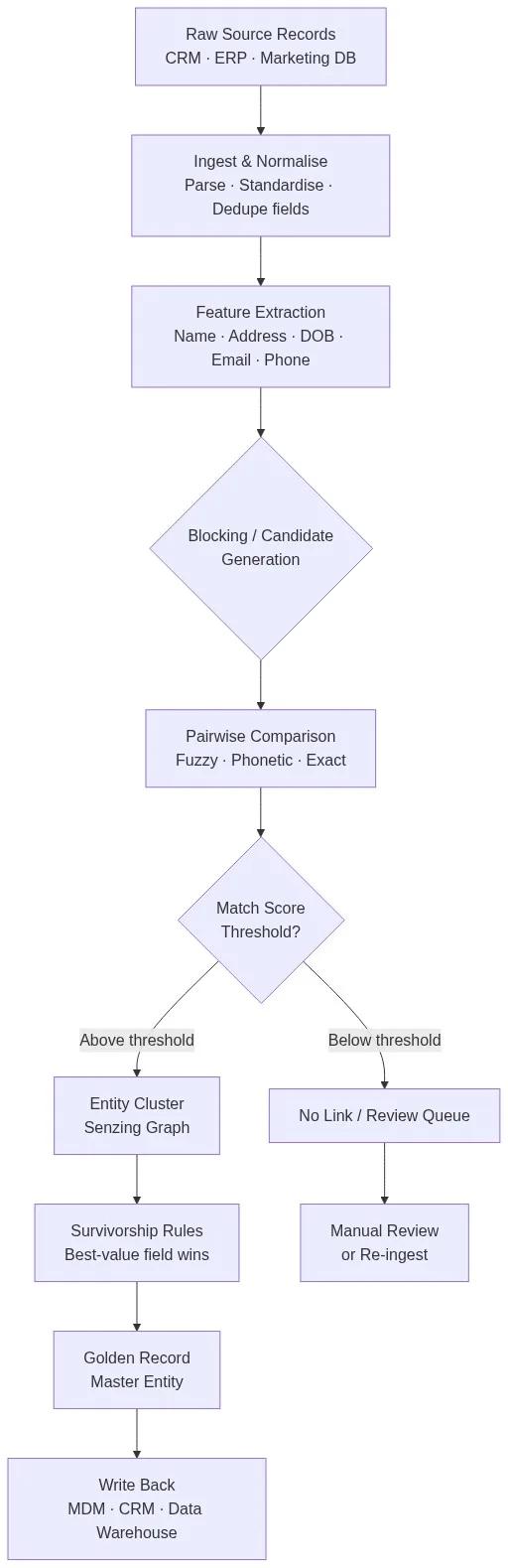
Senzing takes a fundamentally different approach from rule-only deterministic matching engines. Rather than applying a fixed cascade of if-then rules, Senzing extracts feature-level signals from each record, compares them across candidate pairs, scores the comparisons probabilistically, and stores the resulting relationships in an in-memory entity graph. Here is the step-by-step pipeline:
1. Ingestion and Normalisation
Records arrive from any source system — flat files, database tables, API streams, or real-time message queues. Senzing’s loader normalises values: names are tokenised and lowercased, addresses are parsed into components (street number, street name, city, state, ZIP), dates are standardised, and phone numbers are stripped to digits. This normalisation layer is critical — it means that “123 Main St.” and “123 Main Street” will resolve correctly despite the abbreviation difference.
2. Feature Extraction
Each normalised record generates a feature vector. Senzing extracts discrete features across entity attributes:
- Name features: full name, surname, given name, initials, phonetic codes (Metaphone, NYSIIS)
- Address features: street hash, ZIP, city, state, country
- Identity features: date of birth, national ID, passport number, tax ID
- Contact features: email domain, phone number, mobile number
- Relationship features: employer, household, corporate structure
3. Blocking / Candidate Generation
Running all-pairs comparisons across millions of records is computationally infeasible. Senzing uses blocking keys — derived hashes of high-signal features — to partition the record space into candidate buckets. Only records sharing at least one blocking key are compared pairwise. This reduces the comparison space from O(n²) to something tractable without sacrificing recall for genuinely matching pairs.
4. Pairwise Comparison and Scoring
Within each candidate bucket, Senzing scores every pair across all feature dimensions. Each feature comparison returns a match level (exact, close, likely, unlikely, no match) and a corresponding score weight. Weights are summed to produce a composite match score. Crucially, Senzing’s scoring model is pre-trained on large reference datasets — data teams don’t need to hand-calibrate weights from scratch, though they can override defaults for domain-specific tuning.
5. Entity Graph Construction
Pairs above the match threshold are linked in an entity graph. Each node is a source record; each edge represents a resolved relationship with an associated match score. Clusters of connected nodes constitute a resolved entity. The graph is persistent and incremental — when a new record arrives, Senzing re-evaluates only the candidates affected by that record, not the entire dataset. This makes real-time entity resolution operationally practical.
6. Survivorship and Golden Record Output
Once entity clusters are formed, survivorship rules determine which field value from which source record is written to the golden record. Common survivorship patterns include: most-recently-updated wins, longest non-null value wins, highest-trust source wins (e.g. ERP > CRM > marketing list). Match Data Pro’s data match merging and survivorship rules engine applies these policies at scale, producing clean, authoritative golden records ready for MDM or data warehouse write-back.
Senzing vs. Alternative Entity Resolution Approaches
Data teams evaluating entity resolution have several broad approaches available. The table below compares them across the dimensions that matter most in production deployments:
| Approach | Accuracy | Scale | Real-time? | Config effort | Best for |
|---|---|---|---|---|---|
| Deterministic rules only | Medium | High | Yes | High (manual rules) | Clean, structured data with stable formats |
| Fuzzy matching only | Medium-High | Medium | Via API | Medium | Single-domain deduplication, name matching |
| Senzing (probabilistic graph) | Very High | Very High | Yes (streaming) | Low (pre-trained) | Multi-source, multi-domain entity resolution |
| ML / deep learning ER | High (with training data) | High | Limited | Very High (labelled data) | Specialised domains with large labelled sets |
| Manual / spreadsheet | Low | Very Low | No | N/A | One-off, small-volume projects only |
Senzing’s core advantage is that its scoring model arrives pre-trained. Most deterministic or custom-ML approaches require weeks of rule engineering or labelled training data before they produce reliable results. Senzing is typically operational within days of deployment.
How Match Data Pro Integrates Senzing Entity Resolution
Match Data Pro embeds Senzing as a core entity resolution engine within its broader data matching platform, complementing it with configurable fuzzy matching algorithms, AI-powered match suggestions, and survivorship rule management. The integration covers the full pipeline from raw data ingest to golden record write-back:
Pre-resolution: Data Profiling and Cleansing
Before records enter the Senzing engine, Match Data Pro’s AI data profiling layer characterises each source dataset — identifying null rates, format inconsistencies, encoding issues, and domain distribution anomalies. Records are then cleansed and standardised using data cleansing pipelines and CASS-certified address data cleansing before the entity resolution pass. Clean inputs produce dramatically cleaner entity clusters.
Fuzzy Matching Layer
Match Data Pro’s configurable fuzzy matching engine runs in parallel with Senzing’s probabilistic scoring. This is particularly valuable for name-heavy use cases — where Jaro-Winkler, Levenshtein, and phonetic algorithms catch variants that probabilistic scoring alone might weight differently. See the guide to fuzzy name matching algorithms for a detailed comparison of algorithm selection by use case.
Post-resolution: Merging and Survivorship
After Senzing produces entity clusters, Match Data Pro’s match merging and survivorship engine applies configurable field-level policies to produce the golden record. Rules can be set per field, per source system trust rank, and per data freshness window. The resulting golden record is written back to any connected system via the platform’s import/export connectors.
Deployment Options
Match Data Pro with Senzing deploys as:
- SaaS (cloud-hosted): Fully managed, no infrastructure required, monthly subscription with no long-term contract
- On-premise / private cloud: Deploy within your own VPC or data center for data residency and compliance requirements
- Hybrid: Cleansing and profiling in the cloud; entity resolution engine on-premise for sensitive record types
Common Use Cases for Senzing Entity Resolution
Customer Master Data Management (Customer MDM)
A retail bank with 4 million customer records spread across a legacy core banking system, a digital banking app, and a CRM needs a single customer view for regulatory reporting and personalisation. Senzing resolves customers across all three systems, linking records on name + date of birth + address combinations — even when each attribute has minor variants across systems.
B2B Account Resolution
A B2B SaaS company’s CRM contains 80,000 accounts entered by sales reps over five years. “Acme Corp”, “Acme Corporation”, “Acme Corp Ltd”, and “ACME” are four separate accounts with overlapping contacts and deals. Senzing clusters them into a single entity. Match Data Pro’s data matching and merging pipeline then consolidates the four accounts into one, preserving the complete deal and contact history.
KYC / AML Compliance
Financial institutions running KYC and AML workflows need to match incoming customer applications against watchlists, sanctions lists, and PEP databases. Senzing’s probabilistic engine, combined with Match Data Pro’s fuzzy name matching layer, catches variants that exact-match screening misses.
Healthcare Patient Matching
Patient records across hospitals, GP systems, and insurance databases frequently fragment on name changes, address moves, and data entry errors. Senzing resolves patient entities across systems without requiring a shared national patient identifier.
Configuring Senzing Entity Resolution: Key Parameters
- Feature weights: Adjust the relative importance of name, address, DOB, email, and phone in the composite match score
- Match thresholds: Set the score boundary that separates a resolved match from a candidate-for-review
- Blocking key configuration: Define which features generate blocking keys; more keys improve recall but increase compute cost
- Relationship rules: Configure household and organisational hierarchy resolution separately from individual entity resolution
- Source trust ranks: Assign data source reliability scores that weight feature contributions by provenance
- Ambiguous entity handling: Route low-confidence pairs to a manual review queue rather than forcing a binary match/no-match decision
For a deeper look at how scoring algorithms underpin these decisions, see the guide to matching rule scoring algorithms.
Frequently Asked Questions: Senzing Entity Resolution
What is Senzing entity resolution and how does it differ from standard deduplication?
Senzing entity resolution is a probabilistic, graph-based engine that links records across multiple data sources without requiring a shared key. Standard deduplication typically identifies and removes duplicate records within a single dataset. Senzing goes further: it resolves entities across entirely separate systems, handles real-time streaming data, and builds a persistent entity graph that updates incrementally as new records arrive.
Does Senzing require large amounts of training data or hand-crafted rules?
No. Senzing ships with a pre-trained scoring model calibrated on large reference datasets. Data engineers can tune feature weights and thresholds for their specific domain, but the engine does not require a labelled training corpus or weeks of rule engineering before it produces accurate results. Most production deployments are operational within days of initial configuration.
How does Senzing handle real-time entity resolution as new records arrive?
Senzing maintains an in-memory entity graph. When a new record is ingested, the engine evaluates only the candidate set affected by that record’s blocking keys — not the entire dataset. This incremental update model means resolution latency is typically sub-second for individual records, making Senzing suitable for real-time customer onboarding, live search, and streaming data pipelines.
What data types and sources does Senzing entity resolution support?
Senzing works on any structured record that includes named fields. It performs best on records containing name, address, date of birth, email, and phone features. It ingests data from flat files, relational databases, REST APIs, and message queues. Match Data Pro’s connector library extends source compatibility to CRM platforms, ERPs, marketing automation tools, and data warehouses.
Can Senzing entity resolution be deployed on-premise for data residency requirements?
Yes. Senzing is deployable as a containerised on-premise or private cloud installation. Match Data Pro offers full on-premise deployment of the Senzing integration layer, meaning sensitive records never leave your own infrastructure.
Start Resolving Entities with Match Data Pro + Senzing
Match Data Pro’s Senzing integration gives data engineers and CDOs a production-ready entity resolution pipeline with configurable fuzzy matching, AI data profiling, survivorship rules, and full SaaS or on-premise deployment — all on a no-contract monthly subscription.
- Start your free trial — connect your data sources and run your first entity resolution job in minutes.
- Book a technical demo — our data engineers will walk through the Senzing pipeline with your specific data structure and volumes.
- Contact sales: sales@matchdatapro.com