
An MCP server is a piece of software that exposes a set of callable tools to any compatible AI agent via the open Model Context Protocol standard. In the context of data quality, an MCP server means that your AI assistant — Claude, ChatGPT, Cursor, or a custom agent — can discover, configure, and drive enterprise-grade data quality operations: deduplication, fuzzy matching, cleansing, entity resolution, and golden record production. Without writing a single line of integration code.
If you are a data engineer, CDO, or RevOps leader trying to understand what MCP means for your data quality stack in 2026, this is the definitive explainer.
What Is the Model Context Protocol (MCP)?
The Model Context Protocol is an open standard, originally developed by Anthropic and now widely adopted across the AI tooling ecosystem, that defines a common interface between AI agents and external software tools. Think of it as USB for AI: just as USB allowed any device to connect to any computer without a proprietary cable, MCP allows any AI agent to connect to any MCP-compatible tool without a proprietary SDK or integration library.
Before MCP, connecting an AI assistant to an external tool required:
- A custom API integration — endpoint discovery, authentication, request formatting, error handling
- A function-calling schema describing each tool’s inputs and outputs
- Maintenance overhead every time the tool’s API changed
- Separate integration work for each AI client (Claude needed different glue code than ChatGPT)
MCP eliminates all of this. An MCP server declares its tools once, in a standardised format. Any MCP-compatible client — regardless of which AI model powers it — can discover those tools, understand their inputs and outputs, and call them. The integration is written once, by the tool provider, and works everywhere.
How an MCP Server Actually Works
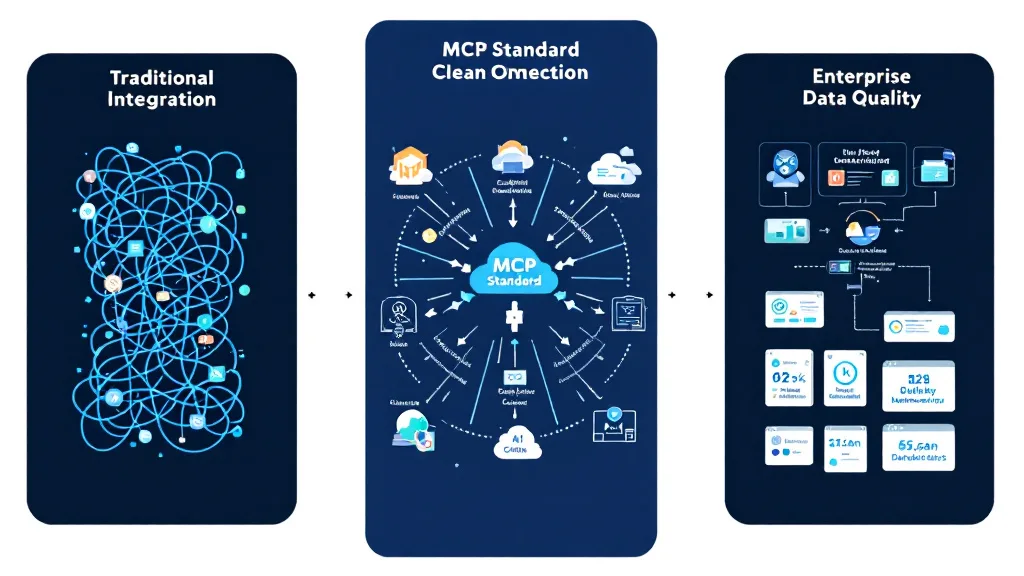
An MCP server operates as a middleware layer between your AI agent and the underlying software platform. The interaction follows a consistent pattern:
- Discovery. The AI client connects to the MCP server and retrieves the tool catalogue — a list of available tools with their names, descriptions, and required parameters. The agent uses this to understand what it can do.
- Selection. When the user gives an instruction (“deduplicate my customer records”), the agent selects the appropriate tools from the catalogue based on the task.
- Invocation. The agent calls the selected tool with the required parameters. The MCP server validates the call, executes the underlying operation in the connected platform, and returns a structured result.
- Orchestration. For multi-step workflows, the agent calls tools in sequence — passing outputs from one step as inputs to the next — until the full task is complete.
The AI model never directly touches the underlying platform. It communicates exclusively through the MCP server’s standardised tool interface. This is what makes the architecture both safe and scalable: the MCP server enforces the platform’s business logic, validation rules, and access controls, regardless of which AI client is driving it.
Why MCP Matters Specifically for Data Quality
Data quality operations are among the most technically demanding workflows an AI agent can be asked to orchestrate. They involve:
- Large datasets — millions of records that cannot fit in any model’s context window
- Precise algorithms — fuzzy matching requires specific, configurable implementations of Levenshtein, Jaro-Winkler, Soundex, and other distance metrics that LLMs cannot replicate natively
- Ordered, stateful pipelines — profiling must precede cleansing, which must precede matching; results from each stage inform the next
- Auditability requirements — enterprise data quality work requires documented, reproducible, versioned match rules — not probabilistic inference
- Governance and access controls — data quality operations often touch sensitive PII; the platform must enforce permissions regardless of how the job was initiated
An MCP server is the correct architectural answer to all five requirements. The AI agent handles the natural language interface and workflow orchestration. The MCP server routes each operation to the underlying data quality engine — which handles the computation with full accuracy, auditability, and scale.
Without MCP, you have two bad options: ask the LLM to do the matching itself (inaccurate, unscalable, unauditable) or force a human to context-switch between an AI assistant and a separate data quality tool (breaking the agentic workflow). MCP creates the third option: seamless, accurate, AI-orchestrated data quality at production scale.
What an MCP Server for Data Quality Exposes
A well-designed data quality MCP server exposes tools across the full pipeline — not just a single operation. Match Data Pro’s MCP Server exposes 54 tools organised into the following workflow stages:
| Workflow Stage | What the Agent Can Do |
|---|---|
| Project Management | Create and manage projects, run automation pipelines, poll job status |
| Data Sources | Connect databases, cloud files, APIs; map columns to field types |
| Data Profiling | Run AI-powered profiling; retrieve null rates, cardinality, format patterns, anomalies |
| Cleansing Rules | Generate AI-suggested rules; create, apply, and template cleansing transforms |
| Fuzzy Matching | Configure algorithms and field weights; run batch jobs; page through results; run live lookups |
| Entity Resolution | Run Senzing-powered cross-source entity resolution for complex multi-system identity matching |
| Golden Records | Apply survivorship rules; produce merged master records |
| Export | Push clean data to Salesforce, HubSpot, SQL databases, cloud storage, flat files |
The breadth of the tool catalogue is what separates a data quality MCP server from a simple API wrapper. A single-operation wrapper (e.g., “call this endpoint to run a deduplication job”) leaves the orchestration burden on the caller. A full-pipeline MCP server gives the agent everything it needs to take a dataset from raw ingestion to clean export — autonomously, in a single conversation.
MCP Server vs Traditional API Integration for Data Quality
| Dimension | Traditional API Integration | MCP Server |
|---|---|---|
| Integration effort per AI client | Custom per client | Once, works everywhere |
| Tool discovery | Manual documentation | Automatic at connection |
| Natural language interface | ❌ Requires separate prompt layer | ✅ Native |
| Multi-step orchestration | Custom workflow code | Agent-managed |
| Access control enforcement | Per-endpoint | Server-enforced, universal |
| Maintenance on API change | Re-integrate per client | Update server once |
| Compatible AI clients | Only those you built for | Any MCP-compatible agent |
Who Should Care About Data Quality MCP Servers?
Data Engineers
If you are building agentic data pipelines — workflows where an AI agent monitors, diagnoses, and repairs data quality issues — an MCP server for data quality is the missing infrastructure layer. It gives your agent deterministic, auditable, scalable data quality tools it can call as first-class operations, without you writing and maintaining custom integration code for each tool.
CDOs and Data Governance Leaders
The governance question with agentic data workflows is not “can we use AI?” but “how do we maintain auditability and control when AI is initiating data operations?” An MCP server answers this directly: the server enforces platform business logic, access controls, and change logging regardless of whether a human or an AI agent triggered the operation. Every job is auditable. Every match rule is versioned. Nothing bypasses governance because of how it was initiated.
RevOps and CRM Teams
For teams using AI assistants in their day-to-day workflow, an MCP server for data quality means deduplication and cleansing become conversational. “Clean up the leads imported last week, merge duplicates above 90% confidence, flag the rest for review” becomes a single instruction to an AI assistant — no UI context-switching, no manual job configuration, no waiting for a data engineer to run the job.
AI and Platform Developers
If you are building MCP agents or AI products that touch data quality, an MCP server gives you a production-grade data quality capability you can expose to your users without building the matching engine yourself. Connect your agent to the MDP MCP Server, and your users get fuzzy matching, deduplication, entity resolution, and address verification — all behind a plain-language interface.
The MDP MCP Server: Built for Production Data Quality
Match Data Pro’s MCP Server is the first MCP server purpose-built for enterprise data quality at scale. It is built on FastMCP, publicly hosted (no local install), authenticated via OAuth 2.1, and live as of August 2026.
It connects any MCP-compatible AI agent — Claude, ChatGPT, Cursor, or custom — to MDP’s full data quality platform:
- Configurable fuzzy matching — Levenshtein, Jaro-Winkler, Soundex, Metaphone, token-based, and custom algorithms
- Deduplication at scale — blocking strategies for millions of records without combinatorial explosion
- AI data cleansing and standardisation — automated rule generation from profiling output
- Senzing entity resolution — graph-based probabilistic resolution for cross-source identity matching
- CASS address verification — USPS-certified address parsing and ZIP+4 appending
- Job automation — recurring pipeline scheduling via cron or event trigger
Available on all MDP plans — SaaS or on-premise. No contract required.
Frequently Asked Questions
What is an MCP server?
An MCP server is software that exposes a set of callable tools to AI agents via the open Model Context Protocol standard. It acts as a standardised middleware layer between AI clients and underlying software platforms, allowing agents to discover and call tools without custom integration code.
What is an MCP server for data quality?
An MCP server for data quality exposes data quality operations — deduplication, fuzzy matching, cleansing, entity resolution, and golden record production — as callable tools that any MCP-compatible AI agent can orchestrate. The AI handles the natural language interface; the MCP server routes each call to the underlying engine, which handles computation with full accuracy and auditability.
Which AI clients are compatible with an MCP server?
Any client built on the open MCP standard — Claude, ChatGPT, Cursor, and custom agents. No proprietary SDK required. If the client speaks MCP, it can connect.
Does MCP replace the REST API?
No. MCP sits alongside the REST API as an additional access layer. Both connect to the same underlying platform. REST is better for programmatic integrations where you control the code. MCP is better for AI agent orchestration based on natural language instructions.
Is Match Data Pro’s MCP Server available now?
Yes — live since August 2026. Publicly hosted, OAuth 2.1 authenticated, available on all MDP plans. No local install or SDK required.
Start Using MCP for Data Quality Today
Match Data Pro’s MCP Server is the first production-grade MCP server for enterprise data quality. Connect your AI agent and start matching, deduplicating, and resolving records at scale — conversationally, accurately, and without writing integration code.
- Read the full MCP Server product page — 54 tools, technical specs, compatible clients
- Start your free trial — no contract, no commitment
- Book a demo — see the MCP Server in action with your data
Related reading:
Why LLMs Couldn’t Fuzzy Match at Scale — Until Now |
How AI Agents Match Millions of Records |
AI Data Matching Software