A data quality framework is a structured, repeatable program that moves raw data through defined stages — from initial profiling to continuous monitoring — so that every downstream system receives data that is accurate, consistent, and fit for purpose. Without a framework, data quality work remains reactive: engineers fix fires one dataset at a time, with no institutional memory and no measurable improvement over time. This guide breaks down each stage of a practical data quality framework and explains what tooling each stage requires.
Ready to start your data quality program today? Register for a free trial of Match Data Pro and run your first profiling job in minutes.
Why a Stage-by-Stage Framework Matters
Ad hoc data quality work produces inconsistent results. A team might deduplicate a CRM export before a campaign, but miss the same duplicates in the data warehouse. Another team might standardise phone formats in one system while leaving the ERP untouched. The root cause is always the same: no shared methodology, no shared tooling, and no shared metrics.
A stage-by-stage framework solves this by defining the sequence of operations, the acceptance criteria at each gate, and the owner of each stage. The framework does not need to be rigid. It should adapt to whether you are processing a one-time migration load or a continuous inbound feed. What does not change is the order: you cannot deduplicate data you have not yet cleansed, and you cannot reliably cleanse data you have not yet profiled.
Organisations that adopt a formal data quality framework typically reduce error rates by 30 to 60 percent within the first six months, according to repeated industry benchmarks. The productivity gain comes not from working harder but from eliminating rework caused by problems that entered the pipeline undetected.
The Six Stages of a Data Quality Framework
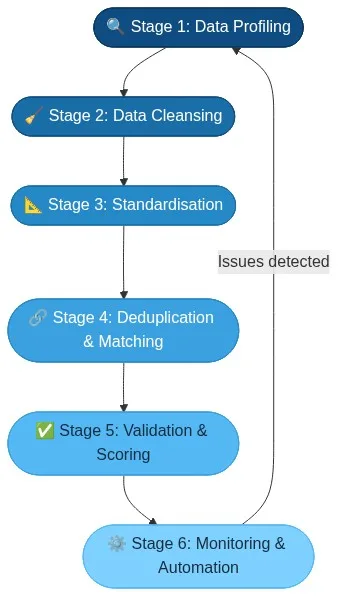
The diagram below shows the full six-stage cycle used in production data quality programs. Each stage feeds the next, and monitoring at Stage 6 feeds back to Stage 1 when new issues are detected.
Stage 1: Data Profiling
Data profiling is the diagnostic stage. Before you touch a record, you need to know the shape of the problem. Profiling answers four questions for every field in every source table:
- Completeness: What percentage of records have a value in this field?
- Uniqueness: How many distinct values exist? What is the duplicate rate?
- Format conformance: Do phone numbers follow a consistent pattern? Are dates ISO 8601 or mixed?
- Referential integrity: Do foreign keys resolve to valid parent records?
A typical enterprise CRM might surface: 18% null email addresses, 34% phone fields with inconsistent country code prefixes, and a duplicate customer rate of 12 to 22%. Without these numbers, every subsequent stage is guesswork. Match Data Pro’s AI data profiling module scans millions of records and returns field-level quality scores, pattern distributions, and anomaly flags — all before a single transformation is applied.
Stage 2: Data Cleansing
Data cleansing corrects the errors the profiling stage identified. This includes removing control characters from name fields, stripping HTML tags from imported free-text columns, fixing transposed digits in phone numbers, and replacing placeholder values (“N/A”, “UNKNOWN”, “999-999-9999”) with nulls or validated values.
Cleansing also handles structural problems. A field labelled company_name might contain values like “ACME Corp.”, “Acme Corporation”, and “acme corp” — all referring to the same entity. Normalising case and expanding abbreviations before matching dramatically improves match recall. Match Data Pro applies configurable cleansing rules at the field level, with regex-based transformations you can define, preview on a sample, and then apply at scale.
Stage 3: Standardisation
Standardisation converts cleaned values into a consistent canonical form across all source systems. Cleansing removes errors; standardisation enforces a shared schema. Common examples:
| Field | Raw value | Standardised value |
|---|---|---|
| Phone | +1 (602) 555-0142 | 16025550142 |
| State | Ariz. | AZ |
| Company name | Intl. Business Machines | IBM |
| Address | 123 Main St. Apt 4B | 123 MAIN ST APT 4B |
| Date | June 3rd, 2024 | 2024-06-03 |
Address standardisation deserves special attention. Postal data enters systems in dozens of formats: abbreviated directionals, missing unit suffixes, transposed city/state fields. Match Data Pro’s CASS-certified address cleansing parses and standardises US addresses to USPS delivery point format, appending ZIP+4 codes and correcting street type abbreviations automatically.
Stage 4: Deduplication and Matching
With clean, standardised data, the matching stage can find records that represent the same real-world entity — even when they differ in spelling, abbreviation, or field completeness. This is where fuzzy matching algorithms replace exact joins. A Jaro-Winkler score of 0.91 between “Jennifer Ramirez” and “Jenifer Ramirez” signals a likely match. A Levenshtein distance of 2 between “Smithe” and “Smith” on the same address record confirms it.
Match Data Pro uses a configurable multi-algorithm scoring engine. You define match definitions: which fields to compare, which algorithm to apply to each field, and the weight each field carries in the overall match score. A customer deduplication job might weight email address at 40%, full name at 30%, and postal code at 20%, with phone as a tiebreaker at 10%. Records above a 0.85 composite score auto-merge; those between 0.70 and 0.84 go to a review queue.
For complex entity resolution across multiple source systems — where the same person might appear in a CRM, an ERP, and a support ticketing system with no shared key — Match Data Pro integrates Senzing entity resolution, which builds an identity graph linking records probabilistically across all three systems without requiring a universal identifier.
Stage 5: Validation and Scoring
Validation confirms that the output of Stage 4 meets the acceptance criteria defined in Stage 1. This is not a spot-check. It is a systematic comparison of pre- and post-processing metrics:
- Duplicate rate reduced from 18% to under 1%?
- Email completeness improved from 82% to 97%?
- Address standardisation coverage above 95% of deliverable records?
- Match false-positive rate below 0.5% on a held-out test set?
If any metric falls short, the record batch is flagged for re-processing or routed to a data steward review queue before it enters production. Match Data Pro’s job output exports include a full match confidence breakdown for every merged record, giving stewards the data they need to review edge cases quickly. You can also export the survivorship rules and golden record logic applied to each merge, making the process auditable.
Stage 6: Monitoring and Automation
A data quality framework that runs once is a project. A framework that runs continuously is a program. Stage 6 operationalises the first five stages by scheduling them as automated jobs and alerting on threshold breaches.
Practical monitoring looks like this: a nightly job ingests new CRM records, runs them through the cleansing and standardisation pipeline, scores them against the existing master, and either merges matches above threshold or queues borderline cases for review — all before the sales team opens their laptops at 9am. If the duplicate rate on inbound records spikes above 5%, an alert fires and the job pauses pending review.
Match Data Pro supports scheduled job automation with configurable triggers, email alerts, and import/export connectors for common CRM, ERP, and database formats. The live fuzzy search API also lets downstream applications query the clean master in real time, preventing new duplicates from entering the system at the point of data entry.
Governance: Who Owns Each Stage?
A framework without ownership is a checklist no one follows. Assign a named owner to each stage — not a team, a person — with a defined escalation path and a measurable SLA.
| Stage | Primary owner | Supporting role |
|---|---|---|
| Profiling | Data engineer | Data analyst |
| Cleansing | Data engineer | Domain SME |
| Standardisation | Data architect | Data engineer |
| Deduplication / Matching | Data engineer | RevOps / CRM lead |
| Validation | Data quality lead | Data steward |
| Monitoring | Platform / IT ops | Data quality lead |
The CDO or VP of Data owns the framework as a whole and sets the quality thresholds that govern when a batch passes or fails each stage gate.
Rolling Out the Framework: A Practical Sequencing Guide
Most organisations try to fix everything at once and stall. A more reliable approach is to sequence the rollout by data domain, starting with the domain that causes the most downstream pain.
Month 1: Run profiling across all customer-facing source systems. Document the top five quality issues by volume and business impact. Do not fix anything yet.
Month 2: Apply cleansing and standardisation rules to the highest-impact source system only. Measure improvement against the profiling baseline.
Month 3: Run the first deduplication job on the cleansed data. Set conservative match thresholds initially — a 0.90 auto-merge threshold with a wide review band (0.75 to 0.89) — and plan for a steward review cycle.
Month 4: Validate outputs, tighten thresholds based on false-positive review, and activate the nightly automation job. Extend the framework to the second source system.
By month 6, most teams have the framework running across three to five source systems with a monitored, automated pipeline. That is when data quality stops being a project and starts being infrastructure.
Want to compress that timeline? Book a demo with the Match Data Pro team and we will walk through how the platform maps to your specific source systems, data volumes, and governance requirements.
Frequently Asked Questions
What is a data quality framework?
A data quality framework is a structured, repeatable program that defines the stages, ownership, tooling, and metrics for maintaining accurate, consistent, and complete data across an organisation’s systems. It typically covers profiling, cleansing, standardisation, deduplication, validation, and ongoing monitoring — run in that sequence, with defined acceptance criteria at each stage gate.
How many stages should a data quality framework have?
Six stages cover most enterprise requirements: profiling, cleansing, standardisation, deduplication and matching, validation and scoring, and monitoring and automation. Smaller organisations processing a single data domain may collapse stages two and three into one step. The minimum viable framework is always profile first, then fix, then validate — never skip profiling.
What is the difference between data cleansing and data standardisation?
Data cleansing removes or corrects errors in existing values — stripping placeholder text, fixing transposed digits, eliminating control characters. Data standardisation converts valid values into a canonical format shared across all systems — for example, converting all state abbreviations to the two-letter ISO standard, or all phone numbers to E.164 format. Cleansing must happen before standardisation for the transformations to produce reliable results.
How do you measure the success of a data quality framework?
Measure success against the baselines established during Stage 1 profiling. Key metrics include: duplicate record rate before and after deduplication, field completeness percentages, address deliverability rate, match false-positive and false-negative rates, and the percentage of inbound records that pass each stage gate without manual intervention. Track these monthly and set target thresholds for each metric tied to business outcomes.
Can a data quality framework work for real-time data feeds as well as batch files?
Yes. The six stages apply to both batch and streaming contexts, though the tooling differs. For batch processing, scheduled jobs run each stage sequentially. For real-time feeds, a live fuzzy search API can match and deduplicate records at the point of entry — rejecting or flagging potential duplicates before they are committed to the master dataset. Match Data Pro supports both modes within the same platform.