Connecting an LLM or AI agent to enterprise data without first cleaning that data is the single fastest way to corrupt your AI outputs. The answer is a structured data quality pipeline that profiles, cleanses, deduplicates, and resolves records into a golden master before any AI workflow touches them. Match Data Pro provides every stage of that pipeline in one cloud SaaS platform, so your LLM retrieves accurate, unified records every time.
Book a demo to see how Match Data Pro cleans and connects your data for AI workflows.
Why LLM Workflows Depend on Data Quality
Large language models do not evaluate data quality. They ingest whatever context they receive and generate outputs based on it. When that context contains duplicate customer records, inconsistent company names, or addresses in three different formats, the model cannot distinguish the good record from the bad one. It produces a confident answer based on contradictory inputs.
Consider a retrieval-augmented generation (RAG) pipeline pulling customer records to answer a support query. If the same customer exists as “Acme Corp”, “ACME Corporation”, and “Acme Inc.” across three source systems, the retrieval step returns three partial records. The LLM merges conflicting fields, invents a composite answer, and delivers a response that satisfies no one.
The fix is not a better prompt. It is a cleaner data layer beneath the model.
Three data quality failures are responsible for most AI output errors:
- Duplicates. Multiple records for the same entity inject conflicting signals.
- Inconsistent formatting. “NY”, “New York”, and “new york” are identical to a human but distinct tokens to a model.
- Missing or null values. A model asked to summarise a record with 40% null fields produces a fabricated summary.
The Six-Stage Data Quality Pipeline for AI Readiness
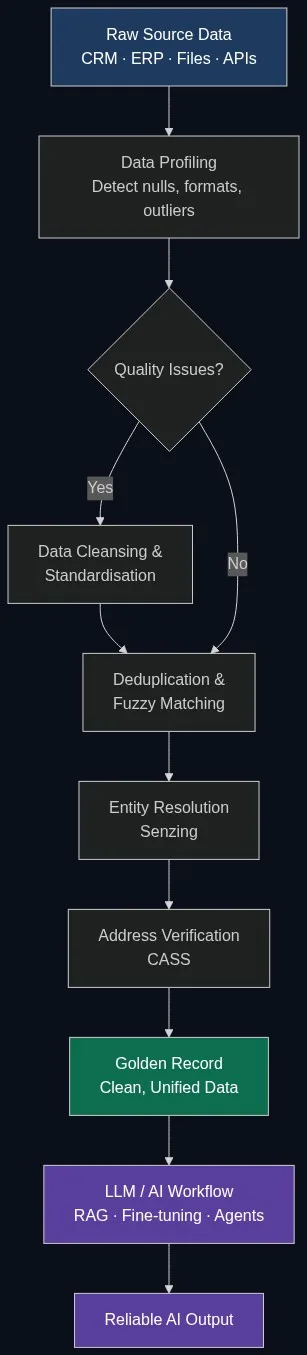
Building a clean data foundation for LLM and AI workflows requires six sequential stages. Skipping any stage introduces a class of errors that compounds downstream.
Stage 1: Data Profiling
Profiling measures what you have before you fix it. It quantifies null rates by field, detects format inconsistencies, identifies outlier values, and flags referential integrity failures. Without profiling, cleansing is guesswork. Match Data Pro’s AI-powered data profiling scans uploaded datasets and returns a structured quality report covering completeness, uniqueness, and format conformance.
A profiling scan on a 500,000-row CRM export might reveal: 12% null email addresses, 8% phone numbers in non-E.164 format, and 3,400 company name variants that likely resolve to fewer than 200 distinct legal entities.
Stage 2: Data Cleansing and Standardisation
Cleansing corrects values. Standardisation normalises them to a consistent format. Both are required before matching.
Practical examples of standardisation for AI readiness:
- Company names: “IBM Corp.”, “I.B.M.”, “International Business Machines” → canonical “IBM”
- Phone numbers: “+1 (212) 555-0100”, “2125550100”, “212.555.0100” → E.164 “+12125550100”
- State codes: “California”, “Calif.”, “CA” → “CA”
- Dates: “09/20/2026”, “20-Sep-2026”, “2026-09-20” → ISO 8601 “2026-09-20”
Match Data Pro’s data cleansing pipeline applies configurable transformation rules across every field type. Rules run in batch on full datasets or in real time via the live API.
Stage 3: Deduplication and Fuzzy Matching
After standardisation, records that represent the same real-world entity must be identified and merged. Exact matching misses near-duplicates: “Jon Smith at Acme” and “Jonathan Smith at Acme Corp” are the same person but share no identical field values.
Fuzzy matching algorithms — Jaro-Winkler, Levenshtein, phonetic, and token-based — score pairwise similarity across multiple fields simultaneously. A composite score above a configured threshold triggers a match. Match Data Pro’s engine scores each candidate pair field by field, applies configurable weights, and returns a ranked list of match candidates with full audit trail.
For AI contexts, deduplication serves a specific function: it ensures that a retrieval query returns one authoritative record, not three partial ones. A RAG pipeline that retrieves a single golden record is more accurate than one that retrieves three conflicting versions and asks the model to reconcile them.
Stage 4: Entity Resolution
Deduplication operates within a single dataset. Entity resolution links records across multiple source systems that share no common identifier.
Match Data Pro integrates Senzing entity resolution, a graph-based probabilistic engine that links records across CRM, ERP, marketing automation, and support systems. The result is a unified entity graph: every occurrence of “Acme Corp” across all systems resolves to one entity ID.
For LLM workflows that pull context from multiple systems, this is critical. The model’s retrieval step can query a single entity ID and receive a complete, conflict-free record rather than a fragmented multi-system view.
Stage 5: Address Verification
Address data is especially prone to degradation. Fields are entered freeform, abbreviated inconsistently, and rarely validated at point of entry. For AI workflows that reason about location — logistics optimisation, territory assignment, regulatory jurisdiction — address errors directly corrupt outputs.
Match Data Pro includes CASS-certified address verification that parses, standardises, and validates US postal addresses against the USPS database, appending ZIP+4 codes and correcting common entry errors. Standardised addresses also improve match rates in subsequent deduplication passes because address fields are in a consistent format.
Stage 6: Golden Record and Output
The output of the pipeline is a golden record: a single, authoritative, conflict-resolved representation of each real-world entity. Survivorship rules determine which field value wins when source records disagree — most recent, most complete, or highest-confidence source. Match Data Pro’s merge and survivorship engine applies these rules automatically and documents every decision.
The golden record is what your LLM, AI agent, or analytics tool receives. It is clean, deduplicated, entity-resolved, and address-verified.
Connecting the Clean Data Layer to LLM Workflows
Once golden records exist, they need to reach your AI workflow efficiently. Match Data Pro supports three integration patterns:
Batch Export to a Vector Store or Knowledge Base
Export clean golden records as CSV, JSON, or via direct connector to your data warehouse. Ingest those records into a vector store (Pinecone, Weaviate, pgvector) to power RAG pipelines. Because every record is deduplicated and entity-resolved, semantic search retrieves one clean result per entity query rather than multiple conflicting fragments.
Live Fuzzy Search API
Match Data Pro’s live fuzzy search API allows any AI agent or LLM integration to query your clean data in real time. An agent can send an unstructured entity string — “ibm corp new york” — and receive back the matched golden record with a confidence score, without requiring an exact key. This is particularly useful for agentic workflows that receive unstructured natural-language entity references.
Automated Job Pipelines
Data quality is not a one-time event. New records enter your systems daily, and quality degrades continuously. Match Data Pro’s job automation runs the full pipeline on a schedule — profiling, cleansing, deduplication, entity resolution, and export — so your AI layer always retrieves from a current, clean dataset. No manual intervention required between runs.
Practical Example: RAG Pipeline on CRM Data
A sales operations team builds a RAG pipeline so their AI assistant can answer questions about customer accounts. The source data is a 1.2M-record CRM export with known quality issues.
Before data quality pipeline:
- Same account exists as “Acme Corp”, “Acme Corporation”, “ACME” in three divisions
- Primary contact “Jon Smith” also appears as “Jonathan Smith” and “J. Smith”
- Address field: “123 Main St Suite 4B”, “123 Main Street, Ste 4B”, “123 Main St, #4B”
AI assistant query: “What is Acme Corp’s total contract value?” Result: three partial records retrieved, model sums a subset of contracts, returns an incorrect total.
After Match Data Pro pipeline:
- All three Acme variants resolved to entity ID E-00481 via Senzing entity resolution
- Three contact variants deduplicated to one golden record: “Jonathan Smith”
- Address standardised via CASS to “123 Main St Ste 4B, [City], [State] [ZIP+4]”
AI assistant query: “What is Acme Corp’s total contract value?” Result: one entity record retrieved, complete contract history returned, correct total calculated.
What to Look for in a Data Quality Platform for AI
When evaluating platforms to underpin your AI data layer, assess these criteria:
- Completeness of the pipeline. Profiling, cleansing, deduplication, entity resolution, and address verification should be available in one platform. Stitching five separate tools increases failure points.
- API access. Your AI workflows need to query clean data programmatically. A live fuzzy search API is not optional.
- Configurability. Matching thresholds, survivorship rules, and transformation logic must be adjustable without code changes.
- Automation. Manual runs do not scale. Scheduled job pipelines are required to keep the clean layer current.
- No lock-in. Monthly SaaS with no long-term contract means you can start immediately and scale without commitment.
Match Data Pro meets all five criteria. Start a free trial and run your first data quality pipeline in under an hour — no contract, no IT provisioning.
Frequently Asked Questions
What is LLM data quality and why does it matter?
LLM data quality refers to the accuracy, completeness, consistency, and uniqueness of the data an LLM retrieves or is trained on. It matters because LLMs do not validate inputs — they generate outputs based on whatever context they receive. Dirty data produces confident but incorrect outputs. Cleaning data upstream is the only reliable way to improve AI accuracy at the source.
What is a clean data foundation for AI?
A clean data foundation is a deduplicated, standardised, entity-resolved dataset that serves as the single source of truth for AI retrieval and generation. It is built by running raw source data through profiling, cleansing, fuzzy matching, entity resolution, and address verification before any AI system queries it.
How do I connect a RAG pipeline to clean enterprise data?
Run your source data through a data quality pipeline to produce golden records. Export those records to a vector store or knowledge base. Configure your RAG retrieval step to query against the clean store. For real-time queries, use a live fuzzy search API that matches unstructured entity strings against golden records and returns scored results.
Does data quality need to run continuously for AI workflows?
Yes. New records enter source systems daily and quality degrades continuously. A single-pass clean is sufficient for a one-time project, but production AI workflows require automated recurring pipelines that re-profile, re-cleanse, and re-deduplicate on a schedule. Match Data Pro’s job automation handles this without manual intervention.
Can fuzzy matching help with retrieval in AI pipelines?
Yes. A live fuzzy search API allows AI agents to send an unstructured entity string and retrieve the best-matching golden record with a confidence score. This removes the requirement for exact key matching in retrieval and handles the name variations, abbreviations, and typos that appear in real-world LLM queries against enterprise data.