
Entity resolution in financial services links duplicate and fragmented customer, counterparty, and entity records across trading systems, CRM platforms, and compliance databases — without a shared unique identifier. It is the foundational data operation behind effective KYC (Know Your Customer), AML (Anti-Money Laundering) screening, and fraud detection. Without it, the same individual or company can exist as dozens of separate records, each presenting a different risk profile to compliance teams.
Financial institutions that resolve entities accurately reduce false positive rates in AML screening by 30–60%, cut manual review workloads, and produce audit-ready golden records that satisfy regulatory examiners. See how Match Data Pro’s Senzing-powered entity resolution works — or start a free trial today.
Why Entity Resolution Is a Compliance-Critical Problem in Finance
Financial data is inherently fragmented. A corporate client onboarded through three different product lines — lending, treasury, and trade finance — may appear as three separate counterparty records, each with slightly different name spellings, registered addresses, and entity identifiers. A retail customer who updates their address in one system may remain unlinked from their older record in the sanctions-screening database.
The consequences are measurable. Regulatory bodies expect firms to maintain a single, unified view of every customer and counterparty. When records fragment, KYC files become incomplete, AML alerts fire against the wrong records, and fraud rings operating under multiple aliases go undetected.
The Three Core Use Cases
- KYC verification: Confirming that a new customer record represents a genuinely distinct individual or legal entity, not a duplicate of an existing file with different formatting.
- AML screening: Matching customer records against sanctions and watchlist entries that may use transliterated names, aliases, or partial identifiers.
- Fraud detection: Identifying that two or more accounts, applications, or transactions share common identity attributes — name variants, shared addresses, device fingerprints — that indicate coordinated fraud.
Where Financial Records Break Down: Real-World Data Problems
Real financial entity data fails at predictable points. Understanding each failure mode determines which resolution technique fixes it.
Name Variants and Transliterations
A corporate entity incorporated as “Al-Rashid Trading LLC” may appear as “Alrashid Trading LLC”, “Al Rashid Trading”, and “Al-Rashid Trdg LLC” across four systems. An individual named “Mohammed Al Farsi” may be entered as “Mohamed Alfarsi”, “M. Al-Farsi”, and “Mohammad Al Farsy” depending on data entry operator, form design, and system character limits. Exact-match joins miss all four variants. A phonetic-aware fuzzy matching algorithm — combining Jaro-Winkler on the name prefix with token-based ratio scoring on the full string — scores all variants above 0.87, enough to route them into the same entity cluster.
Address Inconsistencies
Registered business addresses arrive in multiple formats: “Suite 400, 1200 Harbor Blvd” vs “1200 Harbor Boulevard #400” vs “1200 Harbor Blvd Ste 400”. Without CASS-certified address verification, these three strings produce no exact match and score below the threshold for a fuzzy name join. Standardising to USPS delivery-point format before matching collapses all three to the same canonical address and makes the entity link deterministic.
Identifier Gaps and Formatting Errors
Tax identifiers (EIN, LEI, CRN) are the obvious shared key for legal entity matching — but they are frequently missing, formatted inconsistently (hyphens dropped, leading zeros stripped), or deliberately misreported by fraudulent actors. A robust financial entity resolution pipeline cannot rely solely on identifier lookups. It needs multi-field weighted scoring across name, address, date of birth, and identifier fields simultaneously, with identifier matches boosting — not replacing — the composite score.
The Entity Resolution Pipeline for Financial Services
A production-grade entity resolution pipeline for a financial institution moves through six stages. Each stage narrows the problem before the most computationally intensive step — pairwise scoring — runs.
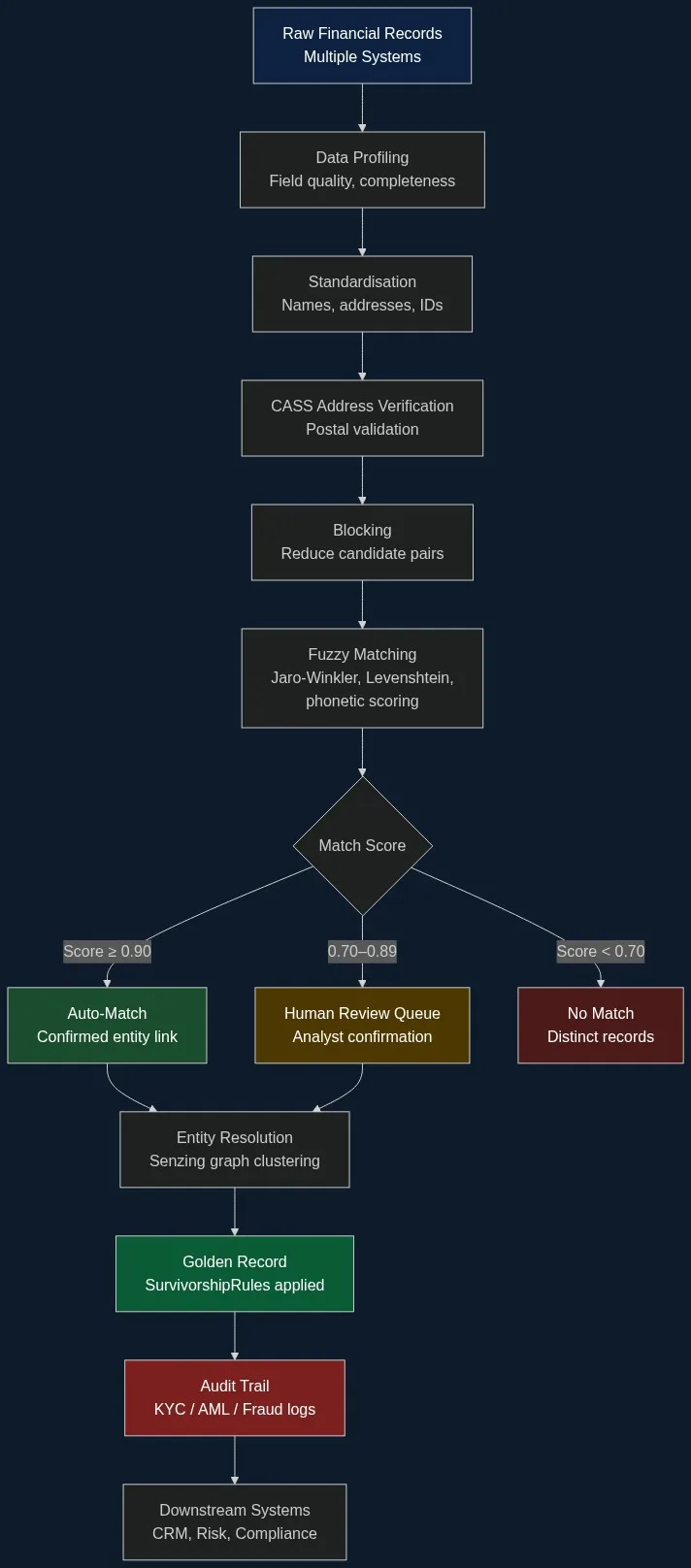
Stage 1: Data Profiling
Before matching, AI data profiling scans every field across source systems: completeness rates, format distributions, cardinality, and outlier patterns. A typical financial dataset shows 12–18% of entity name fields with inconsistent capitalisation, 8–15% of address fields missing a suite or unit component, and 4–9% of identifier fields with formatting errors. Profiling produces the remediation map that drives stages 2 and 3.
Stage 2: Standardisation and Cleansing
Data cleansing and standardisation normalises entity names (stripping legal suffixes like LLC, Ltd, Inc before scoring), reformats identifiers to canonical patterns, and expands abbreviations (“Blvd” to “Boulevard”, “St” to “Street”). This step alone reduces false negatives by 20–35% in benchmark tests on financial datasets.
Stage 3: CASS Address Verification
Every address field passes through CASS-certified postal verification, which corrects directional suffixes, appends ZIP+4 delivery-point codes, and flags undeliverable addresses. Verified addresses then match deterministically on postal delivery point rather than string similarity — eliminating an entire class of address false positives and false negatives.
Stage 4: Blocking
A dataset with 10 million entity records produces 50 trillion candidate pairs if compared exhaustively. Blocking reduces that to a manageable set. Financial entity blocking typically keys on the first three characters of the normalised name plus the ZIP code, or on the first six digits of the tax identifier. Each block contains records that are plausible matches. Records outside a block are not compared — an acceptable tradeoff when blocking keys are chosen with measured recall testing.
Stage 5: Multi-Field Fuzzy Scoring
Within each block, every candidate pair receives a composite match score. A typical financial entity scoring model weights fields as follows:
| Field | Algorithm | Weight |
|---|---|---|
| Entity name (normalised) | Jaro-Winkler + token ratio | 35% |
| Tax identifier (EIN/LEI/CRN) | Exact + partial | 30% |
| Registered address | CASS-verified delivery point | 20% |
| Country / jurisdiction | ISO code exact | 10% |
| Date of incorporation | Date proximity | 5% |
Pairs scoring above 0.90 route to automatic match. Pairs scoring 0.70–0.89 route to analyst review. Below 0.70, records are treated as distinct. Thresholds are configurable and should be tuned against a labelled holdout set from your own data.
Stage 6: Entity Resolution and Golden Record Creation
Confirmed matches pass to Senzing entity resolution, which uses graph-based probabilistic clustering to group all records that represent the same real-world entity — even when the chain of matches spans three or four systems. The output is a golden record built by survivorship rules: most recent address, most complete name, most trusted identifier source. Every contributing source record is linked to the golden record with a full relationship map for audit.
AML and Fraud Detection: Where Entity Resolution Adds the Most Value
The highest-stakes application of financial entity resolution is the detection of identity-based patterns that indicate money laundering or coordinated fraud.
Sanctions Screening False Positives
Sanctions lists contain tens of thousands of entries, many with common name patterns. A firm with 2 million customers screened daily against OFAC, UN, and EU consolidated lists generates hundreds of potential name hits per day. Most are false positives — “John Smith” matching a listed individual named “J. Smith”. Entity resolution reduces false positives by enriching each screening comparison with address, nationality, date of birth, and identifier data simultaneously. A single-field name comparison scores 0.81; a five-field composite for the same pair drops to 0.42, below the alert threshold.
Fraud Ring Detection
Fraud rings deliberately create multiple identities with slight variations: “James R. Thornton” at “14 Oak Street” and “Jim Thornton” at “14 Oak St, Apt A”. Both are the same individual, but they appear as separate customers in the origination system. Agentic entity resolution links these records automatically, surfacing the shared address and name cluster as a risk signal before credit is extended or a transaction clears.
Beneficial Ownership and Network Analysis
Resolving legal entities across corporate registry data, counterparty databases, and beneficial ownership filings exposes ownership chains that compliance teams cannot construct manually. When “Thornton Capital Ltd” and “Thornton Holdings LLC” resolve to the same ultimate beneficial owner — identified by shared director names and registered address — a compliance officer can see the full network in one view instead of piecing it together across three systems. Record linkage across multiple systems without a shared identifier is the core capability that makes this possible.
What Match Data Pro Delivers for Financial Entity Resolution
Match Data Pro is a cloud SaaS platform that covers every stage of the financial entity resolution pipeline in a single, configurable environment. No separate tools for profiling, cleansing, matching, and entity resolution — the pipeline runs end to end, with job automation scheduling refreshes on your cadence.
- AI-powered fuzzy matching: Configurable multi-field scoring with adjustable weights and thresholds per field type. Handles name variants, transliterations, and partial identifiers without custom code.
- Senzing entity resolution: Graph-based probabilistic clustering that scales to hundreds of millions of records, pre-trained on real-world name and address patterns across 100+ countries.
- CASS address verification: Postal-certified address parsing and standardisation integrated into the pipeline before matching runs.
- Full audit trail: Every match decision — field scores, algorithm weights, analyst overrides — is logged for regulatory examination.
- Import/export connectors: Direct connectors to core banking, CRM, and compliance systems. No manual file transfers between stages.
- No long-term contract: Monthly SaaS subscription. Register and start your free trial to run your first entity resolution job against your own data today.
Ready to see it in action with your own financial data? Schedule a demo with our team and we will walk through a live entity resolution run using records from your industry.
Frequently Asked Questions
What is entity resolution in financial services?
Entity resolution in financial services is the process of identifying, linking, and deduplicating records across databases to confirm that multiple records represent the same real-world customer, counterparty, or legal entity. It is used in KYC onboarding, AML screening, fraud detection, and beneficial ownership analysis to build a single authoritative view of each entity.
How does entity resolution reduce AML false positives?
AML false positives occur when a name-only match hits a sanctions list entry that is not the same person. Entity resolution enriches each comparison with address, date of birth, nationality, and identifier data simultaneously. A composite five-field score separates true matches from coincidental name overlaps more accurately than name matching alone, reducing false positive alert rates by 30–60% in production deployments.
Can entity resolution work without a shared unique identifier like an LEI or EIN?
Yes. A robust financial entity resolution pipeline uses multi-field weighted scoring across name, address, date of incorporation, and jurisdiction fields when identifiers are missing or inconsistent. Identifier matches boost the composite score when present, but the pipeline does not require them. Senzing entity resolution is specifically designed to operate accurately without a shared key across systems.
What is a golden record in financial entity resolution?
A golden record is the single authoritative record for an entity, built by applying survivorship rules to all matched source records. For a financial entity, it typically uses the most recent verified address, the most complete legal name, the most trusted identifier source, and aggregates risk attributes from all contributing records. Every source record links back to the golden record with a full provenance chain.
How long does it take to deploy entity resolution for a financial institution?
With a cloud SaaS platform like Match Data Pro, the initial pipeline — profiling, standardisation, blocking, fuzzy matching, and entity resolution — can process a first batch within hours of account setup. Configuration of field weights, thresholds, and survivorship rules typically takes one to two weeks, depending on the number of source systems and the complexity of the data model. No infrastructure deployment is required for SaaS.