
Nicknames, abbreviations, and name variants break entity matching when they are not handled explicitly. “William” and “Bill” share zero lexical overlap; “IBM” and “International Business Machines” score near zero on string similarity alone. A matching engine that relies only on character-level algorithms will miss these pairs — producing false negatives that fragment your customer, vendor, or patient records across multiple identities. The fix is a preprocessing layer that expands and normalises every name field before fuzzy scoring begins.
Ready to handle name variants at scale? Start a free trial of Match Data Pro and run your first entity matching job in minutes.
Why Name Variants Are the Hardest Entity Matching Problem
Most data quality failures in entity matching trace back to one root cause: the same person or organisation is stored under multiple name forms across different source systems. This happens for three main reasons.
First, humans use informal names in everyday contexts. “Robert Johnson” becomes “Bob Johnson” in a sales rep’s CRM entry, “R. Johnson” in a finance export, and “Bobby Johnson” in an event registration. A conventional exact-match or even a standard edit-distance check will not connect these three records without extra help.
Second, organisations shorten their names in practice. “International Business Machines Corporation” is always written as “IBM.” “3M” stands for “Minnesota Mining and Manufacturing.” If your matching engine treats these as different strings, you will end up with duplicate vendor records, split spend analytics, and broken supplier master data.
Third, legacy system migrations introduce truncations. A 30-character name field in an ERP might truncate “St. Christopher’s Medical Center” to “St Christoph Med Ctr” — which bears little resemblance to the canonical form in your CRM. Data standardisation must run before matching can succeed.
The result across all three scenarios is the same: your entity resolution engine sees strings it cannot confidently link, miss rate climbs above 15–25%, and downstream analytics fragment the same entity into 2, 3, or more ghost records.
The Three Variant Classes and How to Handle Each
1. Nicknames and Informal Given Names
Given name nicknames follow well-known patterns: Robert/Bob/Rob/Bobby, William/Bill/Will/Billy, Elizabeth/Beth/Liz/Eliza, Katherine/Kate/Kathy/Cathy. A lookup table mapping each informal form to its canonical base name is the most reliable approach. At Match Data Pro, the fuzzy matching engine supports user-configurable nickname dictionaries, so you can expand domain-specific variants — for example, professional aliases common in healthcare (“Dr.” prefixes, hyphenated surnames) or financial services.
The lookup table should be applied bidirectionally: expand both the source and target record to their canonical form before scoring. This ensures that “Bob” and “Bobby” both map to “Robert” and score a 1.0 similarity on the name field before the multi-field composite score is computed.
2. Abbreviations and Acronyms
Abbreviations appear in two contexts: personal name initials (“J. Smith” vs “John Smith”) and organisation name acronyms (“GE” vs “General Electric”). Both require different resolution logic.
For personal name initials, the safest rule is: if one record contains a single-character first name and the other contains a full first name, check whether the initial matches the first character of the full name. If it does, treat the name tokens as equivalent before passing the field to your similarity scorer. This prevents Jaro-Winkler from scoring “J Smith” against “John Smith” at 0.72 when the correct score should be 1.0 after initial resolution.
For organisation acronyms, maintain a controlled vocabulary of known abbreviation-to-full-name mappings, typically sourced from your supplier master, CRM, or industry-standard code tables. This is especially important in financial services entity resolution, where regulatory filings often use abbreviated legal entity names that differ from trading names.
3. Cultural and Regional Name Variants
International datasets introduce transliteration variants. “Mohammed” appears as “Mohamed,” “Muhammad,” “Mohammad,” and “Muhammed” depending on country of origin and transcription convention. Chinese names may be romanised in different orders (given-name-first vs surname-first). Spanish compound surnames may be hyphenated or space-separated.
Phonetic algorithms — Soundex, Metaphone, Double Metaphone — handle this case well because they encode the sound of a name rather than its exact spelling. “Mohammed” and “Muhammad” map to the same Metaphone code. Combining phonetic encoding with token-based fuzzy scoring gives your entity matching pipeline the coverage it needs across multilingual datasets.
The Preprocessing Pipeline: Five Stages Before Scoring
Handling name variants effectively requires a dedicated preprocessing stage before any similarity algorithm runs. Here is how a production pipeline is structured.
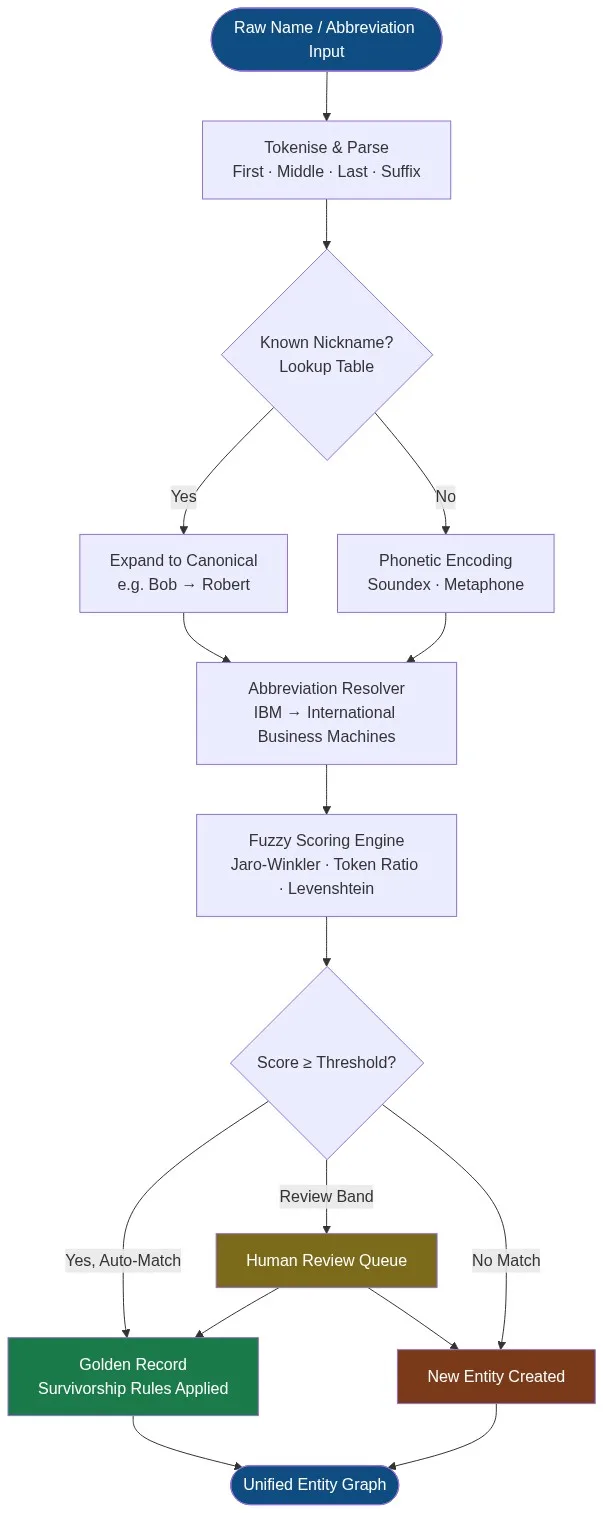
Stage 1 — Tokenise and parse. Split the raw name string into components: title, first, middle, last, suffix. Parsing separates “Dr. Robert A. Johnson Jr.” into four addressable tokens. Field-level matching is always more accurate than whole-string matching for names.
Stage 2 — Normalise casing and punctuation. Uppercase all tokens; strip hyphens, apostrophes, and periods that are not meaningful. “O’Brien” and “Obrien” and “O Brien” should all produce the same normalised form. This stage is part of Match Data Pro’s automated data cleansing layer.
Stage 3 — Apply nickname and abbreviation lookup. For each parsed token, check the nickname dictionary and the abbreviation table. Replace the informal form with its canonical equivalent. Flag the substitution so it can be factored into confidence scoring downstream.
Stage 4 — Phonetic encoding. Generate a Soundex or Double Metaphone code for each token after substitution. This code is added as a blocking key, reducing the comparison space by grouping phonetically similar names before the O(n²) similarity computation begins.
Stage 5 — Multi-algorithm similarity scoring. Run Jaro-Winkler on the normalised name tokens, token-set ratio on full name strings, and Levenshtein edit distance as a tie-breaker. Combine the three scores with configured field weights into a composite match score. Records above your auto-match threshold proceed to survivorship; records in the review band go to a human review queue. This is how multi-algorithm data matching works in practice.
Real-World Example: Before and After Name Variant Resolution
Consider two records from a post-merger CRM consolidation exercise:
| Field | Record A (Legacy CRM) | Record B (Acquired CRM) |
|---|---|---|
| Name | Bobby R. Johnson | Robert Johnson |
| Company | GE Healthcare | General Electric Healthcare |
| b.johnson@gehc.com | robert.johnson@ge-healthcare.com | |
| Phone | 312-555-0182 | (312) 555-0182 |
Without name variant handling, the raw Jaro-Winkler score for “Bobby R Johnson” vs “Robert Johnson” is approximately 0.68 — below a typical auto-match threshold of 0.85. The records are not linked.
After applying the preprocessing pipeline: “Bobby” expands to “Robert” via the nickname dictionary; “R.” is resolved as a matching initial; “GE Healthcare” expands to “General Electric Healthcare” via the abbreviation table; phone numbers are standardised to E.164 format and score 1.0. The composite score now exceeds 0.93 — a confident auto-match. Two fragmented records become one verified golden record.
This is exactly the kind of match that entity resolution and data linkage platforms must get right. Missing it means a salesperson calls the same customer twice, finance processes a duplicate invoice, or a clinician treats a patient with incomplete history.
Configuring Thresholds for Name Variant Scenarios
Name variant handling introduces an important tuning challenge: expanding nicknames increases recall (more true matches found), but an overly aggressive dictionary can increase false positives if two different people share a common nickname. The threshold must be calibrated against the additional evidence from other fields.
A practical configuration approach:
- When name canonicalisation fires (a substitution was made), reduce the name field weight slightly and compensate by increasing the weight on email, phone, and address. You are less certain about the name match, so other fields carry more evidential weight.
- Set a “soft” review band (e.g. composite score 0.70–0.84) for records where a nickname expansion occurred but supporting fields are incomplete or missing. Route these to a human review queue rather than auto-merging.
- Log all substitutions in the match audit trail. This supports explainability: a compliance officer can see exactly why two records were merged, including which nickname dictionary entry fired. Match Data Pro’s entity resolution software records every match decision with field-level evidence.
Threshold tuning is iterative. Run a representative sample of your data through the pipeline, manually review a stratified set of match decisions, and adjust the composite threshold until your precision-recall trade-off meets your use case. For data matching algorithm configuration, Match Data Pro exposes all weights and thresholds in a no-code UI so data engineers can iterate without redeployment.
Scaling to Enterprise Volumes
At 10 million records, a naive all-pairs comparison approach requires 5 × 10¹³ pairwise comparisons — computationally infeasible. Blocking reduces this by grouping records that share a phonetic key or prefix before comparison runs. A well-designed blocking strategy reduces the candidate pair count by 99%+ while retaining near-100% of true match pairs.
Match Data Pro’s Senzing entity resolution engine uses graph-based entity clustering that scales horizontally. Records with common phonetic keys or shared tokens are grouped into candidate sets, scored in parallel, and resolved into entity clusters — all within a configurable job pipeline that can run on a scheduled or triggered basis via the platform’s job automation layer.
For real-time use cases — such as checking for duplicate records at point of CRM entry — the live fuzzy search API applies the same preprocessing and scoring logic in under 100ms per query, including nickname expansion and phonetic blocking.
Ready to eliminate false negatives caused by nicknames and abbreviations? Schedule a demo to see how Match Data Pro handles name variant resolution on your actual data — or register for a free trial and run a proof of concept today.
Frequently Asked Questions
How does entity matching handle nicknames like “Bob” for “Robert”?
A nickname dictionary maps informal given names to their canonical base form before any similarity algorithm runs. Both “Bob” and “Robert” are replaced with “Robert” at the preprocessing stage, so the name field scores 1.0 similarity. Without this step, a standard edit-distance algorithm scores the pair at around 0.62 — well below any reasonable auto-match threshold — and the records are missed.
What is the best algorithm for matching names with abbreviations?
No single algorithm is best for all abbreviation cases. For personal name initials, a rule-based initial resolver outperforms fuzzy algorithms. For organisation acronyms, a controlled vocabulary lookup table is most reliable. Once abbreviations are expanded to canonical forms, Jaro-Winkler or token-set ratio scoring handles the remaining variation. Combining all three methods in a layered pipeline gives the highest accuracy.
How do I match names across languages and transliteration variants?
Phonetic encoding algorithms — Soundex, Metaphone, Double Metaphone — encode names by sound rather than spelling, making them effective across transliteration variants of the same name. “Muhammad” and “Mohammed” map to the same phonetic code. For CJK or non-Latin scripts, a transliteration step is needed before phonetic encoding. Match Data Pro supports configurable phonetic blocking keys for multilingual datasets.
What threshold should I use when name canonicalisation fires?
When a nickname or abbreviation substitution is applied, reduce the name field weight by 10–15% and increase weights on corroborating fields such as email, phone, and address. Set a soft review band (typically 0.70–0.84 composite score) for records where substitution fired but supporting fields are sparse. Auto-match only when the composite score from all fields exceeds your validated threshold — typically 0.85 or above.
Can the same pipeline handle both person names and organisation names?
Yes, but the preprocessing logic differs by entity type. Person name pipelines apply nickname dictionaries, initial resolution, and gender-neutral parsing. Organisation name pipelines apply acronym tables, legal suffix normalisation (“Ltd” vs “Limited” vs “LLC”), and token-order independence. Match Data Pro supports separate matching definitions for each entity type, each with its own field weights, dictionaries, and thresholds.