The best entity resolution software for 2026 combines graph-based probabilistic matching, configurable fuzzy algorithms, and a full survivorship pipeline — all deployable in days, not months. Platforms that deliver this help data teams link fragmented records across CRM, ERP, and third-party sources into a verified golden record with accuracy rates above 95%. Match Data Pro, powered by the Senzing entity resolution engine, is built precisely for this workload.
Not sure which platform fits your use case? Book a demo and see entity resolution running on your own data in under 30 minutes.
What Entity Resolution Software Actually Does
Entity resolution is the process of determining whether two or more records refer to the same real-world entity — a customer, company, patient, or vendor — across datasets that share no common primary key. The software must handle name misspellings, address variants, transposed digits, and missing fields without human intervention for every pair.
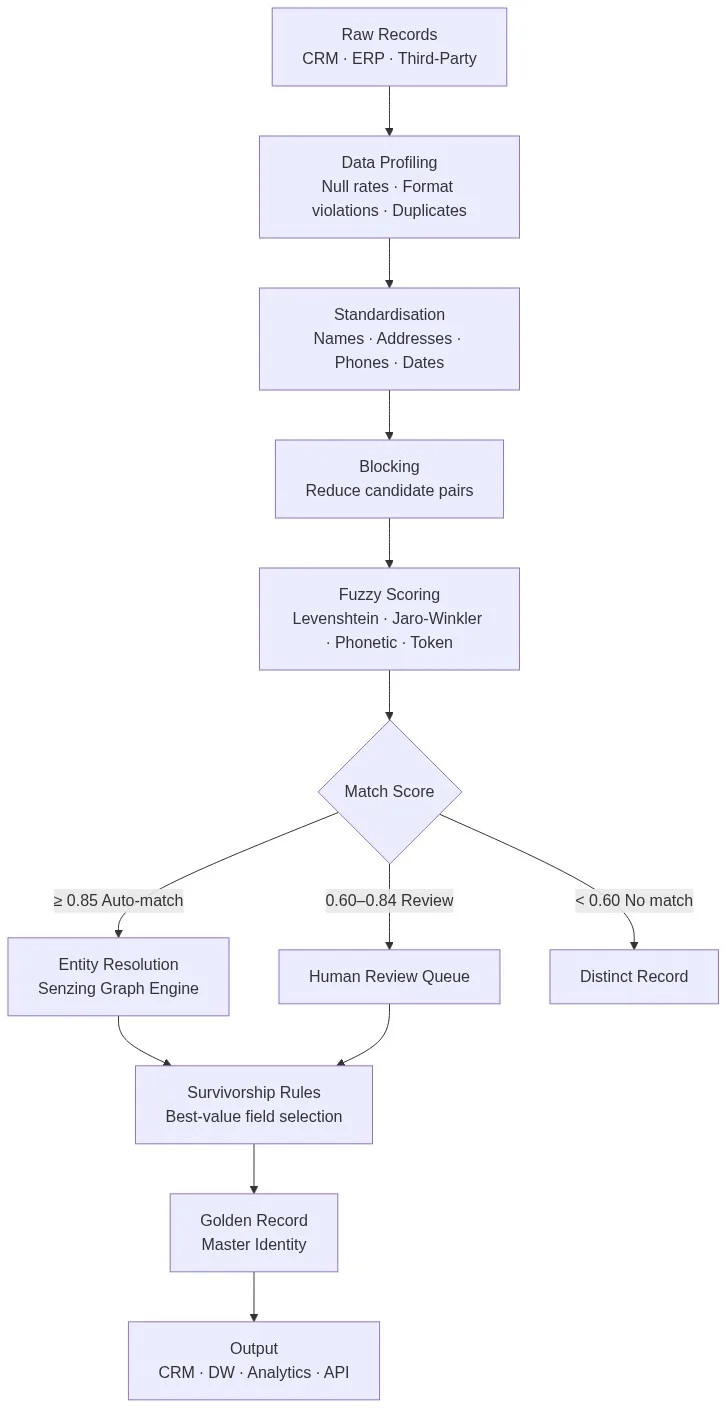
A production-grade platform does this through a staged pipeline:
- Profiling — scans every field for null rates, format violations, and distribution anomalies before any matching runs
- Standardisation — normalises names, phone formats, date formats, and address structures so scoring algorithms operate on consistent inputs
- Blocking — groups candidate pairs by shared tokens (ZIP code, surname initial, industry code) to reduce O(n²) comparisons to a manageable subset
- Fuzzy scoring — applies Levenshtein, Jaro-Winkler, phonetic, and token-based algorithms per field, then combines scores using configurable weights
- Entity resolution — a graph engine clusters matched pairs into entity groups, resolving transitive links (A=B, B=C → A=B=C)
- Survivorship — rules pick the best value for each field from all contributing records to build the golden record
Match Data Pro’s entity resolution engine runs all six stages in an automated job pipeline with no manual handoff between steps.
Six Capabilities That Separate Production-Grade Platforms from Basic Tools
1. Graph-Based Probabilistic Matching
Basic tools compare record pairs in isolation. Graph-based engines track relationships across pairs. If Record A matches Record B, and Record B matches Record C, the graph engine places A, B, and C in the same entity cluster — even if A and C share no direct match signal. Match Data Pro’s Senzing integration uses this approach. It is pre-trained on global name and address patterns, so teams avoid months of manual rule authoring.
2. Configurable Multi-Algorithm Fuzzy Scoring
No single algorithm works for every field type. Names need Jaro-Winkler or phonetic matching. Addresses need token-based comparison and CASS normalisation first. Phone numbers need digit-only normalisation before Levenshtein scoring. A platform that forces one algorithm across all fields will produce false positives on addresses and miss matches on names.
Match Data Pro’s fuzzy matching engine lets teams assign different algorithms and weights per field, then adjust thresholds using a visual score distribution — without writing code.
3. CASS-Certified Address Verification
Address data is the most common source of false non-matches. “123 Main St” and “123 Main Street Suite 4B” refer to the same location, but string comparison scores them low. CASS address verification normalises and validates every address against the USPS postal database before matching begins, correcting abbreviations, adding ZIP+4, and removing unit-level noise. This step alone can lift match recall by 8–15 percentage points on address-heavy datasets.
4. AI Data Profiling Before Every Run
Teams that skip profiling spend days debugging match failures caused by upstream data problems. A good entity resolution platform runs AI data profiling automatically at ingestion — flagging null rates above threshold, detecting unexpected date formats, and identifying columns with high cardinality that will produce blocking misses. Match Data Pro profiles every dataset on import and surfaces a quality scorecard before the match job starts.
5. Survivorship Rules and Golden Record Output
Matching is only half the problem. Once clusters are identified, teams need to decide which field value survives into the master record. Survivorship rules encode that logic: use the most recently updated value, prefer the source with the highest completeness score, or apply custom logic for specific fields. Match Data Pro’s survivorship and golden record engine supports all three approaches with a no-code configuration interface.
6. Real-Time API for Continuous Matching
Batch matching cleans historical data. But new records enter systems every day. A production entity resolution platform needs a real-time matching API that scores incoming records against the existing entity graph at point of entry — preventing duplicates before they accumulate. Match Data Pro exposes a live fuzzy search API that returns match candidates with scores and entity cluster IDs in milliseconds.
How to Evaluate Entity Resolution Software: A Decision Framework
Step 1: Define Your Match Precision and Recall Targets
Start with numbers. What false positive rate is acceptable? A KYC workflow may tolerate zero false positives. A marketing deduplication job may accept 2%. Define both precision (correct matches / total matches) and recall (correct matches / total true matches) targets before evaluating any vendor. Without these, every demo will look impressive.
Step 2: Test on Your Own Data
Vendor benchmarks are produced on clean, curated datasets. Your data has specific quirks — industry abbreviations, international address formats, legacy coding schemes. Insist on a proof-of-concept run using a 10,000–50,000 record sample from your actual environment. Match Data Pro provides a free trial where teams can load real data and run a full match job without purchasing a license.
Step 3: Evaluate Deployment Fit
Cloud SaaS platforms deploy in hours and require no infrastructure management. Match Data Pro runs as a cloud SaaS with no long-term contract, which means teams can run a production pilot in days, not quarters. For teams with data residency requirements, evaluate whether the vendor offers private cloud or on-premise options.
Step 4: Check Scale and Performance
Entity resolution on 10,000 records is a different problem from entity resolution on 100 million records. Ask vendors for documented throughput benchmarks at your target record count. Blocking strategy matters enormously at scale — a poorly configured blocking pass can make an otherwise capable engine unacceptably slow.
Step 5: Verify Audit and Explainability
Regulators and internal governance teams need to understand why two records were matched or not matched. Look for field-level match score breakdowns, algorithm weights used per field, and a full audit trail of every match decision. Match Data Pro’s entity resolution and data linkage engine logs every scoring decision, making compliance reviews straightforward.
Common Entity Resolution Failures and How to Avoid Them
Failure 1: Matching on Unstandardised Data
Running fuzzy matching on raw, unstandardised fields is the single most common cause of poor match accuracy. “IBM Corporation”, “I.B.M.”, and “International Business Machines” will score below threshold on string comparison algorithms unless company name normalisation runs first. Always standardise before scoring.
Failure 2: Single-Algorithm Scoring
A platform that uses only Levenshtein distance will score “Jon” vs “John” at 0.75 (one character edit) — below most match thresholds — even though the two names clearly refer to the same person in context. Multi-algorithm approaches that combine phonetic similarity, nickname dictionaries, and contextual signals resolve this class of error.
Failure 3: Skipping Blocking
Without blocking, a dataset of one million records produces 500 billion candidate pairs. Even a fast scoring engine cannot process this in a reasonable time window. Blocking reduces candidate pairs by 99%+ by comparing only records that share at least one token — surname initial, ZIP code, or industry code. Skipping or misconfiguring blocking is the primary cause of entity resolution jobs that never complete.
Failure 4: No Survivorship Strategy
Teams that focus only on matching and neglect survivorship end up with entity clusters that contain no actionable output. Without survivorship rules, there is no golden record — just a list of matched pairs. Define survivorship logic before the first production run.
Frequently Asked Questions
What is entity resolution software and what does it do?
Entity resolution software identifies records across datasets that refer to the same real-world entity and links them into a verified golden record. It uses fuzzy matching algorithms, blocking strategies, and graph-based clustering to resolve identities without a shared primary key. Production-grade platforms also handle survivorship — selecting the best field values from all contributing records.
How does entity resolution differ from simple deduplication?
Deduplication removes exact or near-exact duplicate records within a single dataset. Entity resolution goes further — it links records across multiple sources, handles complex transitive relationships (A matches B, B matches C, therefore A and C are the same entity), and produces a clustered identity graph rather than just a deduplicated list. Most enterprise use cases require both.
What accuracy rates should I expect from entity resolution software?
Well-configured entity resolution pipelines typically achieve 93–97% precision and 88–95% recall on enterprise data. Accuracy depends heavily on data quality before matching begins, blocking configuration, algorithm selection, and whether CASS address verification was applied. A proof-of-concept run on your own data is the only reliable way to set expectations.
How long does it take to deploy an entity resolution platform?
Cloud SaaS platforms like Match Data Pro can be deployed and running a first match job within a day. The time-consuming phase is configuration — defining blocking keys, algorithm weights, and survivorship rules for your specific data. Most teams complete initial configuration in one to two weeks. Full production rollout, including integration with downstream systems, typically takes two to six weeks.
When should I use real-time entity resolution versus batch processing?
Use real-time entity resolution at the point of record ingestion — when new customers are created in a CRM, when vendor records are imported from procurement, or when patient data arrives from an external system. Use batch processing for historical cleanup of existing datasets. Most production environments need both: a batch run to clean historical data and a real-time API to prevent new duplicates from accumulating.