

Address cleansing is the process of parsing raw postal records into structured components, standardising them against a reference dataset, and verifying deliverability — typically through CASS (Coding Accuracy Support System) certification. Done correctly, it removes undeliverable addresses before they corrupt CRM, ERP, marketing, and logistics systems, cutting return mail rates by 20–40% and preventing downstream analytics failures caused by fragmented customer records.
If your team is evaluating tools or rebuilding a pipeline, start a free trial of Match Data Pro to see address cleansing running against your own data in minutes.
Why Address Data Degrades — and Why It Matters
Address data has a shelf life. Research from the IBM Institute for Business Value found that over a quarter of organisations lose more than USD 5 million annually due to poor data quality, with address errors among the leading contributors. In practice, the degradation comes from four sources:
- Entry errors at point of capture. Web forms, call centre agents, and import jobs introduce typos, transposed street numbers, and missing unit suffixes. “123 Main St” becomes “123 Mian Street” or “123 Main” with no apartment number.
- Format inconsistency across systems. CRM stores “Suite 400” while ERP stores “Ste 400” and the data warehouse stores “STE 400”. None of these match on an exact join, so the same customer appears as three separate entities.
- Natural address change. The USPS processes approximately 40 million address changes per year. Customers move. Buildings are renumbered. ZIP codes split. Without a maintenance cycle, 10–15% of a typical B2B address file becomes stale within 18 months.
- International data merged with US-formatted pipelines. When a team imports a file mixing US, UK, and Canadian addresses into a pipeline designed for USPS format, the parser fails silently and downstream processes receive partial records.
The downstream effects are concrete: failed direct mail campaigns, shipping to wrong locations, duplicate customer records with different address formats, and analytics that segment the same person as two or three distinct buyers. Address cleansing eliminates all four causes in a single automated pipeline.
The Address Cleansing Pipeline: Stage by Stage
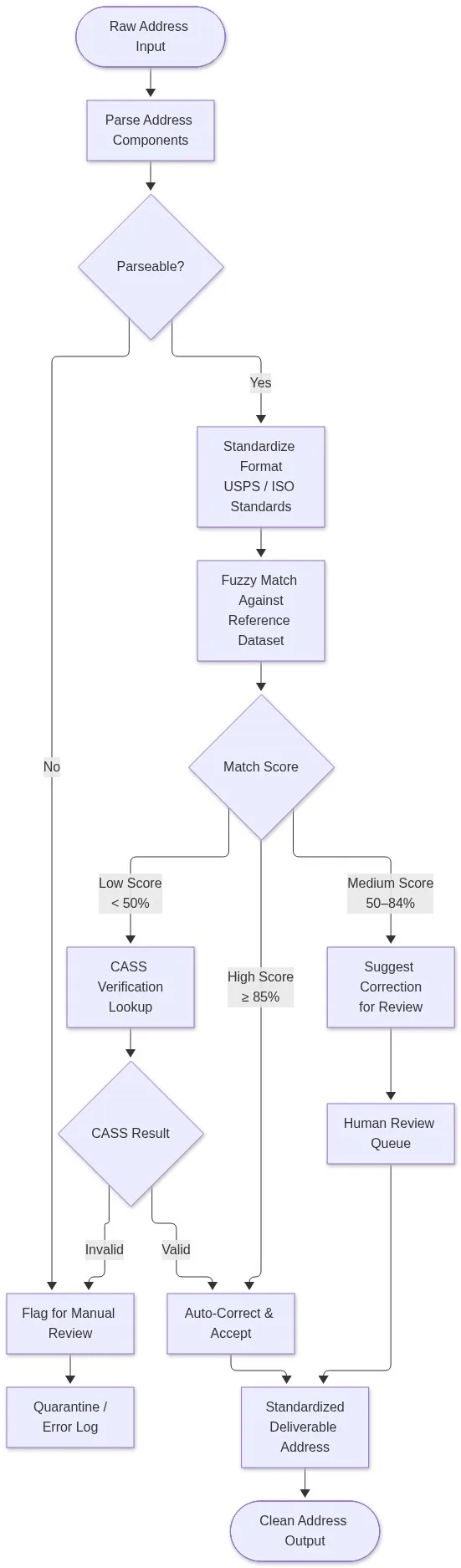
A production-grade address cleansing pipeline has five distinct stages. Each stage handles a specific class of error. Skipping stages is the most common cause of pipelines that pass QA but produce clean-looking data that is still undeliverable.
Stage 1: Parse
Parsing decomposes a raw address string into labelled components: house number, street pre-directional, street name, street type, post-directional, unit type, unit number, city, state, and ZIP+4. A parser that cannot identify “NE” as a pre-directional in “4521 NE Broadway Ave Apt 3B Portland OR 97213” will produce a broken record that fails every downstream stage.
Edge cases the parser must handle: dual addresses (“PO Box 1200 / 400 Commerce Drive”), unit suffixes written as inline text (“Apt 4” vs “#4” vs “Unit 4”), and intersections used as delivery points in rural routes.
Stage 2: Standardise
Standardisation converts every component to a canonical form. Street type “Street” becomes “St”. Direction “Northwest” becomes “NW”. State “California” becomes “CA”. The objective is not readability — it is ensuring that the same real-world address always produces the same string, regardless of which source system it came from. Without standardisation, fuzzy matching in Stage 3 must bridge format variation as well as spelling errors, which degrades precision and recall.
Match Data Pro’s data standardisation pipeline handles USPS abbreviation tables, state/province normalisation for US, Canada, and Australia, and configurable rules for custom domain vocabularies such as military addresses (APO/FPO/DPO).
Stage 3: Fuzzy Match Against Reference Dataset
Once standardised, each address is scored against a reference postal dataset. The match score determines the routing decision. A Jaro-Winkler or Levenshtein algorithm scores the street name component; exact matching handles house number, unit number, ZIP, and state. A composite weighted score is computed.
Example scoring on a misspelled input:
| Field | Input Value | Reference Value | Score | Weight |
|---|---|---|---|---|
| House Number | 4521 | 4521 | 100 | 25% |
| Street Name | Brodway | Broadway | 88 | 35% |
| Street Type | Ave | Ave | 100 | 10% |
| City | Portlnd | Portland | 91 | 15% |
| ZIP | 97213 | 97213 | 100 | 15% |
| Composite | 93.9 |
A score of 93.9 falls above the auto-accept threshold (typically 85+). The system corrects “Brodway” to “Broadway” and accepts the record. Scores between 50 and 84 route to a human review queue with the suggested correction pre-populated. Scores below 50 go to CASS lookup.
For teams building or evaluating matching pipelines, the Match Data Pro fuzzy matching algorithm guide covers algorithm selection, threshold tuning, and composite weighting in detail.
Stage 4: CASS Verification
CASS (Coding Accuracy Support System) is a USPS program that certifies address matching software and reference datasets. A CASS-certified lookup verifies that an address is a real, deliverable point — assigning a full ZIP+4 code and a Delivery Point Barcode (DPB). It also applies NCOA (National Change of Address) data to flag and correct moved addresses.
Three outputs come from CASS:
- DPV (Delivery Point Validation) confirmed: The address exists and is deliverable. ZIP+4 assigned.
- DPV confirmed with secondary missing: The primary address is valid but the unit number is missing or incorrect. The record is deliverable to the building but not the specific unit.
- DPV not confirmed: The address cannot be matched to a deliverable point. Route to quarantine or manual review.
Match Data Pro’s CASS address verification runs as a native pipeline stage — not a third-party call that breaks your data flow. Results are written back to the source record with a verification status flag, verification date, and corrected address fields, giving your governance team a complete audit trail.
Stage 5: Output Routing
Clean, verified addresses go to the output dataset. Records with a secondary-missing flag go to a remediation queue with the DPV status written to a status field. Unverified records go to quarantine with the original address preserved and an error code attached. No record is silently dropped.
Address Cleansing vs. Address Verification vs. Address Standardisation: Comparison
These three terms are often used interchangeably, but they describe distinct operations. Using the wrong term when evaluating vendors leads to purchasing a tool that solves the wrong problem.
| Operation | What It Does | Output | Requires CASS? |
|---|---|---|---|
| Address Standardisation | Converts components to canonical format (St, Ave, NW, CA) | Consistently formatted address | No |
| Address Verification | Confirms the address is real and deliverable | DPV status + ZIP+4 | Yes (for USPS) |
| Address Cleansing | Parse + standardise + fuzzy match + verify + route | Corrected, verified, deliverable record | Yes (full pipeline) |
| NCOA Processing | Applies move data to update old addresses | Forwarded address or undeliverable flag | Yes |
A tool that only standardises will give you consistently formatted addresses that are still undeliverable. A tool that only verifies will catch bad addresses but not correct them. A full address cleansing pipeline does all four operations in sequence.
International Address Cleansing: Where Pipelines Break
CASS is a US-only system. For international address cleansing, the pipeline must reference country-specific postal datasets — Royal Mail PAF for the UK, Canada Post for Canada, and Australia Post’s GNAF for Australia — with country-specific parse rules applied before standardisation runs.
Three international patterns that break US-only pipelines:
- UK postcodes as the primary locator. A UK address like “15 High Street, London, SW1A 2AA” uses the postcode as the deliverability anchor, not the street name. A US-first parser that places ZIP at the end will misclassify the postcode as a city.
- Reversed address order in many Asian address formats. Japanese addresses run largest-to-smallest (prefecture, city, district, street, building). Parsing smallest-to-largest produces completely wrong component assignments.
- No street name in rural addresses. Rural addresses in many markets reference a plot number, village, and postal district — no street component at all. A pipeline that requires a street name will quarantine valid rural records.
Match Data Pro’s data cleansing pipeline includes configurable country-aware address parsing for US, Canada, UK, Australia, and selected EU markets, with ISO 3166 country code detection to automatically apply the correct parse rules.
Integrating Address Cleansing Into Your Data Pipeline
Address cleansing does not run in isolation. It sits inside a broader data quality framework that includes profiling, standardisation, deduplication, entity resolution, and monitoring. The sequence matters: run address cleansing before deduplication, not after. Here is why.
If you deduplicate first, two records with the same customer but different address formats — “123 Main St Apt 4” and “123 Main Street #4” — will score below the match threshold and survive as separate records. If you cleanse addresses first, both records resolve to the same standardised string, and the deduplication match score rises from 71 to 94, triggering an auto-merge.
The correct integration sequence for most enterprise pipelines is:
- Step 1: Profile the dataset — identify completeness gaps, format distributions, and duplicate candidate rates before any cleansing begins.
- Step 2: Standardise all text fields (names, phone numbers, emails).
- Step 3: Run address cleansing (parse, standardise, fuzzy match, CASS verify).
- Step 4: Run deduplication with address fields now contributing accurate match scores.
- Step 5: Run entity resolution to link surviving records across source systems.
- Step 6: Monitor with a data quality monitoring job that re-triggers address verification when records are updated.
Match Data Pro’s job automation layer runs this full sequence on a schedule or via API trigger — no manual re-runs required. The data matching and merging pipeline connects address-cleansed records to the deduplication and survivorship stages in a single configured job.
Frequently Asked Questions
What is address cleansing and how does it work?
Address cleansing is the automated process of parsing raw address strings into structured components, standardising each component to a canonical format, scoring the result against a reference postal dataset using fuzzy matching, and verifying deliverability through CASS certification. The output is a corrected, deliverable address with a verification status flag and ZIP+4 code attached. Records that cannot be verified are quarantined rather than passed through silently.
What is the difference between address cleansing and address standardisation?
Address standardisation converts format only — “Street” becomes “St”, “California” becomes “CA”. It does not verify that the address is deliverable. Address cleansing is the full pipeline: parse, standardise, fuzzy-match against a reference dataset, and CASS-verify. Standardisation is one stage inside address cleansing. A tool that only standardises will give you consistently formatted but potentially undeliverable records.
How often should address cleansing be run?
At minimum, run address cleansing on every new record at the point of entry and on a full-database schedule every six months. The USPS processes approximately 40 million address changes per year, which means a typical B2B database loses 10–15% address accuracy within 18 months without a maintenance cycle. For high-velocity CRM environments, integrate address cleansing as a real-time API call on every new or updated contact record.
Does address cleansing work for international addresses?
Yes, but only if the pipeline includes country-specific parse rules and reference datasets. CASS is a US-only system. International address cleansing requires separate reference databases for each target country — Royal Mail PAF for the UK, Canada Post for Canada, Australia Post GNAF for Australia — and country-aware parsing that handles structural differences such as reversed address order, postcode-led formats, and rural plot addresses with no street name component.
How does address cleansing improve deduplication accuracy?
Address cleansing improves deduplication accuracy because it eliminates format variation before match scoring runs. Two records for the same customer — “123 Main St Apt 4” and “123 Main Street #4” — may score below the match threshold and survive as duplicates if address fields are dirty. After cleansing, both records resolve to the same standardised string and the composite match score rises enough to trigger an auto-merge. Run address cleansing before deduplication, not after.
Start Cleansing Your Address Data Today
Match Data Pro runs the full address cleansing pipeline — parse, standardise, fuzzy match, CASS verify, and quarantine routing — as a single configured job against your own data. No contract. No infrastructure setup required for the cloud deployment.
- Start a free trial — cleanse a sample of your address data in minutes.
- Get instant access for a no-registration test drive.
- Schedule a demo for a walkthrough of the address cleansing and CASS verification pipeline with your data team.
- Contact the sales team directly: sales@matchdatapro.com