
SQL fuzzy matching using native functions like LIKE, SOUNDEX, and DIFFERENCE breaks down quickly at scale. These functions miss transposed characters, nicknames, abbreviated company names, and address variants — producing false-negative rates above 20% on real-world enterprise data. A purpose-built data matching platform applies field-specific algorithms, composite scoring, and blocking strategies that SQL cannot replicate natively, reducing missed matches to under 3%.
If your deduplication or record-linkage job relies on SQL alone, you are almost certainly leaving significant numbers of duplicates unresolved. Learn how Match Data Pro’s data matching platform resolves that gap — then read on for the technical detail.
Why SQL Native Functions Fail at Fuzzy Matching
SQL engines were designed for exact retrieval. Every function that attempts approximate matching carries a fundamental constraint.
LIKE and ILIKE
WHERE company_name LIKE '%acme%' catches simple substrings but fails the moment a record stores “ACME Corp”, “Acme Incorporated”, or “A.C.M.E.” in a different column. Wildcard expansion also forces a full table scan on large datasets, making it unusable at scale without additional indexing.
SOUNDEX and DIFFERENCE
SOUNDEX encodes a name to a four-character phonetic key — useful for catching “Smith” vs “Smyth”, but it collapses too many distinct names into the same code and cannot handle multi-token strings or international characters. The DIFFERENCE function returns a score of 0 to 4, which is too coarse for production thresholding. “Robert Johnson” and “Roberto Jonhson” score 4 — the maximum — meaning identical weight is given to records that differ substantially.
Levenshtein and Trigram Extensions
PostgreSQL’s pg_trgm extension and Levenshtein functions are more capable than SOUNDEX. But even these have limits. Levenshtein edit distance treats every character edit as equal weight. Transposing two adjacent digits in a ZIP code (“90125” vs “90215”) produces the same edit distance as substituting a letter in a name. That is not useful when you need field-aware scoring. Trigram similarity also degrades on short strings — a three-character company code like “IBM” produces only one trigram, destroying recall.
Performance at Scale
None of the SQL fuzzy approaches include blocking — the technique of reducing the candidate pair space before scoring. Without blocking, a 1 million-record table produces 500 billion candidate pairs to evaluate. Even with indexing, SQL fuzzy functions cannot process that volume in a reasonable time window. Dedicated fuzzy matching algorithms with blocking strategies reduce the candidate space by 99.5% before any scoring begins.
What a Purpose-Built Fuzzy Matching Pipeline Does Differently
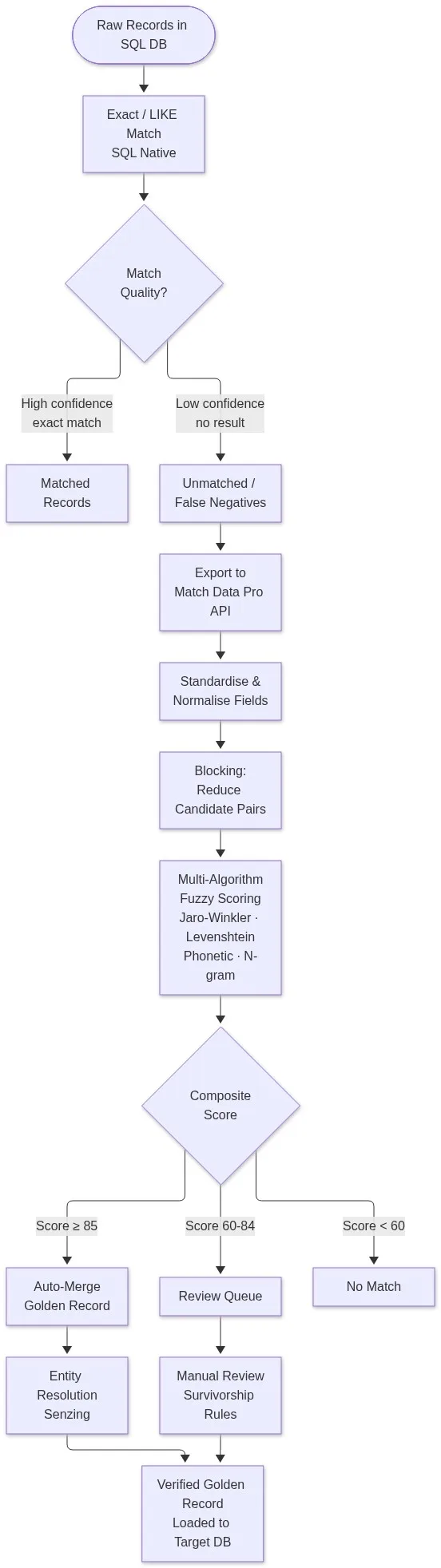
A production-grade fuzzy matching pipeline solves the problems above through five mechanisms SQL does not support natively.
Field-Specific Algorithm Selection
Different fields need different algorithms. Names respond well to Jaro-Winkler, which weights prefix agreement and handles transpositions. Addresses need a combination of CASS standardisation followed by token-based comparison. Phone numbers need digit-normalisation before any string comparison. Company names need stopword removal (“Inc”, “LLC”, “Ltd”) before scoring. Match Data Pro’s AI-powered fuzzy matching engine selects and weights algorithms per field type automatically.
Composite Weighted Scoring
No single algorithm is sufficient. A production match uses a composite score: a weighted sum across multiple field comparisons. Consider these two records:
| Field | Record A | Record B | Algorithm | Score | Weight |
|---|---|---|---|---|---|
| Last Name | Nguyen | Nguyen | Jaro-Winkler | 100 | 0.30 |
| First Name | Michael | Mike | Nickname Table + JW | 92 | 0.20 |
| m.nguyen@acme.com | mnguyen@acme.com | Domain + Token | 88 | 0.25 | |
| Address | 123 Oak St | 123 Oak Street | CASS Std + Token | 95 | 0.25 |
| Composite Score | 94.1 |
SQL SOUNDEX on the name alone would score these at 4/4 — the maximum — with no contextual discrimination. The composite approach gives an actionable 94.1 that confidently routes to auto-merge.
Blocking to Control Candidate Volume
Before any scoring begins, blocking reduces the candidate pair space. Common blocking keys include: first three characters of last name, ZIP code prefix, email domain, and phonetic name code. Records that share at least one blocking key become candidates. Records that share none are excluded. This cuts a 1 million-record job from 500 billion pairs to roughly 2–5 million — a 99.9% reduction that makes the job feasible in minutes, not weeks. See how data deduplication pipelines use blocking to manage scale.
Tiered Match Routing
Three tiers handle the output of scoring:
- Auto-merge (score ≥ 85): Records are merged immediately according to survivorship rules. No human review required.
- Review queue (score 60–84): Records are flagged for a human reviewer who confirms or rejects the match.
- No match (score < 60): Records are written as distinct entities.
In a typical enterprise CRM deduplication run, 70–80% of duplicate pairs fall in the auto-merge tier. That means 70–80% of the work completes without human involvement.
Entity Resolution Across Sources
Fuzzy matching links pairs of records. Entity resolution clusters all records belonging to the same real-world entity — even when they come from five different source systems. Match Data Pro’s Senzing-powered entity resolution engine builds a persistent identity graph, so “Acme Corp”, “ACME Corporation”, and “Acme, Inc.” in three separate databases collapse into one verified golden record. That is a step SQL cannot approach.
The Failure Modes SQL Teams Hit in Production
Teams that start with SQL fuzzy matching and try to extend it into production encounter predictable failure modes.
High False-Negative Rates
Missing a duplicate is a false negative. On enterprise customer data with typical name spelling variations, SQL LIKE-based matching misses 20–35% of duplicates. SOUNDEX reduces that gap but introduces false positives — merging records that should remain separate. Neither gives you the control to tune precision vs recall by field.
No Survivorship Logic
When SQL identifies two matching records, it has no built-in mechanism for deciding which field values survive into the merged record. Should the most recent address win? The most complete name? The verified phone number? Survivorship requires business rules layered on top of matching logic — something a purpose-built platform handles as a configuration step, not a custom development project. Data matching and merging pipelines encode survivorship rules declaratively.
No Audit Trail
Regulatory teams need to know which records were merged, when, why, and by whom. SQL UPDATE statements leave no native audit trail. A production data quality platform writes an immutable log of every match decision — before values, after values, score, algorithm, and operator — that satisfies GDPR and SOX review requirements.
No Address Verification
SQL cannot call USPS CASS certification inline. Addresses like “123 Oak St” and “123 Oak Street Apt 2B” may point to the same location or different units. Without CASS address verification, you cannot standardise them before comparison — meaning address-based blocking and scoring both degrade significantly.
When SQL Fuzzy Matching Is Acceptable
SQL fuzzy approaches have a valid place in the toolchain. They are appropriate when:
- Volumes are under 100,000 records and false-negative tolerance is high.
- You need a quick filter to identify obvious duplicates before a more thorough pass.
- The comparison is on a single, well-structured field (e.g., exact ISO country code lookup).
- You are pre-filtering a candidate set that will be scored by a downstream matching engine.
At enterprise scale — millions of records, multiple source systems, regulated data, or any requirement for a golden record — SQL fuzzy matching is a pre-filter at best, not a solution.
How Match Data Pro Replaces SQL Fuzzy Matching
Match Data Pro is a cloud SaaS platform that covers every stage that SQL cannot: AI data profiling to baseline field quality, standardisation and cleansing, configurable fuzzy matching across any field type, Senzing-powered entity resolution, CASS address verification, and job automation for scheduled or triggered runs. Import connectors pull directly from SQL databases, flat files, APIs, and cloud storage — no custom ETL required. Results write back to your target system via export connectors or the live fuzzy search API.
Deployment is cloud SaaS with no long-term contract. A free trial is available immediately — load your own data and run a match job in under 30 minutes. For teams with specific pipeline requirements, book a demo and walk through your data with a Match Data Pro engineer.
Frequently Asked Questions
Can you do fuzzy matching in SQL without extensions?
Yes, using SOUNDEX, DIFFERENCE, and LIKE. These cover simple phonetic similarity and substring matching. However, they miss transpositions, abbreviations, and multi-token variations — producing false-negative rates of 20–35% on real enterprise data. They are adequate for small-scale lookups but not for production deduplication or entity matching.
What is the difference between Levenshtein distance and Jaro-Winkler in SQL?
Levenshtein counts the minimum number of single-character edits to transform one string to another. Jaro-Winkler measures transpositions and common prefix length, making it more accurate for personal names. Levenshtein is available in PostgreSQL via the fuzzystrmatch extension. Jaro-Winkler typically requires a custom function or external library not built into standard SQL databases.
How do I fuzzy match two large SQL tables efficiently?
The only practical approach at scale is to export the candidate records to a dedicated matching engine that supports blocking — reducing the comparison space from quadratic to linear. Match Data Pro’s import connectors pull directly from SQL databases, apply blocking keys, run multi-algorithm scoring, and write matched pairs back to your database. Processing 1 million records typically completes in under 15 minutes.
What is a composite match score and why does it matter?
A composite match score is a weighted average of similarity scores across multiple fields — name, address, email, phone. It matters because no single field score is reliable enough on its own. A person can share a last name with thousands of records but be uniquely identified by combining name, email domain, and address. Composite scoring raises precision above 92% on enterprise customer data versus 65–70% for single-field scoring.
When should I replace SQL fuzzy matching with a dedicated platform?
When your record volume exceeds 500,000, when you need a survivorship-ruled golden record output, when regulatory compliance requires an audit trail, or when false-negative rates above 5% create measurable downstream problems — CRM duplicates, failed KYC checks, or broken analytics. At that point, SQL fuzzy functions are costing more in remediation than a dedicated platform would cost to operate.