
The best data deduplication software for enterprise use must do more than flag exact duplicates. It needs fuzzy matching, configurable survivorship rules, and the ability to process millions of records without manual review. Match Data Pro delivers all of this in a single cloud SaaS platform — no long-term contract, free trial available today.
Duplicate records are one of the most costly data quality problems enterprises face. A 2023 Gartner estimate placed the average annual cost of poor data quality at $12.9 million per organisation. Much of that cost traces directly to duplicates: inflated CRM counts, mis-targeted marketing campaigns, inaccurate financial reporting, and failed regulatory submissions. Choosing the right data deduplication software eliminates those problems at the source.
What Enterprise Deduplication Software Must Actually Do
Most teams underestimate what enterprise deduplication involves. A simple “find exact matches” query in SQL handles roughly 20-30% of real-world duplicates. The remaining 70-80% require fuzzy matching because the underlying records differ in small but meaningful ways:
- Name variants: “Robert Johnson” vs “Bob Johnson” vs “R. Johnson”
- Address inconsistencies: “123 Main St Ste 4” vs “123 Main Street, Suite 4”
- Transposed digits: phone “555-1234” vs “555-2134”
- Missing fields: email present in one record, absent in the other
- System-of-origin formatting: Salesforce stores first/last name separately; a legacy ERP stores full name in one field
Enterprise deduplication software must handle all of these cases automatically, produce a scored match result for each pair, and then apply survivorship logic to create a single golden record from the best available field values. Learn how survivorship rules and golden record creation work in practice.
Key capabilities to evaluate
- Multi-algorithm fuzzy matching: Levenshtein, Jaro-Winkler, phonetic (Soundex/NYSIIS), token-set ratio
- Configurable match thresholds: different tolerances for name vs address vs phone
- Blocking and indexing: reduce the O(n²) comparison problem to manageable candidate pairs
- Human review workflow: route uncertain pairs (score 60-79) to a stewardship queue
- Automated merge and survivorship: most-recent, most-complete, source-priority rules
- Audit trail: every match decision logged with the algorithm, score, and field comparison that drove it
The Six-Stage Deduplication Pipeline
The diagram below shows the complete deduplication pipeline that best-in-class enterprise software runs on every dataset.
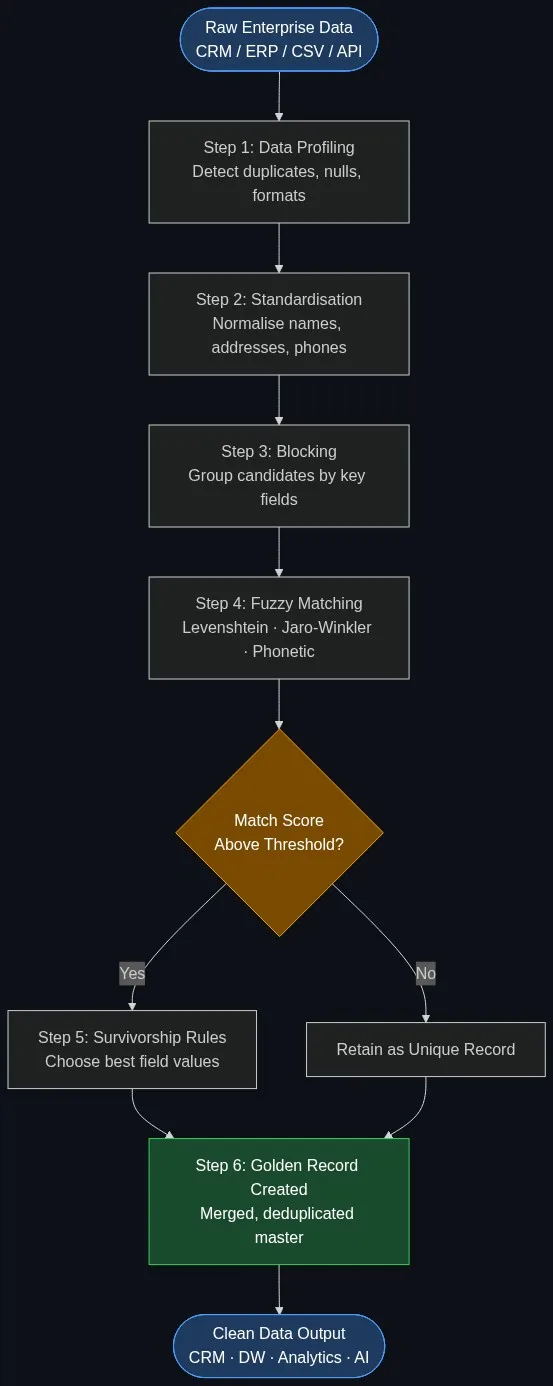
Stage 1: Data profiling
Before matching, AI-powered data profiling scans the dataset for duplicate indicators: high cardinality in name fields, format inconsistencies in phone columns, and null rates by field. This tells you where to focus deduplication effort and which fields are reliable enough to use as blocking keys.
Stage 2: Standardisation
Raw data must be normalised before comparison. “St.” becomes “Street”. “Co.” becomes “Company”. Phone numbers are stripped to digits only. Titles (Mr, Dr, Inc) are removed. Data cleansing and standardisation at this stage improves match accuracy by 15-25% compared to matching raw strings.
Stage 3: Blocking
Blocking groups records into candidate pairs by shared attributes — first three characters of surname, ZIP code, or company name token — so the matching engine only compares plausibly similar records. Without blocking, a 10-million-record dataset produces 50 trillion pairwise comparisons. With blocking, that number drops to tens of millions of tractable pairs.
Stage 4: Fuzzy matching and scoring
Each candidate pair is scored across multiple fields. A typical configuration might weight name at 40%, address at 30%, phone at 20%, and email at 10%. The final composite score drives the match decision. Fuzzy matching algorithms like Jaro-Winkler are particularly effective for short strings (names) while Levenshtein suits longer strings (addresses). Match Data Pro lets you configure the algorithm and weight for each field independently.
Stage 5: Survivorship and merge
For each confirmed duplicate cluster, survivorship rules determine the golden record. Common patterns: use the most recent value for email, the most complete value for address, and the source-of-record (CRM over data lake) for company name. Automated merge with configurable survivorship removes the manual effort from this step entirely.
Stage 6: Output and monitoring
Clean, deduplicated records are written back to your systems via import/export connectors or through the live data matching REST API. Ongoing monitoring flags new duplicates as they enter the system, so the problem does not rebuild over time.
What to Look For When Evaluating Deduplication Platforms
Not all deduplication tools are built for enterprise scale. Here is a practical evaluation checklist.
Scale and performance
Can the platform process 10 million records in under four hours? Does it support parallel processing? Blocking is a non-negotiable requirement at scale — any tool that performs all-pairs comparison will time out above one million records. Match Data Pro processes multi-million record datasets with blocking and parallel execution as standard.
Algorithm configurability
Avoid tools that offer only one algorithm or fixed match logic. Customer deduplication needs different rules than product deduplication. Your vendor matching rules differ again. Configurable scoring and matching rules are essential for accuracy across diverse data domains.
Integration depth
Your deduplication platform needs to connect to where your data lives: Salesforce, HubSpot, SQL databases, flat files, data warehouses. Match Data Pro ships with import/export connectors for all major formats and exposes a REST API for real-time deduplication within existing pipelines.
Entity resolution for complex entities
Customer deduplication is the most common use case, but enterprises also need to deduplicate companies, vendors, products, and locations. True entity resolution — powered by Senzing in Match Data Pro — resolves records even when no single field is a reliable identifier, using graph-based probabilistic matching across all available attributes.
Deployment and data governance
Cloud SaaS is the fastest path to production. Some organisations require on-premise or private cloud deployment for data residency or compliance reasons. Match Data Pro supports both. Regardless of deployment model, every match decision is logged with a full audit trail — essential for GDPR, HIPAA, and SOX compliance.
Ready to see deduplication in action on your own data? Start a free trial of Match Data Pro — no contract, no setup fee, results in minutes.
Common Deduplication Mistakes That Undermine Enterprise Projects
Skipping the profiling step
Teams that jump straight to matching without profiling first waste hours tuning thresholds for problems they did not know existed. Profiling reveals the actual duplicate rate, the most unreliable fields, and the format inconsistencies that will distort match scores. Always profile before you match.
Using a single algorithm for all fields
Applying Levenshtein to a phone number column is the wrong tool. Phone numbers are better compared after normalisation to digit-only strings, then exact match. Names need phonetic algorithms to catch “Smith” / “Smyth” / “Smythe”. Address fields need token-based comparison to handle word-order variation.
Setting one threshold for all record types
A threshold of 85 might be perfect for customer records with rich data. The same threshold on a vendor table with sparse data will produce too many false negatives. Segment your data by type and tune thresholds independently. Match Data Pro supports multiple match definitions within a single deduplication job.
Ignoring the ongoing problem
A one-time deduplication run solves today’s problem. New duplicates enter every system through every new data load, CRM import, and integration event. Without ongoing monitoring and automated deduplication — ideally via the real-time matching API — the duplicate rate will rebuild to its original level within 12-18 months.
How Match Data Pro Addresses Every Enterprise Requirement
Match Data Pro is a cloud SaaS platform built specifically for enterprise data quality management. It covers the entire deduplication workflow in one place:
- AI data profiling: automatically surfaces duplicate indicators and field quality scores before matching begins
- Multi-algorithm fuzzy matching: Levenshtein, Jaro-Winkler, Soundex, NYSIIS, token-set ratio — configured per field
- Configurable blocking: define blocking keys by field or field combination to manage scale
- Senzing entity resolution: graph-based matching for complex multi-source deduplication across entity types
- Automated survivorship and merge: rule-based golden record creation with field-level conflict resolution
- Live fuzzy search API: deduplicate in real time as new records enter, not just in batch
- CASS address verification: USPS-certified address standardisation integrated into the cleansing pipeline
- Import/export connectors: CSV, Excel, SQL, Salesforce, HubSpot, and more
- Job automation: schedule recurring deduplication runs on any cadence
- Full audit trail: every decision is logged with score, algorithm, and field comparison details
No long-term contract. Monthly SaaS pricing. Book a demo to see how Match Data Pro handles your specific deduplication use case, or register for a free trial and test it on your own data today.
Frequently Asked Questions
What is enterprise data deduplication software?
Enterprise data deduplication software identifies and removes duplicate records across large datasets — typically millions of rows — using fuzzy matching, scoring algorithms, and survivorship rules to merge duplicates into a single authoritative golden record. It differs from basic deduplication tools by supporting configurable algorithms, blocking for scale, multi-source matching, and audit trails required for compliance.
How does fuzzy matching improve deduplication accuracy?
Fuzzy matching compares records on similarity rather than exact equality. “Robert Johnson” and “Bob Johnson” score 78% similar using a combination of phonetic and token-ratio algorithms — well above the threshold for a likely duplicate. Exact matching would miss this pair entirely. In practice, fuzzy matching finds 70-80% more duplicates than SQL exact-match queries on the same dataset.
How long does enterprise deduplication take to run?
With proper blocking, a 10-million record dataset processes in 2-4 hours on a modern cloud deduplication platform. Without blocking, the same job may never complete due to the O(n²) comparison problem. Blocking groups records into candidate pairs by shared keys — ZIP code, surname prefix, domain — before fuzzy comparison begins, making scale achievable.
What are survivorship rules in data deduplication?
Survivorship rules determine which field values are kept when two duplicate records are merged into one golden record. Common rules include: keep the most recently updated value, keep the longest/most complete value, or prioritise a specific system of record (e.g. CRM over data lake). Good deduplication software applies survivorship rules automatically at merge time, field by field.
Can deduplication software handle ongoing duplicate prevention, not just one-time clean-up?
Yes. Platforms like Match Data Pro expose a real-time fuzzy search API that checks incoming records against the existing golden record set before they are written to the database. This prevents duplicate creation at the point of entry. Scheduled batch jobs complement real-time checks for bulk loads and periodic data imports from partner systems.