
Duplicate records cost organisations an average of $15 million per year in wasted spend, failed analytics, and operational errors. Every duplicate customer, supplier, or asset record inflates operational costs, corrupts reporting, and erodes trust in data systems. The fix is a structured deduplication pipeline — not a one-time cleanup.
Why Duplicate Records Exist at Scale
Duplicates enter datasets through predictable routes: manual data entry by different staff members, batch imports from acquisitions or partner feeds, CRM migrations that carry legacy records, and web forms that lack real-time validation. A customer who fills out a form as “Robert J. Smith” becomes a different record from the “Bob Smith” entered by a sales rep.
At 100,000 records, a 5% duplication rate means 5,000 redundant records. At 10 million records, that same rate produces 500,000 duplicates — each one consuming storage, distorting analytics, and generating potentially conflicting downstream actions. A data profiling run is usually the first indication of how severe the problem actually is.
The True Financial Impact of Duplicate Records
The costs break into four categories. Each is measurable and each grows nonlinearly with dataset size.
Wasted Marketing Spend
Duplicate contact records mean duplicate campaign sends. If 8% of your 2 million marketing contacts are duplicates, you are sending 160,000 extra emails per campaign — paying for delivery, list maintenance, and suppression list management on records that should not exist. At $0.003 per email and 12 campaigns per year, that is $5,760 in direct send costs — before accounting for list rental fees, unsubscribe rate inflation, and deliverability damage from engagement dilution.
Revenue Leakage
Sales teams working from duplicate records make duplicate outreach attempts to the same prospect. They also miss cross-sell signals: if a customer’s three purchases sit across three duplicate records, the single-customer revenue view is invisible. One financial services firm found that 12% of their accounts receivable exceptions were caused by duplicate company records in their ERP — the same entity billed under two slightly different name variants.
Broken Analytics and Reporting
Dashboards built on dirty data produce directionally wrong metrics. Customer counts are overstated. Churn rates are understated. Lifetime value calculations are fragmented. A CDO at a logistics company identified that their customer retention rate was 4 percentage points higher than reality — because churned customers were reappearing as new records after CRM re-imports.
Compliance and Regulatory Risk
Duplicate records create regulatory exposure in industries with KYC, AML, and data retention obligations. If a sanctioned entity appears under two slightly different name spellings, a screening system running exact-match logic may clear one and flag the other — creating a gap an auditor will find. Under GDPR and CCPA, duplicate records also complicate data subject access requests: responding to one record while a second exists means incomplete compliance.
How to Measure Your Current Duplication Rate
Before fixing duplicates, quantify the problem. A structured AI data profiling run surfaces the key indicators:
- Exact duplicate rate: records with identical values across all key fields.
- Near-duplicate rate: records where name, email, phone, or address differ by 1-3 characters — detected only by fuzzy matching algorithms.
- Field-level null rate: empty fields inflate apparent uniqueness.
- Cross-source overlap: the same entity appearing in CRM, ERP, and marketing automation under different IDs.
Industry benchmarks: B2B CRM data typically shows 10-25% duplication within 18 months of a migration. Healthcare patient records average 8-10% duplication across integrated systems. Financial services entity data can reach 15-20% duplication after an acquisition.
Ready to measure your duplication rate? Start a free trial of Match Data Pro and run a profiling job on your dataset in minutes.
The Deduplication Pipeline: From Raw Data to Golden Records
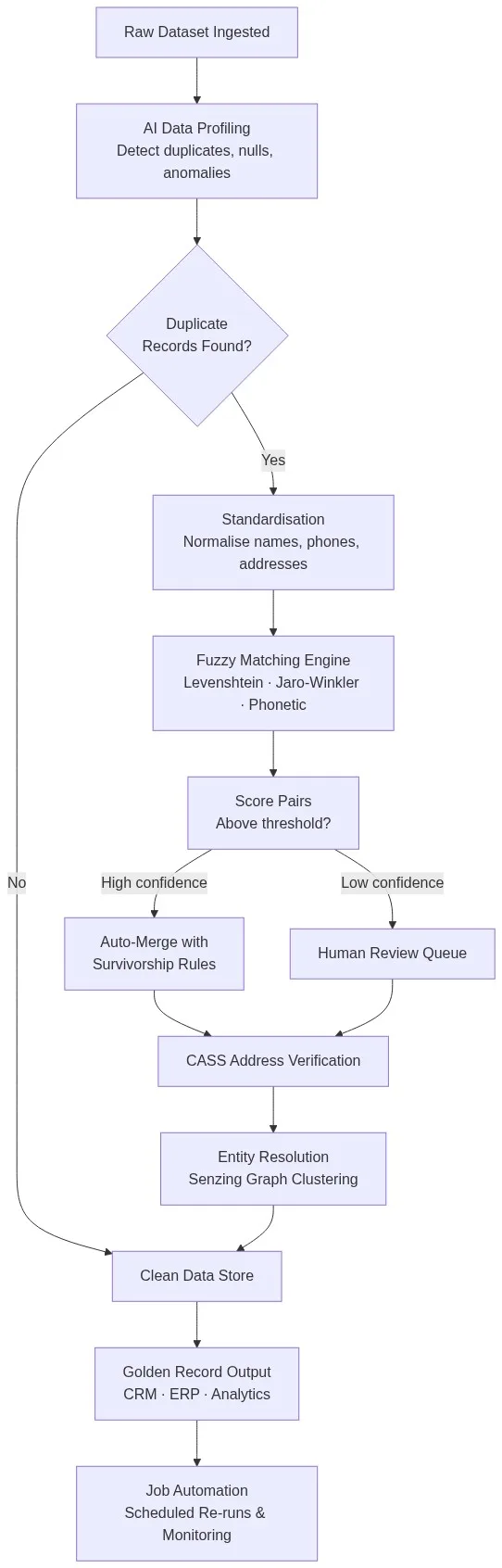
Eliminating duplicates at scale requires a pipeline, not a script. The diagram below shows the seven-stage process Match Data Pro runs automatically.
Stage 1: Profiling
Match Data Pro’s AI data profiling engine scans every field for null rates, format anomalies, value distributions, and candidate duplicate clusters. It outputs a quality report before a single merge decision is made.
Stage 2: Standardisation
Phone numbers normalise to E.164 format. Company suffixes (“Inc.”, “Incorporated”, “Corp”) collapse to a canonical form. Name fields split into first/last with title extraction. Unstandardised values are the primary reason fuzzy matching produces false positives at this stage.
Stage 3: Blocking
Comparing every record pair at 10 million records would require 50 trillion comparisons. Blocking reduces the candidate set by grouping records that share an indexed key — first three characters of surname, area code, ZIP prefix — before running similarity scoring. Match Data Pro applies multi-key blocking automatically.
Stage 4: Fuzzy Matching
Within each block, Match Data Pro’s fuzzy matching engine scores every candidate pair using a weighted combination of algorithms: Levenshtein edit distance for short strings, Jaro-Winkler for names, token-set ratio for company names with varying word order, and phonetic encoding (Soundex, Double Metaphone) for transcription errors.
Example pair scored by the engine:
| Field | Record A | Record B | Score |
|---|---|---|---|
| Company | Acme Corp | ACME Corporation | 0.91 |
| Phone | +1 312 555 0147 | 3125550147 | 1.00 |
| jsmith@acme.com | j.smith@acme.com | 0.94 | |
| Address | 123 N Wacker Dr | 123 North Wacker | 0.88 |
| Composite | 0.93 — Auto-merge |
Stage 5: Threshold Routing
Pairs scoring above 0.90 route to automatic merge. Pairs between 0.70 and 0.90 route to a human review queue. Pairs below 0.70 are retained as distinct records. Thresholds are configurable per dataset and field type.
Stage 6: Survivorship and Merge
When two records merge, survivorship rules determine which field value wins. Rules can be: most recent non-null value, source system priority, longest string, or manual override. Match Data Pro’s survivorship rule engine applies these consistently and logs every merge decision for audit. The result is a golden record — one authoritative representation of the entity.
Stage 7: Address Verification and Entity Resolution
After merging, Match Data Pro runs CASS address verification against every postal field, correcting street abbreviations and appending ZIP+4 codes. Senzing entity resolution then clusters any remaining cross-source duplicates that share no common key — linking records by pattern of attributes rather than exact field values.
Preventing Duplicates from Re-entering the System
A deduplication run without prevention is a recurring cost. Match Data Pro’s live fuzzy search API checks incoming records against the existing golden record store at the point of entry. A new web form submission for “Jon Smyth at Acme Corp” scores against existing records in real time — flagging a probable duplicate before it is written to the database.
Job automation handles the ongoing maintenance: scheduled re-profiling, incremental deduplication runs on newly imported batches, and alert triggers when duplication rates cross defined thresholds. The result is a repeatable data quality workflow rather than a quarterly fire drill.
For teams with CRM deduplication as the primary use case, see the step-by-step guide to CRM deduplication. For multi-source consolidation across acquired datasets, the merge purge guide covers the full cross-dataset pipeline.
Book a demo to see how Match Data Pro measures and eliminates duplicates in your environment.
Frequently Asked Questions
What is the average cost of duplicate records for enterprise organisations?
Industry research consistently places poor data quality costs at 15-25% of revenue for affected organisations, with duplicate records contributing a significant share. Direct costs include wasted marketing spend, excess storage, failed analytics, and compliance penalties. For a mid-market company with $50M in revenue, that can mean $7.5M-$12.5M in annual data quality losses — most of which go unmeasured until a profiling exercise surfaces the extent of duplication.
How does fuzzy matching detect duplicates that exact-match logic misses?
Fuzzy matching scores the similarity between two values rather than requiring character-for-character equality. An exact match query would treat “Robert Smith” and “Bob Smith” as completely different. A fuzzy engine combining Jaro-Winkler scoring on the name field with phonetic encoding would score them as probable matches (0.82+) and route them for merge review. This is the core technique behind probabilistic deduplication.
How long does a deduplication project typically take?
With a platform like Match Data Pro, initial profiling and a first deduplication pass on a 1-million-record dataset typically completes in under 24 hours. Configuration of survivorship rules and threshold tuning adds 1-3 days for the first project. Subsequent runs on incremental data are automated and run in minutes. The longest phase is usually stakeholder alignment on merge rules, not the technical work.
Should we deduplicate before or after a CRM migration?
Always before. Migrating dirty data into a new CRM embeds duplicates at the foundation of the new system, where they are harder to remove and more expensive to correct. A pre-migration deduplication pass using data cleansing and standardisation ensures you carry only golden records into the new environment, reducing cutover complexity and post-migration support load.
What is a golden record and how is it produced?
A golden record is the single authoritative version of an entity — customer, company, address, or product — produced by merging all duplicate representations using defined survivorship rules. Each field in the golden record holds the value judged most accurate based on rules like source priority, most recent update, or longest non-null string. Match Data Pro produces and exports golden records to any downstream system via import/export connectors or API.