
EMPI (Enterprise Master Patient Index) and entity resolution solve the same fundamental problem — linking records that represent the same real-world entity across siloed systems — but they are engineered for different contexts, data scales, and operational requirements. EMPI is a domain-specific technology built for healthcare; entity resolution is a generalised technique applicable to any industry. Understanding where they overlap, where they diverge, and which approach fits your environment can save your team months of implementation effort.
Ready to see how modern entity resolution handles your matching problem? Start a free trial of Match Data Pro today — no contract required.
What Is an EMPI and Why Do Healthcare IT Teams Use It?
An Enterprise Master Patient Index is a database and matching system that creates a single, authoritative patient identity across every clinical, administrative, and billing system in a healthcare organisation. Its job is to answer one question: are Jane Smith DOB 1982-04-15 in the EHR and J. Smith DOB 04/15/82 in the billing system the same person?
EMPI systems typically use a combination of deterministic rules (exact SSN match, exact date of birth) and probabilistic scoring across demographic fields — name, date of birth, address, phone, and gender — to assign a match confidence score. When the score exceeds a threshold, the system links the records under a single enterprise ID (often called a Master Patient Identifier or MPI).
EMPI Data Model
A typical EMPI operates on a fixed set of demographic attributes. The patient record might look like this:
| Field | Source A (EHR) | Source B (Billing) | Match Weight |
|---|---|---|---|
| Last Name | Johnson | Jonhson | 0.87 (fuzzy) |
| First Name | Margaret | Maggie | 0.72 (nickname) |
| Date of Birth | 1975-03-22 | 03/22/75 | 1.00 (exact) |
| ZIP Code | 90210 | 90210 | 1.00 (exact) |
| Phone | 310-555-0142 | 3105550142 | 1.00 (normalised) |
The composite score for this pair exceeds 0.85, triggering an automatic link. Below 0.60, the system marks the records as distinct. The grey zone (0.60–0.85) routes to a human reviewer.
EMPI platforms are deeply integrated with healthcare-specific data standards like HL7, FHIR, and IHE PIX/PDQ. They often run within the hospital firewall, feeding the EHR, lab systems, pharmacy, and patient portal from a single source of identity truth.
What Is Entity Resolution and How Does It Differ?
Entity resolution is the broader, domain-agnostic process of identifying and linking records that refer to the same real-world entity — a customer, company, product, address, or person — across disparate data sources. Where EMPI is a healthcare-specific product, entity resolution is a capability that can be applied across CRM, ERP, financial systems, government databases, or any multi-source data environment.
Modern entity resolution platforms like Match Data Pro use graph-based probabilistic matching powered by Senzing entity resolution to handle millions of records in real time. Unlike EMPI systems that work on a fixed demographic schema, entity resolution can operate on any field combination — company name, tax ID, domain, address, SIC code — and adapt scoring weights to the data at hand.
Key Architectural Differences
| Dimension | EMPI | Enterprise Entity Resolution |
|---|---|---|
| Domain | Healthcare only | Any industry |
| Schema | Fixed demographic fields | Any field combination |
| Standards | HL7, FHIR, IHE PIX/PDQ | REST API, CSV, JDBC, cloud connectors |
| Matching approach | Probabilistic + deterministic rules | Graph-based, AI-weighted probabilistic |
| Scale | Tens of millions of patient records | Hundreds of millions of records |
| Deployment | On-premise (typically) | SaaS or on-premise |
| Human review | Built-in workflow | Configurable threshold routing |
| Audit trail | Healthcare compliance grade | Configurable audit logging |
Where EMPI Falls Short Outside Healthcare
EMPI tools are purpose-built for patient data. That focus creates three significant limitations when healthcare IT teams try to apply them beyond clinical identity:
1. Rigid Schema
EMPI systems are optimised for a specific demographic model. Matching on company entities, financial accounts, or supply chain records requires different field weights and algorithms that EMPI platforms cannot easily reconfigure. You cannot, for example, add a tax ID field or weight domain names differently without custom development.
2. Limited Cross-Domain Linking
Modern healthcare organisations need to link patient identities not just within clinical systems, but to payer data, pharmacy benefit managers, and population health platforms. EMPI systems rarely expose flexible APIs for this kind of cross-domain entity resolution. A REST-based matching API is far better suited to multi-domain integration at speed.
3. Batch-Centric Processing
Many legacy EMPI platforms process records in nightly batch runs. Real-time matching at the point of registration — when a patient presents at the emergency department — requires sub-second response times that batch-oriented architectures cannot deliver. Comparing batch vs API deduplication shows why real-time architecture matters at patient intake.
Where Entity Resolution Has an Edge
General-purpose entity resolution platforms have several structural advantages over domain-specific EMPI tools:
Configurable Matching Algorithms
Match Data Pro’s fuzzy matching engine lets you choose the algorithm per field — Jaro-Winkler for names, exact match for dates of birth, phonetic for foreign name variants, token-set ratio for company names. EMPI platforms typically apply a fixed algorithm weighting across all fields with limited adjustment.
Consider these two patient records that a rigid EMPI might miss:
| Field | Record 1 | Record 2 | Note |
|---|---|---|---|
| Name | Mohamed Al-Rahman | Mohammad Alrahman | Transliteration variant |
| DOB | 1989-11-03 | 1989-03-11 | Transposed month/day |
| Address | 14 Oak St, Apt 2B | 14 Oak Street Unit 2B | Unit suffix variant |
An EMPI using fixed weights on date of birth would score this pair low because the DOB transposition drops the date field score to zero. A configurable entity resolution engine can reduce the DOB weight, increase the address match weight, and surface this as a likely duplicate for human review.
Cross-Industry Entity Types
Entity resolution handles people, companies, addresses, and products within the same pipeline. For an integrated delivery network that also manages vendor contracts, research partnerships, and payer relationships, this matters. A single entity resolution platform can match patient records in one job, vendor records in another, and run both on an automated schedule.
Real-Time API Matching
Match Data Pro exposes a live fuzzy search API that returns match candidates in milliseconds. At patient registration, the front-desk system calls the API with the incoming demographics and gets back ranked candidates instantly — no batch window, no manual lookup. This is the same architecture used in real-time fraud detection and CRM deduplication.
The Six-Stage Pipeline That Bridges Both Worlds
Whether you run an EMPI, a general entity resolution platform, or both, the underlying data quality pipeline is the same. Skipping any stage degrades match accuracy at every stage downstream.
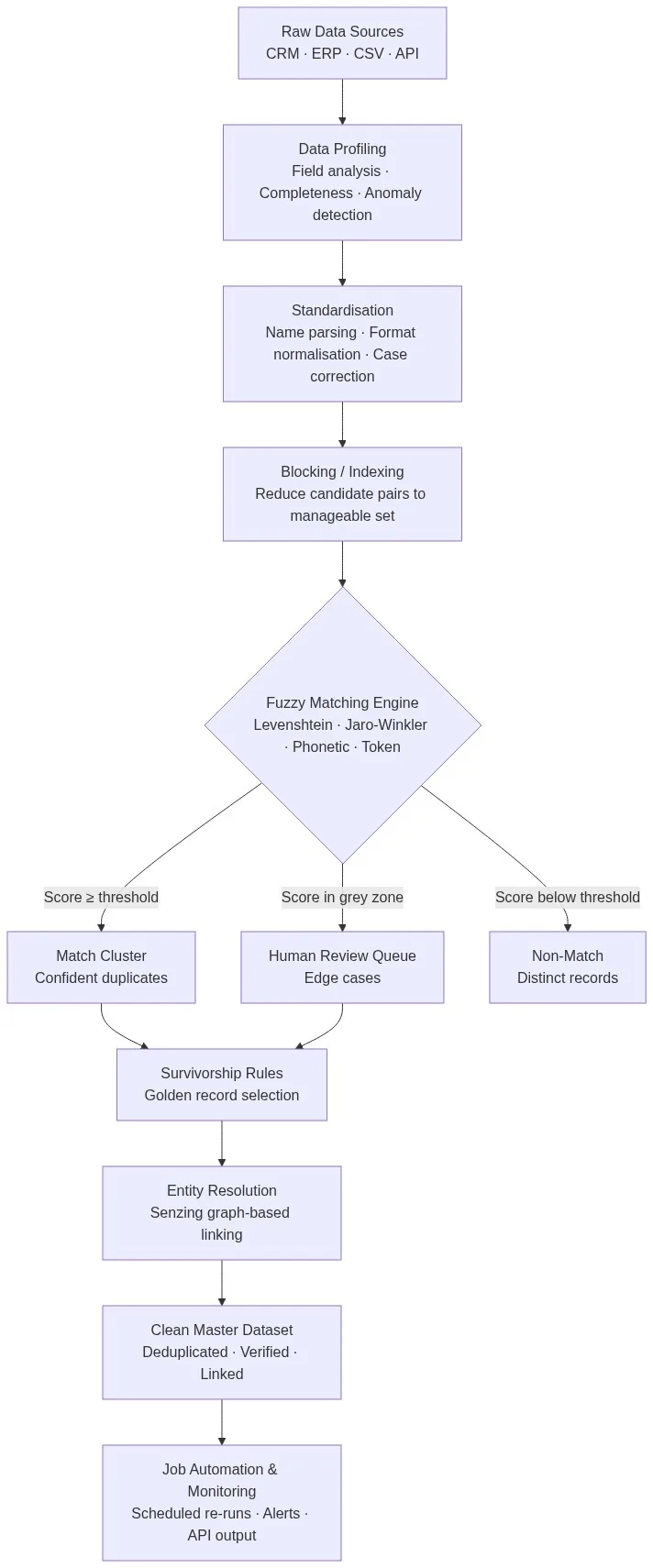
Stage 1: Data Profiling. Scan every incoming field for completeness, format consistency, and anomaly rate. Match Data Pro’s AI data profiling engine scores each field across six dimensions and flags fields with high null rates or inconsistent formats before they enter the matching pipeline.
Stage 2: Standardisation. Name parsing (first/last/middle split), date format normalisation (MM/DD/YY to ISO 8601), phone number stripping, and address component separation. Without this step, “John A. Smith” and “Smith, John A.” never match, even with a perfect fuzzy algorithm.
Stage 3: Blocking / Indexing. Comparing every record against every other record is O(n²). Blocking reduces the candidate pair space by grouping records that share at least one common token — a ZIP code, first three characters of surname, or soundex code. This makes matching 10 million records computationally feasible.
Stage 4: Fuzzy Matching. Apply per-field algorithms and compute a composite match score for each candidate pair. Scores above the auto-link threshold produce confirmed matches. Scores in the grey zone route to human review. Scores below the threshold are discarded as non-matches.
Stage 5: Survivorship and Golden Record Creation. When two records match, survivorship rules determine which field value survives in the master record. The rule might be: prefer the most recently updated value, prefer the longer value, or prefer the value from the most trusted source system. Match Data Pro’s survivorship engine lets you configure these rules per field.
Stage 6: Automation and Monitoring. Both EMPI and entity resolution need scheduled re-runs as new records arrive. Match Data Pro’s job automation scheduler handles this: define a pipeline, set a cadence (nightly, hourly, or event-triggered), and the platform runs the full profile-standardise-match-merge cycle without manual intervention.
Ready to run this pipeline on your data? Book a demo and our team will walk through the configuration for your specific data environment.
When to Choose EMPI, Entity Resolution, or Both
Choose EMPI When:
- Your matching scope is exclusively patient demographic data within a single healthcare system.
- You need deep integration with HL7 FHIR and IHE PIX/PDQ standards out of the box.
- Regulatory requirements (HIPAA, ONC Cures Act) require a healthcare-certified system bundled with your EHR.
- Your EHR vendor provides EMPI capabilities included in the same product.
Choose Entity Resolution When:
- You need to match entities beyond patient demographics — vendors, payers, research partners, or staff.
- You operate across multiple industries or data domains in the same organisation.
- You need real-time matching via API, not just nightly batch processing.
- You want configurable algorithms and field weights without custom development.
- You need a complete data quality framework — profiling, cleansing, deduplication, and entity resolution — in one platform.
Consider Both When:
Large integrated delivery networks often run an EMPI for clinical identity and a separate entity resolution platform for enterprise-wide data quality. The two systems can coexist: the EMPI owns patient identity within the clinical domain, while the entity resolution platform handles cross-domain matching, vendor deduplication, and the broader data quality pipeline. Linking records across multiple systems is exactly where entity resolution adds value that EMPI cannot provide.
Frequently Asked Questions
What is the difference between EMPI and entity resolution?
EMPI (Enterprise Master Patient Index) is a domain-specific identity matching system designed for healthcare patient records, using fixed demographic fields and healthcare data standards (HL7, FHIR). Entity resolution is the broader, domain-agnostic process of linking records across any data type or industry, using configurable algorithms, flexible field schemas, and REST API integration.
Can entity resolution replace an EMPI in healthcare?
For many use cases, yes. A configurable entity resolution platform can match patient demographics with the same or greater accuracy than a traditional EMPI, while also handling non-patient entities like vendors, payers, and staff. The tradeoff is that EMPI platforms offer deeper out-of-the-box integration with healthcare-specific standards and EHR systems.
What matching algorithms does an EMPI use?
Most EMPI platforms combine deterministic rules (exact matches on SSN, date of birth) with probabilistic scoring across demographic fields using algorithms like Jaro-Winkler for names and Soundex for phonetic variants. Composite weighted scores determine whether records are auto-linked, flagged for review, or rejected as non-matches.
How does a healthcare organisation choose between EMPI and general entity resolution?
If matching scope is limited to patient identity within a single healthcare system integrated with HL7 FHIR, an EMPI is often the right fit. If the organisation needs to match entities across domains — patients, vendors, payers, research partners — or needs real-time API-based matching and configurable algorithms, a general entity resolution platform delivers more flexibility at comparable or lower cost.
What is a golden record in the context of patient matching?
A golden record is the single authoritative representation of a patient built by applying survivorship rules to all matched duplicate records. For each demographic field, a rule determines which source value survives — typically the most recently updated, the most complete, or the value from the most trusted source system. The golden record becomes the single identity the entire organisation references.