Choosing between building, buying, or combining approaches for entity resolution is one of the highest-stakes infrastructure decisions a data team makes. For most organisations processing millions of records across CRM, ERP, and third-party sources, buying a proven cloud SaaS platform delivers accurate results in days — not months — at a fraction of the build cost. The hybrid path suits teams that need a branded API layer over a battle-tested matching engine. Understanding where each approach succeeds and fails prevents a six-figure engineering mistake.
Need to evaluate your options quickly? Start a free trial of Match Data Pro and run your first entity resolution job against real data before committing to any approach.
What Entity Resolution Actually Requires
Entity resolution identifies records across datasets that refer to the same real-world entity — a person, company, address, or asset — and links or merges them into a unified golden record. The process is harder than it looks. Consider these two customer records:
| Field | Record A (CRM) | Record B (ERP) |
|---|---|---|
| Name | Acme Corp. | ACME Corporation |
| Address | 123 Main St, Chicago IL | 123 Main Street, Chicago, Illinois 60601 |
| Phone | 312-555-0182 | (312) 555-0182 |
| Contact | J. Smith | John Smith |
A deterministic join on any single field fails. Entity resolution requires multi-field fuzzy scoring — running Jaro-Winkler on the name, token-set ratio on the address, and exact normalised matching on the phone — then weighting those scores to produce a composite similarity score. Only then can the system decide: merge, flag for review, or reject.
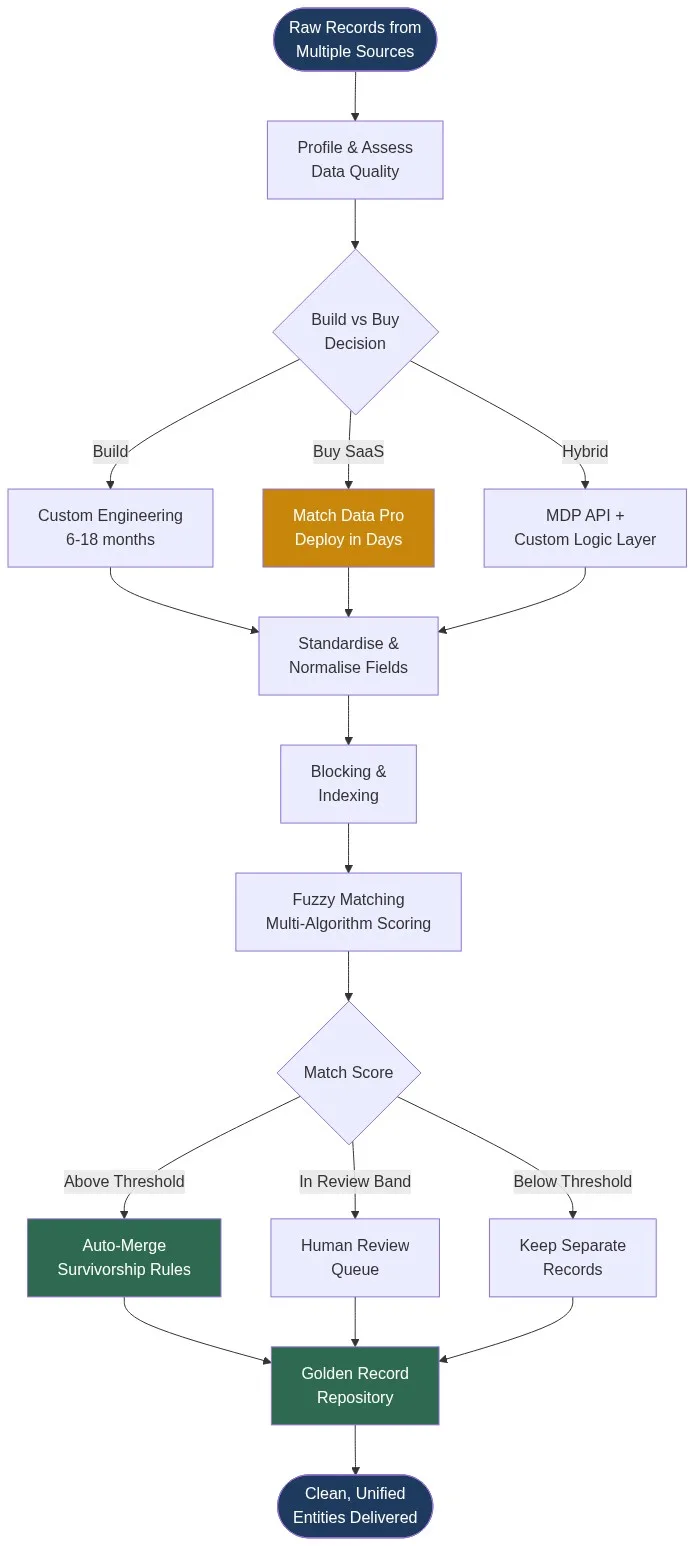
That pipeline has at minimum six stages: data profiling, standardisation, blocking, fuzzy matching, threshold routing, and survivorship. Each stage must be configurable, auditable, and scalable to tens of millions of record pairs. The technical bar is significant regardless of which approach you choose.
The Build Approach: Real Costs and Hidden Risks
Building entity resolution in-house sounds appealing. Custom logic, full control, no vendor dependency. In practice, the engineering effort almost always runs over scope and timeline.
What a custom build actually requires
- Matching engine: Multiple algorithm implementations (Levenshtein, Jaro-Winkler, Soundex, token-based), field weighting configuration, and threshold management.
- Blocking layer: Candidate pair generation must be efficient at scale. Without blocking, comparing 10 million records pairwise generates 50 trillion comparisons.
- Survivorship logic: Rules for which field value wins when two records conflict — most recent, most complete, highest source reliability.
- Review interface: A UI for human review of borderline pairs, with accept/reject and feedback loops into the model.
- Audit trail: Every match decision logged with field scores, algorithm used, and operator action — required for GDPR, HIPAA, and SOX.
- Ongoing maintenance: Algorithms need retuning as data patterns shift. Schema changes in source systems break normalisation rules.
The cost reality
A mid-complexity entity resolution build typically requires 2 senior engineers for 6-18 months. At a fully-loaded cost of $180K-$220K per engineer per year, that is $180K-$660K in labour before the first record is matched in production. Add infrastructure, testing, and ongoing maintenance and the three-year total exceeds $800K for most teams. The build vs. buy analysis for entity resolution software consistently shows that internal builds cost $500K-$1.5M over three years.
The risk compounds with time. A six-month build schedule pushes the business value of clean data out by half a year. During that window, duplicates accumulate, analytics remain unreliable, and the team that was supposed to be running data initiatives is instead debugging a matching engine.
The Buy Approach: What to Evaluate in a SaaS Platform
Buying a purpose-built entity resolution platform eliminates the engineering burden and delivers a production-ready pipeline in days. The key is knowing what separates commodity matching tools from platforms capable of handling enterprise-scale, multi-domain entity resolution.
Five capabilities that define enterprise-grade platforms
- Configurable multi-algorithm scoring: No single algorithm works across all field types. Name fields need Jaro-Winkler; address fields need token-set ratio; numeric IDs need exact or transposition-tolerant matching. The platform must let you assign per-field algorithms and weights.
- Blocking efficiency: Sorted neighbourhood, inverted index, or phonetic blocking cuts candidate pairs from quadratic to linear growth. Without this, no platform scales past a few hundred thousand records.
- Graph-based entity clustering: Linking A to B and B to C should automatically link A to C. Platforms using Senzing’s graph-based entity resolution handle transitive relationships natively, without hand-coded chain logic.
- Survivorship rules: Field-level controls for which value populates the golden record. The platform should support source-priority, recency, and completeness rules — and handle conflicts without data loss. See how survivorship rules and golden records work in practice.
- Audit trail and explainability: Every match decision should be traceable to the field scores and algorithm weights that produced it. This is non-negotiable for regulated industries.
Match Data Pro as the buy option
Match Data Pro delivers all five capabilities in a cloud SaaS platform with no long-term contract. The platform combines AI-powered data profiling that assesses field quality before matching runs, configurable fuzzy algorithms across every field type, Senzing entity resolution for graph-based probabilistic clustering, and CASS-certified address verification. Import connectors support CSV, Excel, SQL databases, and REST API. Job automation runs scheduled deduplication and entity resolution pipelines without manual triggering. The live fuzzy search API enables real-time duplicate prevention at record entry — before dirty data enters the system.
Deployment takes hours, not months. A team can profile a dataset, configure matching rules, run a full entity resolution job, and review the golden record output on day one. Book a demo to see the full pipeline on your data.
The Hybrid Approach: When a Custom Layer Makes Sense
Hybrid means using a proven SaaS matching engine as the core — accessed via API — while building custom logic around it. This is the right path for a specific minority of teams, not a general recommendation.
When hybrid is justified
- Domain-specific pre-processing: Your source data requires industry-specific parsing before standard matching can run — for example, parsing chemical compound names, ISIN codes, or legal entity identifiers that a general normaliser does not handle.
- Embedded product use case: Your platform is a product, not an internal tool. You need to expose matching as a branded capability to customers via your own API, with the SaaS engine running under the hood.
- Proprietary scoring override: Your business domain has matching logic that is genuinely unique — a risk scoring model, a compliance classification rule — that cannot be expressed through standard field weights and thresholds.
Match Data Pro’s REST API and live fuzzy search API support hybrid architectures directly. Your pipeline calls MDP endpoints for candidate generation, scoring, and deduplication, then applies your proprietary logic to the scored results. This keeps the matching engine maintained and updated by the vendor while your custom layer handles domain-specific requirements. Learn how agentic entity resolution workflows use this pattern at scale.
When hybrid is not justified
Most teams that claim they need a hybrid approach are actually rationalising a build. The real motivation is often familiarity with coding over configuration, or a belief that their data is uniquely complex. In practice, configurable field weights, custom blocking keys, and adjustable thresholds in a platform like Match Data Pro handle the vast majority of domain-specific requirements without writing a line of matching code.
If you are running entity resolution internally against CRM, ERP, or marketing data — with no customer-facing product requirement — buy rather than hybridise. The ongoing maintenance of a custom API layer adds engineering cost and introduces failure points with every upstream schema change.
Decision Framework: How to Choose
Run through these four questions in order. Stop when you have a clear answer.
- Do you have a dedicated engineering team with 6+ months of runway? If no, buy. The build timeline alone rules out the custom path.
- Does your use case require customer-facing API branding or proprietary scoring logic? If yes, consider hybrid. If no, buy.
- Can your domain-specific requirements be expressed through configurable field weights, custom blocking keys, and threshold rules? For 90% of teams the answer is yes. Buy and configure.
- Is your data volume and schema so unusual that no commercial platform matches your requirements? If genuinely yes, build. But verify this claim with a platform trial first — you may be surprised by what configuration alone achieves.
The right-sizing your data quality stack analysis confirms that most teams dramatically overestimate the complexity of their requirements when evaluating build vs. buy. A free trial resolves the question in hours.
Comparison table
| Factor | Build | Buy (Match Data Pro) | Hybrid |
|---|---|---|---|
| Time to first match | 6-18 months | Hours to days | 2-6 weeks (API integration) |
| 3-year cost | $500K-$1.5M+ | Monthly SaaS subscription | SaaS fee + engineering time |
| Algorithm flexibility | Fully custom | Configurable, multi-algorithm | MDP algorithms + custom override |
| Maintenance burden | Full engineering ownership | Vendor-managed | Custom layer only |
| Audit trail | Build it yourself | Built-in, compliance-grade | MDP trail + custom logging |
| Scale | Depends on build quality | Tested at tens of millions of records | Inherits MDP scale |
Frequently Asked Questions
How long does it take to build entity resolution from scratch?
A production-ready entity resolution build typically takes 6-18 months with 2 senior engineers. The timeline includes algorithm development, blocking optimisation, review interface, audit logging, and performance tuning at scale. Most teams underestimate the maintenance cost after initial deployment, which adds ongoing engineering overhead every time source schemas change or data volumes grow.
What is the typical cost of buying entity resolution software?
Enterprise entity resolution SaaS platforms typically range from $1,000 to $10,000 per month depending on record volume, number of sources, and features enabled. Match Data Pro offers monthly subscriptions with no long-term contract, so teams can start at a lower tier and scale. Compare this to $500K-$1.5M over three years for a custom build.
When does the hybrid approach make sense for entity resolution?
Hybrid is justified when you are building a customer-facing product that needs branded matching APIs, or when your domain requires pre-processing logic that no commercial platform supports natively. For internal data quality use cases — CRM deduplication, master data management, analytics — buy and configure. The hybrid path adds engineering overhead that rarely delivers enough incremental value to justify the cost.
Can a SaaS entity resolution platform handle industry-specific data like financial or healthcare records?
Yes. Platforms like Match Data Pro handle entity matching across all major verticals through configurable field weights, custom blocking keys, and domain-appropriate algorithms. Financial records use ISIN and LEI normalisation. Healthcare records use HIPAA-compliant patient matching with name, DOB, and address scoring. Configuration replaces most domain-specific engineering.
What is Senzing and why does it matter for entity resolution?
Senzing is a graph-based probabilistic entity resolution engine that links records through transitive relationships — if A matches B and B matches C, Senzing clusters all three as one entity automatically. It is pre-trained on real-world data and requires no hand-crafted rules, which makes it significantly faster to deploy than custom probabilistic models. Match Data Pro integrates Senzing natively for enterprise entity resolution workloads.
Ready to test entity resolution against your own data? Register for a free trial of Match Data Pro — no contract, no credit card required. Or book a demo to walk through the pipeline with your specific use case.