
AI agents require clean, resolved, deduplicated master data to function reliably. When an agentic workflow acts on a customer record, places an order, triggers a support escalation, or routes a transaction, it cannot evaluate whether the record it received is accurate. If the same customer exists as three separate entities across your systems, the agent will act on whichever record it receives first, with no way to reconcile the conflict. The only fix is resolved master data before the agent ever runs.
This article explains exactly what master data requirements agentic workflows impose, the data quality failures that cause agent errors, and how to build the data foundation that makes AI agents trustworthy. Start a free trial and run your first data quality pipeline today.
What Agentic Workflows Actually Do with Your Data
An AI agent is a system that perceives a state, decides on an action, executes that action, and observes the result. Unlike a simple chatbot, an agent can call external tools, write to databases, send emails, trigger workflows, and loop until a task is complete. That autonomy is valuable. It is also dangerous when the data the agent reads is wrong.
Three common agentic patterns each create distinct master data requirements:
Retrieval-Augmented Generation (RAG)
A RAG agent queries a data store to retrieve context, then generates a response. If your customer data contains three records for “Acme Corp” — entered as “Acme Corp”, “Acme Corporation”, and “ACME Inc.” — the retrieval step returns three partial records. The model averages or selects between them without knowing which is authoritative. The result is a confident answer built on a fragmented data source.
Tool-Calling Agents
A tool-calling agent identifies which API to invoke based on natural language instructions. It might call a CRM update endpoint with a customer ID. If your CRM contains duplicate customer IDs — customer 10041, 10041-A, and 10041B for the same person, created by three separate import processes — the agent may update the wrong record or update all three with conflicting values.
Multi-Agent Pipelines
Multi-agent systems pass context between agents: a research agent gathers facts, a decision agent classifies them, an execution agent acts. Each handoff amplifies the original data error. If the research agent retrieved a duplicate record, the decision agent classifies it, the execution agent acts on it, and the error is now embedded in the output of three agents rather than one.
The Four Master Data Failures That Break AI Agents
Not all data quality problems affect agents equally. These four create the most agent failures in production systems.
1. Duplicate Records
The same real-world entity appears as multiple records. This is the most common and most damaging. An agent that retrieves one record per customer ID will retrieve the wrong record 20-30% of the time in a typical enterprise CRM with 15-25% duplication rates. Data deduplication must run before any agent workflow goes into production.
Example: A revenue operations agent is asked to calculate total contract value for Acme Corp. The source data shows three separate account records with $240K, $180K, and $95K in contracts respectively. These are the same account entered by three regional teams. The agent returns $240K (the first result), missing $275K in contracts.
2. Cross-System Identity Fragmentation
The same entity exists in multiple source systems with no shared identifier. The CRM has customer ID C-9921. The ERP has vendor ID V-33041. The marketing platform has contact ID 882-KK. All three refer to Acme Corp. An agent querying any single system receives an incomplete picture. Entity resolution resolves these cross-source identities into a single entity graph, so an agent can query one canonical ID and receive a complete, conflict-free record.
3. Inconsistent Formatting
Field values that represent the same information in different formats look distinct to a matching algorithm and to an agent’s context window. Phone numbers stored as “+1-212-555-0100”, “2125550100”, and “(212) 555-0100” are the same number. A deduplication algorithm treating them as three distinct values will fail to link the records. Data cleansing and standardisation enforces a canonical format for every field type before deduplication or agent consumption.
4. Stale or Outdated Records
An agent acting on a record last updated 18 months ago may send communications to a lapsed address, calculate a revenue figure that excludes 6 quarters of transactions, or route a support case to an account team that no longer manages the customer. Golden record survivorship rules — selecting the most recent, most complete, or highest-confidence field value — ensure the agent reads the best available version of the truth.
The Master Data Pipeline That AI Agents Require
The following diagram shows the full pipeline from raw source records to AI-ready master data.
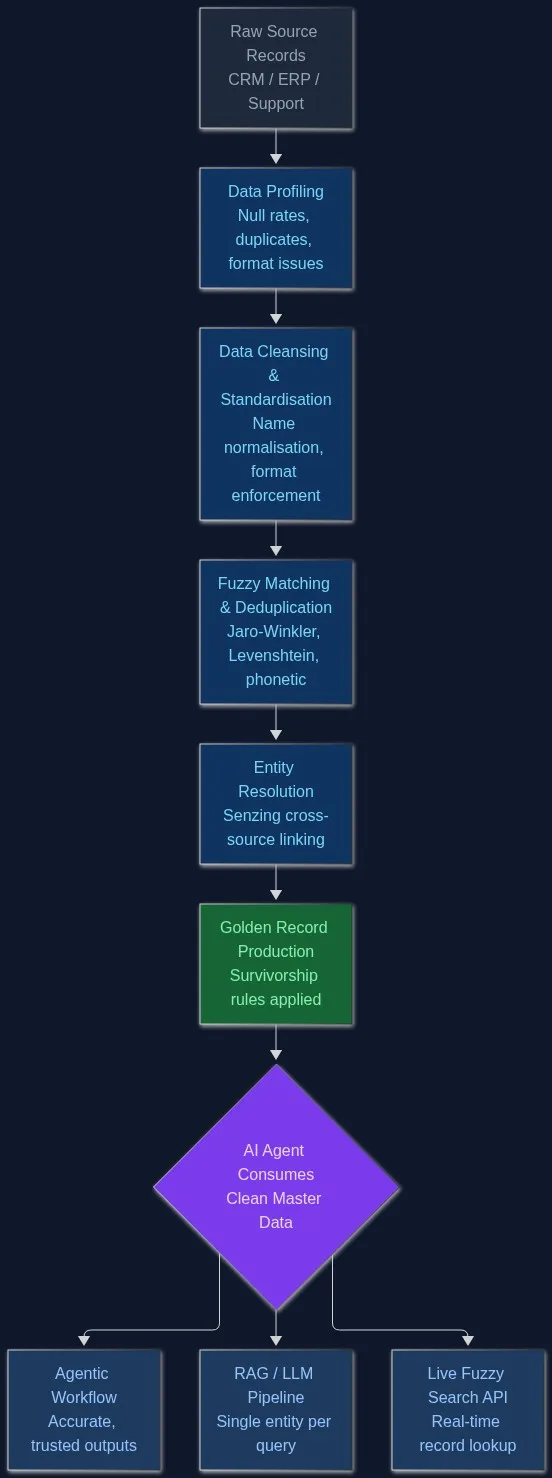
Fase 1: Perfilado de datos
Before fixing data, measure it. AI-powered data profiling scans your dataset and returns null rates by field, duplicate candidate counts, format inconsistency rates, and referential integrity failures. A profiling pass on a 500,000-row CRM export might show 18% null email addresses, 3,200 company name variants that resolve to fewer than 400 distinct legal entities, and 7% of phone numbers in non-standard format. Without profiling, cleansing is guesswork.
Fase 2: Limpieza y estandarización
Cleansing corrects invalid values. Standardisation normalises them to a canonical form. Both are prerequisites for accurate matching. Match Data Pro’s data cleansing pipeline applies configurable transformation rules across all field types: company name normalisation, phone E.164 formatting, date ISO 8601 conversion, and address parsing. Rules run in batch on full datasets or in real time via API for point-of-entry validation.
Stage 3: Fuzzy Matching and Deduplication
After standardisation, records representing the same entity must be identified and merged. Exact matching misses near-duplicates. “Jon Smith, Acme Corp” and “Jonathan Smith, ACME Corporation” share no identical field value but are the same person at the same company. Match Data Pro’s configurable fuzzy matching engine scores candidate pairs field-by-field using Jaro-Winkler, Levenshtein, phonetic, and token-based algorithms with configurable weights. Pairs above the match threshold are flagged for merge. Borderline cases are queued for human review.
Stage 4: Entity Resolution Across Systems
Deduplication operates within a single dataset. Cross-system identity fragmentation requires entity resolution: linking records from different source systems that share no common key. Match Data Pro integrates Senzing entity resolution, a graph-based probabilistic engine that links records across CRM, ERP, marketing, and support systems. The result is a unified entity graph. Every reference to Acme Corp across all systems resolves to entity ID E-00481. Any agent querying that ID receives a complete, cross-system record.
Stage 5: Golden Record Production
The golden record is the single, authoritative, conflict-resolved representation of each real-world entity. When source records disagree on a field value, survivorship rules determine which value wins: most recent, most complete, or highest-confidence source. Match Data Pro’s merge engine applies survivorship automatically and documents every decision, creating a full audit trail that shows exactly which source record contributed each field value and when.
How AI Agents Consume Clean Master Data
Once golden records exist, there are three patterns for making them available to agents.
Batch Export to a Vector Store or Data Warehouse
Export golden records as JSON or CSV, or push them directly to your data warehouse via Match Data Pro’s import/export connectors. Ingest those records into a vector store (Pinecone, Weaviate, pgvector) for RAG pipelines. Because each record is deduplicated and entity-resolved, a semantic search query returns one clean result per entity rather than multiple conflicting fragments.
Live Fuzzy Search API for Real-Time Lookup
Not every agent workflow can wait for a batch export. For real-time record lookup, Match Data Pro’s live fuzzy search API allows an agent to send an unstructured entity string — “acme corp new york” — and receive back the best-matching golden record with a confidence score. No exact key required. This is essential for agentic workflows that receive unstructured entity references from natural language inputs.
Scheduled Job Automation
Data quality degrades continuously. New records enter source systems daily. Without recurring pipeline runs, the golden record layer drifts from reality. Match Data Pro’s job automation runs the full pipeline — profiling, cleansing, deduplication, entity resolution, and export — on a configurable schedule. Agents always read from a current, clean master dataset without manual intervention.
A Concrete Example: Agentic RevOps on Dirty vs. Clean Data
A revenue operations team deploys an AI agent to calculate quarterly pipeline value by account segment and flag accounts below retention risk thresholds. The source data is a 1.4M-row CRM export.
Before the Master Data Pipeline
| Issue | Ejemplo | Agent Impact |
|---|---|---|
| Duplicate accounts | “Acme Corp” x3 across regions | Pipeline value undercounted by $275K |
| Cross-system fragmentation | CRM ID C-9921, ERP ID V-33041 — same company | Agent misses 6 quarters of ERP revenue |
| Inconsistent names | “GlobalTech”, “Global Tech Inc.”, “GTech” | Treated as 3 separate accounts |
| Stale records | Account owner changed 11 months ago, not updated | Retention alert sent to wrong team |
After the Master Data Pipeline
All three Acme Corp variants resolved to entity ID E-00481. ERP and CRM linked via Senzing across 94% of accounts. All company name variants normalised to canonical legal name. Golden record reflects current account owner via survivorship rules. Agent calculates correct pipeline value, routes retention alerts accurately, and flags 12 accounts for intervention that the previous run missed entirely.
Ready to give your AI agents data they can trust? Register for a free trial or book a demo to see the full pipeline in action.
What to Look for in a Master Data Platform for Agentic AI
When evaluating a data quality platform to underpin your agentic AI stack, assess these criteria:
- End-to-end pipeline in one platform. Profiling, cleansing, deduplication, entity resolution, and golden record production should not require five separate tools. Each integration point is a failure point.
- Real-time API access. Agents need to query clean data at inference time, not just at batch export time. A live fuzzy search API is not optional for agentic deployments.
- Configurable match thresholds. Your matching precision requirements differ between use cases. Automatic merges, human review queues, and no-match thresholds must all be adjustable without engineering changes.
- Automated recurring pipelines. Manual runs do not scale. The pipeline must run on a schedule so the golden record layer stays current.
- Full audit trail. Every merge decision, survivorship ruling, and entity resolution link must be logged. When an agent acts on a bad record, you need to trace exactly where the data came from.
- Deployment flexibility. Some data cannot leave your infrastructure. SaaS with on-premise and private cloud options covers both scenarios.
Match Data Pro meets all six criteria. Available as cloud SaaS or on-premise deployment, with no long-term contract.
Preguntas frecuentes
Why do AI agents need clean master data?
AI agents act autonomously on the data they receive. They cannot evaluate whether a record is accurate, duplicate, or outdated. If master data contains duplicates, cross-system fragmentation, or stale values, the agent will produce confident but incorrect outputs. Resolving, deduplicating, and standardising master data before an agent runs is the only way to make agent outputs reliable.
What is a golden record and how does it help AI agents?
A golden record is a single, authoritative, conflict-resolved representation of a real-world entity, created by applying survivorship rules to all source records for that entity. It helps AI agents by ensuring they receive exactly one record per entity, with the best available value for each field, rather than multiple conflicting records from different source systems.
What is the difference between deduplication and entity resolution for AI?
Deduplication identifies and merges duplicate records within a single dataset. Entity resolution links records across multiple source systems that share no common identifier. AI agents typically pull data from multiple systems, so both are required. Deduplication alone leaves cross-system fragmentation unaddressed. Entity resolution without deduplication leaves within-system duplicates intact.
How often should master data be refreshed for agentic AI workflows?
Continuously or on a schedule that matches the rate at which your source systems change. For most enterprise CRM and ERP environments, a daily full pipeline run plus real-time point-of-entry validation provides sufficient freshness. High-velocity systems — e-commerce, real-time financial data — may require sub-hourly runs. Match Data Pro’s job automation supports any schedule cadence.
Can AI agents query master data in real time?
Yes, via a live fuzzy search API. Rather than requiring agents to query a batch-exported dataset, a fuzzy search API accepts an unstructured entity string and returns the best-matching golden record with a confidence score in real time. This is critical for agentic workflows where entity references arrive as natural language strings rather than structured keys.