If you are searching for a Data Ladder alternative, the decision usually comes down to four things: where your data is allowed to live, whether you need true entity resolution or rule-based matching, how much of the world your addresses cover, and whether you can see a price before you talk to sales. Match Data Pro is a data quality platform that covers the same ground as DataMatch Enterprise — profiling, cleansing, fuzzy matching, deduplication and merge — and adds native Senzing entity resolution, Loqate address verification for over 245 countries, a real-time matching API, and published pricing.
Want to test it on your own data? Start a free trial of Match Data Pro — no contract, and no infrastructure to stand up first.
Why teams start looking for a Data Ladder alternative
Data Ladder’s DataMatch Enterprise is a capable and well-established product, and plenty of teams run it happily for years. The teams who start shopping around usually do so for one of five reasons, and none of them is that the matching stopped working.
- The deployment model no longer fits. A tool that began life as a desktop application on an analyst’s machine becomes awkward once matching needs to run as a scheduled service that other systems depend on.
- Matching has turned into entity resolution. Deduplicating one list is a different problem from working out that the same person appears in a CRM, a billing system and a support desk under three spellings and two addresses.
- Addresses went global. A process built around United States addresses hits a wall the first time a meaningful share of records arrives from outside North America.
- Someone needs an answer now, not tonight. Batch matching cannot stop a duplicate being created at the point of entry. That needs an API call that returns in under 300 milliseconds.
- Procurement wants a number. Quote-only pricing makes budgeting and renewal comparison harder than it needs to be.
What Data Ladder does well
A fair comparison starts with what the incumbent gets right. According to Data Ladder’s own product documentation, DataMatch Enterprise covers a full data quality lifecycle: import, profiling, cleansing, matching, deduplication, and merge and purge. It combines proprietary and established matching algorithms, including fuzzy, phonetic, exact and alphanumeric methods, and lets you build multiple match definitions with their own confidence levels and weights.
It is built around a guided, wizard-style interface, which is genuinely useful for analysts who want to get to a result without writing code. Data Ladder also publishes a scheduler, a command line interface and an API add-on for automation, and has more recently added REST API and Docker deployment. The company advertises 99% match accuracy on its own site. Treat that, and every vendor accuracy figure including ours, as a claim to test against your own data rather than a fact to accept.
The only accuracy benchmark that means anything is the one you run yourself, on your records, with your definition of a match.
Match Data Pro vs Data Ladder at a glance
The table below compares publicly documented capabilities as of September 2026. Where a vendor does not publish a detail, it is marked as not published rather than guessed at.
| Capability | Datos de partidos Pro | Data Ladder (DataMatch Enterprise) |
|---|---|---|
| Core data quality lifecycle | Import, profiling, cleansing, matching, deduplication, merge and export | Import, profiling, cleansing, matching, deduplication, merge and purge |
| Fuzzy matching | Configurable definitions and criteria, Jaro-Winkler, Levenshtein, phonetic and probabilistic methods | Proprietary and established algorithms including fuzzy, phonetic, exact and alphanumeric |
| Dedicated entity resolution engine | Senzing integrated natively as a module | Proprietary matching algorithms; no third-party entity resolution engine published |
| Address verification | Loqate, over 245 countries, USPS CASS certification and geocoding | Address verification and standardization offered; country coverage not published |
| Real-time matching API | Live Fuzzy Search, sub-300ms responses against any reference dataset | REST API available; real-time lookup latency not published |
| Deployment | SaaS on Google Cloud, or on-premise via Docker Compose on Linux, Windows Server and Azure | Desktop and on-premise; REST API and Docker deployment added more recently |
| Automatización | API, manual project run, and scheduler across the whole project | Scheduler, command line interface and API add-on |
| Published pricing | Yes for SaaS, by record volume and tier. On-premise quoted separately | Not published |
| Free trial | Yes, no contract | Demo and trial by request |
Sources: dataladder.com for Data Ladder capabilities, and Match Data Pro product documentation for ours. If you spot something out of date, tell us and we will correct it.
Five differences that matter most
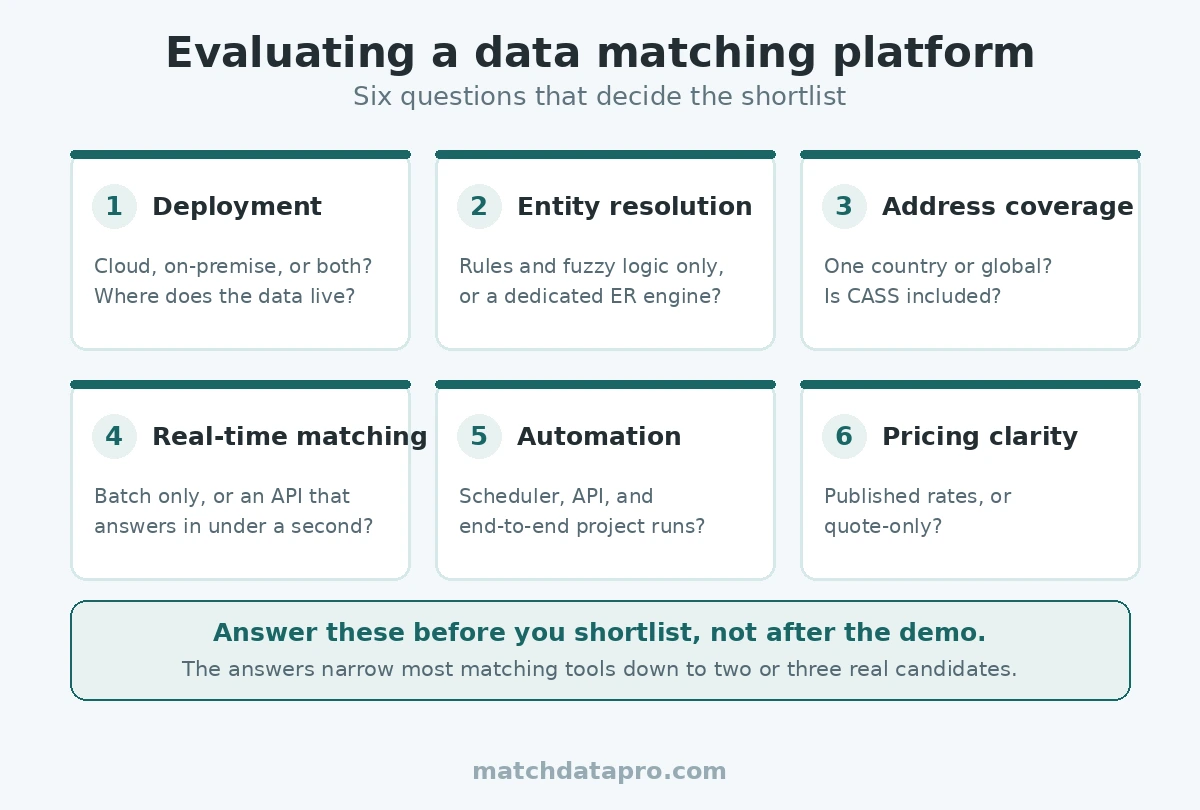
1. Deployment and data residency
This is usually the first question that eliminates options, and it rarely comes from the data team. It comes from security, legal or a customer contract.
Match Data Pro runs two ways from the same codebase. As SaaS on Google Cloud, where you sign up and start, or on-premise via Docker Compose on Linux, Windows Server with WSL2, or an Azure virtual machine. In the on-premise deployment your records never leave your own infrastructure, which is what regulated industries and government buyers usually need to hear.
Data Ladder originated as a desktop and on-premise product and has added REST API and Docker deployment. If a hosted service is what you want, confirm directly with them what is available today rather than relying on any comparison page, including this one.
2. Entity resolution, not just record matching
Rule-based fuzzy matching answers whether two records look alike. Entity resolution answers a harder question: which records, across every source you own, describe the same real-world person or organization, and why.
Match Data Pro integrates Senzing as a native module. You map your columns to Senzing attributes and it resolves entities without threshold tuning, returning an Entity ID, a match key showing which attributes drove each decision, and categories for ambiguous and possible matches that it deliberately held apart for a human to review.
That last part matters more than it sounds. A tool that silently merges an ambiguous pair is not more accurate than one that flags it, it is just less honest about the uncertainty.
3. Global address verification with CASS
Match Data Pro’s address verification is built on Loqate and covers over 245 countries and territories. It corrects and standardizes the address, appends USPS CASS-certified delivery information for United States records such as DPV confirmation, ZIP+4 and carrier route, and can add latitude, longitude and an accuracy code.
Every verified field is appended alongside your original data rather than overwriting it, and each result carries an Address Verification Code so you can tell a rooftop-accurate match from a street-level guess. Data Ladder offers address verification and standardization; its country coverage is not published, so ask them directly if international addresses are a significant share of your data.
4. Matching at the point of entry
Batch deduplication cleans up duplicates after they exist. Live Fuzzy Search stops them being created. It exposes any reference dataset in your project as an API endpoint that returns scored matches in under 300 milliseconds, so a CRM or web form can check whether a record already exists before it is saved.
It answers three ways depending on what the calling system needs: every match ranked by score, the single best match, or a simple true or false for duplicate detection.
5. SaaS pricing you can read before you call anyone
Match Data Pro publishes its pricing for its SaaS tiers by record volume. Ten thousand records start at $27 per month on the Basic tier. One million records run from $525 per month, and ten million from $844 per month, with the Complete platform tier at $1,687 per month at that volume. Senzing entity resolution is an add-on priced to match your tier, and discounts apply for quarterly, semiannual and annual terms. On-premise deployments are quoted per deployment rather than published, so ask us for a figure if you plan to run in your own infrastructure.
Data Ladder does not publish pricing. That is a common and entirely legitimate enterprise model, but it does mean you cannot compare total cost of ownership without entering a sales process first.
When Data Ladder is still the better choice
No honest comparison ends with the other product losing every round. There are situations where staying put, or choosing DataMatch Enterprise in the first place, is the right call.
- Your workflow is genuinely desktop-shaped. If one or two analysts run matching projects locally and nothing downstream depends on a schedule, a desktop-first tool is a reasonable fit and a migration buys you little.
- You use ProductMatch for catalog data. Product and catalog matching is a distinct problem, and Data Ladder ships a product aimed squarely at it.
- Your team is already expert in it. Years of accumulated match definitions and institutional knowledge have real value. Switching costs are not only licence costs.
- Your data is entirely domestic and batch-only. If you never touch an international address and nothing needs a real-time answer, two of the biggest reasons to move do not apply to you.
How to run an evaluation that actually tells you something
Vendor comparison pages, this one included, are a starting point and not evidence. The only thing that settles it is a bake-off on your own records.
- Take a real extract, not a sample of clean rows. Include the messy sources, the international addresses and the records your team argues about.
- Write down what a match means to you first. Agree the rules before you see either tool’s output, or you will unconsciously grade to whichever result looks tidier.
- Build a labelled answer key. A few hundred manually reviewed pairs is enough to measure false positives and false negatives properly.
- Run both tools on the same extract. Measure precision and recall, not the headline match count. A tool that matches more records may simply be wrong more often.
- Time the whole job, including setup. Configuration time is real time, and it recurs every time requirements change.
- Test the exceptions. Look specifically at how each tool handles ambiguous pairs, because that is where silent errors enter your golden records.
Moving from Data Ladder to Match Data Pro
A migration is less daunting than it sounds, because the concepts carry over. Both products think in data sources, mappings, match definitions and outputs.
- Import your sources. Connectors cover files, databases, cloud storage and APIs, so you can point at the same sources you feed today.
- Rebuild cleansing as rules. Cleansing and standardization covers basic and advanced rules, regex patterns, dictionaries, validations, parsers and filters.
- Recreate your match definitions. Fuzzy matching uses definitions and criteria, so an existing Data Ladder definition usually maps across directly.
- Run both in parallel for one cycle. Compare the outputs on the same input before you retire anything. This is the step people skip and regret.
- Automate it. Once the results agree, automation runs the whole project by API, on a schedule, or on demand.
If you would rather not do that alone, talk to our team and we will run a proof of concept on your data with you.
Frequently Asked Questions
What is the best Data Ladder alternative in 2026?
It depends on what pushed you to look. If you need entity resolution rather than rule-based matching, global address verification, real-time matching at the point of entry, or an on-premise deployment with published pricing, Match Data Pro covers all four in one platform. If your need is purely desktop-based batch deduplication of domestic records, the case for switching is much weaker.
Is Match Data Pro a direct replacement for DataMatch Enterprise?
It covers the same lifecycle: import, profiling, cleansing and standardization, fuzzy matching, deduplication, merge and export. It adds Senzing entity resolution, Loqate address verification across more than 245 countries, a real-time matching API and project-level automation. Most Data Ladder workflows have a direct equivalent.
Can Match Data Pro run on-premise like Data Ladder?
Yes. Match Data Pro deploys on-premise through Docker Compose on Linux, Windows Server with WSL2, or an Azure virtual machine, and in that deployment your data never leaves your infrastructure. The same product is also available as SaaS on Google Cloud.
How much does Match Data Pro cost compared to Data Ladder?
Match Data Pro publishes its SaaS pricing by record volume, starting at $27 per month for 10,000 records and $525 per month for one million records, with discounts for longer terms. On-premise pricing is not published and is quoted per deployment. Data Ladder does not publish pricing at all, so a direct cost comparison requires a quote from them.
What is the difference between data matching and entity resolution?
Data matching compares records and scores how similar they are against rules you define. Entity resolution determines which records across all of your sources represent the same real-world person or organization, and explains each decision. Match Data Pro offers both: a configurable fuzzy matching module and a Senzing-powered entity resolution module.
Does Match Data Pro handle international addresses?
Yes. Address verification is built on Loqate and covers more than 245 countries and territories, with USPS CASS certification for United States addresses and optional geocoding that returns latitude, longitude and an accuracy code.
How long does it take to migrate from Data Ladder?
For a typical workflow, most teams rebuild their sources, cleansing rules and match definitions within a few days, then run both systems in parallel for one cycle to compare outputs before retiring the old process. Complex environments with many definitions take longer, and we run proofs of concept to size this properly.
Try it against your own data
The fastest way to settle a comparison is to run it. Start a free trial with no contract, or book a working session and we will match a sample of your records alongside you. You can also browse the full product documentation before you talk to anyone.