
Fuzzy matching is the technique data teams use to find records that refer to the same real-world entity even when names, addresses, or identifiers are spelled inconsistently across systems. It replaces brittle exact-match logic with algorithm-driven similarity scoring, and it is the foundation of every serious deduplication, entity resolution, and data cleansing workflow.
When “Acme Corp.” in your CRM meets “ACME Corporation” in your ERP, exact matching returns zero results. Fuzzy matching scores the two strings at 91/100 and flags them for merge review. That single capability separates data teams that ship clean pipelines from those drowning in duplicate records.
According to Gartner, poor data quality costs organisations at least $12.9 million per year on average. Fuzzy matching is one of the most direct levers to reduce that cost.
Ready to see fuzzy matching in action? Start a free trial and run your first match job in minutes.
How Fuzzy Matching Algorithms Work
Every fuzzy matching engine reduces to the same core operation: take two strings, compute a similarity score between 0 and 100, and decide whether that score clears a threshold. The algorithms differ in how they measure similarity.
Levenshtein Distance (Edit Distance)
Levenshtein counts the minimum number of single-character insertions, deletions, or substitutions needed to transform one string into another. “Robert” to “Robrt” = 1 edit = high similarity. It handles typos well but is computationally expensive at scale without blocking strategies.
Jaro-Winkler
Jaro-Winkler rewards strings that share a common prefix. It is the preferred algorithm for short strings like personal names. “Jon Smith” vs “John Smith” scores 96/100. “Smith Jon” vs “John Smith” scores lower because the prefix differs, which is why you normalise name order before scoring.
Phonetic Algorithms: Soundex and NYSIIS
Soundex encodes words by sound. “Smith” and “Smyth” both encode to S530. NYSIIS (New York State Identification and Intelligence System) is more accurate for multi-syllable names and handles vowel variations better. Use phonetic algorithms when your data comes from manual data entry or voice transcription.
Token Set Ratio
Token Set Ratio splits strings into word tokens, sorts them, and compares the sorted sets. This handles company name variations cleanly. “International Business Machines Corp” vs “IBM Corp” is a poor direct string match, but after abbreviation expansion and token comparison the score climbs to 88/100. See our guide on managing nicknames and abbreviations for how this preprocessing step works.
The Fuzzy Matching Pipeline: Six Stages
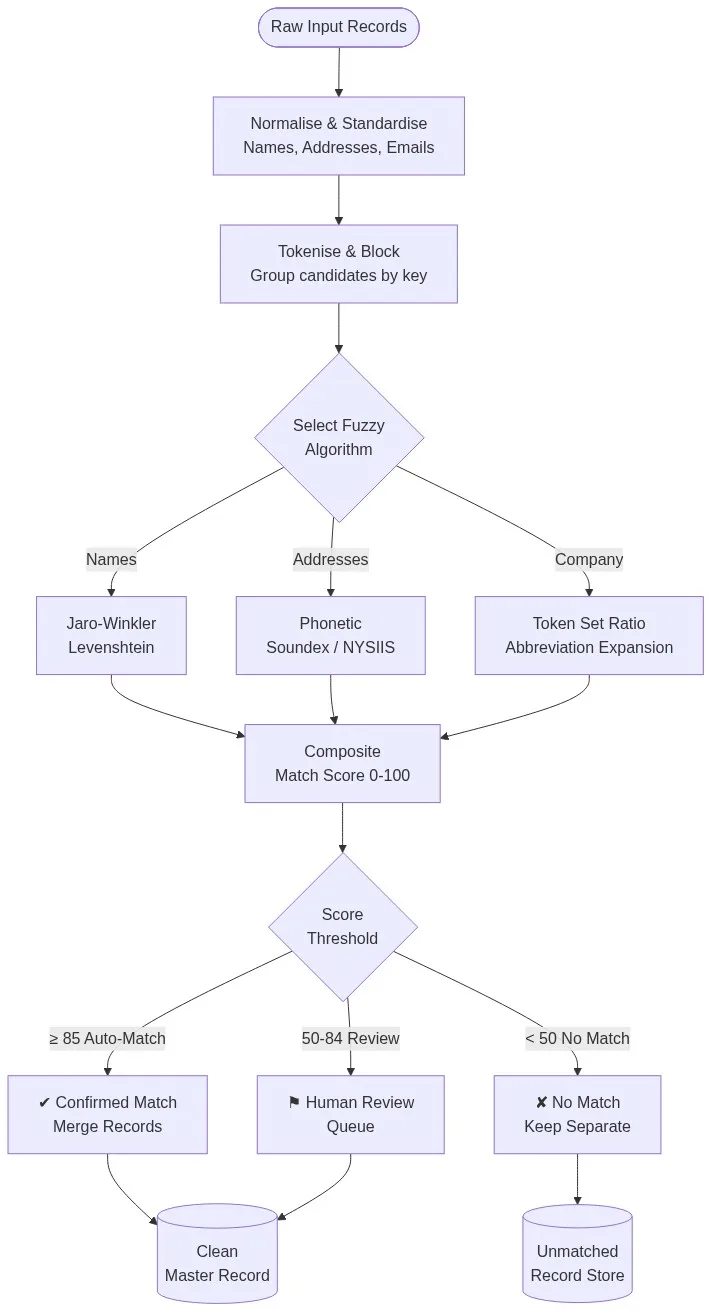
Fuzzy matching is not a single function call. It is a pipeline. Running an algorithm directly on two raw datasets produces poor results and poor performance. The six-stage pipeline below is what production-grade platforms — including Match Data Pro’s fuzzy matching engine — implement.
Stage 1: Profiling
Before writing a single matching rule, profile every field. Identify completeness rates, value distributions, and format inconsistencies. AI data profiling automates this step and flags which fields will cause the most matching failures. A field that is 40% null is not a reliable match key.
Stage 2: Standardisation
Standardise formats before scoring. Phone numbers become E.164. Dates become ISO 8601. Company suffixes (LLC, Ltd, Inc.) get stripped or normalised. State abbreviations get expanded. This step alone can lift match rates by 15-25 percentage points. See data standardisation best practices for a full field-by-field treatment.
Stage 3: Blocking (Candidate Generation)
You cannot compare every record against every other record. With 1 million records, that is 500 billion comparisons. Blocking reduces the comparison space by grouping records that share a common key: the first three characters of a surname, the first five digits of a postcode, or a Soundex code. Only records in the same block are scored against each other.
Stage 4: Algorithm Selection and Scoring
Apply the right algorithm to the right field type. Jaro-Winkler on names. Token Set Ratio on company names. Exact match on structured codes like tax IDs or account numbers. Phonetic on fields with known transcription noise. Score each field pair independently, then combine into a composite score using configurable weights.
Stage 5: Threshold Routing
Three outcome bands:
- Score 85+: Auto-match. Records are confirmed as duplicates and queued for merge.
- Score 50-84: Review queue. A steward reviews candidate pairs and confirms or rejects the match.
- Score below 50: No match. Records are kept separate.
Threshold calibration is an iterative process. Start with a sample of known duplicates and adjust until precision and recall meet your business requirements.
Stage 6: Survivorship and Merge
Once a match is confirmed, survivorship rules determine which field values survive into the golden record. The most recent non-null value wins by default, but you can configure source priority, majority vote, or field-level rules. The golden record is written to your master store. See how this works in practice in our CRM deduplication guide.
Algorithm Comparison: Choosing the Right Tool for Your Data
| Algorithm | Best For | Handles Typos | Handles Word Order | Handles Phonetics | Scale Performance |
|---|---|---|---|---|---|
| Levenshtein | General text, short strings | Yes | No | No | Moderate |
| Jaro-Winkler | Person names | Yes | No | No | High |
| Soundex / NYSIIS | Phonetic name matching | Partial | No | Yes | High |
| Token Set Ratio | Company / org names | Partial | Yes | No | Moderate |
| N-gram | Addresses, product codes | Yes | Partial | No | High |
| AI / ML Ensemble | High-volume mixed data | Yes | Yes | Yes | Very High |
Real-World Fuzzy Matching Examples
CRM Deduplication
A B2B software company imports contacts from three sources: Salesforce, a tradeshow CSV, and a purchased list. The same contact appears as “Jennifer Lopez-Martinez”, “Jen Lopez Martinez”, and “J. L. Martinez”. Exact matching produces three separate records. Fuzzy matching with Jaro-Winkler on first name, token set ratio on last name, and exact match on email domain returns a composite score of 87/100, auto-matching all three into one golden record.
Supplier Deduplication in ERP
A procurement team finds “3M Company”, “3M Corp”, and “Minnesota Mining and Manufacturing” scattered across their vendor master. Token Set Ratio scores “3M Company” vs “3M Corp” at 92/100. A separate abbreviation-expansion rule maps “Minnesota Mining and Manufacturing” to “3M” before scoring, pushing that pair to 89/100. Both pairs auto-match. The vendor master drops from 14,200 to 11,800 records after one run.
Address Matching Across Databases
“123 Main St Ste 4” vs “123 Main Street Suite 4” is a common failure case for exact matching. After standardisation (Suite/Ste normalisation, Street/St expansion), the records score 98/100 on Levenshtein and auto-match. Address matching at scale adds a CASS verification step that confirms deliverability before the score is calculated.
Fuzzy Matching vs. Exact Matching: When to Use Which
Exact matching has its place. Use it on structured, controlled fields: surrogate keys, ISBN codes, national ID numbers, and verified email addresses. Exact matching is fast and deterministic.
Use fuzzy matching on any field that:
- Comes from manual data entry
- Has been migrated from a legacy system
- Is a free-text or semi-structured field (names, addresses, descriptions)
- Crosses organisational or system boundaries
- Contains abbreviations, nicknames, or transliteration variants
Most production pipelines use a hybrid: exact match on controlled fields first to reduce the candidate set, then fuzzy match on the remaining fields to resolve ambiguous cases. Read how the best fuzzy matching software implements this hybrid approach at scale.
How Match Data Pro Implements Fuzzy Matching
Match Data Pro’s fuzzy matching engine exposes every algorithm above through a no-code configuration interface. You define match keys, select algorithms per field, set weights, and configure threshold bands. The platform handles blocking, parallel processing, and survivorship automatically.
Key differentiators:
- AI-powered match suggestions that propose algorithm and weight combinations based on your data profile
- Configurable composite scoring across up to 20 fields per match rule
- Real-time entity resolution via API for live lookups at point of entry
- CASS address verification integrated into the address matching step
- SaaS and on-premise deployment with no-contract monthly pricing
- Job automation that schedules recurring match runs on new data increments
For teams currently running fuzzy matching with SQL LIKE clauses or Python scripts, the limitations of SQL fuzzy matching at scale become apparent quickly. A dedicated platform scales to tens of millions of records without the indexing and timeout problems that plague database-native approaches.
After the match job runs, you want to track quality over time. That is where data quality dashboards close the loop, surfacing duplicate rates, match confidence distributions, and steward review backlogs in one view.
Start Matching Your Data Today
Match Data Pro offers a no-contract SaaS plan with an instant free trial. Load your data, configure a match rule, and see scored candidate pairs in under 10 minutes.
- Start a free trial — no credit card required.
- Book a demo with the Match Data Pro team.
- Email sales@matchdatapro.com with your use case.
Frequently Asked Questions
What is fuzzy matching in data quality?
Fuzzy matching is a technique that compares records using similarity algorithms — Jaro-Winkler, Levenshtein, Soundex, token set ratio — to find records that refer to the same entity even when field values are not identical. It is the core mechanism behind deduplication, entity resolution, and cross-system data linking.
What is the best fuzzy matching algorithm?
No single algorithm is best for all data types. Jaro-Winkler performs best on short personal names. Token Set Ratio is best for company names with word-order variation. Levenshtein handles general text and typos. Phonetic algorithms (Soundex, NYSIIS) handle pronunciation-based variants. Production systems combine multiple algorithms into a weighted composite score.
What match score threshold should I use?
Most implementations use 85+ for auto-match, 50-84 for human review, and below 50 for no-match. These thresholds should be calibrated against a sample of known true-positives and true-negatives from your specific dataset. Different field types and use cases require different thresholds.
How is fuzzy matching different from entity resolution?
Fuzzy matching scores the similarity between two record pairs. Entity resolution is the broader process that uses fuzzy matching scores — plus blocking, survivorship, and golden record creation — to resolve identities across an entire dataset or across multiple source systems. Fuzzy matching is a component of entity resolution, not a synonym for it.
Can fuzzy matching work in real time?
Yes. Match Data Pro’s live fuzzy search API performs fuzzy matching in milliseconds at the point of data entry, returning ranked candidate matches before a new record is saved. This prevents duplicates from entering the system rather than cleaning them up after the fact. Response times are typically under 100ms for datasets up to 10 million records.