
Data as a Service (DaaS) delivers data on demand via APIs and cloud pipelines. It only works when the underlying data is clean, deduplicated, and entity-resolved. Without a quality layer upstream, every consumer inheriting that data stream gets the same errors, duplicates, and address failures — amplified at scale.
If your organisation is building or evaluating a DaaS layer, the data quality pipeline is not optional. It is the product. Start a free trial of Match Data Pro to see how the full pipeline runs on your own data.
What DaaS Actually Requires from Your Data
DaaS abstracts data delivery behind an API or subscription service. Consumers — internal BI teams, third-party applications, AI pipelines, or partner organisations — query or subscribe to data without touching source systems directly. The promise is consistent, trusted, always-fresh data.
That promise breaks when source data has not been cleaned first. Consider a typical multi-source DaaS layer pulling from a CRM, an ERP, and three third-party data vendors. Without a quality pipeline, the same company “Acme Corp” appears as:
| Source | Record value | Problem |
|---|---|---|
| CRM | Acme Corp | Base record |
| ERP | ACME Corporation | Case + suffix variant |
| Vendor A | Acme Corp. | Trailing punctuation |
| Vendor B | Acme Co | Abbreviation |
| Vendor C | Acme | Truncated |
A consumer querying for “Acme Corp” revenue data gets four conflicting records instead of one authoritative golden record. DaaS without data quality is a liability distribution system.
The Five Data Quality Problems That Break DaaS
1. Duplicates Across Source Systems
DaaS pipelines typically aggregate 3–10 source systems. Each system maintains its own records with its own creation rules. When the same customer, vendor, or location exists in two systems under slightly different names, the DaaS layer surfaces both. Consumers cannot tell which is authoritative. Analytics double-count revenue. AI models train on contradictory facts.
The fix is data deduplication before data enters the DaaS pipeline. Run AI-powered fuzzy matching across all source systems to identify and collapse duplicates. Duplicates resolved at source do not propagate downstream.
2. Inconsistent Formats and Standards
Source systems store dates, phone numbers, country codes, and industry classifications differently. One system stores phone as +1-800-555-0100. Another stores it as 18005550100. A third uses (800) 555-0100. These are the same number, but a DaaS consumer trying to match on phone gets zero hits.
Data standardisation normalises every field to a canonical format before data reaches the API layer. Format-normalised data is joinable, filterable, and machine-readable regardless of the source system it originated in.
3. Unverified Address Data
Address fields degrade at approximately 15–20% per year as people and businesses relocate. A DaaS layer exposing address data to logistics, marketing, or compliance consumers must verify those addresses or risk distributing stale, undeliverable, or fraudulently entered values.
CASS address verification validates every address against the USPS postal database, appends ZIP+4, corrects street suffixes, and flags undeliverable records. Verified addresses carry a deliverability score that consumers can filter on.
4. Fragmented Entity Identity
DaaS consumers often need a single view of a customer, vendor, or location across the data they query. If the pipeline has not resolved entities — linking the five “Acme Corp” variants to a single entity ID — consumers cannot build that view. They build it themselves, inconsistently, in every downstream system.
Entity resolution assigns a persistent identity key to every matched record cluster. Every consumer querying a company, person, or location gets the same entity ID regardless of which source the data came from. Match Data Pro uses Senzing’s graph-based entity resolution engine for production-grade identity linking.
5. Profiling Gaps — Not Knowing What You Are Distributing
Many teams build DaaS pipelines without first profiling the source data. They discover completeness problems, format violations, and high null rates only after consumers report errors. At that point, every downstream system has already ingested bad data.
Data profiling before pipeline build reveals null rates per field, format distribution, duplicate estimates, and outliers. It converts a guessing exercise into a measurement exercise. You know exactly what you are distributing before the first API call goes live.
The DaaS Data Quality Pipeline
A reliable DaaS pipeline runs data quality before the output layer, not after. The sequence matters. Address verification on unstandardised data produces lower accuracy. Fuzzy matching on unprofiled data produces unpredictable results. The pipeline below is the correct order:
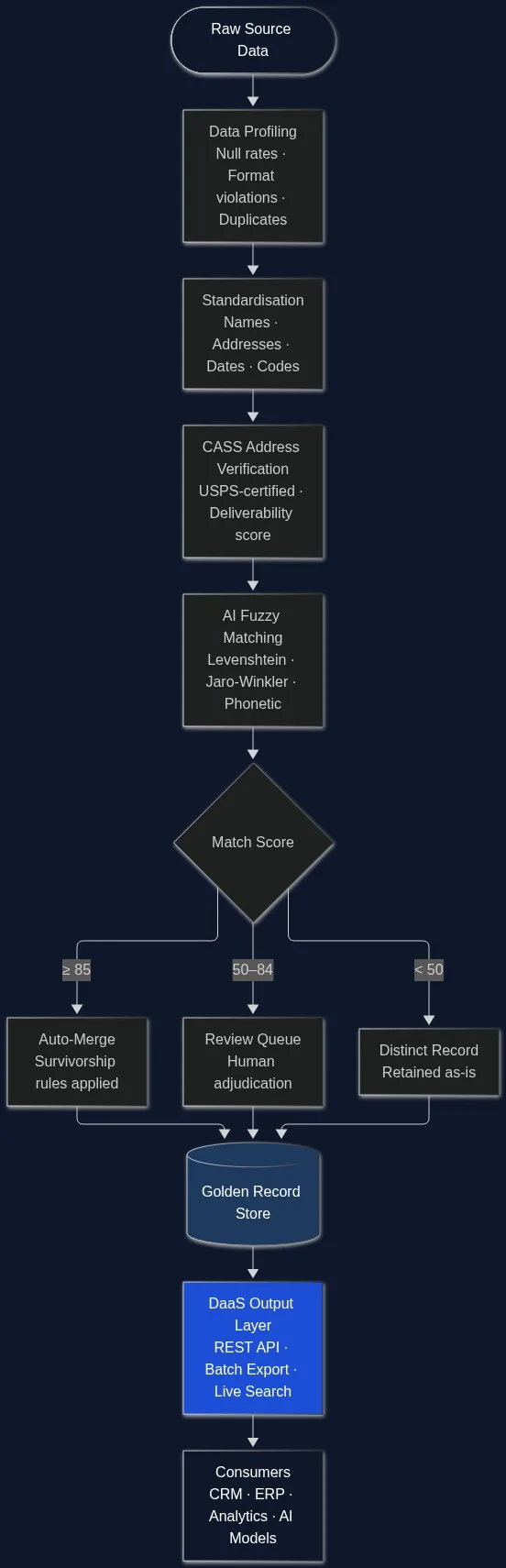
- Profile: Scan every source field. Measure null rates, format violations, duplicate density, and value distribution.
- Standardise: Normalise names, phone numbers, dates, country codes, and industry classifications to canonical formats.
- Verify addresses: Run CASS certification on all address fields. Append ZIP+4. Flag undeliverable records.
- Fuzzy match: Score every record pair across sources using weighted Levenshtein, Jaro-Winkler, phonetic, and token-based algorithms. Fuzzy matching catches variants that exact joins miss.
- Resolve entities: Cluster matched records under a persistent entity ID using Senzing’s graph-based resolution engine.
- Apply survivorship: Select the most authoritative field value from each cluster using configurable survivorship rules (most recent, most complete, most trusted source).
- Publish to DaaS layer: Expose golden records via REST API, batch export, or live fuzzy search API. Consumers get one clean, resolved record per entity.
How Match Data Pro Powers the DaaS Quality Layer
Match Data Pro is a cloud SaaS platform that covers every stage of the DaaS data quality pipeline in one environment. There is no need to assemble separate tools for profiling, cleansing, matching, and resolution. The full pipeline runs in a single configurable workflow.
AI-Powered Fuzzy Matching at Scale
Match Data Pro’s data matching engine applies field-specific algorithms — Jaro-Winkler for person names, token-based matching for company names, phonetic encoding for noisy free-text fields. Match scores are configurable thresholds: records scoring above 85 auto-merge, 50–84 go to review, below 50 remain distinct. This three-tier routing handles millions of record pairs without manual review for every decision.
Senzing Entity Resolution
For enterprise DaaS with complex identity requirements — financial services, healthcare, government — Match Data Pro integrates Senzing’s graph-based entity resolution. Senzing assigns persistent entity IDs without hand-crafted rules, handles multi-hop relationships, and processes records in real time. Every DaaS consumer querying an entity gets the same resolved ID, regardless of which source the query reaches.
Live Fuzzy Search API
DaaS consumers do not always query clean strings. A sales team searching “Acme Co” should find “Acme Corp” and “ACME Corporation.” Match Data Pro’s REST API with live fuzzy search returns ranked results by similarity score, not exact match only. This means every consumer benefits from the matching intelligence baked into the pipeline — without building it themselves.
Job Automation and Scheduled Pipelines
DaaS data must stay current. Match Data Pro’s job automation runs quality pipelines on a schedule — daily, weekly, or triggered by inbound data events. New source records get profiled, standardised, matched, and resolved automatically before reaching the output layer. No manual re-runs. No stale data distributed to consumers.
Import/Export Connectors
DaaS environments typically pull from multiple upstream sources and push to multiple downstream consumers. Match Data Pro’s import/export connectors handle CSV, Excel, database direct, and API-based ingestion. Cleaned, resolved output goes back to any downstream system: CRM, data warehouse, analytics platform, or partner API.
Ready to see it in action? Book a demo and walk through the pipeline on your own DaaS use case.
DaaS Data Quality: Real-World Impact by Use Case
Financial Services: KYC and AML Screening
A financial institution operating a DaaS layer for KYC and AML screening must resolve counterparty identities consistently across transaction data, sanctions lists, and customer records. A fragmented identity layer — five records for the same company under slightly different names — means five separate screening results, some of which miss the flag. Entity resolution at the DaaS quality layer collapses those five records into one verified identity before screening runs.
Healthcare: Patient Identity Across Systems
A health system providing a DaaS layer to clinical analytics and population health teams needs consistent patient identity. A patient admitted to three facilities under “Jon Smith,” “Jonathan Smith,” and “J. Smith” produces three separate care histories. Fuzzy matching and entity resolution at the DaaS layer unify those records before analytics consumers ever see them. This reduces duplicate record rates from a typical 8–12% down to under 2%.
RevOps: Account-Level Revenue Roll-Up
A RevOps team using a DaaS layer for account-based revenue reporting needs every transaction, interaction, and opportunity linked to the correct account entity. Without entity resolution, “Acme Corp” transactions split across five account records produce incorrect revenue totals and broken attribution. A clean entity layer ensures every revenue event rolls up to the correct golden account record.
Frequently Asked Questions
What is the main difference between DaaS and a traditional data warehouse?
A data warehouse stores processed data for internal analytics. DaaS exposes data to external or cross-team consumers via APIs and subscriptions, often in near real time. DaaS requires stricter upfront data quality because errors are distributed instantly to every consumer rather than surfaced slowly in internal reports.
Why does data matching matter more in a DaaS environment than in a traditional pipeline?
In a DaaS environment, unresolved duplicate entities reach every consumer simultaneously. Each consumer then resolves duplicates independently, producing inconsistent results. Matching and entity resolution at the source layer means every consumer gets the same resolved golden record, eliminating divergence at scale.
How long does it take to build a DaaS quality pipeline with Match Data Pro?
Most teams complete a first-pass pipeline — profiling, standardisation, deduplication, and address verification — within one to two weeks on Match Data Pro. Entity resolution configuration typically adds another week. The platform deploys as cloud SaaS with no infrastructure setup. A free trial is available without a contract.
Can the data quality pipeline run in real time for DaaS use cases?
Yes. Match Data Pro exposes a REST API that runs fuzzy matching and entity resolution in real time. New records submitted via API are scored and resolved against the existing golden record store before being added to the DaaS output layer. Latency is typically under 200ms per record for single-record lookups.
What is a survivorship rule and why does it matter for DaaS?
A survivorship rule defines which field value wins when two matched records carry different values for the same field. For example: use the most recently updated address, prefer the longest name, or trust Source A over Source B for tax IDs. Without survivorship rules, merged records inherit arbitrary values. With them, every golden record is deterministically built from the most authoritative source.