
Entity resolution and master data management (MDM) solve different problems, and confusing them is one of the most expensive mistakes a data team can make. Entity resolution links records that refer to the same real-world entity across disparate systems. MDM is a broader governance discipline that manages how authoritative data is defined, owned, and maintained across an organisation. Most teams need entity resolution. Only some need full MDM.
If your team is spending months debating which to buy, start with a free trial of Match Data Pro and run entity resolution against your real data before committing to a multi-year MDM programme.
¿Qué es la resolución de entidades?
Entity resolution (ER) is the process of identifying records across different datasets that refer to the same real-world person, organisation, or object, and linking or merging them into a single verified representation. It operates at the data layer.
Consider a B2B data team managing three systems: Salesforce, HubSpot, and an ERP. Each holds customer records. The same customer may appear as:
| System | Récord | Issue |
|---|---|---|
| Salesforce | Acme Corp, 123 Main St | Correct |
| HubSpot | ACME Corporation, 123 Main Street | Format variation |
| ERP | Acme Corp., 123 Main St, Suite 4 | Added unit suffix |
Without entity resolution, these appear as three separate customers. Analytics over-count. Revenue reporting is wrong. Deduplication campaigns mail three versions of the same offer.
Entity resolution uses fuzzy matching algorithms to score similarity across name, address, phone, and email fields. It applies blocking to limit comparisons to plausible pairs. It assigns a composite score, routes near-certain matches to automatic merge, and sends borderline pairs to human review. The output is a golden record: a single authoritative record built from the best field values across all sources.
What entity resolution does not do
Entity resolution does not define data ownership policies, enforce which team controls a field, or govern how records are updated going forward. It resolves the current state of your data. It does not govern the future state.
What Is Master Data Management?
MDM is an enterprise programme, not a single technology. It defines what constitutes authoritative data, who owns it, how it is governed, and how it is distributed to consuming systems. MDM typically covers: data domains (customer, product, supplier, location), stewardship workflows, policy enforcement, and integration with source systems.
A full MDM implementation includes:
- Data model definition: canonical schemas for each domain
- Stewardship workflows: who approves changes, who resolves conflicts
- Integration layer: push and pull from source systems
- Policy engine: rules for what can change and when
- Entity resolution engine: to identify and deduplicate records at intake
That last bullet is critical. Every MDM programme requires entity resolution to function. MDM without ER produces a governed repository of duplicates.
Key Differences: Entity Resolution vs MDM
| Dimensión | Resolución de entidad | MDM |
|---|---|---|
| Ámbito de aplicación | Data linkage and deduplication | Full governance programme |
| Deployment time | De días a semanas | De 6 a 18 meses |
| Costo | Low to moderate SaaS subscription | $200K–$1M+ per year |
| Team required | Data engineer, analyst | Data stewards, architects, executives |
| Governance | Produces audit trail, not policy | Enforces data ownership policy |
| Resultado | Linked records, golden record | Governed master data hub |
| Prerequisite? | No | Requires ER as a component |
The comparison shows why most data teams reach for entity resolution first. It delivers measurable value in weeks. A full MDM programme may not produce ROI for 12 months or more.
When You Need Entity Resolution (Without Full MDM)
Entity resolution alone is sufficient for most operational data quality use cases:
CRM and marketing deduplication
A RevOps team with 300,000 contact records across two CRMs needs to identify and merge duplicates before a migration. Entity resolution runs against the combined dataset, produces a scored match list, and outputs a clean merged file in hours. No MDM programme needed.
Supplier and vendor consolidation
A procurement team merging supplier databases from two acquisitions needs to identify the same vendor registered under different names and address formats. Entity resolution and data linkage handles this without defining a full governance model.
Compliance screening
Financial services teams running KYC or AML checks need to match incoming customer records against watchlists and internal databases. Entity resolution in financial services runs these comparisons in real time via API, returning confidence scores and match evidence. No MDM hub required.
Analytics and reporting accuracy
A data engineering team whose revenue dashboards count the same customer three times due to spelling variants needs data deduplication, not a governance programme. Entity resolution corrects the data layer. Reporting becomes accurate within days.
When You Need MDM (and Entity Resolution Inside It)
MDM becomes the right investment when your organisation needs centralised data ownership and policy enforcement that spans multiple business units, not just a one-time or periodic cleanse.
Classic MDM triggers:
- Multiple business units disagree on what a “customer” record looks like
- Regulatory mandates require a single source of truth with audit trails per domain
- A global ERP rollout requires clean, governed product and supplier data at go-live
- Post-merger integration requires harmonising master data across two wholly separate organisations
Even in these scenarios, entity resolution must run first. Without it, the MDM hub ingests duplicates and the programme fails within months.
How Match Data Pro Fits In
Match Data Pro is a cloud SaaS platform built for the entity resolution layer. It covers every stage teams need before, during, or alongside MDM:
- AI data profiling to scan datasets and identify duplicate rates, missing values, and format inconsistencies before any matching runs
- Data cleansing and standardisation to normalise name formats, address structures, and phone patterns so fuzzy algorithms operate on clean inputs
- AI-powered fuzzy matching with configurable Jaro-Winkler, Levenshtein, phonetic, and token-based algorithms scored by field weight
- Senzing entity resolution for graph-based probabilistic identity matching at enterprise scale — the same engine that powers identity resolution in financial services and healthcare
- CASS address verification to validate US postal addresses against the USPS database before matching runs
- Job automation to schedule recurring deduplication, profiling, and verification runs without manual intervention
- Import/export connectors for CSV, database, and API-based pipelines so data moves cleanly between source systems and consuming applications
Here is the decision workflow teams use to determine whether they need entity resolution, MDM, or both:
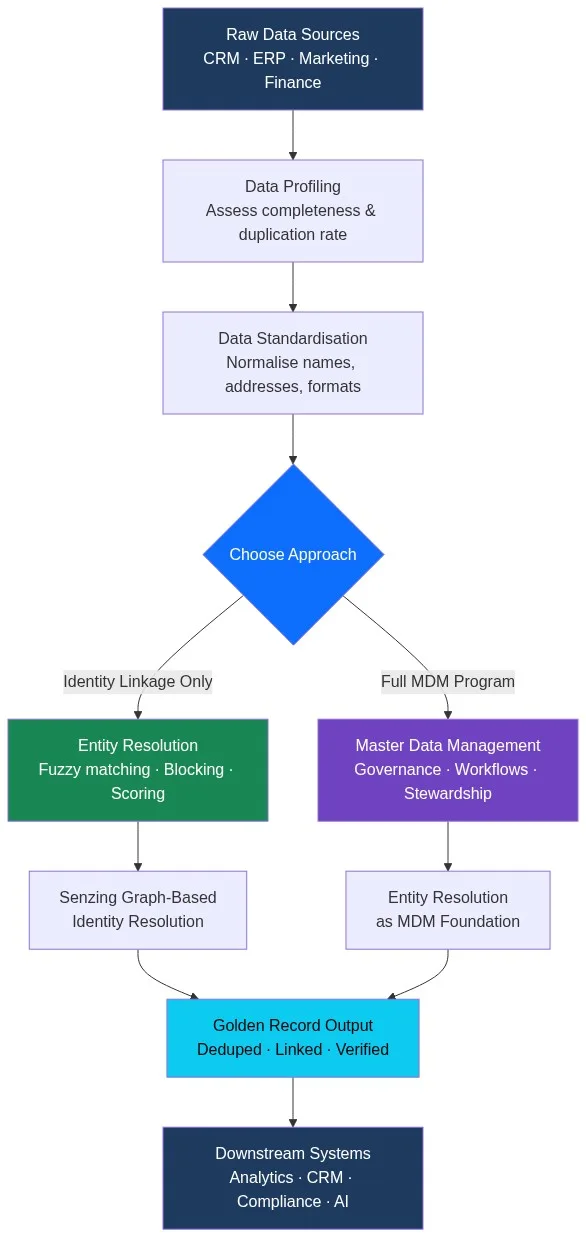
For teams evaluating MDM as a future direction, Match Data Pro functions as the entity resolution foundation. You build the linkage and deduplication capability now. When the organisation is ready for a full governance layer, the clean data and match configuration are already in place.
No long-term contract is required. You can start a free trial and validate results against your own data before any commitment. Or book a demo to see how the platform handles your specific use case.
Preguntas frecuentes
What is the difference between entity resolution and MDM?
Entity resolution identifies and links records that refer to the same real-world entity across systems, producing a deduplicated golden record. MDM is a broader governance programme that defines data ownership, stewardship workflows, and policy enforcement across domains. Entity resolution is a component inside MDM, and can also be deployed independently without a full MDM programme.
Do I need MDM if I already have entity resolution?
Not necessarily. Entity resolution handles identity linkage and deduplication, which solves most operational data quality problems. MDM becomes necessary when you need centralised data ownership policies, multi-domain governance, or regulatory-grade stewardship workflows spanning multiple business units. Many teams run entity resolution for years without needing full MDM.
Can entity resolution replace MDM?
Entity resolution replaces the identity linkage function of MDM but not the governance function. If your core need is finding and merging duplicate records, linking customer identities across systems, and producing a clean master file, entity resolution is sufficient. If you need formal data stewardship, multi-domain data ownership, and organisation-wide policy enforcement, MDM adds those layers on top of entity resolution.
How long does entity resolution take to deploy versus MDM?
Entity resolution on a cloud SaaS platform typically deploys in days to a few weeks, depending on data volume and pipeline complexity. A full MDM programme typically takes 6–18 months to deploy and requires significant organisational change management. Most teams see measurable ROI from entity resolution within the first month. MDM ROI timelines are typically 12 months or longer.
What is Senzing entity resolution and how does it differ from standard fuzzy matching?
Senzing is a graph-based probabilistic entity resolution engine that builds identity graphs across records rather than simply comparing pairs. It pre-loads trained models for customer, person, and organisation matching, so it requires no hand-crafted rules. Standard fuzzy matching compares two records and returns a score. Senzing groups records into resolved entity clusters across an entire dataset, handling many-to-many identity relationships that pair-wise fuzzy matching cannot resolve. Match Data Pro includes Senzing as part of its entity resolution capability.