

First Matching Condition Scoring Rules: Revenue Ranges & Band Algorithms Explained

A first matching condition scoring rule evaluates an incoming data field against an ordered sequence of conditions and assigns a numeric score the moment the first condition is satisfied — stopping all further evaluation. When applied to revenue ranges, this pattern converts unstructured or semi-structured revenue strings into discrete band scores that feed directly into a composite fuzzy match score. The result: deterministic, auditable, and configurable scoring logic that scales across millions of records without ambiguity.
Revenue data is one of the most inconsistently formatted fields in B2B datasets. A CRM record might store "$5M", a data warehouse might store 5000000, and a third-party enrichment feed might store "5,000,000 USD". Before you can match two company records on revenue similarity, you need a scoring layer that normalises these representations, maps them to named bands, and produces a score you can weight within a broader match rule. First-match condition logic — sometimes called a “break-on-first-match” or “first-wins” scoring pattern — is the most reliable way to achieve this at scale.
This guide walks through the mechanics of first-match scoring rules for revenue ranges, shows concrete configuration examples, explains how to integrate band scores into a composite match pipeline, and covers edge cases that trip up most implementations.
What Is a First Matching Condition Rule?
A first matching condition rule is a sequential evaluation structure where conditions are tested in a defined order and evaluation halts as soon as one condition returns true. The score (or label) attached to that condition is the output. No further conditions are tested.
This contrasts with scoring models that evaluate all conditions and sum or average results. In a first-match model, order matters: more specific conditions must precede general ones, or the general condition will absorb records intended for the specific band.
The pattern is analogous to a SQL CASE WHEN … THEN … END statement or a nested if / else if chain, and it is exactly what deterministic matching engines use for field-level scoring. As IBM’s documentation on master data management notes, deterministic matching uses a series of rules, like nested if statements, to run logical tests on datasets and seek a clear Yes or No result — first-match condition rules implement this pattern for scored, non-binary outputs.
In the context of revenue matching, first-match logic works as follows:
- Parse and normalise the raw revenue string to a numeric value.
- Test the value against Band 1’s condition (e.g., < $1M). If true → assign Score 1. Stop.
- If false, test Band 2 (e.g., $1M–$10M). If true → assign Score 2. Stop.
- Continue until a band matches, or assign a default score if none match.
This is the foundation of configurable, rules-driven fuzzy scoring — and it integrates directly into the broader matching rule scoring algorithm stack.
Why Revenue Band Scoring Matters in Fuzzy Matching
In B2B entity resolution and CRM deduplication, revenue similarity is a strong signal for company identity — but only when it is scored at the right granularity. Two records representing the same Fortune 500 company should score high on revenue even if one reads "$4.2B" and another reads "4200000000". Conversely, a $500K startup and a $900M mid-market firm should score low on revenue similarity, signalling they are likely different entities even if their names are similar.
Raw numeric distance is a poor proxy for revenue similarity in B2B data. The absolute difference between $900M and $1B is $100M — but both belong to the same “large enterprise” band and represent the same tier of company. A scoring system that penalises this pair based on raw delta will under-match same-entity records. Revenue band scoring solves this by discretising the revenue continuum into meaningful business segments.
Revenue Band Scoring vs. Raw Numeric Similarity
| Approach | Method | Handles Format Variation? | Business-Tier Aware? | Auditable? |
|---|---|---|---|---|
| Raw numeric distance | ABS(A − B) / MAX(A, B) | Only after normalisation | No | Moderate |
| Percentile bucketing | Dataset-relative quartiles | Only after normalisation | Partially | Low (shifts with data) |
| First-match band scoring | Ordered conditional rules | Yes — after parse step | Yes — by design | High — deterministic |
First-match band scoring wins on auditability and business alignment. A data steward reviewing a match decision can immediately trace why two records scored 4/5 on revenue: both fell into Band 4 ($100M–$1B). No statistical inference required.
For teams operating fuzzy matching pipelines at scale, this auditability is essential for compliance, data governance, and business stakeholder sign-off.
Designing Revenue Band Scoring Rules: Step-by-Step
Step 1: Normalise the Revenue String
Before any condition can be evaluated, the raw revenue field must be parsed to a clean numeric value. Revenue strings appear in dozens of formats in real-world B2B data:
"$4.2B"→ 4,200,000,000"USD 4,200,000,000"→ 4,200,000,000"4.2 billion"→ 4,200,000,000"4200000000"→ 4,200,000,000"~$4B"→ 4,000,000,000 (approximate — flag for review)""oNULL→ assign default score 0
A robust parser should handle currency symbols, shorthand multipliers (K, M, B, T), locale-specific separators (comma vs. period), and approximate markers. Any value that cannot be parsed should fall to a configured default score — not throw an error that halts the pipeline.
Step 2: Define Your Revenue Bands
Band definitions should map to your organisation’s market segmentation model. A typical B2B SaaS configuration uses five bands:
| Band | Label | Revenue Range | Score |
|---|---|---|---|
| 1 | Small Business | < $1M | 1 |
| 2 | Mid-Market (Lower) | $1M – $10M | 2 |
| 3 | Mid-Market (Upper) | $10M – $100M | 3 |
| 4 | Enterprise | $100M – $1B | 4 |
| 5 | Large Enterprise | > $1B | 5 |
Scores are integers 1–5, making downstream comparison arithmetic straightforward. If both records in a candidate pair resolve to the same band score, they receive full credit on the revenue field. If they are one band apart, they receive partial credit. Two or more bands apart scores near zero.
Step 3: Write the First-Match Conditions in Order
Conditions must be ordered from most restrictive (lowest threshold) to least restrictive. If you place the > $1B condition first, every record over $1B will match it — including the $10B records you intended to keep in Band 5. The first-match pattern requires strict ordering:
IF revenue < 1_000_000 THEN score = 1 // Band 1: Small Business
ELSE IF revenue < 10_000_000 THEN score = 2 // Band 2: Lower Mid-Market
ELSE IF revenue < 100_000_000 THEN score = 3 // Band 3: Upper Mid-Market
ELSE IF revenue < 1_000_000_000 THEN score = 4 // Band 4: Enterprise
ELSE score = 5 // Band 5: Large Enterprise
DEFAULT (null/unparseable) score = 0
The DEFAULT condition acts as a catch-all for null, empty, and unparseable inputs. Assigning score 0 (rather than discarding the record) ensures the pipeline continues and the missing revenue data is flagged in the match audit log.
Step 4: Assign Field Weight in the Composite Score
Revenue band score is one field among several in a composite match score. Typical field weights for B2B company matching:
| Field | Matching Method | Weight (%) |
|---|---|---|
| Company Name | Fuzzy (Jaro-Winkler + token sort) | 35% |
| Domain / Website | Exact + normalised | 25% |
| Revenue Band | First-match band score | 15% |
| Industry / SIC Code | Exact / taxonomy lookup | 15% |
| Employee Count Band | First-match band score | 10% |
The revenue field weight (15%) reflects that revenue is a useful corroborating signal but should not dominate the match decision — name and domain carry higher evidential weight. This is consistent with best practices in data matching and merging pipelines where no single field is dispositive.
Revenue Band Scoring in Practice: Worked Examples
Example 1: Same-Band Match (Full Credit)
Record A: Company Name = “Acme Corp”, Revenue = “$4.8M”
Record B: Company Name = “Acme Corporation”, Revenue = “4,750,000”
Both revenue values parse to numbers in the $1M–$10M range → both score Band 2. Revenue band delta = 0. Full revenue score credit applied. Company name fuzzy score = 0.91 (Jaro-Winkler). Composite score exceeds match threshold → AUTO MATCH.
Example 2: Adjacent-Band Match (Partial Credit)
Record A: Company Name = “Global Tech Inc.”, Revenue = “$95M”
Record B: Company Name = “Global Technologies Inc”, Revenue = “$120M”
Record A parses to Band 3 (Upper Mid-Market, <$100M). Record B parses to Band 4 (Enterprise, <$1B). Revenue band delta = 1. Partial credit applied (typically 50% of field weight). Company name fuzzy score = 0.87. Composite score falls in review zone → MANUAL REVIEW queue.
Example 3: Null Revenue (Default Score)
Record A: Company Name = “Summit Capital Partners”, Revenue = NULL
Record B: Company Name = “Summit Capital Partners LLC”, Revenue = “$2.3B”
Record A revenue is null → score 0 (default). Record B → Band 5. Revenue band delta = 5. Revenue contributes 0 credit. However, company name fuzzy score = 0.95. Domain match (if available) = exact. Composite score still exceeds threshold if other fields are strong enough — revenue is not a blocking field in this configuration.
This is the correct behaviour: a missing field should reduce confidence, not block an otherwise strong match.
The Revenue Scoring Pipeline: End-to-End Flow
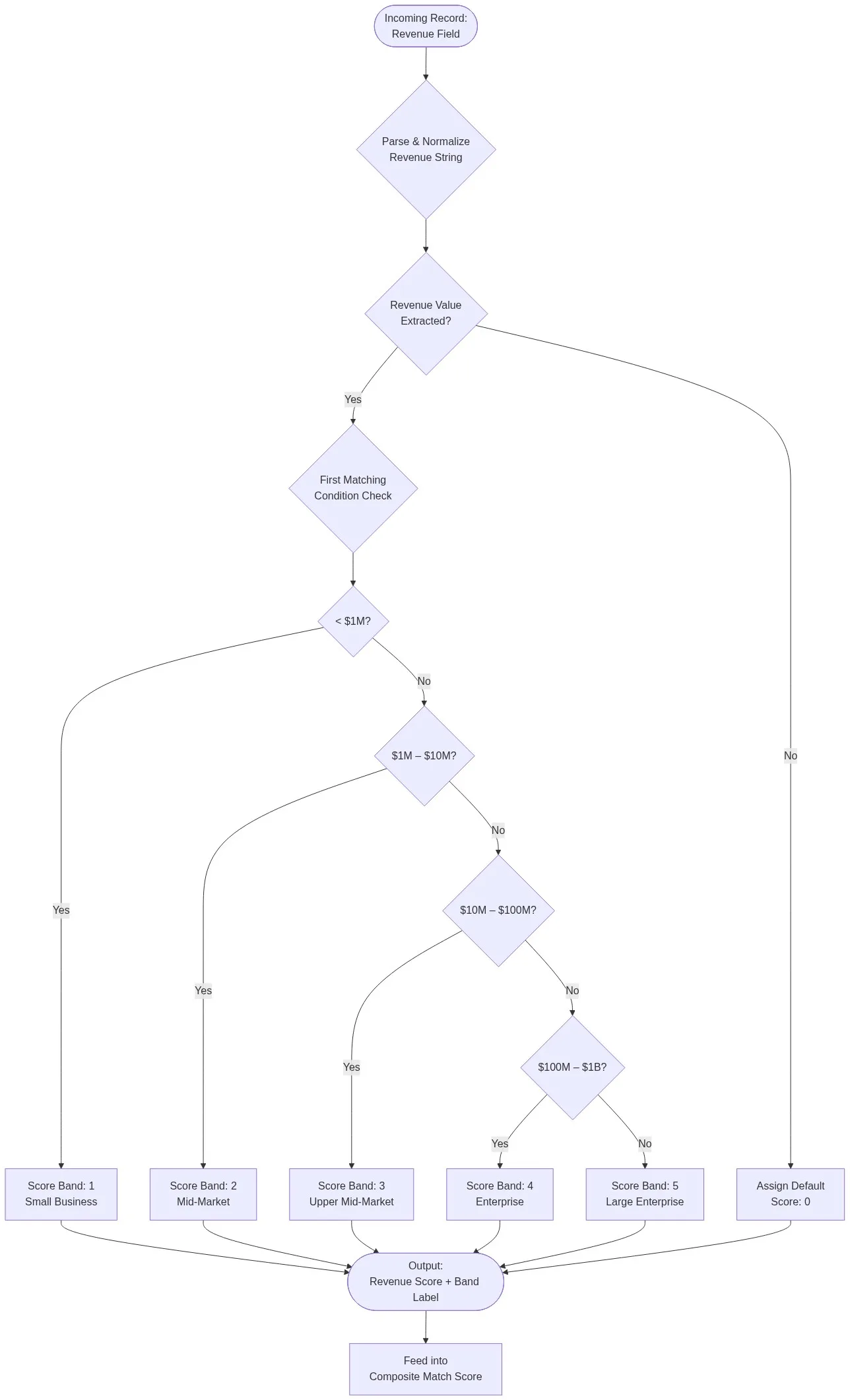
The diagram below shows how the first-match condition scoring rule fits into the complete revenue band scoring pipeline — from raw input through to composite match score contribution.

The key architectural decision is where parsing happens. Best practice: parsing and normalisation occur in a pre-processing stage before the scoring rules engine, so the engine always receives a clean numeric value. This keeps the rules themselves simple, testable, and auditable — which directly supports the data cleansing pipeline integration pattern used in production deployments.
Common Configuration Mistakes and How to Avoid Them
Mistake 1: Overlapping Band Boundaries
If Band 1 is defined as <= $1M and Band 2 as >= $1M, records with exactly $1M revenue satisfy both. In a first-match model, Band 1 always wins — which may not be the intended behaviour. Use exclusive upper bounds: Band 1 = < $1M, Band 2 = < $10M (implied lower = $1M).
Mistake 2: Placing Catch-All Bands First
Placing a broad condition (e.g., > $0) before specific bands collapses all records into one band. Always order conditions from most restrictive threshold to least restrictive, with the catch-all ELSE at the end.
Mistake 3: No Default for Null/Unparseable Values
Without a defined default, null revenue fields cause either pipeline errors or silent misscores. Always define an explicit default score (typically 0) and log null revenue occurrences for upstream data quality review via data profiling.
Mistake 4: Hardcoded Thresholds Without Version Control
Band thresholds that reflect today’s market segmentation may be wrong in 18 months. Store band definitions in a configuration table or YAML file, not in application code. Version-control your scoring rule definitions as you would application schema.
Mistake 5: Treating Revenue Band Score as a Blocking Field
Revenue data is frequently missing or stale in B2B datasets. Configuring revenue band score as a required field for a match to proceed will suppress valid matches where revenue is simply not available. Use revenue as a weighted contributing field, not a blocking gate. For a broader look at scoring best practices, see the full matching rule scoring algorithm guide.
Implementing First-Match Revenue Scoring in Match Data Pro
Match Data Pro’s rules engine supports first-match condition scoring natively through its configurable scoring rule builder. You define bands in the UI or via API, assign weights to each field within the composite score, and the engine handles parsing, evaluation, and score aggregation automatically.
Key capabilities relevant to revenue band scoring:
- Text-to-numeric parser: Handles shorthand (K/M/B/T), currency symbols, locale separators, and approximate markers out of the box.
- First-match rule sequencing: Conditions are evaluated top-to-bottom; the first match wins. Order is explicitly visible and reorderable in the UI.
- Configurable default scores: Define what score is assigned when a field is null, empty, or unparseable — independently per field.
- Band delta scoring: Optionally configure partial credit for adjacent bands (e.g., 1-band delta = 50% credit, 2-band delta = 0%).
- Audit trail: Every match decision logs the band assigned to each field, the delta, and the weighted contribution — enabling full score traceability.
- Job automation: Revenue band scoring rules run as part of scheduled or event-triggered match jobs across millions of records.
For teams evaluating tooling options, the data quality software comparison for 2026 covers how platforms differ on scoring rule configurability — a critical differentiator for production deployments.
AI data profiling can also be used upstream to automatically detect revenue field formats across your dataset before scoring rules are applied — reducing parser failure rates and surfacing format inconsistencies early.
FAQ: First Matching Condition Scoring Rules for Revenue Ranges
What is a first matching condition scoring rule in data matching?
A first matching condition scoring rule evaluates a field value against an ordered list of conditions and assigns a score the moment the first condition is satisfied, then stops. In revenue scoring, this means testing whether a normalised revenue value falls below successive thresholds (e.g., <$1M, <$10M, <$100M) and assigning the score attached to the first matching threshold. This produces deterministic, auditable scores with no ambiguity about which rule fired.
Why use revenue bands instead of raw revenue difference for matching?
Raw revenue difference is a poor similarity signal in B2B matching because the business significance of a given dollar gap varies enormously by scale. A $100M gap between two $900M companies is negligible; the same gap between a $100K and a $100.1M company is vast. Revenue bands discretise the revenue continuum into business-meaningful segments (Small Business, Mid-Market, Enterprise) so that similarity scoring reflects commercial reality rather than arithmetic distance.
How should I handle null or missing revenue fields in a scoring rule?
Always define an explicit default score for null or unparseable revenue values — typically 0. This ensures the record continues through the pipeline rather than causing an error or being silently dropped. Log all null revenue occurrences in your audit trail and flag them for upstream data quality remediation. Do not configure revenue as a blocking field; a missing revenue value should reduce confidence, not veto an otherwise strong match.
What order should revenue band conditions be evaluated in?
Revenue band conditions must be ordered from the most restrictive (lowest threshold) to the least restrictive, with a catch-all else clause at the end. The pattern is: IF revenue < $1M → Band 1; ELSE IF revenue < $10M → Band 2; and so on. Placing a broad condition (e.g., revenue > $0) before specific bands will absorb all records into that band, collapsing your scoring granularity.
How do first-match condition scoring rules differ from probabilistic matching?
First-match condition scoring rules are deterministic: a given input always produces the same output, and the logic is fully human-readable. Probabilistic matching uses statistical models to estimate the likelihood that two records represent the same entity, producing a probability score rather than a rule-fired result. In practice, production matching pipelines combine both: deterministic first-match rules for structured fields like revenue bands, and probabilistic/fuzzy scoring for name and address fields. See the data matching software buyer’s guide for a comparison of scoring architectures.
Start Matching Smarter with Configurable Scoring Rules
First matching condition scoring rules for revenue ranges are one of the highest-leverage configurations in a B2B fuzzy matching pipeline. Getting them right — correct band boundaries, proper ordering, robust null handling, and appropriate field weights — transforms a noisy revenue field into a reliable match signal.
Match Data Pro’s configurable rules engine makes this straightforward: define your bands, set your weights, and let the engine handle parsing, evaluation, and audit logging at scale. No-contract monthly SaaS, instant free trial, full on-premise deployment option.
- Start your free trial — configure your first revenue band scoring rule in minutes.
- Book a demo — see first-match scoring rules configured live against your data.
- Contact sales@matchdatapro.com — for enterprise deployments, custom band definitions, and on-premise licensing.