

Fraud Blocker Fuzzy Name Matching Software: Algorithms & How to Choose

Fuzzy Name Matching Software: Algorithms, Use Cases & How to Choose

Two streams of glowing data records merging into a unified golden database — fuzzy name matching and data merging pipeline visualised in deep blue and teal tones

Fuzzy name matching software identifies records that refer to the same person, company, or entity even when the names are misspelled, abbreviated, phonetically similar, or formatted inconsistently across source systems. Unlike exact-match comparisons, fuzzy algorithms calculate a similarity score for each candidate pair, letting data teams set confidence thresholds to auto-match high-confidence pairs, route borderline cases for human review, and reject low-confidence pairs. For any organisation managing customer, supplier, patient, or employee data across more than one system, fuzzy name matching is the foundational capability that prevents duplicate records, broken entity relationships, and downstream analytics errors.

Why Exact Matching Fails on Real-World Name Data

Real-world name data is inherently dirty. The same individual might be stored as “Jonathan R. Smith” in a CRM, “Jon Smith” in an ERP, and “J. Smith” in a legacy billing system. A standard SQL WHERE name = name join returns zero matches across all three. The same problem appears with company names: “International Business Machines,” “IBM Corp,” and “I.B.M.” are three string representations of the same entity, and no exact-match logic will connect them.

The consequences are significant. Duplicate customer records inflate marketing costs and skew revenue attribution. Unlinked supplier records cause duplicate payments. Fragmented patient records in healthcare settings create clinical risk. According to IBM’s documentation on probabilistic matching, two records may belong to the same person even if their attribute values are not the same — and deterministic exact-match rules alone cannot surface those connections reliably.

This is precisely where fuzzy name matching software earns its place in the data quality stack.

The Most Common Name Variation Types

Core Algorithms Used in Fuzzy Name Matching Software

No single algorithm handles all name variation types equally well. Production-grade fuzzy name matching software combines multiple algorithms and weights their scores at the field level. Understanding the mechanics of each helps data engineers configure matching pipelines that maximise recall without sacrificing precision.

Levenshtein (Edit Distance)

Levenshtein distance counts the minimum number of single-character edits — insertions, deletions, and substitutions — required to transform one string into another. A Levenshtein distance of 1 between “Smith” and “Smyth” translates to a high similarity score. This algorithm excels at catching typos and OCR errors. Its weakness: it treats all characters as equally weighted and does not account for phonetic equivalence.

Ejemplo: levenshtein("Jonathan", "Johnathan") = 1 → high similarity. levenshtein("Smith", "Jones") = 5 → low similarity.

Jaro-Winkler

Jaro-Winkler gives extra weight to matching characters at the start of a string, which makes it particularly effective for personal names where the first few characters are usually the most reliable identifiers. It handles transpositions natively and is the preferred algorithm for short name fields.

Example: “Kathy” vs “Cathy” scores ~0.87 on Jaro-Winkler — high enough to warrant a match review. “Kathy” vs “Katy” scores ~0.93 — likely an auto-match candidate.

Soundex and Metaphone

Phonetic algorithms encode names by their pronunciation rather than their spelling. Soundex maps “Smith” and “Smyth” to the same code (S530). Metaphone and Double Metaphone are more sophisticated, handling non-English phonetics more accurately. These algorithms are essential for matching names where spelling variation reflects regional or linguistic differences rather than simple transcription errors.

Token-Based and N-gram Matching

Token matching splits names into individual words (tokens) and compares them in any order. This handles transposed first/last names and middle initials naturally. N-gram matching breaks strings into overlapping character sequences (bigrams, trigrams) and compares the overlap ratio. Token-based approaches are the standard for company name matching where legal-form suffixes (“Ltd,” “LLC,” “Inc”) need to be weighted or excluded.

Algorithm Comparison at a Glance

Algorithm Lo mejor para Weakness Typical Score Range
Levenshtein Typos, OCR errors, data entry mistakes Slow on large datasets; no phonetic awareness 0–1 (normalised)
Jaro-Winkler Short personal name fields Less effective for long strings or transpositions 0–1
Soundex / Metaphone Phonetic variants, multilingual names No sensitivity to spelling accuracy Binary code match
Token / N-gram Company names, multi-token personal names Requires tokenisation rules per data type 0–1 (Jaccard-based)
AI / ML Ensemble High-volume, mixed-quality, multi-language data Requires training data; less interpretable 0–1 (probability)

The Fuzzy Name Matching Pipeline: End to End
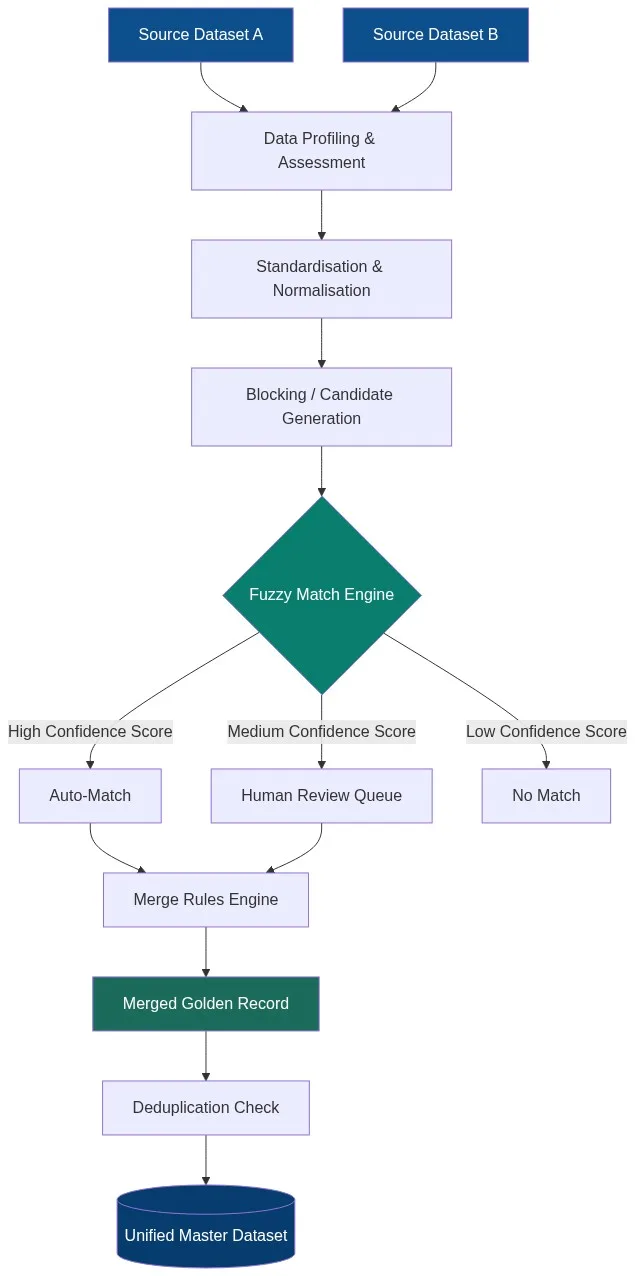
Effective fuzzy name matching is not just a single algorithm call. It is a pipeline of coordinated steps that scale across millions of records while keeping false positive rates manageable. The diagram below illustrates the full end-to-end process used in production data quality environments.

Fuzzy name matching software pipeline flowchart: from dual source datasets through profiling, normalisation, fuzzy match engine, confidence scoring, merge rules, and into a unified golden master record
End-to-end fuzzy name matching pipeline: profiling → normalisation → blocking → match scoring → human review → golden record creation.

Stage 1: Data Profiling

Before any matching runs, a data profiling pass assesses completeness, format consistency, and value distribution across name fields. This surfaces issues that would otherwise generate spurious match candidates: null names, placeholder values like “UNKNOWN” or “TEST,” and malformed strings from import errors. Skipping this step is the most common cause of inflated false-positive rates.

Stage 2: Standardisation and Normalisation

Name data is normalised before comparison: case-folded to lowercase, punctuation stripped, common abbreviations expanded (e.g., “St.” → “Street,” “Corp.” → “Corporation”), and Unicode characters transliterated to ASCII where appropriate. For personal names, salutations and suffixes (“Dr.,” “Jr.,” “III”) are isolated into separate tokens so they don’t inflate edit-distance scores.

Stage 3: Blocking (Candidate Generation)

Comparing every record against every other record is O(n²) — computationally infeasible at any meaningful scale. Blocking partitions records into candidate pairs that share at least one indexing attribute: the same first three characters of the surname, the same Soundex code, the same ZIP code, or the same first letter of the given name. Only candidate pairs within the same block are compared. A well-designed blocking strategy can reduce comparisons by 99%+ while retaining 98%+ of true matches.

Stage 4: Similarity Scoring

Each candidate pair is scored across multiple fields simultaneously. A typical configuration for personal name matching might weight: given name (Jaro-Winkler, weight 0.30), surname (Levenshtein, weight 0.40), middle initial (exact match, weight 0.10), date of birth (exact, weight 0.15), and email (exact, weight 0.05). The weighted composite score determines which decision zone the pair falls into.

Stage 5: Threshold Decision

Three thresholds divide the score space:

Stage 6: Merge and Golden Record Creation

Once pairs are confirmed as matches, a merge rules engine determines which field values survive into the merged golden record. Common survivorship strategies: most-recent value wins, most-complete value wins, or source-priority ranking. The output is a single canonical record representing the entity, with a lineage trail back to every contributing source record.

Key Use Cases for Fuzzy Name Matching Software

CRM Deduplication

Sales and marketing databases accumulate duplicates constantly — through web form submissions, CSV imports, and system integrations that lack native deduplication. A fuzzy name match across first name, last name, email, and phone fields eliminates duplicates before they inflate campaign counts, skew attribution models, or result in a prospect receiving the same outreach twice. RevOps teams using data matching at import time prevent duplicates at the source rather than cleaning them reactively.

Entity Resolution Across Systems

Enterprise data environments routinely store the same customer, supplier, or employee across an ERP, a CRM, an HR system, and a data warehouse — each with slightly different name representations. Fuzzy name matching combined with Senzing entity resolution links these records into a unified entity view without requiring a shared primary key. The result: a single, accurate 360° record that feeds downstream analytics and reporting reliably.

Financial Services KYC and AML

Know Your Customer (KYC) and Anti-Money Laundering (AML) compliance require matching customer names against sanctions lists, PEP databases, and internal watchlists where name representations span multiple languages and transliteration systems. Fuzzy phonetic matching combined with multi-token comparison is the standard approach for catching name variants that exact matching would miss.

Healthcare Patient Matching

Patient identity matching is a high-stakes application where both false positives (merging two different patients) and false negatives (missing a record for the same patient) carry clinical and regulatory consequences. Probabilistic fuzzy matching across name, date of birth, address, and insurance ID is the recommended approach for healthcare interoperability, particularly when records span multiple EHR systems or care settings.

Supplier and Vendor Master Deduplication

Procurement teams managing hundreds or thousands of vendor records across multiple ERPs frequently encounter the same supplier registered under different legal-form variants. Fuzzy company name matching combined with address and tax ID matching surfaces duplicate vendor records before they generate duplicate payments or compliance gaps.

How to Evaluate and Choose Fuzzy Name Matching Software

Not all fuzzy matching tools are created equal. The following criteria separate production-ready platforms from lightweight utilities.

Evaluation Criterion What to Look For Red Flags
Algorithm Coverage Multiple configurable algorithms (Jaro-Winkler, Levenshtein, Soundex, token) Single-algorithm tools or black-box matching only
Throughput at Scale Documented benchmark for millions of records; efficient blocking No published benchmarks; no blocking/indexing strategy
Threshold Configuration Separate auto-match, review, and reject thresholds per field Single global threshold applied to all fields equally
Human Review Workflow Built-in review queue with match evidence display Auto-matches everything above a threshold with no review path
Merge / Survivorship Rules Configurable field-level survivorship (most recent, most complete, source priority) First-record-wins only; no merge audit trail
Integration & Connectors Native connectors for CRM, ERP, data warehouse; REST API for real-time matching CSV-only import/export; no API access
Deployment Flexibility SaaS and on-premise options for data-residency requirements Cloud-only with no on-premise or private cloud option
Transparent Pricing Published monthly pricing; free trial available Quote-only; no trial; long minimum contract

Match Data Pro vs Alternatives

Match Data Pro is purpose-built for the fuzzy name matching use case with a configurable multi-algorithm engine, per-field threshold controls, and a built-in human review queue. It processes 2 million records in under 5 minutes, supports both SaaS and on-premise deployment, and is available on a no-contract monthly subscription with an instant free trial. Competitors like Informatica and IBM QualityStage offer comparable algorithmic depth but require significant implementation investment and are priced for large enterprise budgets. OpenRefine is a useful open-source tool for small datasets but lacks the throughput, automation, and review workflow required for production pipelines. See the full data quality software comparison for a detailed side-by-side.

Configuring Fuzzy Name Matching Rules in Practice

The most common mistake data engineers make when setting up fuzzy name matching is applying a single algorithm with a single global threshold. A well-tuned configuration looks more like this:

Field: given_name
  Algorithm: Jaro-Winkler
  Weight: 0.30
  Threshold contribution: high

Field: family_name
  Algorithm: Levenshtein (normalised) + Soundex fallback
  Weight: 0.40
  Threshold contribution: high

Field: date_of_birth
  Algorithm: Exact match
  Weight: 0.20
  Threshold contribution: medium

Field: email_domain
  Algorithm: Exact match
  Weight: 0.10
  Threshold contribution: low

Composite auto-match threshold: 0.88
Composite review threshold:     0.72
Composite reject threshold:     <0.72

This configuration auto-matches “Jonathan Smith / 1985-03-14” with “Jon Smith / 1985-03-14” at a composite score of ~0.91 (above the 0.88 auto-match threshold), routes “J. Smith / 1985-03-14” to review at ~0.79, and rejects “J. Smith / 1972-09-01” at ~0.61. Tuning these weights and thresholds against a labelled sample of your own data — not a vendor-supplied benchmark — is the correct calibration approach.

For a deeper dive into scoring rule design, see our guide to matching rule scoring algorithms.

Frequently Asked Questions

What is fuzzy name matching software?

Fuzzy name matching software is a category of data quality tooling that compares name strings across datasets and calculates a similarity score, allowing records that refer to the same person or organisation to be linked even when the names are not identical. It uses algorithms like Levenshtein, Jaro-Winkler, Soundex, and token-based methods to handle typos, abbreviations, phonetic variants, and formatting differences.

How does fuzzy name matching differ from exact matching?

Exact matching returns a match only when two strings are character-for-character identical. Fuzzy matching assigns a continuous similarity score between 0 and 1, allowing matches to be found above a configurable threshold even when strings differ. Exact matching is faster and more precise when data is clean and well-governed; fuzzy matching is essential when real-world data quality variation is unavoidable.

What algorithms are most accurate for personal name matching?

Jaro-Winkler is generally considered the most accurate single algorithm for short personal name fields because it weights prefix agreement and handles transpositions. For production pipelines, combining Jaro-Winkler on the given name with Levenshtein on the surname and Soundex as a phonetic fallback — each with calibrated field weights — consistently outperforms any single-algorithm approach on real-world name data.

How do I prevent false positives in fuzzy name matching?

The most effective false positive controls are: (1) normalise and standardise name data before comparison; (2) use blocking to limit comparisons to plausible candidate pairs; (3) set per-field thresholds rather than a single global score; (4) require corroborating field matches (e.g., date of birth or address) before auto-matching on name alone; and (5) route borderline scores to a human review queue rather than auto-resolving them.

Can fuzzy name matching work on company names as well as personal names?

Yes, but company name matching requires a different configuration. Token-based matching handles word-order variation (“Acme Corp” vs “Corporation, Acme”), abbreviation expansion handles legal-form variants (“Ltd” → “Limited”), and synonym tables handle common short forms (“IBM” → “International Business Machines”). Match Data Pro’s configurable synonym tables and token-comparison engine are specifically designed for this use case alongside personal name matching.


Start Matching Names Accurately Today

Match Data Pro’s fuzzy name matching engine supports Levenshtein, Jaro-Winkler, Soundex, and token-based algorithms with per-field weight configuration, a built-in human review queue, configurable merge rules, and Senzing entity resolution — all accessible via SaaS or on-premise deployment with no minimum contract.