
Ask any data engineer who has tried it: you cannot point a large language model at a million-row dataset and ask it to deduplicate the records. You will get back something that looks like results — confident, well-formatted, plausible — and you will trust it until you find the false positives buried in your CRM, your golden records, your pipeline.
This is not a criticism of LLMs. It is a precise statement about what they are and are not built to do. Understanding the gap — and how it has now been closed — matters for every data team considering agentic workflows in 2026.
The Three Engineering Reasons LLMs Cannot Fuzzy Match at Scale
1. Context Window Limits Make Large Dataset Matching Impossible
Every LLM operates within a context window — the maximum amount of text it can process in a single interaction. Even the largest models available in 2026 top out at a few million tokens. A single row in a typical CRM dataset might consume 50–100 tokens across all its fields. At that rate, a 500,000-record dataset would require 25–50 million tokens of context — an order of magnitude beyond what any current model can hold.
The practical consequence: you cannot load a real-world dataset into an LLM and ask it to match records. You can load a sample. And a sample is not a deduplicated database — it is a deduplicated sample, which is a very different and largely useless thing.
Teams that have tried to work around this by chunking datasets into batches introduce a new problem: a duplicate pair that spans two different chunks will never be compared. Your recall drops silently, and you have no reliable way to measure how much you missed.
2. LLMs Hallucinate Similarity — Confidently and Incorrectly
Fuzzy matching is, at its core, a mathematical problem. Given two strings, how similar are they? The answer depends entirely on which algorithm you use — and different algorithms produce very different results for different use cases.
Levenshtein distance counts character-level edit operations. Jaro-Winkler weights prefix agreement more heavily, making it well-suited for names. Soundex and Metaphone encode phonetic representations, catching “Smith” and “Smyth” as equivalent. Token-based methods like cosine similarity work better for multi-word fields like company names. Blocking strategies reduce the comparison space from O(n²) to something tractable at scale.
An LLM has none of these. It has statistical associations between tokens learned during training. When you ask it whether “Jon Smyth, 123 Main St” and “Jonathan Smith, 123 Main Street” are the same person, it will usually say yes — and it will be right much of the time. But “usually” and “much of the time” are not acceptable thresholds for production data quality. You need a documented, auditable, configurable algorithm with a known false positive rate — not a probabilistic text model making educated guesses.
The failure mode is insidious: LLM-generated match results look correct. They are well-formatted, they include confidence-sounding language, and the obvious matches are right. The errors cluster in the edge cases — the ones that matter most for data integrity.
3. No Configurable Fuzzy Logic, No Auditability, No Repeatability
Production data quality is not a one-time job. A CRM deduplication run today will need to be repeated next quarter when new records arrive. The match rules need to be documented, versioned, and auditable — a compliance or governance requirement for most enterprise data teams.
An LLM cannot provide this. There are no match rules to version. There is no threshold to adjust. There is no way to say “re-run this exact job with the same parameters on the new data.” Every run is a new inference. The results are not reproducible in the engineering sense of the word.
For a one-off exploration, this may be acceptable. For a data quality pipeline that runs weekly against a production database, it is not.
What LLMs Are Actually Excellent At
None of the above is an argument against using LLMs in data quality workflows. It is an argument for using them correctly.
LLMs excel at:
- Understanding intent. “Deduplicate my customer records, match on name and address, auto-merge anything above 90% confidence” is a complex, context-rich instruction. An LLM can parse it, resolve ambiguities, and translate it into a sequence of precise tool calls. A REST API cannot.
- Configuring complex systems from natural language. Setting up a fuzzy match job requires selecting algorithms, setting field weights, choosing blocking keys, and defining threshold bands. An LLM can infer sensible defaults from a data profile and a plain-language brief — dramatically reducing the configuration burden on the analyst.
- Interpreting and summarising results. After a match job runs, an LLM can read the output, identify patterns in the false positive clusters, suggest threshold adjustments, and draft a summary for a non-technical stakeholder — all in seconds.
- Orchestrating multi-step pipelines. Profile → cleanse → match → resolve → export is a five-step workflow with dependencies. An LLM can manage this sequence, handle errors, and adapt the next step based on what the previous one returned.
The correct mental model: the LLM is the project manager. The matching engine is the specialist. You do not ask the project manager to write the code — but you absolutely need the project manager to coordinate the specialists.
The Architecture That Closes the Gap
The Model Context Protocol (MCP) is the open standard that makes this division of labour operational. An MCP server exposes a set of callable tools to any compatible AI client. The AI agent discovers the tools, selects the right ones based on the user’s instruction, calls them in sequence, and reads the results — without the user writing a single line of integration code.
Match Data Pro’s MCP Server is built on this architecture. It exposes 54 tools covering the full data quality workflow: project creation, data source configuration, column mapping, AI-powered profiling, cleansing rule generation, fuzzy match configuration, batch matching, result pagination, entity resolution, golden record production, and export.
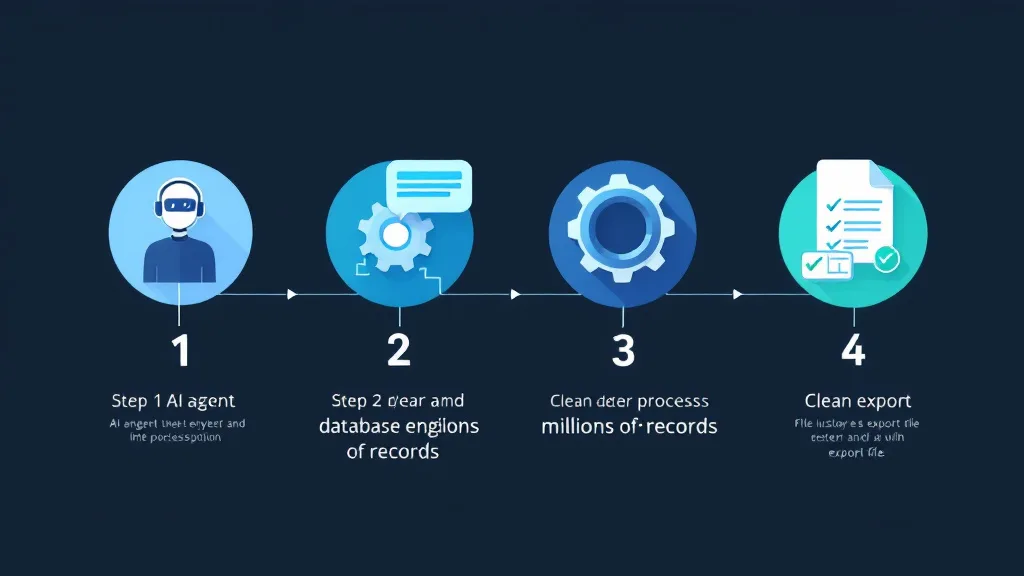
When an analyst tells their Claude or ChatGPT session to “deduplicate the contacts in the Salesforce export using Jaro-Winkler on name fields and exact match on email domain,” the agent:
- Creates a project via the MCP Server
- Configures the data source and maps the relevant columns
- Runs MDP’s AI profiling to validate the data before matching
- Builds a fuzzy match configuration with the specified algorithm and field weights
- Executes the match job against MDP’s engine — not inside the LLM’s context
- Pages through results and applies survivorship rules
- Exports the golden record set
At no point does the LLM attempt to compare records. It orchestrates. MDP’s deterministic engine matches. The accuracy, throughput, and auditability of the result are identical to a human-configured job — because it is the same engine, called via a different interface.
Why This Matters for Data Teams in 2026
The shift to agentic workflows is not theoretical. Data engineering teams are actively integrating AI assistants into their toolchains — for pipeline monitoring, schema inference, anomaly detection, and increasingly for data quality operations. The question is not whether AI agents will be involved in data quality work, but how accurately they will do it.
Teams that hand the matching task directly to an LLM will get plausible-looking results with an unknown and unmeasurable error rate. Teams that use LLMs to orchestrate a purpose-built matching engine will get documented, auditable, reproducible results at production scale — with the natural language interface that makes the workflow accessible to analysts who are not fuzzy matching specialists.
The MDP MCP Server is the first implementation of the second approach at scale. It is live now, compatible with Claude, ChatGPT, Cursor, and any custom MCP agent, and available on all MDP plans.
The Practical Checklist: LLM vs MCP Server for Fuzzy Matching
| Requirement | LLM Alone | MDP MCP Server |
|---|---|---|
| Handle 1M+ records | ❌ Context limit | ✅ No limit |
| Configurable fuzzy algorithms | ❌ None | ✅ Levenshtein, Jaro-Winkler, Soundex, Metaphone & more |
| Auditable match rules | ❌ Black box | ✅ Versioned, documented |
| Reproducible runs | ❌ Each inference differs | ✅ Same engine, same config |
| Plain-language configuration | ✅ | ✅ Via AI agent orchestration |
| Production throughput | ❌ Token cost scales with data | ✅ Fixed engine cost |
| False positive rate control | ❌ Unmeasurable | ✅ Threshold-configurable |
| No-code interface | ✅ Partial | ✅ Full workflow |
Empezando
The MDP MCP Server is live now. If you are building agentic data pipelines, evaluating LLM-assisted data quality tooling, or simply trying to deduplicate a large dataset without writing a match job from scratch, it is the fastest path from plain-language instruction to production-grade results.
- Read the full MCP Server product page — technical specs, all 54 tools, compatible clients
- Start your free trial — no contract, no commitment
- Book a demo — see the MCP Server in action with your data
Related reading:
AI Data Matching Software |
Entity Resolution |
Live Fuzzy Search API