
Source-to-target mapping defines exactly how every field in a source system transforms into a field in the target system. Get it wrong and your pipeline delivers corrupted, misaligned, or incomplete data at scale. Get it right and you move data that is clean, typed correctly, deduplicated, and ready for analytics from day one.
Every migration, integration, and warehouse load starts with a mapping document. But mapping alone is not enough. Without profiling the source first and cleansing the data before it moves, even a perfect mapping spec produces a broken target. This article covers the best practices that keep both the mapping and the data quality layers in sync.
Book a demo to see how Match Data Pro automates the data quality layer that sits behind your mapping specs.
What Source-to-Target Mapping Actually Covers
A source-to-target mapping document is a structured specification that records four things for every field: the source field name and type, the target field name and type, the transformation logic, and any business rule or constraint that governs the mapping. It is the contract between the data engineering team and the system that will consume the output.
A minimal mapping row looks like this:
| Source field | Source type | Target field | Target type | Transformation |
|---|---|---|---|---|
| CUST_FNAME | VARCHAR(50) | first_name | TEXT | TRIM, PROPER CASE |
| ACCT_ZIP | CHAR(5) | postal_code | VARCHAR(10) | Append ZIP+4 via CASS lookup |
| ORD_DT | INT (YYYYMMDD) | order_date | DATE | Cast to ISO 8601 (YYYY-MM-DD) |
| CUST_ID | CHAR(12) | customer_id | UUID | Hash to UUID v4 |
The most common mapping failures are type mismatches (loading a VARCHAR date into a DATE column), truncation errors (a 100-character name into a VARCHAR(80) target), and silent nulls (a source field that is 40% empty but maps to a NOT NULL target column).
Profile the Source Before Writing a Single Mapping
Skipping source profiling is the single biggest cause of mapping rework. AI data profiling surfaces the field-level facts your mapping spec needs: actual max length, null rate, cardinality, value distribution, and format patterns. Without those facts, every mapping row is a guess.
What profiling reveals before mapping
Run profiling on the raw source before the mapping workshop. Common findings that change mapping decisions:
- Unexpected nulls. A customer_email field shows 38% null. The target schema marks it NOT NULL. Mapping fails at load without a default or exclusion rule.
- Format heterogeneity. A phone field contains (555) 123-4567, 555.123.4567, and +15551234567 in the same column. Standardisation is required before mapping to an E.164 target.
- Hidden duplicates. A vendor table with 12,000 rows contains 2,100 duplicates across VEND_NAME and VEND_ADDR. Loading without deduplication inflates the target by 17%.
- Type drift. A numeric revenue field stores values like “$1,200.00” as VARCHAR. A direct cast to DECIMAL fails on 8% of rows.
Data profiling should produce a field-level quality report that feeds directly into the transformation column of your mapping document.
The Seven Best Practices for Accurate Source-to-Target Mapping
1. Map metadata, not just fields
Every mapping row should capture the business owner, the last-updated date, and whether the mapping is confirmed or provisional. Mapping documents drift when changes are made verbally and never recorded. Treat the spec as a versioned artefact in source control.
2. Standardise before you map
Data standardisation normalises formats, units, and value sets in the source before the mapping runs. Mapping a non-standard value to a target that expects a standard code (for example, “United States” to “US”) without a lookup table produces load errors. Define the transformation logic in the mapping doc, then enforce it in the pipeline.
3. Deduplicate at the source, not the target
Loading duplicates into a target and deduplicating afterwards costs two to three times more engineering effort. Data deduplication using fuzzy matching catches near-duplicates that exact-match logic misses. A vendor named “Acme Corp.” and “ACME Corporation” are the same entity. A fuzzy Jaro-Winkler score of 0.91 on name plus a postal code match confirms the link before the record moves.
4. Apply entity resolution across all source systems
When the migration draws from multiple sources (CRM, ERP, flat file exports), the same entity appears in each with different keys. Entity resolution links those records before the target load so the target carries one canonical record per entity rather than three conflicting copies. Senzing entity resolution, available inside Match Data Pro, handles this without hand-crafted rules.
5. Verify addresses before mapping postal fields
Postal fields are the most commonly mis-mapped fields in CRM and ERP migrations. A source address field that mixes street, city, state, and ZIP into a single string cannot map cleanly to a parsed target schema without parsing and CASS verification first. Address data cleansing parses the string, validates it against the USPS database, and returns a structured, deliverable address with ZIP+4 appended. Map that structured output, not the raw string.
6. Build a validation layer into the mapping spec
Every mapping should carry an acceptance test: the expected row count, the acceptable null rate for each field, and the allowed value distribution for coded fields. Run these tests after each load cycle. A target customer table with 5% more rows than the source table signals that the deduplication step missed records, or that orphan rows from a join are duplicating.
7. Automate iterative runs with job scheduling
A one-time migration spec becomes a recurring integration spec the moment the business asks for delta loads. Job automation in a data quality platform lets you schedule the full pipeline (profile, cleanse, deduplicate, entity resolve, load, validate) on a defined cadence. Mapping changes propagate through the pipeline configuration, not through individual SQL scripts.
Where Data Quality Intersects with Mapping
Source-to-target mapping is not only a schema exercise. Every transformation cell in the mapping spec implies a data quality operation. Renaming a field is trivial. Converting, standardising, deduplicating, and verifying it is not.
The diagram below shows the full pipeline that sits behind a mapping spec when data quality is built in:
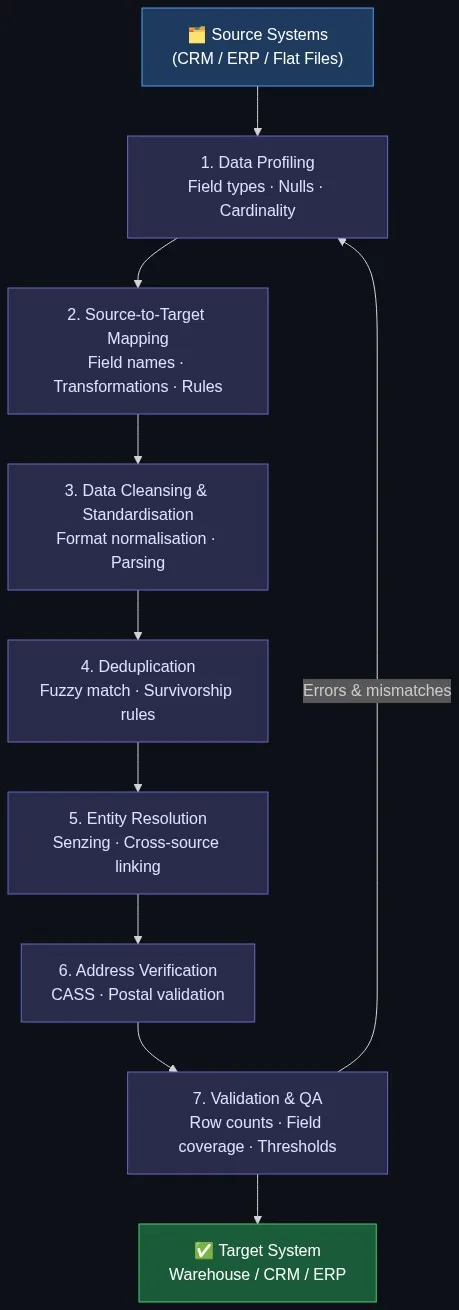
Match Data Pro implements each stage of this pipeline as a configurable job. Import the source via a connector (CSV, database, Salesforce, Excel), run AI profiling, apply cleansing rules, execute fuzzy deduplication, resolve entities with Senzing, verify addresses with CASS, and export the clean output to the target. The mapping document drives the transformation configuration; the pipeline enforces the data quality.
Teams that integrate data quality into mapping see 35 to 55% fewer load errors on first-pass migration loads, based on reported outcomes from enterprise data migration projects. The reduction comes from catching format errors, null violations, and duplicate inflation before the target ever receives a record.
Common Mapping Mistakes and How to Fix Them
Mapping before profiling
Writing mapping specs from schema documentation rather than observed source data produces specs that fail on null rates, type drift, and length violations. Always profile first. The profiling output becomes the transformation logic. Fix: run automated data profiling on every source table before the mapping workshop.
Ignoring data lineage
When a target field is derived from three source fields (first_name plus middle_name plus last_name to full_name), the lineage must be documented in the mapping spec. Teams that skip lineage documentation cannot trace data quality issues back to the source. Fix: add a “source derivation” column to every mapping row.
Skipping cross-system deduplication
Multi-source migrations frequently load the same customer from CRM and ERP as two separate records in the target. The downstream system then sends duplicate communications or computes incorrect revenue metrics. Fix: apply fuzzy matching across all source keys before the target load.
Treating mapping as a one-time document
Business requirements change. New fields appear. Source systems are upgraded. A mapping spec that is not version-controlled becomes inaccurate within weeks. Fix: store the mapping spec in Git, linked to the pipeline configuration. Changes to the spec trigger a pipeline update, not a manual script rewrite.
How Match Data Pro Supports Source-to-Target Mapping Workflows
Match Data Pro is a cloud SaaS platform that automates the data quality layer between source and target. It does not replace your mapping document. It enforces the transformation and quality rules that your mapping document defines.
Key capabilities relevant to mapping pipelines:
- AI data profiling: Scans source tables and returns field-level quality metrics before mapping begins.
- Data cleansing and standardisation: Applies format normalisation, parsing, and value-set enforcement as defined in the mapping transformation column.
- Fuzzy deduplication: Catches near-duplicate records across source tables before the target load, using configurable Levenshtein, Jaro-Winkler, and phonetic algorithms.
- Entity resolution (Senzing): Links records across multiple source systems into a single canonical entity before mapping to the target key.
- CASS address verification: Parses, validates, and standardises postal fields so they map cleanly to structured target schemas.
- Job automation: Schedules the full pipeline on a daily, weekly, or event-driven cadence with no manual trigger required.
- Import/export connectors: Connects to CSV, Excel, SQL databases, Salesforce, and other common source and target systems.
No long-term contract. Start a free trial and run a source-to-target mapping pipeline on your own data in under an hour.
Frequently Asked Questions
What is source-to-target mapping in data engineering?
Source-to-target mapping is a specification document that defines how every field in a source system maps to a field in a target system, including the field names, data types, transformation logic, and business rules. It acts as the contract between data engineering and the downstream system, ensuring that data moves correctly and consistently.
Why should data profiling happen before source-to-target mapping?
Profiling the source first reveals actual null rates, type drift, format heterogeneity, and cardinality that schema documentation does not show. These findings directly affect transformation logic. Without profiling, mapping specs are based on assumptions that fail at load time, causing rework that costs 2 to 4 times the effort of getting the profiling right upfront.
How does deduplication fit into source-to-target mapping?
Deduplication should run on the source data before the target load, not after. Fuzzy matching identifies near-duplicate records (different spellings, nicknames, transposed digits) that exact-match logic misses. Removing duplicates at the source prevents inflated row counts, conflicting records, and downstream reporting errors in the target system.
What is entity resolution and why does it matter for mapping?
Entity resolution links records that represent the same real-world entity across multiple source systems, even when they have different IDs, field values, or formats. In a mapping context, it ensures that one canonical record enters the target per entity, rather than three conflicting copies from CRM, ERP, and a flat file export.
How does address verification improve source-to-target mapping accuracy?
Address fields are among the most inconsistently structured fields in source systems. CASS-certified address verification parses unstructured address strings, validates them against the USPS postal database, and returns a clean, structured, deliverable address with ZIP+4 appended. This structured output maps cleanly to a parsed target schema, eliminating type errors and load failures caused by raw address strings.