
Poor data quality in healthcare kills patients, delays diagnoses, and drives up costs. Studies estimate that inaccurate or duplicate patient records contribute to adverse events in roughly 1 in 5 hospital admissions in the United States. The fix is a structured pipeline that profiles, standardises, deduplicates, and continuously monitors every patient record flowing through your systems.
Ready to fix patient record quality at scale? Start a free trial of Match Data Pro and run your first profiling job in under 30 minutes.
Why Healthcare Data Quality Problems Are Uniquely High-Stakes
In most industries, a duplicate record wastes a marketing dollar. In healthcare, a duplicate patient record can mean a clinician sees the wrong allergy list, administers the wrong dose, or fails to flag a chronic condition. The data problems cluster around three root causes.
Fragmented source systems
A single patient may have records in an EHR, a lab information system, a pharmacy system, an insurance claims database, and a radiology platform. Each system assigns its own patient identifier. None of them share a master patient index by default. The result: “Robert Johnson” in the EHR, “Bob Johnson” in the pharmacy, and “R. Johnson” in the claims system are treated as three separate people.
Name and date-of-birth variation
Healthcare records are entered under time pressure by multiple staff members. Common errors include transposed date-of-birth digits (1965-04-12 vs. 1965-12-04), shortened given names (William vs. Bill), and hyphenated surnames entered inconsistently. A simple exact-match join misses every one of these pairs.
Address data decay
Patients move. Discharge summaries and appointment reminders sent to a stale address miss the patient entirely. The USPS estimates roughly 10-15% of addresses in any large database become invalid within 12 months. Healthcare operations teams have no mechanism to catch this decay unless address verification is built into the pipeline.
The Four-Stage Healthcare Data Quality Pipeline
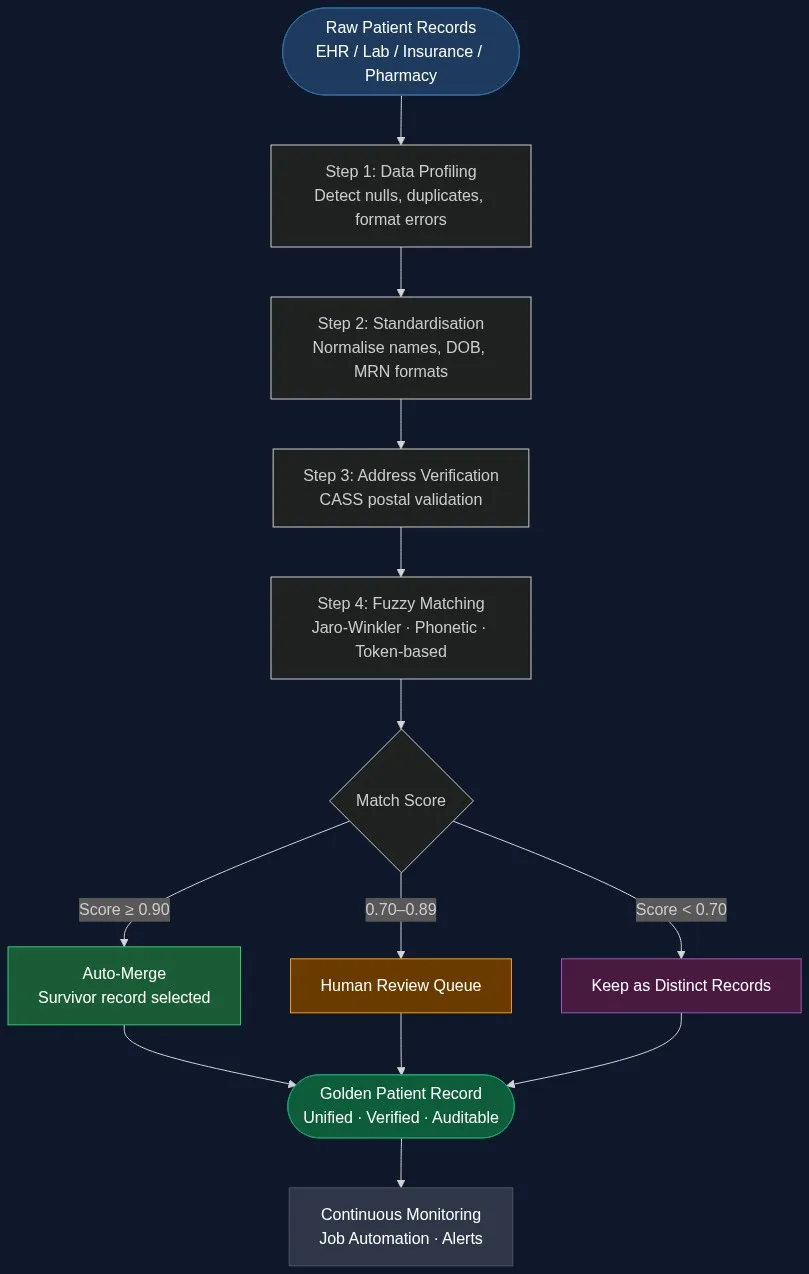
The diagram below shows the end-to-end pipeline. Each stage has a defined input, a set of operations, and a measurable output quality metric.
Stage 1: AI data profiling
Profiling is the diagnostic layer. Before any record is touched, AI data profiling scans every field across every source dataset and reports: null rates, format inconsistencies, value distribution anomalies, and probable duplicate clusters. A typical 500,000-record patient dataset surfaces 8-12% null MRNs, 4-6% transposed date-of-birth values, and 15-20% duplicate candidate pairs at this stage. Without profiling, you are flying blind into the cleansing stage.
Stage 2: Standardisation and cleansing
Data cleansing and standardisation converts raw field values into a normalised schema before any matching occurs. For healthcare records, this means:
- Given names mapped to canonical forms (Bill → William, Bob → Robert)
- Date-of-birth normalised to ISO-8601 (YYYY-MM-DD)
- Phone numbers stripped to 10-digit format
- Gender codes harmonised across M/Male/1 variations
- MRN prefixes from legacy systems stripped and padded to a uniform length
Standardisation before matching is non-negotiable. Running fuzzy matching on un-normalised fields produces false positives and false negatives in equal measure.
Stage 3: Address verification
Every patient address should be validated against the USPS postal database using CASS-certified address verification. CASS validation corrects street abbreviations, appends ZIP+4 codes, and flags non-deliverable addresses with a specific reason code. A team processing 100,000 discharge letters annually that skips this step wastes 10,000-15,000 mailings per year at full print-and-postage cost. More critically, patients at non-deliverable addresses never receive follow-up care instructions.
Stage 4: Fuzzy matching and deduplication
With clean, standardised records, the matching engine applies a weighted multi-algorithm scoring model. Fuzzy matching algorithms work in combination rather than isolation:
| Field | Algorithm | Weight | Match threshold |
|---|---|---|---|
| Given name | Jaro-Winkler + Phonetic | 25% | ≥ 0.85 |
| Family name | Jaro-Winkler + Phonetic | 25% | ≥ 0.85 |
| Date of birth | Exact + Transposition check | 30% | Exact or 1-digit swap |
| Address | Token-based + CASS normalised | 15% | ≥ 0.80 |
| Phone | Exact (normalised) | 5% | Exact |
A composite score at or above 0.90 triggers automatic merge. Scores between 0.70 and 0.89 route to a human review queue. Below 0.70, records are kept separate. This threshold model is configurable: a children’s hospital with high nickname variation might lower the name weight and raise the DOB weight.
Entity Resolution: Linking Records Across Siloed Systems
Deduplication within a single system is only half the problem. Healthcare organisations need to link the same patient across an EHR, a claims system, and a pharmacy platform where no shared identifier exists. This is the entity resolution problem. Senzing entity resolution, integrated into Match Data Pro, applies graph-based probabilistic matching across all source systems simultaneously. It builds a persistent entity graph where each node is a resolved patient identity and each edge represents a confirmed linkage between source records.
The practical output: a patient who appears as “Elizabeth M. Rodriguez” in the EHR, “E. Rodriguez-Morales” in the pharmacy, and “Rodriguez, Liz” in the claims system resolves to a single golden patient record with a unified medication history, allergy list, and contact address. Clinicians working from this golden record see the complete picture instead of a fragment.
The Survivorship Rules That Build the Golden Patient Record
When two or more source records merge, survivorship rules determine which field value wins. This is not a trivial decision in healthcare. The wrong survivorship rule can populate the golden record with a stale phone number or an outdated primary-care physician. Data merging and survivorship rules in Match Data Pro are configured field by field:
- Most recent wins: Contact address, phone number, insurance ID
- Most complete wins: Given name (prefer “Elizabeth” over “E.”)
- Source priority wins: Date of birth from the EHR beats claims data
- Union (keep all): Allergy codes, diagnosis codes (safety-critical, never discard)
Every merge decision is written to an audit log with the source record IDs, field-level scores, the winning survivorship rule, and the timestamp. This log supports HIPAA compliance audits and gives clinical informaticists a reversible chain of custody.
Automating Continuous Data Quality in Healthcare Operations
A one-time cleansing project degrades within months. New admissions, insurance updates, and EHR migrations introduce fresh errors at a constant rate. Healthcare data quality requires automated, repeatable data quality workflows that run on a schedule or trigger on ingestion events.
Match Data Pro’s job automation engine lets data teams configure scheduled jobs that:
- Profile incoming feed files from lab and insurance partners nightly
- Run incremental deduplication against the master patient index for new records only
- Fire alerts when duplicate rates exceed a configurable threshold (e.g., more than 2% new duplicates in a daily batch)
- Push golden records downstream to the EHR via REST API connectors within minutes of resolution
For healthcare IT teams operating under HIPAA, this architecture also means every data movement is logged, every job run is timestamped, and every field change is traceable. The record linkage pipeline produces an end-to-end audit trail that satisfies both clinical governance and privacy compliance requirements.
Book a personalised walkthrough to see how Match Data Pro handles real patient record data at scale: Schedule a demo.
Measuring Data Quality in Healthcare: Key Metrics
Healthcare data quality is measurable. Teams that track these metrics can demonstrate programme value to CDOs and compliance officers:
| Metric | Definition | Target benchmark |
|---|---|---|
| Duplicate rate | % of patient records with at least one duplicate | < 1% |
| MRN null rate | % of records with missing medical record number | < 0.5% |
| Address deliverability | % of addresses passing CASS verification | > 97% |
| DOB format error rate | % of records with unparseable or implausible DOB | < 0.2% |
| Match review queue rate | % of pairs requiring human review (score 0.70-0.89) | 5-10% |
These metrics feed directly into the data quality dashboard in Match Data Pro, giving operations leads and CDOs a real-time view of record health across every source system.
Frequently Asked Questions
What is data quality in healthcare and why does it matter?
Data quality in healthcare refers to the accuracy, completeness, and consistency of patient and operational records across clinical systems. It matters because inaccurate records contribute to misdiagnoses, medication errors, duplicate testing, and regulatory non-compliance. Studies estimate that duplicate patient records alone affect 8-12% of hospital records, creating direct patient safety risks and wasted operational spend.
How do you deduplicate patient records across multiple systems?
Deduplicating patient records across systems requires a multi-step pipeline: standardise name, DOB, and address fields; apply fuzzy matching algorithms (Jaro-Winkler for names, token-based for addresses) with weighted scoring; route high-confidence pairs to auto-merge and borderline pairs to human review; then apply survivorship rules to build a unified golden patient record. Entity resolution tools like Senzing handle cross-system linkage without a shared identifier.
What causes duplicate patient records?
Duplicate patient records are caused by multiple registration entry points with no real-time deduplication check, inconsistent name and DOB formatting across departments, patients presenting under nicknames or maiden names, system migrations that import records without matching against the existing master patient index, and mergers between health systems that combine previously separate databases.
Is fuzzy matching accurate enough for healthcare records?
Yes, when configured correctly. A multi-algorithm approach that combines Jaro-Winkler name similarity, phonetic matching, exact DOB matching with transposition detection, and address token scoring achieves precision rates above 97% on healthcare datasets. The critical configuration decision is the threshold model: auto-merge at 0.90+, human review at 0.70-0.89, and retain as separate below 0.70. This keeps false-positive merges below 0.5%.
How does Match Data Pro support HIPAA compliance in healthcare data pipelines?
Match Data Pro writes a full audit log for every record operation: source record IDs, field-level match scores, the survivorship rule applied, and the timestamp of the merge. This log is queryable and exportable for HIPAA compliance audits. The platform operates as a cloud SaaS with no long-term contract, and all data processing can be scoped to specific datasets without retaining PII beyond the active job window.