
A data audit trail records every insert, update, and delete applied to a record — who made the change, when, from which system, and what the previous value was. Without one, data governance is a statement of intent, not a verifiable practice. Regulated industries require audit trails by law; everyone else needs them to trust their analytics.
Ready to put audit-ready data quality in place? Book a demo with the Match Data Pro team and see the full governance pipeline in action.
Why Audit Trails Matter for Data Governance
Data governance frameworks demand accountability at the record level, not just the dataset level. Regulations like GDPR, HIPAA, SOX, and CCPA each require organisations to demonstrate that data was handled correctly — and to produce evidence on demand. An audit trail is that evidence.
Consider a healthcare provider that updates a patient’s address. Without a trail, there is no way to prove the old address was removed, who authorised the change, or whether the update propagated correctly across systems. A single bad address change can misdirect prescriptions and trigger a breach notification.
For financial teams, SOX requires that any change to a material financial record is traceable to an authorised user. For marketing, GDPR Article 30 requires records of processing activities — including what personal data was altered and when. The penalty for non-compliance is up to 4% of global annual turnover.
What regulators actually inspect
- The before-state and after-state of every changed field
- The identity of the user or system that made the change
- The timestamp, accurate to the second
- The source system or integration that triggered the event
- Evidence that the change was authorised (role-based access log)
The Five Components of an Effective Data Audit Trail
Not every change log qualifies as a governance-grade audit trail. A real trail has five components working together.
1. Field-level delta capture
Row-level logging (“record 4421 was updated”) is insufficient. You need field-level deltas: which specific columns changed, what the old value was, and what the new value is. Example:
| Record ID | Field | Old Value | New Value | Changed By | Timestamp |
|---|---|---|---|---|---|
| CUST-8801 | jsmith@acme.com | john.smith@acme.com | crm_import_job | 2026-10-07 09:14:33 UTC | |
| CUST-8801 | phone | 555-0100 | 555-0198 | api_user: rev_ops | 2026-10-07 09:14:33 UTC |
2. Immutable log storage
Audit entries must be write-once. If a bad actor can overwrite the log, it is not an audit trail. Append-only storage, cryptographic hashing of log sequences, or write-once object storage (S3 Object Lock, Azure Immutable Blob Storage) are the standard options.
3. Identity and access metadata
Each log entry must capture the actor: a human user (with role), an automated job (with job ID and scheduled trigger), or an external API call (with authenticated client ID). This is what connects a data change to an authorised action.
4. Source-system tagging
In multi-system environments — CRM, ERP, marketing automation, data warehouse — records arrive from many places. Tag every entry with the originating system and integration connector. When a conflict surfaces, you can trace exactly which source injected the erroneous value.
5. Compliance routing
High-risk changes (PII fields, financial fields, master record merges) should trigger a compliance check at write time. Changes that fail the check route to a review queue rather than committing silently. This prevents dirty data from reaching the golden record while still capturing a full record of the attempted change.
How Match Data Pro Supports Audit-Ready Data Pipelines
Match Data Pro’s data quality pipeline records the provenance of every operation it performs. Every cleansing step, standardisation pass, deduplication merge, and entity resolution decision generates a timestamped log entry with before/after field values, the rule or algorithm that triggered the change, the confidence score, and the operator identity.
Deduplication and merge audit
When Match Data Pro’s deduplication engine identifies two records as duplicates and merges them into a golden record, the audit log captures the full merge decision: match score, algorithm weights, survivorship rule applied, and both source records preserved in their pre-merge state. If a downstream system questions the merge, you can replay the exact logic that produced it.
Entity resolution decisions
Senzing-powered entity resolution in Match Data Pro logs every link decision at the relationship graph level. Two records linked as the same entity, unlinked due to a threshold change, or routed to manual review — each state transition is recorded with a reason code and timestamp.
Job automation logs
Scheduled data quality jobs run on a configured schedule and write structured JSON logs on completion. Each log covers records processed, records changed, records flagged, errors encountered, and duration. These logs feed directly into reporting dashboards and can be exported for compliance review.
Building the Audit Trail: A Practical Six-Stage Workflow
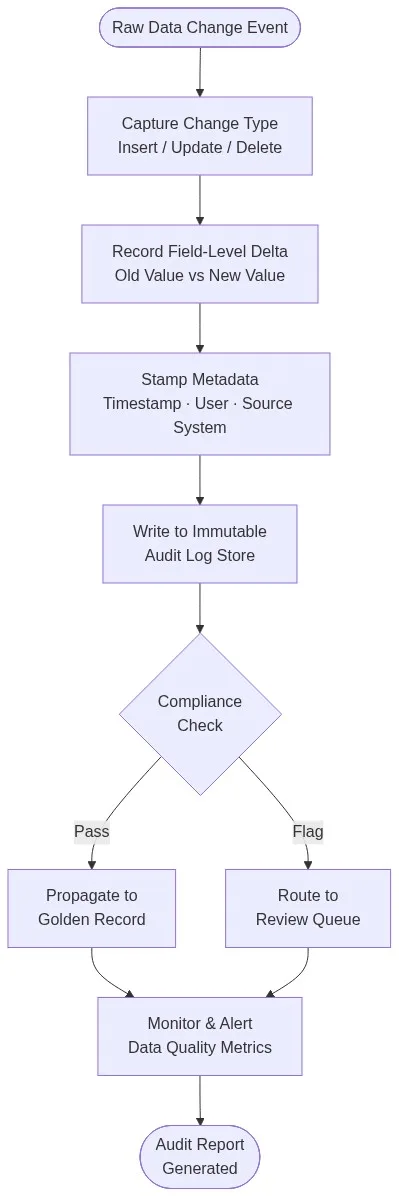
Here is the stage-by-stage workflow for implementing a governance-grade audit trail in a data quality program. The diagram below maps the full flow from raw change event to audit report.
Stage 1: Intercept change events
Use database triggers, change data capture (CDC) streams, or platform-level hooks to intercept every insert, update, and delete before it commits. Do not rely on application-layer logging alone — it misses bulk imports, API writes, and direct database access.
Stage 2: Record the delta
For each intercepted event, capture the old and new value for every changed field. Store null as “field did not exist” to distinguish blank from missing.
Stage 3: Stamp metadata
Attach actor, timestamp (UTC), source system, and change type (INSERT / UPDATE / DELETE) to each delta record. Use a monotonically increasing sequence number to detect gaps in the log.
Stage 4: Write to immutable store
Write the stamped delta to an append-only audit store. For cloud deployments, object storage with object-lock policies is the most cost-effective option. For on-premise, write-once WORM storage or a dedicated audit database with restricted delete permissions achieves the same result.
Stage 5: Run compliance checks
For changes to designated sensitive fields (email, national ID, financial account number, address), trigger a real-time compliance check. Pass changes that meet policy to the golden record. Route flagged changes to a human review queue with the full audit context attached.
Stage 6: Monitor and report
Feed the audit log into a monitoring layer that alerts on anomalies: a single user changing 500+ records in one session, a field that has never been modified suddenly receiving bulk updates, or a compliance check failure rate above a configured threshold.
Want to see how Match Data Pro handles audit-grade data quality from profiling through to entity resolution? Start a free trial today — no contract required.
Audit Trails Across Common Data Quality Operations
Address verification audit
When CASS address verification corrects a postal record, the audit entry logs the raw input, the corrected output, the verification code (match, non-match, default), and the verification timestamp. If a mailing returns, you can prove the address was verified on a specific date and the USPS correction was applied correctly.
Data profiling audit
Match Data Pro’s AI data profiling captures a snapshot of every dataset it analyses: null rates, pattern distributions, outlier counts, and field-level quality scores. Each profiling run is timestamped and versioned. Run a second profile after cleansing and the delta is evidence of the quality improvement — useful for both governance reporting and vendor SLA verification.
Import and export audit
Every import job that feeds records into Match Data Pro and every export that pushes clean data downstream is logged with row counts, rejected records, and transformation rules applied. This closes the lineage loop from source file to destination system.
Frequently Asked Questions
What is a data audit trail in data governance?
A data audit trail is a timestamped, immutable record of every change made to a dataset — capturing who changed it, when, what the old value was, and what the new value is. In data governance, audit trails are the evidence layer that proves data handling policies were followed and that regulators can inspect on demand.
Which regulations require a data audit trail?
GDPR (Article 30 records of processing), HIPAA (audit controls under the Security Rule), SOX (Section 302 and 404 controls on financial records), and CCPA (records of consumer data handling) all require organisations to maintain verifiable records of how personal and financial data was processed and changed. Specific retention periods vary from 3 to 7 years depending on the regulation.
How long should audit logs be retained?
Retention requirements vary by regulation: HIPAA requires 6 years, SOX requires 7 years, and GDPR requires logs to be kept as long as they are relevant to active processing. As a practical baseline, most data governance programs retain audit logs for 7 years and archive to low-cost object storage after 2 years to manage cost.
What is the difference between an audit log and a change log?
A change log records what changed; an audit trail records what changed, who changed it, why it was authorised, and that it cannot be altered after the fact. An audit trail is an immutable, identity-linked, governance-grade change log. A change log is a development tool. In regulated environments, only an audit trail satisfies compliance requirements.
Can automated data quality tools generate audit trails?
Yes. Platforms like Match Data Pro log every operation they perform — cleansing, standardisation, deduplication merges, entity resolution decisions, address verification — with field-level before/after values, timestamps, and the rule or algorithm that triggered the change. This means the audit trail is generated automatically, without requiring manual documentation of each data quality step.