
Inaccurate data costs organisations an average of $12.9 million per year in wasted spend, failed decisions, and missed revenue — and that figure compounds every month the data goes uncorrected. The root causes are consistent: duplicate records, unstandardised formats, missing fields, and unverified addresses. Each one creates a hidden tax on every system that consumes the data.
This article breaks down exactly where that cost lands, how to measure it, and the pipeline changes that eliminate it — with real before/after examples from CRM, ERP, and marketing workflows.
Ready to see what bad data is costing your organisation? Start a free trial of Match Data Pro and run a data profile in minutes.
Why Inaccurate Data Has a Direct Financial Cost
Data errors do not stay isolated. A single misspelled company name in a CRM creates a cascade: sales reps contact the same prospect twice, marketing counts the same lead as two, finance produces a revenue forecast built on inflated pipeline numbers. Each downstream system that consumes the bad record amplifies the error.
Three mechanisms drive the majority of the cost:
- Operational waste. Staff spend time correcting records manually, resolving duplicate orders, and chasing undeliverable mail. Industry estimates put data-related rework at 10–25% of operational labour costs in data-intensive teams.
- Decision degradation. Analytics built on inaccurate data produce wrong outputs. A sales territory model fed 8% duplicate customer records will overstate coverage and misallocate headcount.
- Compliance exposure. Regulatory frameworks — GDPR, CCPA, HIPAA, Basel III — require accurate, current records. Inaccurate data creates audit risk, fine exposure, and remediation costs that arrive long after the original error.
A Real-World Cost Illustration
Consider a B2B marketing team running a campaign to 200,000 records. If 12% are duplicates — a conservative estimate for a CRM that has never been deduplicated — and the cost per contact is $1.20 (email, print, or SDR outreach), that is $28,800 in direct wasted spend on that single campaign. Add the sales time spent chasing the same prospect under two names, and the real number is higher still.
The same logic applies to duplicate records across any system: the cost is not just the duplicated contact — it is the corrupted view of the customer that persists everywhere the record travels.
The Five Places Inaccurate Data Hits the Bottom Line
1. Wasted Marketing Spend
Duplicate and inaccurate records inflate audience size. Campaigns reach the same person multiple times under different identifiers, burning budget and degrading sender reputation. Undeliverable addresses — typically 10–15% of any list that has not been verified in the past 12 months — generate hard bounces that affect email domain health and increase direct mail costs without a single response.
Address standardisation and CASS-certified address verification eliminate undeliverable records before campaigns run, not after the spend is gone.
2. Lost Revenue from Broken Customer Visibility
When a customer exists as three separate records — “Acme Corp”, “Acme Corporation”, and “Acme Corp.” — your revenue team cannot see total wallet share, renewal dates, or cross-sell history accurately. Account executives work with a fragmented view. Sales forecasts are unreliable. Renewal alerts fire for the wrong contact.
The solution is entity resolution: linking all three records to a single verified identity using fuzzy matching across name, address, phone, and domain fields. Match Data Pro’s Senzing-powered entity resolution handles name variants, abbreviations, and transposed fields at scale.
3. ERP and Procurement Errors
Inaccurate vendor records in an ERP system generate duplicate purchase orders, failed three-way matches, and incorrect payment runs. “Global Supply Co” and “Global Supply Company Inc” may be the same vendor — but if they exist as two records, accounts payable processes both. Inventory counts built on duplicate SKUs give procurement a false picture of stock levels.
A data deduplication pipeline that runs across vendor and product master data catches these before they reach the payment or inventory system.
4. Failed Analytics and Reporting
Dashboards and BI reports are only as reliable as the records that feed them. Duplicate customer IDs overstate customer counts. Inconsistent date formats cause joins to fail silently. Missing industry codes produce blank segments in territory models. The result: leadership makes resource allocation decisions based on outputs that do not reflect reality.
Running AI-powered data profiling before analytics pipelines surface null rates, format violations, and value distribution anomalies before a single report runs. Match Data Pro’s profiling engine scores every field and flags issues with remediation recommendations.
For teams who have already invested in analytics infrastructure, improving data quality upstream is the most direct path to trustworthy reporting outputs.
5. Compliance and Audit Risk
Regulators expect accurate, current, deduplicated records. A financial institution that cannot produce a single verified customer identity across all its accounts faces KYC failures. A healthcare organisation with fragmented patient records risks billing errors and clinical safety issues. A retail company with inaccurate consent records faces GDPR enforcement risk.
These are not hypothetical risks. GDPR fines for data accuracy violations have reached tens of millions of euros. The cost of fixing data before an audit is a fraction of the cost of fixing it after one.
How to Measure the Cost of Inaccurate Data in Your Organisation
Before you can fix the problem, you need to quantify it. The following framework gives data leaders a structured way to calculate the actual financial exposure:
| Cost Category | Measurement Approach | Typical Range |
|---|---|---|
| Duplicate outreach | Duplicate rate x cost per contact x campaign volume | 8–15% of campaign budget |
| Undeliverable mail | Hard bounce rate x fully-loaded cost per contact | $0.50–$3.00 per bad record |
| Rework labour | Hours spent on manual corrections x fully-loaded hourly rate | 10–25% of data team time |
| Missed cross-sell | Fragmented account count x average deal value x close rate | Varies; often 5–12% of pipeline |
| Compliance remediation | Regulatory finding rate x average remediation cost | $50K–$5M+ per incident |
Start with a data quality framework that profiles each dataset and scores it against completeness, accuracy, consistency, and uniqueness dimensions. This gives you a baseline you can measure improvement against.
The Fix: A Five-Stage Data Quality Pipeline
The diagram below shows how inaccurate data enters the pipeline, where Match Data Pro applies each correction stage, and where financial value is recovered.
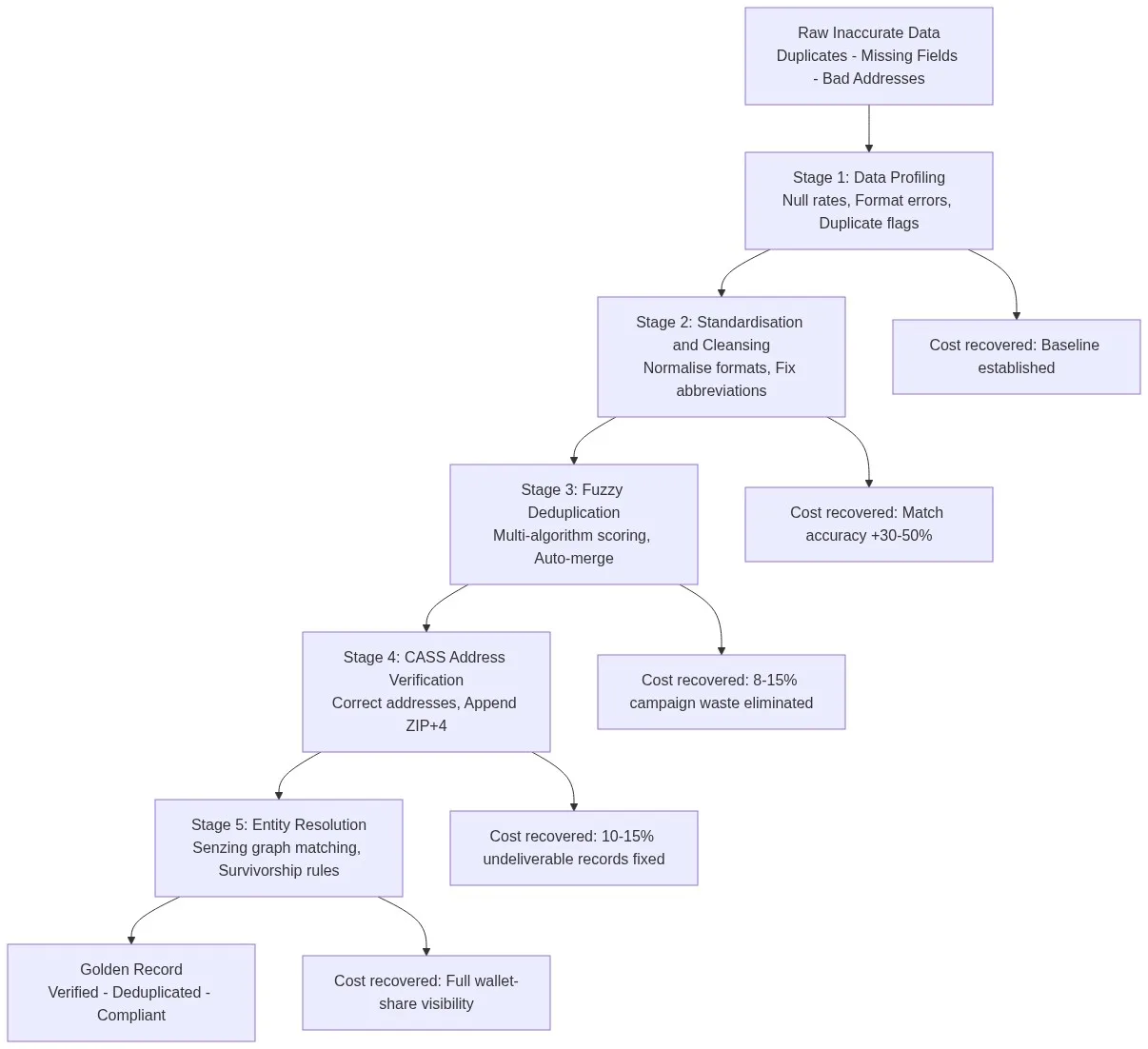
Stage 1: Profiling
Profile every dataset before touching a record. Match Data Pro’s profiling engine scans field-level completeness, value distributions, format patterns, and outlier rates. A profiling run on a 500,000-record CRM typically identifies: 11% null phone numbers, 9% duplicate email addresses, 14% inconsistent company name formats, and 6% address records that will fail postal verification.
Stage 2: Standardisation and Cleansing
Before matching runs, every field needs a consistent format. “St.” becomes “Street”. “Co.” becomes “Company”. Phone numbers are normalised to E.164. Dates are aligned to ISO 8601. Modern data cleansing at Match Data Pro applies configurable transformation rules that handle domain-specific patterns — industry codes, SIC categories, product identifiers.
Stage 3: Deduplication with Fuzzy Matching
Exact matching misses most duplicates. “Acme Corp” and “Acme Corporation” share no identical string — but a Jaro-Winkler similarity score of 0.94 on the name field, combined with a matching phone number and ZIP code, produces a composite score above the merge threshold. Match Data Pro runs configurable multi-algorithm scoring across every field combination, with user-defined weights and thresholds. Records above the auto-merge threshold consolidate automatically; borderline pairs go to a human review queue.
Stage 4: Address Verification
CASS-certified address verification corrects transposed street numbers, appends ZIP+4 codes, and flags addresses that do not exist in the USPS database. A typical enterprise dataset sees 10–15% of address records corrected or suppressed after CASS processing. This directly reduces wasted mail spend and improves delivery confidence scores for digital outreach.
Stage 5: Entity Resolution and Golden Record Creation
Entity resolution goes beyond deduplication. Where deduplication collapses identical-source duplicates, entity resolution in CRM workflows links records across CRM, ERP, marketing automation, and support systems that refer to the same real-world entity — even when they share no common key. Match Data Pro’s Senzing-powered engine builds a graph of related records and applies survivorship rules to produce a single golden record with the most reliable field values from every source.
Want to see how the pipeline applies to your data? Book a demo with the Match Data Pro team and we will walk through your specific use case.
Preventing Inaccurate Data at the Point of Entry
Batch cleansing fixes what is already broken. Prevention stops new errors from entering. Match Data Pro’s live fuzzy search API lets any web form, CRM, or integration check an incoming record against the existing master dataset in real time — before it is written to the database. If a new prospect matches an existing account at a score above 0.85, the form returns a suggested merge rather than creating a new record.
Combined with job automation — scheduled cleansing and deduplication runs that execute on a defined cadence — this means inaccurate data no longer accumulates between manual intervention cycles. The pipeline runs continuously, and the data quality score improves incrementally on every pass.
Match Data Pro’s import/export connectors pull data from CRM, ERP, flat files, and databases without custom integration work, so the pipeline runs on your actual production data, not a sample. Register for a free trial to connect your first data source today.
Frequently Asked Questions
What does inaccurate data actually cost a business?
Industry benchmarks put the average cost of inaccurate data at $12.9 million per year for large organisations, covering wasted marketing spend, operational rework, failed analytics decisions, and compliance remediation. The actual number depends on data volume, duplication rate, and how many downstream systems consume the bad records — each additional system multiplies the impact.
How do I calculate the cost of bad data in my organisation?
Start by profiling your primary datasets to measure duplication rate, null rates, and format error rates. Then multiply each error category by its downstream cost: duplicate rate x campaign cost per contact, undeliverable address rate x mail cost, rework hours x fully-loaded labour rate. A structured data quality framework gives you a repeatable baseline to measure improvement against quarter over quarter.
What is the difference between data cleansing and deduplication?
Data cleansing corrects individual field errors — formatting, casing, abbreviations, missing values. Deduplication identifies and merges records that represent the same real-world entity. Both are required for accurate data. Cleansing first improves match accuracy: standardising “Corp.” to “Corporation” before fuzzy scoring prevents false non-matches that would otherwise leave duplicates in place.
How does fuzzy matching help reduce inaccurate data costs?
Fuzzy matching detects duplicate and near-duplicate records that exact matching misses — typos, name variants, transposed digits, abbreviations. By collapsing these into verified golden records before campaigns, analytics, or financial processes run, fuzzy matching eliminates the downstream costs of operating on fragmented data: wasted outreach, wrong forecasts, and compliance gaps caused by fragmented customer identities.
How long does it take to see ROI from a data quality project?
Most organisations see measurable ROI within the first campaign or reporting cycle after cleansing — typically 30 to 90 days. The immediate gains come from reduced duplicate outreach and improved address deliverability. Longer-term ROI builds as entity resolution improves customer visibility, analytics accuracy rises, and compliance risk decreases. Match Data Pro’s cloud SaaS model with no long-term contract means you can start a trial, profile your data, and measure the impact before committing.