
When you integrate data from multiple systems — CRM, ERP, marketing platform, third-party data provider — you will find duplicates across every source boundary. Dedupe software for multi-source data integration resolves this by identifying and collapsing overlapping records before they corrupt downstream analytics, inflate contact counts, or trigger duplicate outreach. The process requires more than basic exact-match filtering: records rarely share identical field values across systems, so fuzzy matching and entity resolution are essential.
Before choosing a platform, run a data profiling pass across each source to understand field coverage, format variance, and estimated duplicate rate. That baseline drives every subsequent configuration decision. Book a demo to see how Match Data Pro handles multi-source deduplication on your own data.
Why Multi-Source Deduplication Is Different from Single-Source Deduplication
Single-source deduplication — finding duplicates inside one CRM or one spreadsheet — is comparatively straightforward. The field schema is consistent, formats are relatively uniform, and blocking keys are predictable. Multi-source integration changes each of those assumptions.
Schema Mismatch
Source A stores a full name in one field: John P. Smith. Source B splits it into first_name and last_name. Source C uses an abbreviation: J Smith. Before any comparison can happen, the fields must be parsed and normalised to a common structure. Without this step, even a record that represents an identical person will score below any reasonable match threshold.
Format Variance
Consider a phone number. One system stores (312) 555-0147; another stores 3125550147; a third stores +1-312-555-0147. An exact-match join on phone number returns zero results despite three systems referring to the same person. Address data is worse: Suite 400, Ste 400, and STE. 400 are the same unit suffix in three different formats.
Overlapping but Non-Identical Coverage
Source A has 400,000 records. Source B has 350,000. The overlap may be 60–70%, but you cannot know in advance which records overlap, which are unique, and which represent the same entity under a different identifier. This is the core challenge that fuzzy matching and entity resolution solve.
The Six-Stage Pipeline for Multi-Source Deduplication
A robust multi-source deduplication pipeline runs through six ordered stages. Skipping any stage produces compounding errors downstream.
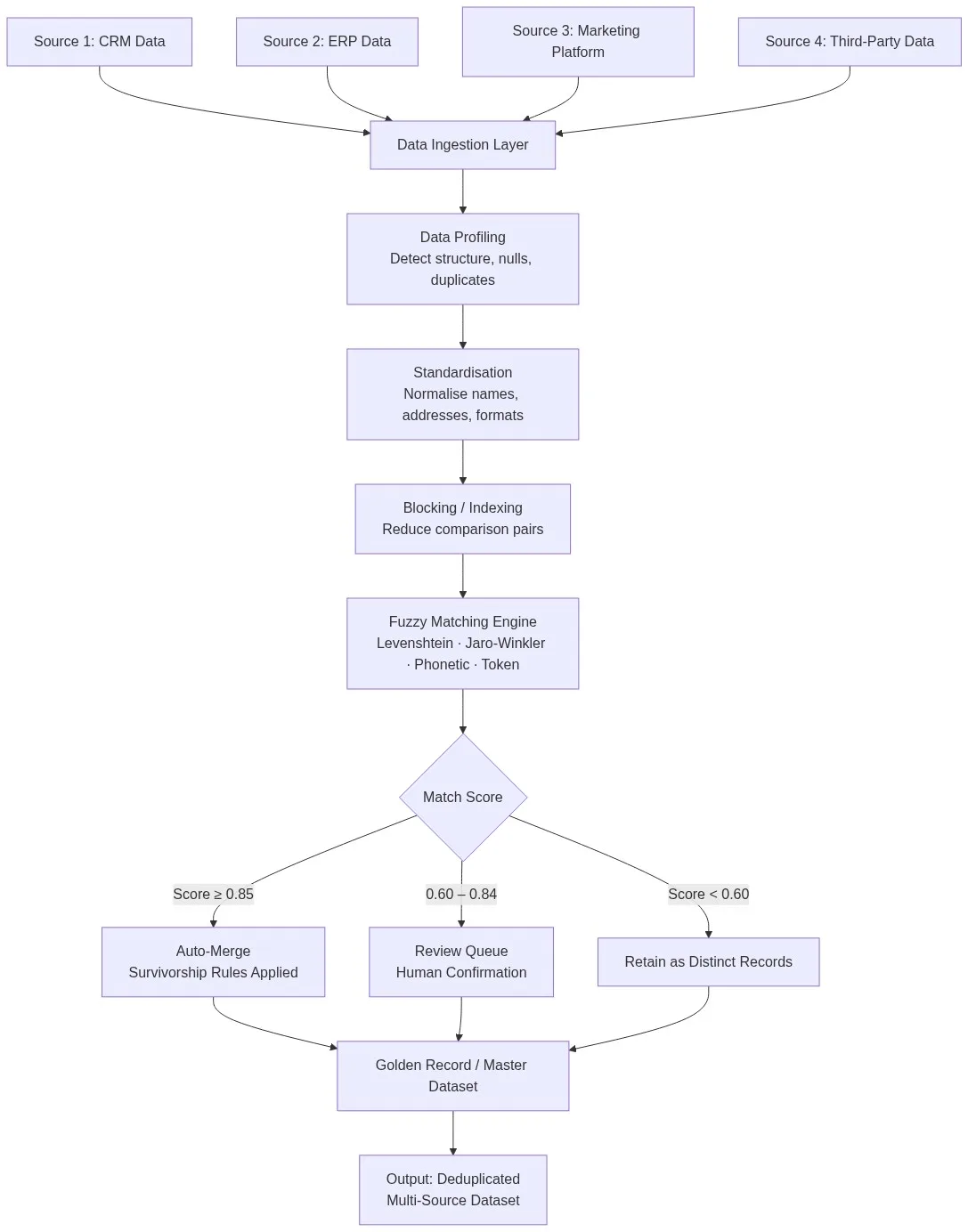
Stage 1: Profiling
Before standardisation, profile every source independently. Measure null rates, value distributions, format patterns, and intra-source duplicate rates. A source with 22% null email addresses requires a different blocking strategy than one with 98% email coverage. Match Data Pro’s AI data profiling engine scans each dataset automatically and surfaces these metrics before any matching runs.
Stage 2: Standardisation
Normalise every field to a shared canonical form. Name parsing splits full names and removes honorifics. Phone normalisation strips punctuation and applies E.164 format. Address standardisation expands abbreviations and applies USPS postal rules via data cleansing and standardisation routines. After this stage, J Smith, John P. Smith, and John Smith share enough normalised tokens to become comparable.
Stage 3: Blocking and Indexing
Comparing every record in Source A against every record in Source B is computationally infeasible at scale. A dataset of 500,000 records from two sources generates 250 billion comparison pairs. Blocking reduces this to a tractable number by grouping records into candidate sets — for example, all records sharing the same first three characters of last name and same ZIP code. Match Data Pro applies multiple overlapping blocking keys in parallel to maintain recall while cutting comparison volume by 99%+.
Stage 4: Fuzzy Matching and Scoring
Within each block, the engine scores every candidate pair using a weighted combination of algorithms. Name fields use Jaro-Winkler for short strings and token-set ratio for full names with middle initials. Phone fields use exact match after normalisation. Address fields use Levenshtein distance on parsed components. Email fields use exact match plus domain-level fuzzy scoring for corporate variants.
A typical weighted scoring configuration looks like this:
| Field | Algorithm | Weight |
|---|---|---|
| Last name | Jaro-Winkler | 30% |
| First name | Jaro-Winkler | 20% |
| Address | Levenshtein on parsed components | 25% |
| Phone | Exact after E.164 normalisation | 15% |
| Exact + domain fuzzy | 10% |
A composite score of 0.85 or above triggers auto-merge. Scores between 0.60 and 0.84 route to a human review queue. Scores below 0.60 retain both records as distinct entities.
Stage 5: Survivorship and Merging
Once two records are confirmed as duplicates, survivorship rules determine which field value populates the golden record. Common rules: most recent non-null wins; longest string wins for name fields; verified address (CASS-certified) wins over unverified. The merge purge process in Match Data Pro applies these rules automatically, producing a single authoritative record with a full audit trail showing which source contributed each field value.
Stage 6: Validation and Ongoing Monitoring
After deduplication, validate output quality. Measure match rate, false-positive rate (confirmed non-duplicates that were auto-merged), and golden record completeness. Set up ongoing monitoring so that new records ingested from any source are checked against the existing master dataset in real time via the deduplication API before they enter the system.
Handling Specific Multi-Source Overlap Scenarios
Scenario 1: CRM Plus ERP Overlap
A manufacturing company has 280,000 customer records in their CRM and 195,000 accounts in their ERP. The CRM uses email as the primary key; the ERP uses account number. There is no shared identifier. After standardisation and fuzzy matching, the team finds 140,000 records match across both systems — but 23,000 of those matches score in the 0.60–0.84 confidence band, meaning they share the same company name and ZIP but different contact names. Those route to a review queue before merging.
Scenario 2: Post-Acquisition Database Merge
A company acquires a competitor and needs to merge two separate customer databases. Both use the same CRM platform, but with different custom field schemas. A multi-source record linkage approach maps fields from each instance, standardises them, then runs a full cross-database deduplication pass. Result: 18% of records are duplicates, and the combined database shrinks from 620,000 to 510,000 records — eliminating 110,000 ghost contacts before the combined team begins outreach.
Scenario 3: CRM Plus Third-Party Contact List
A B2B marketing team imports a third-party contact list of 80,000 records. Before uploading, they run it against the existing CRM using the batch deduplication pipeline. Result: 31,000 records (39%) already exist in the CRM. Of the remaining 49,000, 8,000 match at confidence scores of 0.60–0.84 — likely the same company at a slightly different address. Those are flagged for sales review before loading, preventing both duplicate outreach and the cost of enriching records that already exist.
Key Capabilities to Look for in Dedupe Software for Multi-Source Integration
Not all deduplication tools are designed for multi-source scenarios. Single-source tools often lack the schema flexibility, blocking sophistication, and survivorship controls needed for true multi-source integration. Evaluate platforms on these six dimensions:
- Schema flexibility: Can the tool map and normalise fields from disparate sources without requiring identical schemas?
- Configurable algorithms: Can you weight different algorithms by field type? Name fields, phone fields, and address fields need different scoring approaches.
- Multiple blocking strategies: Does the tool support overlapping blocks to prevent recall loss when one field is missing or erroneous?
- Survivorship rule engine: Can you define field-level rules for which source wins on which attribute?
- Audit trail: Does every merge decision produce a record showing what source contributed what value?
- API for real-time prevention: Once the initial batch is clean, can the tool block future duplicates at the point of ingestion?
Match Data Pro handles all six dimensions. The platform’s configurable matching engine supports both deterministic and probabilistic scoring, and its Senzing entity resolution layer adds graph-based identity resolution for complex multi-source scenarios involving large record volumes or high entity ambiguity. Deployment is cloud SaaS with no long-term contract. Start a free trial and run your first multi-source deduplication job in hours.
Common Mistakes in Multi-Source Deduplication Projects
Skipping Pre-Match Standardisation
The most common failure mode: teams run matching on raw, unstandardised data. The result is a high false-negative rate — missed matches — because the scoring engine cannot recognise Ste 400 and Suite 400 as equivalent. Standardise first, always. On a dataset with moderate format variance, standardisation alone can increase match recall by 20–35%.
Using a Single Blocking Key
A single blocking key — say, ZIP code — misses records where ZIP is absent or erroneous. Multiple overlapping keys (ZIP plus last-name prefix, city plus phone prefix, email domain plus company token) ensure that missing or wrong values in one key do not exclude a valid match candidate from the comparison set.
Setting Thresholds Without Profiling
A threshold of 0.85 that works well for a clean enterprise CRM may be far too aggressive for a third-party contact list with inconsistent formatting. Profile your data first. Then tune thresholds against a labelled sample of known matches and known non-matches before running the full pipeline at scale.
Treating Deduplication as a One-Time Event
New records enter every system daily. Without an API-based real-time check at ingestion — or at minimum a weekly batch job — duplicates accumulate again within months. Match Data Pro’s job automation runs scheduled deduplication passes and real-time API checks to keep the master dataset clean continuously, not just on day one.
Frequently Asked Questions
What is dedupe software for multi-source data integration?
Dedupe software for multi-source data integration identifies, scores, and collapses duplicate records across two or more data systems that share no common primary key. It uses fuzzy matching algorithms and survivorship rules to produce a single golden record from overlapping sources, regardless of schema differences or formatting inconsistencies between them.
How do you handle records with no shared identifier across systems?
Without a shared identifier, the matching engine compares normalised attribute values — name, phone, email, address — using weighted fuzzy algorithms. A composite score above a defined threshold triggers a merge. Below that threshold, records are held for human review. This approach correctly resolves 85–95% of true duplicates across typical enterprise datasets.
What overlap rate should I expect when integrating two customer databases?
Overlap rates vary by industry and data type. B2B datasets integrating CRM and ERP typically show 40–70% overlap. Post-acquisition merges of two customer lists in the same market often run 15–30%. Third-party list appends against an existing CRM typically show 25–45% overlap. Profiling before matching gives you the exact figure for your specific data.
Can deduplication software handle address variants across countries?
Yes, but international address standardisation requires a tool that understands country-specific postal formats. US addresses benefit from CASS-certified verification, which standardises unit suffixes, directionals, and ZIP+4 codes. Non-US addresses need format-aware parsing by country. Match Data Pro’s address standardisation handles both, reducing false negatives caused by formatting differences in global datasets.
How long does a multi-source deduplication project take?
A standard two-source deduplication project — profiling, standardisation, matching, and golden record output — typically completes in two to four weeks using a purpose-built platform. The largest time investments are data access (extracting and mapping source schemas) and threshold tuning (validating against labelled samples). Ongoing deduplication via API or scheduled jobs adds negligible overhead once the initial configuration is complete.