
Data democratisation gives every team access to trusted data for self-service analysis. But it only works when the underlying data is clean, deduplicated, and entity-resolved. Without that foundation, distributing access to data means distributing errors at scale — and that makes every business decision less reliable, not more.
Ready to give your whole organisation access to data it can actually trust? Start a free trial of Match Data Pro and see how clean, matched data accelerates self-service analytics across every team.
What Data Democratisation Actually Means
Data democratisation is the process of making data accessible to business users across an organisation, not just data engineers and analysts. The goal is to let marketing, finance, RevOps, product, and operations teams answer their own questions without filing a data request every time.
That goal is achievable. But most implementations stall because the foundational data is not ready. Teams get access to self-service tools — BI dashboards, data warehouses, embedded analytics — and immediately run into conflicting numbers. The sales team’s customer count differs from finance’s by 12%. Marketing’s total contact list includes 20,000 duplicates. No one trusts the data, so no one uses it.
The problem is not the access layer. It is the data quality layer underneath it. Governance policies set the rules; clean, deduplicated, entity-resolved data is what makes those rules enforceable across the organisation.
The Four Data Quality Problems That Block Democratisation
When an organisation attempts data democratisation without fixing data quality first, four problems surface almost immediately.
1. Duplicates Inflate Every Metric
A marketing team runs a campaign and reports 85,000 unique contacts reached. Finance cross-references that against the customer database and finds only 62,000 real customers. The gap: 23,000 duplicate records. When every team is pulling from the same dirty source, every metric is off by a different amount — making cross-team reconciliation impossible.
Data deduplication consolidates those duplicates into single verified records before any team accesses the data. The result is consistent counts across every dashboard and report.
2. Format Inconsistencies Break Joins and Filters
One system stores phone numbers as (555) 123-4567. Another stores them as 5551234567. A third uses +1-555-123-4567. When a business analyst tries to filter by phone or join two tables on that field, the query returns zero results. The data exists; the format prevents access.
Data standardisation normalises every field — name prefixes, phone formats, date formats, state abbreviations — into a consistent structure before it reaches the data layer any team queries.
3. Fragmented Identity Breaks Customer Analysis
The same company might appear as “Acme Corp”, “ACME Corporation”, and “Acme Co.” across CRM, ERP, and procurement systems. A RevOps analyst trying to build a 360-degree account view gets three separate records instead of one. Entity resolution links those three records into a verified golden record using graph-based clustering — so every team sees the same customer, the same account, the same supplier.
4. Profiling Gaps Mean Teams Don’t Know What They Have
Before democratising access, teams need to understand what the data contains: how complete it is, what formats are in use, what the duplicate rate is, which fields have high null rates. Without data profiling, teams are handed data they cannot evaluate. They either over-trust it or stop using it.
The Six-Stage Pipeline That Makes Democratisation Work
Data democratisation is not a one-time project. It requires a continuous quality pipeline that keeps data clean as it flows from source systems into the shared data layer. Here is the six-stage pipeline that makes it operational.
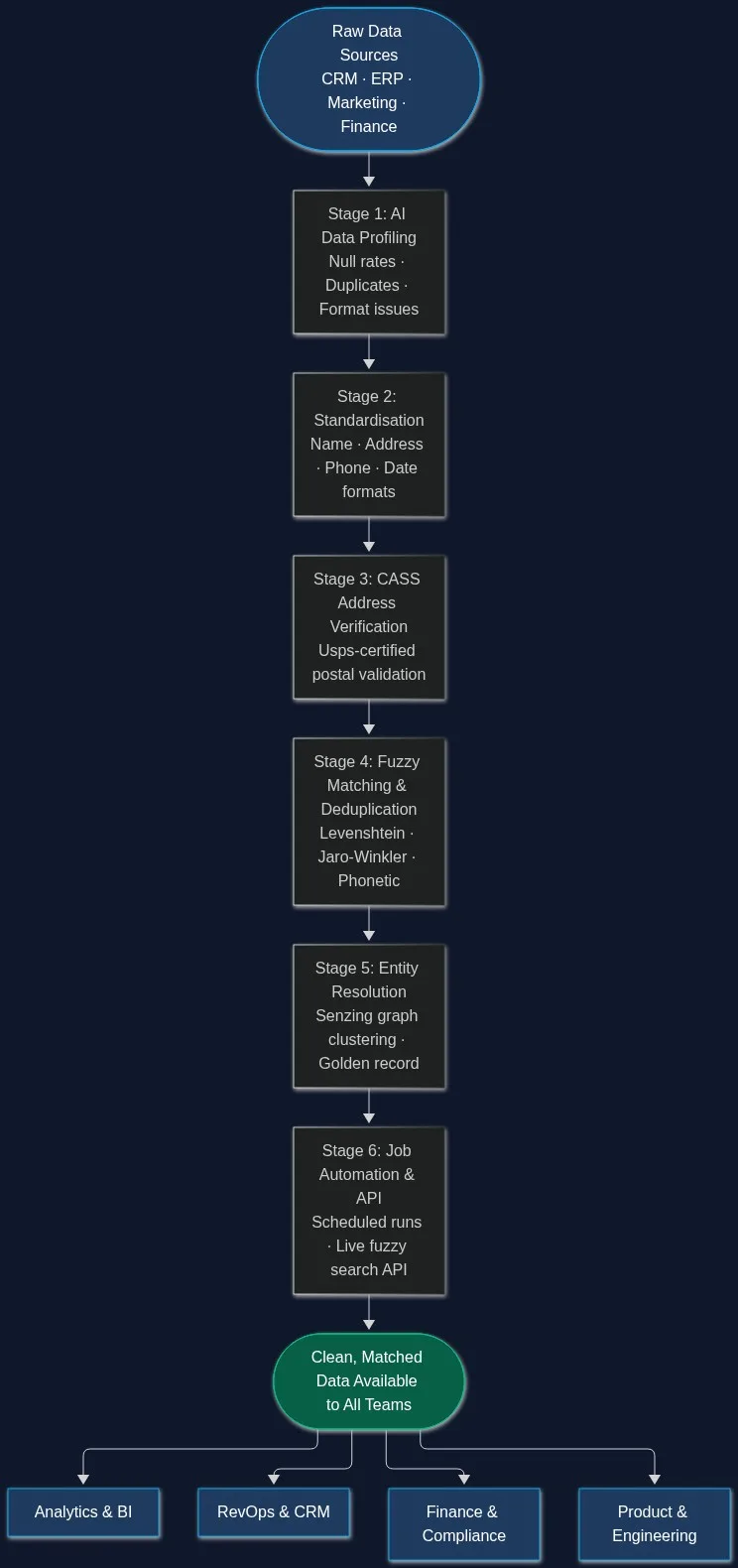
Fase 1: Perfilado de datos para IA
Before any cleaning begins, AI profiling scans every field across every source system. It measures null rates, format distributions, duplicate candidate rates, and value-range outliers. A typical enterprise dataset reveals that 18–35% of records have at least one quality issue. That number must be known before access is widened.
Match Data Pro’s AI profiling engine runs automated column-level analysis and flags the fields most likely to break downstream queries. It surfaces issues before they reach the analyst.
Fase 2: Normalización
Once profiling is complete, standardisation converts raw field values into consistent formats. Names are parsed into first/last/prefix components. Addresses are structured into street, city, state, ZIP. Phones are normalised to E.164 format. Dates are aligned to ISO 8601. This stage eliminates the format inconsistencies that break joins and filters.
Stage 3: CASS Address Verification
Address records decay at approximately 10–15% per year as people and businesses move. CASS-certified verification corrects and validates every postal address against the USPS database — appending ZIP+4 codes, correcting street abbreviations, and flagging undeliverables. For any team using addresses for outreach, billing, or compliance, this stage is not optional.
Stage 4: Fuzzy Matching and Deduplication
Fuzzy matching identifies records that refer to the same entity even when field values differ. Consider this example:
| Registro A | Disco B | Resultado del partido |
|---|---|---|
| Jon Smyth, 123 Main St, Chicago IL | Jonathan Smith, 123 Main Street, Chicago, IL 60601 | 91/100 |
| Acme Corp, 500 Oak Ave | ACME Corporation, 500 Oak Avenue | 95/100 |
| sarah.jones@email.com | s.jones@email.com, Sarah Jones | 78/100 |
Records scoring above the configured threshold are consolidated. Those in the review band (typically 70–89) are flagged for steward review. Those below are kept separate. This produces a deduplicated master dataset that every team can rely on.
Etapa 5: Resolución de entidades
Fuzzy matching handles pairwise comparison. Entity resolution handles multi-source identity clustering. Using Senzing’s graph-based engine, Match Data Pro links the same entity across five, ten, or twenty source systems — even when no shared identifier exists. The result is a golden record with verified fields drawn from the most authoritative source for each attribute.
Stage 6: Job Automation and Live API Access
A clean dataset at a point in time decays immediately. Job automation schedules recurring profiling, cleansing, and matching runs — daily, weekly, or triggered by inbound data events. The live fuzzy search API lets operational systems query the clean data layer in real time, returning best-match results at under 200ms per lookup. This keeps the shared data layer current for every team that queries it.
How Each Team Benefits from Clean, Matched Data
Once the pipeline is running, the gains are concrete and measurable by team.
Analytics and BI Teams
Analysts spend 60–80% of their time cleaning data before they can run analysis, according to industry benchmarks. With a clean, deduplicated source, that time drops sharply. Dashboards stop showing conflicting numbers. Reports don’t require manual reconciliation before each presentation. Better reporting starts with higher data quality — not with better visualisation tools.
RevOps and CRM Teams
Revenue operations teams depend on accurate contact and account data for segmentation, scoring, and routing. When CRM contains 15–20% duplicates — a typical rate for systems more than two years old — lead scoring is distorted, territory assignments are skewed, and attribution reports are wrong. Clean, entity-resolved customer data gives RevOps a single account record to build every workflow on.
Finance and Compliance Teams
Finance teams reconcile transactions against customer and vendor records. When vendor master data contains duplicates, duplicate payments follow. When customer names don’t match across systems, revenue recognition breaks. Deduplicated, standardised records reduce reconciliation time and eliminate the category of errors that come from treating one entity as two. For compliance, a single source of truth is the only defensible data state during an audit.
Product and Engineering Teams
Product teams building features on user data need accurate identity signals. If the same user appears as multiple records, usage analytics are wrong, personalisation misfires, and churn models are trained on noise. The live fuzzy search API lets product and engineering teams query the clean data layer directly — with sub-200ms response times and configurable match thresholds.
Building a Data Democratisation Strategy That Lasts
Data democratisation is not a technology project. It is a data quality programme that happens to include an access layer. The access layer is the easy part. The hard part is maintaining data quality continuously as source data changes, new systems are onboarded, and business rules evolve.
Three practices keep the programme sustainable:
- Define data ownership at the domain level. Each team owns the quality of the data they produce. RevOps owns contact data quality. Finance owns vendor master quality. Without clear ownership, issues are caught downstream and blamed upstream.
- Run profiling on every inbound dataset. New data sources introduced without profiling are the most common way clean environments get contaminated. Automated profiling on ingestion catches issues before they propagate.
- Set match thresholds by use case, not globally. A financial reconciliation use case requires a match threshold of 95+. A marketing segmentation use case might operate at 80. Configurable thresholds let each team consume data at the confidence level their use case requires.
Match Data Pro supports all three practices. Import connectors bring in data from CRM, ERP, and flat-file sources. AI profiling runs at ingestion. Match thresholds are set per job definition, not globally. And job automation keeps the pipeline running without manual intervention.
Want to see it in practice? Book a demo and we will walk through a live pipeline using your data quality scenario.
Preguntas frecuentes
What is data democratisation in a data management context?
Data democratisation is the practice of making trusted data accessible to all business teams — not just data engineers — for self-service analysis. It requires a clean, deduplicated, and entity-resolved data layer underneath any access tool, otherwise distributing access only distributes errors at scale.
Why do data democratisation initiatives fail?
Most fail because data quality is not addressed before access is widened. Teams discover conflicting numbers, duplicate records, and format inconsistencies and stop trusting the data. The fix is not better tooling — it is a profiling, standardisation, deduplication, and entity resolution pipeline applied before any team queries the shared data layer.
How does fuzzy matching support data democratisation?
Fuzzy matching identifies records that refer to the same entity even when field values differ — “Jon Smyth” and “Jonathan Smith” score 91/100 and get merged into one record. This eliminates duplicates that exact matching misses, so every team pulling from the shared data layer gets consistent, deduplicated results regardless of how the original data was entered.
What is a golden record and why does every team need one?
A golden record is a single, authoritative version of an entity — customer, vendor, or product — built by merging and deduplicating records from every source system using survivorship rules. It is the record every team should query. Without it, different teams see different versions of the same customer and produce conflicting reports.
How does Match Data Pro support data democratisation?
Match Data Pro provides a six-stage cloud SaaS pipeline — AI profiling, standardisation, CASS address verification, fuzzy matching, Senzing entity resolution, and job automation — that produces clean, entity-resolved data for every team to consume. Import/export connectors, a live fuzzy search API, and configurable match thresholds per job make it deployable across any stack without a long-term contract.