
A single source of truth (SSOT) is one authoritative, deduplicated, and verified master record for every entity — customer, vendor, product, or location — accessible by every system that needs it. Without one, your CRM shows 47,000 customers, your ERP shows 44,200, and your analytics platform shows 51,000. None of them agree, and none of them can be fully trusted.
Building an SSOT means solving three problems in sequence: eliminating duplicates, resolving fragmented identities across systems, and applying survivorship rules to decide which field values win. Match Data Pro automates all three stages in one configurable cloud pipeline.
Book a demo to see how Match Data Pro consolidates multi-source data into a trusted golden record.
Why Siloed Data Prevents a Single Source of Truth
Most organisations run 4–12 data systems simultaneously. A B2B company might maintain customer records in Salesforce, HubSpot, an ERP, a marketing automation platform, and a data warehouse. Each was populated independently, on different timelines, by different teams with different naming conventions.
The result is predictable: the same company appears as “Acme Corp,” “ACME Corporation,” and “Acme Corp.” in three systems. The same contact appears twice with a transposed phone digit. An address carries an old suite number that was corrected in one system but not the others.
The compounding cost of fragmentation
Data fragmentation compounds quickly. A 2% duplicate rate across 500,000 customer records means 10,000 wasted outreach attempts per campaign cycle. A 5% address error rate across a vendor master of 80,000 records means 4,000 misdirected purchase orders. These are not edge cases — they are routine outcomes of siloed data without a unification strategy.
The downstream effects include inflated customer counts, conflicting revenue attribution, failed compliance checks, and analytics that cannot be reconciled across teams. Every report carries a silent asterisk: “results may vary depending on which system you pulled from.”
The Six-Stage Pipeline for Building a Single Source of Truth
An SSOT is not a destination you reach once — it is an ongoing pipeline that continuously ingests, cleans, links, and updates records. The six stages below describe how Match Data Pro builds and maintains it.
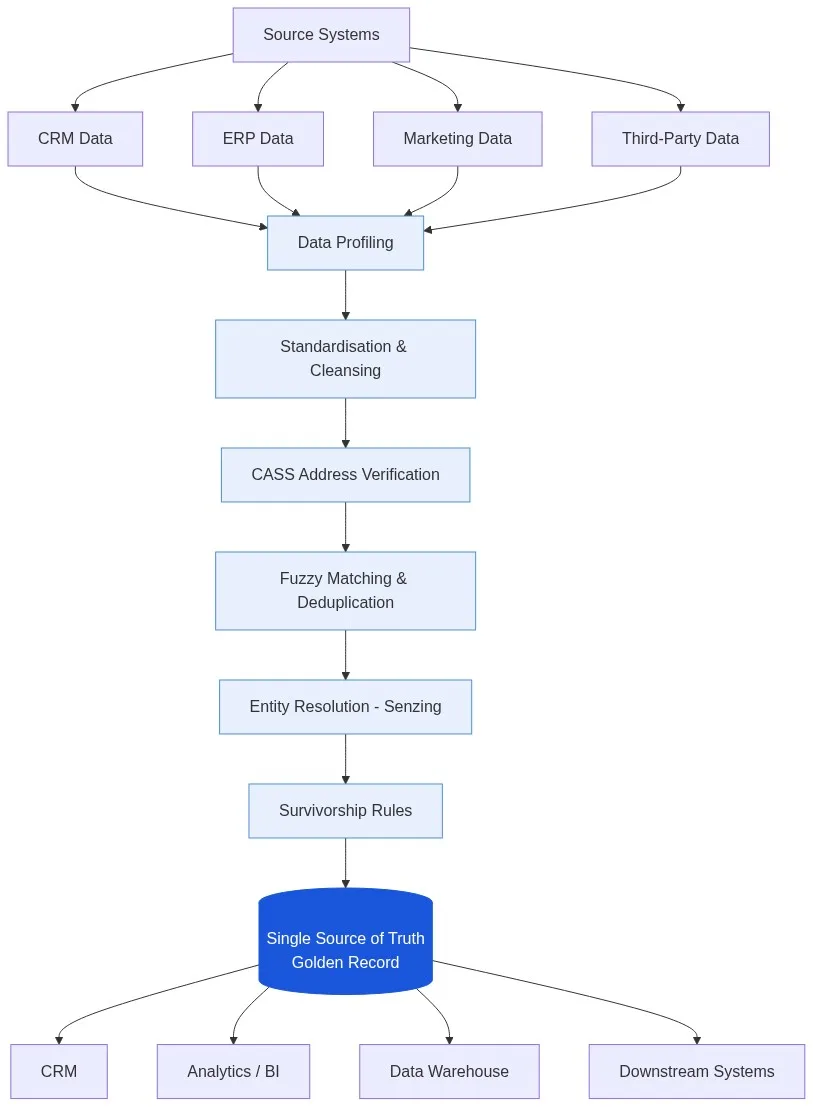
Fase 1: Análisis de los datos
Before you can fix anything, you need a precise picture of what is broken. AI data profiling scans every field across every source system, measuring null rates, format violations, cardinality anomalies, and duplicate density. A typical enterprise dataset reveals 15–30% of records with at least one quality issue before any cleansing begins.
Stage 2: Standardisation and cleansing
Standardisation converts “St.”, “Street”, and “ST” into a single canonical form. It expands “NY” to “New York”, normalises phone numbers to E.164 format, and applies title-casing rules to name fields. Data standardisation must happen before matching — otherwise identical records score as mismatches because their surface representations differ.
Stage 3: CASS address verification
Addresses decay at approximately 10–15% per year as people move, businesses relocate, and postal codes change. CASS address verification validates and corrects every postal record against the USPS database, appending ZIP+4 codes and correcting deliverability errors. A verified address is both more accurate and more match-ready than a raw one.
Stage 4: Fuzzy matching and deduplication
Exact-match joins fail on real-world data. “Jon Smith” and “Jonathan Smith” share the same entity but return zero overlap on a string equality check. Fuzzy matching scores similarity across multiple fields simultaneously — name, email, phone, address — and combines those scores into a weighted composite. Pairs above the configured threshold are flagged as duplicates. Pairs in the review zone are routed to a human queue.
A typical fuzzy matching pass on a merged CRM + ERP dataset:
| Registro A | Disco B | Name Score | Phone Score | Address Score | Compuesto | Decisión |
|---|---|---|---|---|---|---|
| Acme Corp, 212-555-0100 | ACME Corporation, 212-555-0100 | 87 | 100 | 95 | 93 | Auto-merge |
| Jon Smith, jon@acme.com | Jonathan Smith, j.smith@acme.com | 79 | — | 97 | 84 | Auto-merge |
| Sarah Jones, 415-555-0199 | Sara Jones, 415-555-0198 | 94 | 96 | 100 | 96 | Auto-merge |
| Global Tech Inc, gti@email.com | GTI Inc, gti@different.com | 61 | — | 72 | 64 | Cola de revisión |
Etapa 5: Resolución de entidades
Deduplication removes obvious duplicates within a source. Entity resolution links records across sources that represent the same real-world entity — even when they share no common identifier. Match Data Pro embeds Senzing entity resolution, a graph-based probabilistic engine that builds an identity graph across all connected sources. Two records from different systems — one a customer in Salesforce, one a contact in an ERP — get resolved to the same entity without requiring a shared primary key.
Stage 6: Survivorship and golden record construction
When multiple records resolve to the same entity, survivorship rules determine which field values appear in the golden record. Rules can be data-source-based (“prefer CRM phone over ERP phone”), recency-based (“use the most recently updated address”), or completeness-based (“use whichever record has a non-null email”). The result is a golden record — a single, authoritative representation of each entity that all downstream systems can consume.
Common Failure Patterns When Building an SSOT
Organisations that fail to achieve a working SSOT usually make one of three mistakes.
Skipping profiling and jumping straight to matching
Matching unstandardised data produces false negatives at scale. “123 Main St” and “123 Main Street” will not match on exact comparison and will score unexpectedly low on some fuzzy algorithms if the address field has not been parsed and normalised first. Profiling reveals these issues before matching runs.
Using a single algorithm for all field types
Levenshtein distance works well for short name fields. Token-set ratio works better for long company names with varying word order. Phonetic algorithms (Soundex, Double Metaphone) handle name spelling variants that character-based methods miss. A production SSOT pipeline uses a different algorithm — or combination of algorithms — for each field type. Match Data Pro’s configurable matching engine lets you assign algorithms and weights per field.
Treating the SSOT as a one-time project
New records enter every system every day. A golden record built today will drift by next quarter if the pipeline does not run continuously. Match Data Pro’s real-time deduplication API checks incoming records against the golden record store at point of entry, preventing duplicates before they accumulate. Scheduled batch jobs re-run the full pipeline on a configurable cadence to catch anything that slipped through.
What a Working Single Source of Truth Enables
Once your SSOT is operational, the downstream benefits are concrete and measurable.
Analytics and reporting accuracy
When every business intelligence tool pulls from the same deduplicated, verified master, revenue attribution becomes consistent, customer counts become reliable, and cross-system reports reconcile without manual intervention. Teams stop spending 40% of their analysis time arguing about which number is correct.
CRM and operational efficiency
Sales reps stop calling the same prospect twice because two records exist in different territories. Support teams see a complete interaction history rather than a fragmented view split across duplicates. Marketing suppression lists work correctly because the entity that opted out maps cleanly to every downstream system.
Compliance and audit readiness
Regulatory frameworks — GDPR, CCPA, HIPAA — require organisations to respond accurately to data subject requests. Without an SSOT, a deletion request for “Jon Smith” may only delete the Salesforce record, leaving the ERP and warehouse records intact. A unified identity means one request propagates everywhere. Match Data Pro maintains a full audit trail of every match decision, merge, and survivorship rule applied.
Ready to build your single source of truth? Start a free trial — no contract, no setup fee, operational in hours.
Maintaining the SSOT at Scale
Blocking to keep matching tractable
Comparing every record against every other record is O(n²) — infeasible at millions of records. Blocking groups records into candidate sets using one or more keys (first three characters of last name, area code, ZIP code) so that fuzzy comparison only runs within plausible groups. Match Data Pro’s blocking engine supports multiple simultaneous blocking keys, which catches cross-block true matches that single-key blocking misses.
Schema drift and field mapping
Source systems evolve. A CRM field that contained “first_name” in 2023 may be split into “given_name” and “preferred_name” in 2026. Source-to-target mapping configurations in Match Data Pro allow field remapping without rebuilding the entire pipeline. Import/export connectors handle format translation automatically across CSV, JSON, XML, and direct database connections.
Preguntas frecuentes
What is a single source of truth in data management?
A single source of truth is one authoritative, deduplicated master record for each entity — customer, vendor, product, or location — that all systems and teams reference. It is built by profiling source data, standardising formats, running fuzzy matching and deduplication, resolving cross-system identities, and applying survivorship rules to select the best field values for the golden record.
How long does it take to build a single source of truth?
An initial SSOT for a dataset of one to five million records typically takes two to four weeks using an automated platform: one week for profiling and standardisation, one week for matching and entity resolution configuration, and one week for survivorship rule-setting and validation. Ongoing maintenance is automated. Manual approaches take months and rarely reach the same quality threshold.
What is the difference between a single source of truth and a data warehouse?
A data warehouse stores historical, queryable data for analytics. An SSOT is an operational master record that reflects current, authoritative entity data. Many teams build their SSOT as a curated layer within or alongside their data warehouse, but the two serve different functions. The SSOT feeds the warehouse; the warehouse stores history derived from the SSOT.
Can you build a single source of truth across cloud and on-premise systems?
Yes. The SSOT pipeline — profiling, cleansing, matching, entity resolution — runs against data extracted from any source, whether cloud-hosted SaaS, on-premise database, or flat file. Match Data Pro’s import connectors ingest from all three. The resulting golden records can be pushed back to any target system via export connectors or the live fuzzy search API.
What happens to the single source of truth when new records are added?
New records should be checked against the existing golden record store at point of entry using a real-time API. If a match exceeds the auto-merge threshold, the new record updates the existing golden record according to survivorship rules. If it falls in the review zone, it enters a human review queue. If it is genuinely new, a new golden record is created. Scheduled batch jobs re-validate the full dataset on a configurable cadence.