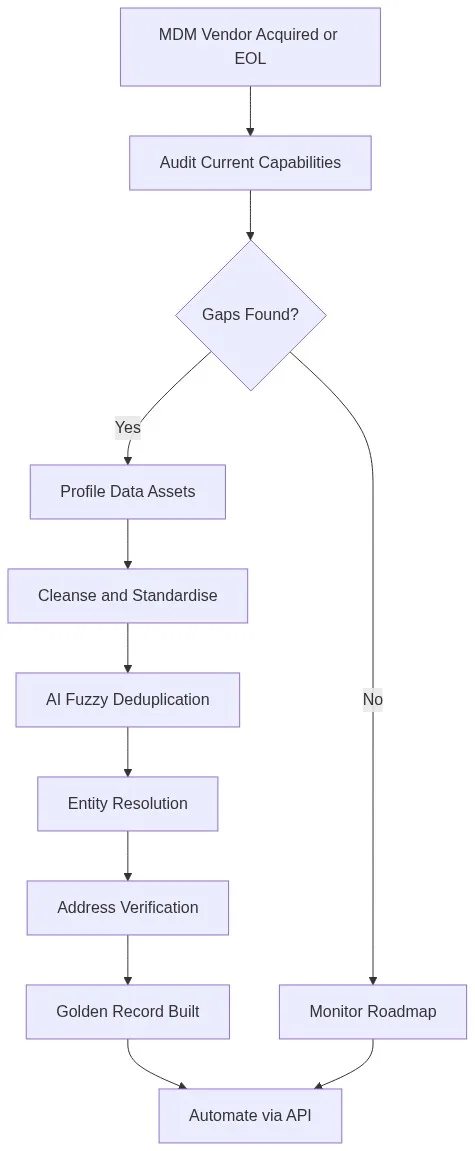
When your MDM vendor is acquired, your data quality program faces three immediate risks: feature roadmap freeze, price increases, and forced platform migration. The right response is to audit your current capabilities, identify gaps, and evaluate whether a purpose-built data quality platform can deliver more for less — without the lock-in.
Ready to evaluate your options now? Start a free trial of Match Data Pro — no contract, no commitment.
What Happens to Your Data Quality Program When a Vendor Is Acquired
MDM and data quality acquisitions follow a predictable pattern. The acquiring company absorbs the product, signals a “commitment to the roadmap,” and then quietly begins consolidating features into its own platform. Within 12 to 18 months, pricing changes, support tiers shrink, and your negotiating leverage disappears.
For data teams, the practical impact is immediate. Three things happen in quick succession:
- Roadmap uncertainty. Features you depended on — fuzzy matching tuning, deduplication automation, custom field weighting — may not appear in the next release cycle.
- Pricing pressure. Post-acquisition vendors routinely increase licence fees by 20–40% at renewal.
- Integration risk. If the acquirer migrates APIs or changes connector formats, your ETL pipelines and job automation break.
The goal is not to panic. It is to act methodically. Start with an honest audit of what your current platform does well and where the gaps already exist.
Step 1: Audit Your Current MDM Capabilities
Before evaluating alternatives, document your current state across five capability dimensions:
1. Data profiling and discovery
Can the platform automatically scan incoming datasets, flag anomalies, and score completeness, uniqueness, and consistency? AI-powered data profiling should surface field-level quality scores in minutes, not hours of manual SQL.
2. Cleansing and standardisation
Does the platform parse and standardise names, addresses, phone numbers, and free-text fields consistently across record types? Many legacy MDM tools rely on static lookup tables and break on regional variants or abbreviation patterns.
3. Deduplication and fuzzy matching
Can you configure multi-algorithm fuzzy matching — Jaro-Winkler for names, Levenshtein for codes, token-ratio for company names — with per-field weights? AI-powered fuzzy matching should let you tune match thresholds without rebuilding rules from scratch every time your data changes.
4. Entity resolution
Does the platform resolve identity across sources when no shared identifier exists? True entity resolution via Senzing uses graph-based probabilistic matching — not just field comparison — to link records from CRM, ERP, billing, and support systems into a single entity view.
5. Address verification
Is CASS-certified address verification built in, or is it a separate licensed module? Address data cleansing with CASS certification verifies deliverability and appends ZIP+4 codes without manual correction workflows.
Step 2: Identify the Gaps Your Current Platform Leaves Open
Most MDM tools were built for governance workflows, not high-volume matching pipelines. When you audit the five dimensions above, you typically find three recurring gaps:
Gap 1: No real-time matching API
Batch-only platforms cannot deduplicate records at point of entry. If a sales rep creates a duplicate account in your CRM at 10:03 AM, a nightly batch job catches it 14 hours later — after it has already been touched by six downstream systems. A live fuzzy search API blocks the duplicate at the moment of creation.
Gap 2: Rigid survivorship rules
When two records match, which field values survive into the golden record? Legacy MDMs apply a single source-wins rule. That breaks when Source A has the correct address but Source B has the correct phone number. Configurable survivorship rules resolve this field by field. See how data match merging and survivorship rules produce reliable golden records.
Gap 3: No job automation
Teams running manual cleansing exports on a weekly schedule cannot keep pace with data ingestion rates above 50,000 records per day. Job automation schedules profiling, cleansing, deduplication, and export steps as a pipeline that runs without human intervention.
Step 3: Build the Evaluation Criteria for a Replacement Platform
Once you have documented your gaps, translate them into a scored evaluation matrix. The table below covers the criteria most relevant to MDM replacement decisions:
| Capability | Minimum requirement | Best-in-class |
|---|---|---|
| Fuzzy matching | Levenshtein + phonetic | Multi-algorithm, per-field weighted, configurable thresholds |
| Entity resolution | Rule-based deterministic | Graph-based probabilistic (Senzing) |
| Address verification | Format validation | CASS-certified, ZIP+4 append, deliverability score |
| Real-time API | None | Live fuzzy search API with sub-200ms response |
| Job automation | Scheduled batch export | Event-triggered pipeline with failure alerting |
| Deployment | SaaS only | SaaS + private cloud / on-premise option |
| Contract terms | Annual lock-in | Month-to-month, no minimum commitment |
Evaluate every shortlisted platform against this matrix. Weight the capabilities in order of business impact. If 60% of your downstream failures trace back to duplicate customer records, fuzzy matching and deduplication should carry the highest weight in your scoring.
Step 4: Run a Parallel Proof of Concept
Do not migrate. Prove it first. A parallel PoC lets you validate a replacement platform against a representative sample of your live data before committing to any transition.
A production-representative PoC for data quality tooling should include:
- A sample of 500,000 to 1 million records from your primary source system
- A known set of duplicate pairs (ground truth) to measure recall and precision
- At least one edge-case field type — nicknames, transposed digits, international addresses, unit suffixes
- Timing metrics: how long does the full pipeline take end to end?
Match Data Pro supports PoC runs directly from the platform. Upload a CSV or connect via API connector, configure your matching rules, and run the full pipeline — data profiling through deduplication to golden record output — without writing a single line of code. Every match decision shows the field-level scores and algorithm weights that produced it.
Step 5: Plan the Migration Without Disrupting Live Pipelines
The migration itself is the highest-risk phase. Three failure modes account for 80% of migration problems:
Failure mode 1: Moving dirty data
Teams migrate before cleaning. The new platform inherits all the duplicates, inconsistencies, and missing values from the old one. Run a full cleanse-and-deduplicate pass on the source data before the cutover date. See the data quality steps most teams skip before migration.
Failure mode 2: Breaking existing API integrations
Legacy MDM APIs use proprietary schemas. When the connector changes, every downstream system that pulls golden records breaks. Map all API consumers before cutover. Rebuild connector logic against the new platform’s REST endpoints in a staging environment before go-live.
Failure mode 3: Losing match configuration
Matching rules, field weights, and threshold settings accumulated over years represent institutional knowledge. Export and document every rule before decommissioning the old platform. Rebuild and validate in the new system against your PoC ground truth dataset.
Why Data Teams Are Re-Evaluating Their Stack Right Now
Enterprise data quality is undergoing consolidation. Large platform vendors are acquiring specialised tools to bundle them into suite offerings. The result is that many data teams find themselves paying for capabilities they do not use while lacking the ones they need most.
The alternative is a purpose-built data quality platform that focuses on the core pipeline: data profiling, cleansing, AI-powered deduplication, entity resolution, and address verification — deployed on a no-contract SaaS model that lets you scale up or down without renegotiating an enterprise licence.
Match Data Pro delivers all five pipeline stages in a single cloud platform. Month-to-month pricing. No implementation consultants required. Start your free trial and run a PoC against your own data today.
Not ready to start a trial yet? Book a demo and walk through the platform with a data quality engineer.
Frequently Asked Questions
What should I do immediately when my MDM vendor announces an acquisition?
Audit your current capabilities across five dimensions: data profiling, cleansing, deduplication, entity resolution, and address verification. Document what works, what does not, and what you depend on that is at risk. This audit becomes the evaluation brief for any replacement platform you assess in the 90 days following the announcement.
How long does it typically take to migrate from a legacy MDM platform?
A full migration including PoC, data cleansing, connector rebuild, and parallel testing typically takes 60 to 120 days for mid-size deployments. The biggest time sink is cleaning source data before cutover. Teams that skip the cleansing step and migrate dirty data extend the timeline by 30 to 90 additional days.
Can a data quality platform replace a full MDM system?
For most data teams, yes. Full MDM suites add governance workflows and business glossary features that most teams do not use daily. If your core requirement is clean, deduplicated, entity-resolved data delivered to downstream systems, a purpose-built data quality platform covering profiling, matching, cleansing, and API delivery covers 90% of the MDM use case at a fraction of the cost.
How do I validate that a new platform matches records as accurately as my current system?
Build a ground-truth dataset of known duplicate pairs from your production data. Run both platforms against the same sample. Compare precision (what fraction of flagged matches are true matches) and recall (what fraction of true duplicates were found). Target precision above 92% and recall above 88% for most enterprise use cases.
Does Match Data Pro support on-premise deployment for regulated environments?
Match Data Pro is a cloud SaaS platform. For teams in regulated environments that require data to remain on-premise, the platform supports private cloud deployment options. Contact the sales team at sales@matchdatapro.com to discuss deployment architecture for your specific compliance requirements.