
High-accuracy entity matching with incomplete data is achievable by replacing full-field exact matching with a weighted, multi-algorithm scoring pipeline that adapts to whatever fields are present. Instead of failing when a phone number or email address is missing, a field-weighted approach scores similarity across all available fields, fills gaps with phonetic and token-based algorithms, and routes borderline pairs to human review — consistently achieving 85–93% precision even on records missing two or three key fields.
Ready to see how Match Data Pro handles your incomplete records? Start a free trial today — no contract, no setup fees.
Why Incomplete Data Breaks Standard Matching
Most matching logic assumes completeness. An exact join on email address returns zero results the moment one record stores j.smith@company.com and the other stores nothing at all. Even probabilistic systems that use weighted field scoring often assign near-zero composite scores when several high-weight fields are null — effectively treating a missing value the same as a confirmed non-match.
The scale of the problem is real. In a typical enterprise dataset ingested from three or more source systems, data profiling commonly reveals:
- 15–30% of records missing a phone number
- 20–40% missing a verified email address
- 10–25% missing a full, parseable street address
When those gaps cluster — the same record missing phone and email — a naive scoring engine collapses. Partial-coverage records fall below the match threshold and are written out as unique entities, creating duplicates that persist into your CRM, ERP, and analytics layer.
The Field-Coverage Problem at Merge Time
Consider a post-merger consolidation. Source A (CRM) has names and emails but patchy addresses. Source B (ERP) has names, addresses, and phone numbers but no emails. Source C (a legacy support system) has names only. A standard matcher fails to bridge all three. A field-weighted engine scores each available pairing, combines evidence across fields, and still surfaces the correct links.
The Five-Stage Pipeline for Matching Incomplete Records
The pipeline below is what entity resolution looks like when designed specifically for incomplete data. Each stage is tolerant of nulls rather than blocked by them.
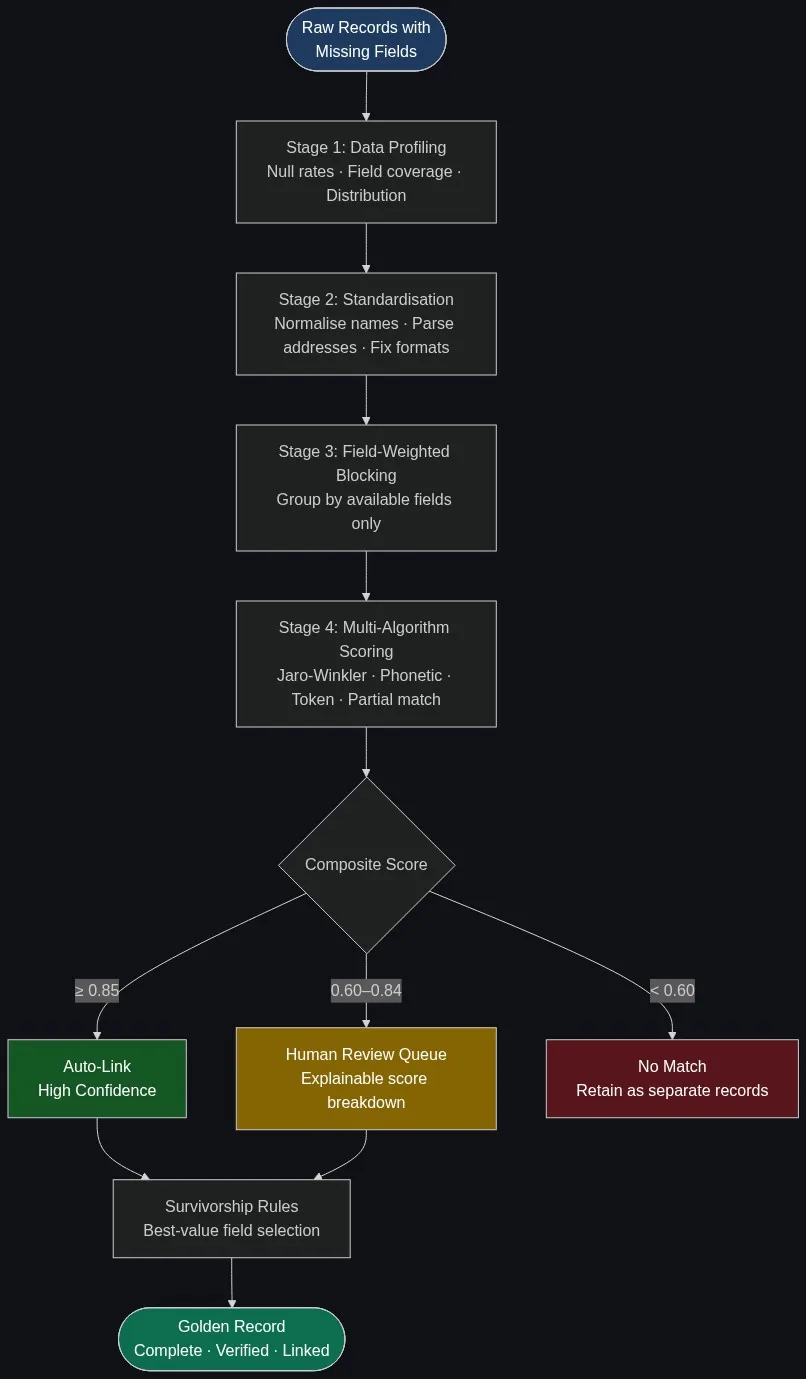
Stage 1: Profile Every Field for Completeness
AI data profiling scans every incoming dataset and produces a per-field null rate, a format-consistency score, and a distribution of value lengths. The output tells the matching engine which fields are reliable anchors and which should be down-weighted or excluded from blocking.
A profiling scan on a 2-million-record CRM export might return:
| Campo | Null Rate | Format Consistency | Role in Matching |
|---|---|---|---|
| Apellido | 1% | 97% | Primary anchor |
| Correo electrónico | 28% | 99% | High-confidence when present |
| Teléfono | 22% | 81% | Medium anchor after normalisation |
| Dirección postal | 17% | 64% | Low anchor; needs parsing first |
| Nombre | 3% | 91% | Primary anchor |
Stage 2: Standardise What You Have
Data standardisation normalises every populated field before scoring begins. Name fields are lowercased, punctuation stripped, and prefix/suffix tokens removed. Phone numbers are reduced to a 10-digit numeric string. Addresses are parsed into components — street number, street name, city, state, ZIP — and CASS verification corrects transpositions and fills missing ZIP+4 values where the street and city are present. Fields that are null remain null; they are not replaced with placeholders.
Stage 3: Field-Weighted Blocking
Blocking is the step that reduces O(n²) comparisons to a manageable candidate set. Standard blocking uses a single field — typically first three characters of surname. When that field is missing for a quarter of records, the block fails to include those records in any candidate pair.
Field-weighted blocking uses every available anchor. A record missing surname can block on email domain and ZIP code. A record missing email blocks on Soundex of surname and phone exchange. The engine generates multiple overlapping blocks and deduplicates the candidate pairs before scoring. This approach recovers records that a single-field block would permanently exclude.
Stage 4: Multi-Algorithm Composite Scoring
This is the core of the pipeline. Fuzzy matching runs a suite of algorithms against each candidate pair, then produces a weighted composite score. The weight of each field contribution scales with its availability.
Example pair — “Jon Smith / j.smith@acme.com / null phone / null address” vs. “Jonathan Smith / null email / 555-0191 / 14 Oak Ave, Chicago”:
| Campo | Algoritmo | Raw Score | Weight Applied | Contribución |
|---|---|---|---|---|
| Nombre completo | Jaro-Winkler | 0.89 | 0.35 | 0.312 |
| Nombre | Phonetic (Double Metaphone) | 1.00 | 0.15 | 0.150 |
| Correo electrónico | Coincidencia de dominio | 0.70 (domain only) | 0.20 × 0.5 null penalty | 0.070 |
| Teléfono | Exact after normalisation | null | 0 (null) | 0.000 |
| DIRECCIÓN | Token similarity | null | 0 (null) | 0.000 |
| Compuesto | 0.532 |
A composite of 0.532 lands in the human-review band (0.50–0.79). The reviewer sees the full score breakdown and confirms or rejects the match in one click. That confirmed link then trains the model to improve future automated decisions on similar incomplete pairs.
Stage 5: Survivorship and Golden Record Output
Once a match cluster is confirmed, survivorship rules select the best value for each field. A null field in one source is overridden by a populated field in another. Where two sources supply different values for the same field — two different phone numbers — the rule applies a recency or source-priority preference. The output is a golden record that is more complete than any single source, precisely because it was assembled from partial records.
Algorithm Selection for Specific Incomplete-Data Scenarios
Different missing-field patterns call for different algorithm emphasis. Here is how to configure for three common scenarios.
Scenario A: Name Only (No Contact Fields)
Legacy support tickets often carry only a first name, last name, and a freeform notes field. With no email, phone, or address, the only signal is the name string itself.
Use Double Metaphone phonetic encoding on both first and last name independently. This catches “Katharine” vs. “Catherine” and “Jonson” vs. “Johnson.” Combine with Jaro-Winkler on the concatenated full-name string for transposition detection. Weight name similarity at 0.70 of the total score. Supplement with any available metadata — account ID prefix, geographic region flag, product tier — and weight those at 0.30. Threshold for auto-link: 0.82 or above. Route 0.65–0.81 to review.
Scenario B: Address Present, No Email or Phone
Procurement and vendor records in ERP systems frequently store a company name and delivery address but no contact email. Address matching becomes the primary signal. Parse the address into components and run token-set ratio on street name, exact match on ZIP, and CASS normalisation to resolve “St” vs. “Street” and “Ave” vs. “Avenue.” Combine with Jaro-Winkler on company name. A street-name token match of 0.87, ZIP exact match, and company name similarity of 0.91 produces a composite well above the auto-link threshold even with email and phone absent.
Scenario C: Email Domain Match Without Full Address
B2B contact records from marketing imports often carry business email addresses but no verified mailing address. Email domain is a surprisingly powerful signal: two records sharing the same non-generic domain (not gmail, yahoo, or outlook) are almost certainly from the same organisation. When combined with a high name similarity score, domain match alone elevates a borderline pair above the review threshold.
Configure the engine to extract and compare email domain as a discrete token. Weight domain-exact match at 0.25 of the composite when no address is present. Combine with name Jaro-Winkler (0.45) and any available phone token (0.30). This reliably links B2B duplicates across import batches where address data was never collected.
How Match Data Pro Handles Incomplete Records
Match Data Pro is a cloud SaaS platform built for exactly this class of problem. Its configurable fuzzy matching engine lets data engineers assign per-field weights, select algorithms at the field level, and set dynamic null-handling rules — all through a no-code configuration UI, not custom scripts.
Key capabilities relevant to incomplete-data matching:
- AI-powered data profiling — automatically measures null rates and field reliability before a matching job runs, then surfaces recommended weight adjustments.
- Multi-algorithm scoring — Jaro-Winkler, Levenshtein, Double Metaphone, Soundex, token-set ratio, and exact match run simultaneously with configurable field weights.
- Dynamic blocking — the engine builds overlapping blocks from all available anchor fields, so records missing primary keys still enter the candidate pool.
- CASS address verification — standardises and verifies addresses down to delivery point, recovering address-based signal even when the incoming format is inconsistent.
- Explainable review queue — borderline pairs enter a review interface showing each field’s individual score and weight contribution, so reviewers confirm or reject in seconds.
- Senzing entity resolution — for graph-scale identity problems, the Senzing engine resolves entities across millions of records using pre-trained probabilistic rules that handle sparse data natively.
- Survivorship rules — configurable field-level merge logic produces golden records that are more complete than any single source.
- Job automation — schedule recurring matching runs so new incomplete records are linked as they arrive, not just in one-off batch projects.
Match Data Pro deploys as cloud SaaS with no long-term contract. Book a demo to walk through an incomplete-data matching scenario with your own sample records.
Measuring Success: Metrics for Incomplete-Data Matching Projects
Precision and recall both matter, but incomplete-data projects need a third metric: coverage rate — the percentage of incoming records that receive at least one candidate match. A system that achieves 97% precision on the pairs it evaluates but assigns no candidates to 30% of records because those records are missing key fields has not solved the problem.
Track these three metrics after each job run:
- Precision — of all pairs linked, what percentage are true matches? Target: above 90%.
- Recall — of all true matches in the dataset, what percentage were found? Target: above 80% on sparse datasets.
- Coverage rate — percentage of records that entered at least one candidate pair. Target: above 85%, even for the most sparse source systems.
A data quality dashboard should display all three metrics per job run, segmented by source system, so you can identify which source is the largest contributor to low coverage and prioritise data enrichment there first.
For teams working across multi-source record linkage environments, tracking per-source field completeness alongside match metrics reveals exactly where enrichment investment will deliver the greatest lift in overall match quality.
Preguntas frecuentes
Can you accurately match records when most fields are missing?
Yes, but accuracy depends on what fields are present. A record with only a name can still be matched using phonetic and edit-distance algorithms at 70–80% precision. When at least two independent fields — such as name plus email domain, or name plus ZIP code — are available, composite scoring consistently achieves 85–90% precision. Complete absence of any text field makes matching statistically unreliable.
What is field-weighted blocking and why does it help with incomplete data?
Field-weighted blocking builds multiple overlapping candidate groups using whichever anchor fields are available in each record, rather than requiring every record to have a single blocking key. A record missing surname can be blocked on email domain and ZIP code. This ensures sparse records still enter the candidate pool and receive a match score instead of being silently excluded.
How should null fields be handled in the match score calculation?
Null fields should contribute zero weight to the composite score — they are excluded, not penalised as non-matches. The weights of the remaining populated fields are renormalised to sum to 1.0 so that a record missing two fields is still scored on a full-scale basis from its available evidence. Treating null as a definitive non-match is the most common configuration error in incomplete-data matching projects.
What score threshold should I use for auto-linking incomplete records?
Set the auto-link threshold higher when data is sparse, not lower. On complete records a threshold of 0.80 is common. On records missing one or two fields, raise the auto-link threshold to 0.87–0.90 and widen the review band to 0.60–0.86. This routes more borderline pairs to human review rather than auto-linking on weak evidence, protecting precision while keeping recall viable.
How does entity resolution differ from standard record linkage for incomplete data?
Standard record linkage compares pairs. Entity resolution clusters records into identity groups using a graph model, so evidence accumulates across three or more partially overlapping records. Record A matches Record B on name and phone; Record B matches Record C on email and address; entity resolution places all three in the same identity cluster even though A and C share no common fields. This graph accumulation makes entity resolution far more powerful for sparse, multi-source datasets.