

The ZIP+4 code extension is a four-digit suffix appended to the standard five-digit ZIP code — written as 12345-6789 — that identifies a specific USPS delivery segment such as a city block, building floor, or PO Box range. For data engineers and CRM/marketing ops teams managing large address datasets, appending and validating ZIP+4 codes via CASS-certified software is the single most impactful step toward achieving USPS deliverability compliance, qualifying for presort postage discounts, and eliminating undeliverable address records at scale.
What Does the ZIP+4 Extension Mean?
Most people are familiar with the five-digit ZIP code — a geographic routing identifier assigned by the USPS to group delivery areas. The ZIP+4 extension adds four more digits after a hyphen, narrowing the delivery target from a general postal zone down to a precise delivery segment. Each segment typically covers one side of a city block, a floor of a high-rise building, a specific PO Box range, or a rural route section.
The full nine-digit code is sometimes called ZIP+4, ZIP9, or the ZIP code 4-digit extension. The format is always: [5-digit ZIP]-[4-digit extension]. For example:
- 10001-1234 — a specific delivery segment in Manhattan, New York
- 90210-9602 — a delivery segment in Beverly Hills, CA
- 60601-1234 — a block-level segment in Chicago, IL
Unlike the base ZIP code, the +4 extension is not static. Approximately 5% of ZIP+4 codes change every month due to new construction, address renumbering, and USPS route restructuring. A mailing list verified twelve months ago may have 50%+ drift in the worst cases, translating directly into undeliverable mail, wasted postage spend, and CRM data rot.
What Does Each Part of ZIP+4 Identify?
The four extension digits are assigned by the USPS and can represent:
- Delivery sector: a group of streets or a segment of a large building
- Delivery segment: a single side of a block, a floor, or a PO Box cluster
- Carrier route suffix: used by USPS sorting machines to direct mail to the correct carrier’s sequence
The USPS Delivery Point Validation (DPV) system takes this further — it confirms not just that a ZIP+4 address exists in USPS records, but that it is currently active and deliverable. A DPV-confirmed address returns a deliverability indicator (Y = deliverable, S = deliverable with secondary info required, D = deliverable only to general delivery, N = not deliverable).
Why ZIP+4 Codes Matter for Data Quality Teams
Address data is among the most volatile fields in any enterprise dataset. In CRM systems, marketing databases, and customer master files, address records degrade at roughly 11–15% per year as people move, businesses relocate, and postal routes restructure. The ZIP+4 extension is the linchpin of USPS address validation — without it, you cannot achieve CASS certification on a mailing list, cannot qualify for automation postage discounts, and cannot reliably deduplicate records at the block or building level.
Here is what poor ZIP+4 data costs an organisation:
- Undeliverable-as-addressed (UAA) mail: The USPS returns or discards mail that cannot be routed. UAA rates above 2% trigger USPS scrutiny on bulk mail permits.
- Lost presort discounts: USPS automation pricing requires CASS-certified ZIP+4 codes. Without them, mailers pay full first-class rates on every piece.
- Address correction surcharges: USPS charges address correction fees on unverified bulk mail — up to $0.07 per piece on large volumes.
- CRM deduplication failures: Without ZIP+4, two records for 123 Main St and 123 Main Street in the same ZIP may not deduplicate correctly if the delivery segments differ.
- Entity resolution errors: When resolving customer entities across multiple data sources, an incorrect or missing ZIP+4 can cause false merges between records at different building floors or PO Box ranges.
According to USPS PostalPro, an address must first be standardised before it can be CASS-certified as deliverable — address correction software fixes spelling errors, corrects abbreviations, and standardises capitalisation so each address complies with the official USPS format.
What Is CASS Certification and How Does ZIP+4 Fit In?
CASS stands for Coding Accuracy Support System. It is the USPS programme that certifies address-matching software for accuracy in appending ZIP+4 codes, carrier route codes, and DPV indicators. Only software that passes USPS CASS testing cycles can legally claim CASS-certified status — and only CASS-certified output is accepted for automation postage pricing.
CASS processing does four things to an address record in sequence:
- Standardise — parse and reformat street types, unit designators, directionals, and state abbreviations to USPS standards
- Match — compare the address against the live USPS ZIP+4 file to find the best match
- Append — add the correct +4 extension, carrier route code (e.g., C001, R002, H003), and DPV indicator
- Return — output the fully standardised, ZIP+4-coded address with CASS metadata fields
CASS vs. Non-CASS Address Lookup: A Comparison
| Característica | Basic ZIP Lookup | CASS-Certified Processing |
|---|---|---|
| ZIP+4 appended | Sometimes | Always (where deliverable) |
| USPS standardisation | Partial | Full (street type, direction, units) |
| DPV confirmation | No | Yes (Y/S/D/N indicator) |
| Carrier route code | No | Yes (City, Rural, Highway, PO Box) |
| Qualifies for presort discount | No | Yes (within 12 months of processing) |
| LACSLink (rural-to-city conversion) | No | Yes |
| SuiteLink (secondary address append) | No | Yes |
| USPS address correction fee avoidance | No | Yes |
The ZIP+4 CASS Address Verification Pipeline
The diagram below shows the full address verification pipeline — from raw input through ZIP+4 lookup and CASS validation to a cleansed, deliverable output record:
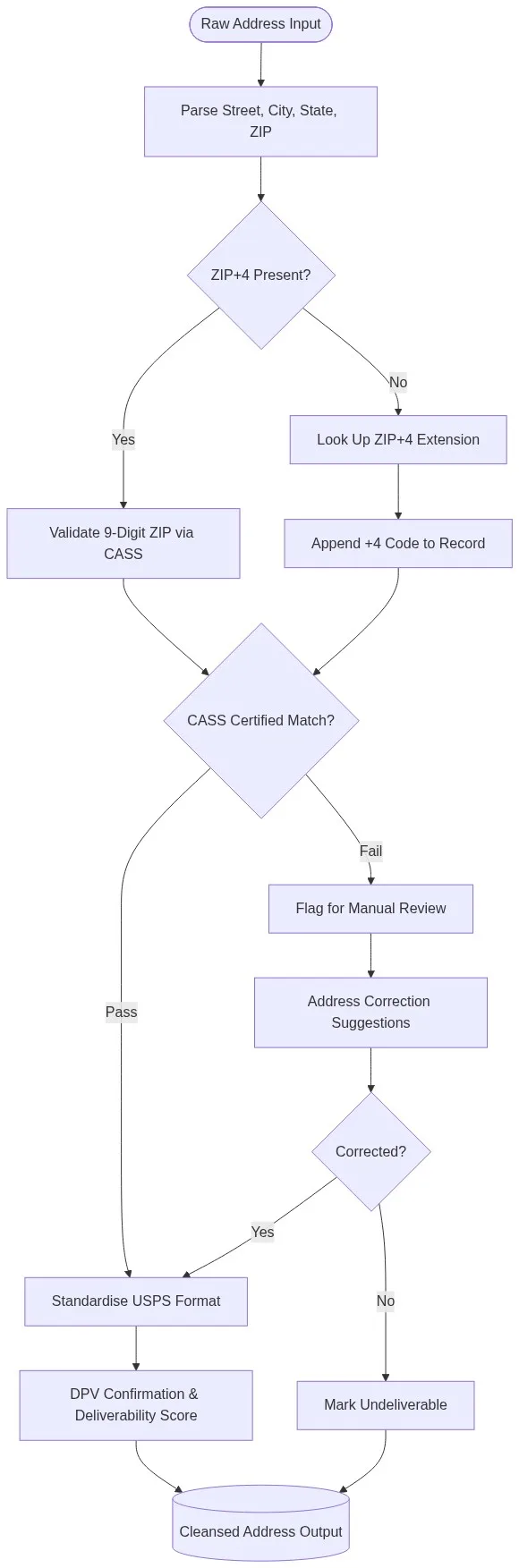
In practice, a data engineer running this pipeline against a CRM export of 500,000 address records would execute the following stages:
Stage 1: Address Parsing
The raw address string — often a single concatenated field like "123 Main St Ste 4 Chicago IL 60601" — must be parsed into its constituent components: house number, pre-directional, street name, street type, post-directional, unit type, unit number, city, state, and ZIP. Poor parsing at this stage causes downstream CASS match failures. A data profiling pass should flag records where the ZIP field contains non-numeric characters, where city/state combinations are inconsistent, or where the address field is null or below a minimum token count.
Stage 2: Standardisation
Each component is standardised to USPS format. Street type “Street” becomes “ST”, “Avenue” becomes “AVE”, “Suite” becomes “STE”. Directionals are expanded or contracted as required. City names are validated against the USPS City-State file. State codes are confirmed as valid two-character abbreviations. This stage alone removes a large proportion of CASS match failures.
Stage 3: ZIP+4 Lookup and CASS Match
The standardised address is submitted to the CASS engine, which compares it against the USPS ZIP+4 address file. The engine returns the correct ZIP+4 extension, the carrier route code, the delivery point barcode (DPBC), and the DPV indicator. Records that do not match exactly may receive a close-match suggestion — these should be flagged for review rather than automatically accepted.
Stage 4: DPV Confirmation
Delivery Point Validation (DPV) confirms that the ZIP+4-coded address actually corresponds to a currently active USPS delivery point. A DPV result of “Y” means the address is fully deliverable. “S” means secondary information (apt, suite, unit) is required. “D” means only general delivery is available. “N” means no match — the address is undeliverable as written.
How Match Data Pro Handles ZIP+4 Verification at Scale
Match Data Pro’s CASS Address Verification module integrates the full ZIP+4 lookup, standardisation, and DPV pipeline into the same platform used for fuzzy matching, deduplication, and entity resolution. This means data teams can run a complete address quality workflow — profile, cleanse, standardise, CASS-certify, and deduplicate — in a single automated job rather than stitching together separate tools.
Key capabilities relevant to ZIP+4 processing:
- Batch ZIP+4 appending: Process hundreds of thousands of records against the USPS database in a single job run, with full CASS output fields returned to your dataset
- Fuzzy address matching post-CASS: After ZIP+4 standardisation, run fuzzy match passes to deduplicate records where the same physical address appears under variant spellings or partial inputs
- AI data profiling pre-processing: Automatically detect address fields with missing ZIP+4 codes, malformed formats, or city/state/ZIP inconsistencies before submitting to CASS — saving processing credits and reducing match failure rates
- Entity resolution after address cleansing: Use Senzing entity resolution to link customer records across multiple source systems once addresses have been standardised and ZIP+4 codes appended — preventing false merges caused by pre-cleanse address variance
- Job automation: Schedule recurring CASS verification jobs to refresh ZIP+4 codes on a monthly or quarterly basis, accounting for the ~5% monthly change rate in USPS delivery data
For data engineers working with data cleansing pipelines, ZIP+4 verification fits naturally as a downstream step after field standardisation and before deduplication. Running deduplication on un-standardised addresses produces a high rate of false non-matches — two records for the same physical location may fail to deduplicate because one has “Apt 3” and the other has “Unit 3” and they carry different ZIP+4 extensions before CASS processing.
Teams evaluating tools should also consult the data matching software buyer’s guide for a side-by-side comparison of CASS capabilities across leading platforms.
ZIP+4 in the Context of Data Matching and Deduplication
ZIP+4 codes are not just a postal concern — they are a data quality anchor. In any data matching and merging workflow, the address is one of the most reliable blocking keys available. Using a validated ZIP+4 as a blocking key in a fuzzy match job dramatically reduces the candidate comparison space: instead of comparing every record against every other record across an entire dataset, the engine only compares records within the same delivery segment.
This has a direct performance impact on large-scale deduplication jobs. A CRM with 2 million address records and no ZIP+4 blocking requires O(n²) comparisons — potentially 4 trillion pairs. With ZIP+4 blocking reducing each segment to an average of 30–50 records, the same job completes in a fraction of the time with equal or better match recall.
For teams running fuzzy matching on address fields, ZIP+4 standardisation also reduces false positives: “123 Main St Floor 2” and “123 Main St Floor 3” in the same building will have different ZIP+4 extensions and different DPV delivery points — preventing incorrect merges of distinct customer records that happen to share a building address.
See also: address matching at resident, household, and individual level for a deeper look at how address data feeds identity resolution workflows.
Frequently Asked Questions: ZIP+4 Code Extension
What is a ZIP+4 code extension?
A ZIP+4 code extension is the four-digit suffix appended after a hyphen to a standard five-digit US ZIP code — for example, 90210-4321. It identifies a specific USPS delivery segment such as one side of a city block, a floor of a building, or a PO Box group. The full nine-digit code is assigned by the USPS and is used to route mail to the exact delivery point rather than just the general postal zone covered by the five-digit ZIP.
What does the 4-digit ZIP code extension mean?
The four-digit extension narrows the delivery target from a broad ZIP code area to a delivery segment containing typically 10–20 delivery points. The first two digits of the extension identify the delivery sector (a group of blocks or a large building), and the last two digits identify the delivery segment (a single block face, floor, or PO Box range). Together they allow USPS automation equipment to sort mail to the carrier’s exact delivery sequence.
How do I find or look up the ZIP+4 code for an address?
The USPS provides a free ZIP+4 lookup tool at usps.com. For batch processing of address lists, you need CASS-certified software that submits addresses programmatically to the USPS ZIP+4 database and returns the appended codes along with DPV confirmation. Match Data Pro’s CASS Address Verification module handles batch ZIP+4 appending at scale, processing hundreds of thousands of records in a single job with full standardisation and deliverability scoring.
Why does my ZIP+4 code change over time?
USPS updates its delivery point database continuously — approximately 5% of ZIP+4 codes change every month due to new construction, address renumbering, route consolidation, and building conversions. A mailing list that was CASS-verified twelve months ago may have significant ZIP+4 drift. The USPS requires that mailing lists used for automation postage discounts be processed through CASS-certified software within the preceding twelve months. Data teams should schedule recurring verification jobs to maintain ZIP+4 accuracy.
What is the difference between a ZIP+4 code and a Delivery Point Code (DPV)?
A ZIP+4 code identifies a delivery segment — a group of addresses within a routing zone. A Delivery Point Validation (DPV) confirmation goes one step further: it verifies that the specific, fully-coded address (including ZIP+4) is an active, deliverable point in the USPS delivery file. DPV returns a status code (Y/S/D/N) indicating whether the address can receive mail. You need both ZIP+4 appending and DPV confirmation to achieve full CASS certification on a mailing list.
Start Verifying Addresses with Match Data Pro
Match Data Pro’s CASS Address Verification module gives data engineers and marketing ops teams a production-ready pipeline for ZIP+4 appending, DPV confirmation, and address standardisation — integrated with the same platform used for fuzzy matching, deduplication, and Senzing entity resolution. No separate tools. No stitched-together scripts. One job, fully automated.
- Process hundreds of thousands of address records in a single batch CASS job
- Append ZIP+4 codes, carrier routes, and DPV indicators directly to your dataset
- Run fuzzy deduplication on standardised addresses post-CASS to eliminate residual duplicates
- Schedule recurring verification jobs to maintain USPS compliance as delivery data changes
- Deploy on SaaS or on-premise — no contract required
Start your free trial and run your first address verification job today. Or contact sales@matchdatapro.com to book a demo and see CASS verification in action on your own address data.
For a broader view of how address quality fits into an enterprise data quality programme, see our guides on data cleansing, data profiling, and the data quality software comparison for 2026.