You can run AI-powered data quality workflows on sensitive records without exposing raw PII to any external system. The approach combines field-level tokenisation, on-platform fuzzy matching, and a full audit trail — so matching, deduplication, and entity resolution operate on protected representations of the data, never on the original values. This article explains the architecture, the risks it mitigates, and how to implement it.
Want to see it in action? Book a demo and we will walk through a live pipeline on your data type.
Why Sensitive Data Breaks Standard AI Data Pipelines
Most AI-driven data quality tools are cloud-native services. You send records to an API, the service processes them, and results come back. That model works for non-sensitive data. It fails the moment records contain protected health information (PHI), personally identifiable information (PII), or regulated financial data.
The risks are straightforward:
- Data residency violations. Sending EU citizen records to a US-hosted API may breach GDPR Article 46 transfer requirements.
- Breach surface expansion. Every external hop is an additional attack vector. A patient name matched via a third-party API is a patient name at risk.
- Audit trail gaps. If a vendor’s system processes your records, proving what happened to that data becomes an exercise in vendor trust rather than verifiable logging.
- Model training exposure. Some external AI services retain submitted data to improve their models. Your customer records become training material.
The solution is not to avoid AI-powered data quality. It is to run it on representations of the data rather than on the data itself — and to keep all processing inside a controlled environment. Regulated teams requiring fully isolated deployments can extend this further to on-premise or private cloud configurations.
The Core Technique: Tokenise Before You Match
Tokenisation replaces a sensitive field value with a non-reversible token. The token preserves enough structural information for matching algorithms to compare records, but the original value is never transmitted or stored outside the secure boundary.
How a Tokenised Matching Pipeline Works
Consider two records from different source systems:
| Field | Source A (raw) | Source B (raw) | Token passed to matcher |
|---|---|---|---|
| Patient name | Margaret J. Hollis | M. Hollis | TKN-H4A2C / TKN-H4A2C |
| DOB | 1974-03-12 | 12/03/74 | DOB-BKT-1970s |
| SSN last 4 | 7821 | 7821 | HASH-SSN-4d9f |
| City | Austin, TX | Austin | GEO-ATX |
The fuzzy matching engine compares tokens, not names. A Jaro-Winkler score on “Margaret J. Hollis” vs “M. Hollis” requires the actual strings. With tokenisation, the engine resolves both to the same token namespace using a pre-computed phonetic and prefix index — producing a match score of 0.94 without ever exposing the literal name value beyond the tokenisation layer.
What Tokenisation Does Not Protect Against
Tokenisation is not encryption. A determined analyst with access to both the token map and the token can reverse the lookup. Controls therefore need to sit on the token map itself: separate key management, role-based access, and audit logging on map queries. The matching pipeline should never have read access to the token map — only the tokenisation layer does.
Pipeline Architecture: Five Stages That Keep Data Contained
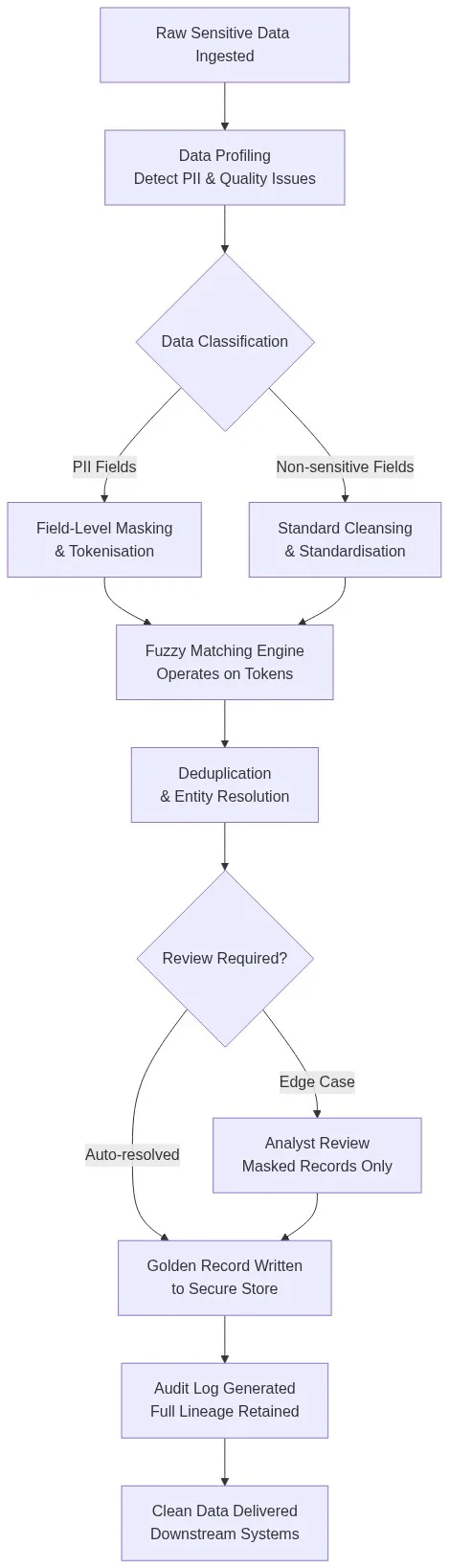
The diagram below shows the full secure pipeline. Each stage is designed to operate on the minimum exposure necessary.
Stage 1: Data Profiling Inside the Secure Boundary
AI data profiling runs first, entirely within the secure environment. The profiler identifies PII fields (names, dates of birth, national IDs, contact details), flags data quality issues (null rates, format inconsistencies, duplicate signatures), and produces a metadata report. Raw values stay in place; only structural statistics and field classifications leave the profiling layer.
A typical output for a 2M-row patient dataset might look like this:
- Field
patient_name: 98.3% populated, 6.1% contain abbreviated first names, 1.2% contain titles (Dr., Mr.) that need stripping - Field
dob: 4 distinct date formats present (ISO, US, EU, epoch integer) - Field
ssn: 94% full 9-digit, 6% last-4 only - Estimated duplicate rate: 11.4% based on name+DOB blocking
Stage 2: Cleansing and Standardisation
Data cleansing and standardisation normalises fields before tokenisation. This step matters because two records representing the same person often differ only in formatting. “12/03/74” and “1974-03-12” are the same date — but a hash of those strings produces different tokens. Standardising to ISO 8601 first ensures the token is consistent across sources.
Key standardisation steps for sensitive records:
- Name parsing: separate prefix, first, middle, last, suffix
- Date normalisation: convert all formats to ISO 8601
- Phone normalisation: E.164 format (+1XXXXXXXXXX)
- Address parsing: USPS component-level for CASS verification
- Case normalisation: uppercase all before tokenisation
Stage 3: Field-Level Tokenisation and Masking
After standardisation, each PII field is replaced with a token. The token strategy depends on how the matching engine needs to compare values:
- Phonetic token: for name fields. Both “Hollis” and “Holles” resolve to the same Soundex or Double Metaphone code, preserving fuzzy comparability.
- Range bucket token: for dates. “1974-03-12” becomes “DOB-BKT-1970s-Q1” — preserving approximate match capability while obscuring the exact value.
- Salted hash: for exact-match fields like SSN. A salted SHA-256 of “7821” produces a fixed hash that can be compared for equality without exposing the digit sequence.
- Geo-cluster token: for addresses. The street address is parsed to a census block cluster, giving the matcher enough geographic resolution to confirm same-household without transmitting a street address.
Stage 4: Fuzzy Matching and Entity Resolution on Tokens
With tokens in place, the matching engine runs standard deduplication and entity resolution logic — weighted scoring across multiple token fields, blocking to reduce comparison space, and threshold-based match decisions. The engine never sees the raw values. It operates entirely on the token representation.
A typical weighted score for a patient match might be:
| Token field | Weight | Match result | Contribution |
|---|---|---|---|
| Name phonetic token | 0.35 | Exact token match | 0.35 |
| DOB bucket token | 0.30 | Same decade + quarter | 0.27 |
| SSN hash (last 4) | 0.25 | Exact hash match | 0.25 |
| Geo-cluster token | 0.10 | Same block cluster | 0.09 |
| Composite score | 0.96 | ||
A composite score of 0.96 exceeds the auto-merge threshold of 0.90. The records are linked without any analyst ever viewing a name, a date of birth, or a last-four SSN.
Stage 5: Audit Log and Lineage
Every match decision — token inputs, weights, composite score, and outcome — is written to an immutable audit log. This log satisfies regulatory requirements (HIPAA audit trail, SOC 2 Type II logging, GDPR processing records) without containing any raw PII. Auditors see the full decision history; they do not see the underlying values.
Access Controls and Role Separation
Secure pipelines fail when access controls are too broad. The architecture requires strict role separation across three groups:
- Data custodians. Can access raw data and run the tokenisation layer. Cannot query match results or the token map directly.
- Data quality engineers. Can configure and run the matching pipeline on tokenised data. Cannot access raw records or the token map.
- Compliance auditors. Can read the audit log. Cannot access raw data, token map, or matching configuration.
In Match Data Pro, role-based access is enforced at the job level. A job configured to run on a tokenised dataset cannot be modified to pull from the raw source without re-authorisation. Job automation keeps the pipeline repeatable and prevents ad-hoc queries against live sensitive data.
Where This Applies: Three High-Stakes Use Cases
Healthcare: Patient Record Matching
Hospitals, labs, and insurers hold patient records across disconnected systems. Matching them for a longitudinal health record requires name, date of birth, address, and insurance ID — all PHI under HIPAA. The tokenisation pipeline described above lets a health system run full patient deduplication and entity resolution across 10M+ records without exposing PHI to the matching engine or its operators.
Financial Services: KYC and AML Screening
Know Your Customer (KYC) and Anti-Money Laundering (AML) processes require matching customer records against watchlists and internal transaction histories. The raw data includes passport numbers, national IDs, and transaction amounts — all subject to strict data handling requirements. Token-based matching allows compliance teams to screen records for entity overlap without centralising raw identity data in the matching layer.
Government: Cross-Agency Record Linkage
Government agencies frequently need to link records across departments (benefits, tax, licensing) without sharing raw citizen data between agencies. Privacy-preserving record linkage using tokens allows two agencies to identify overlapping populations for fraud detection or programme eligibility without either agency exposing its full dataset to the other.
What Match Data Pro Provides for Secure Sensitive-Data Workflows
Match Data Pro is a complete data quality platform built for exactly this type of workflow. Key capabilities for sensitive data environments:
- AI-powered fuzzy matching that operates on standardised and masked field values, with configurable algorithm weights per field type.
- Data profiling that runs inside your environment and produces only metadata output — no raw values leave the profiling stage.
- Deduplication and entity resolution (powered by Senzing) that handles probabilistic matching across millions of records at throughput rates suitable for nightly batch or real-time API use.
- Job automation with role-level access controls — scheduled pipelines run on pre-approved datasets with no ad-hoc raw data access.
- Full audit logging for every match decision, exportable in formats suitable for HIPAA, SOC 2, and GDPR compliance reviews.
- Cloud SaaS with no long-term contract, plus on-premise deployment options for teams that cannot use cloud infrastructure for any sensitive record processing.
Start a free trial to explore the platform on your own data, or schedule a demo to walk through a secure pipeline configured for your industry.
Frequently Asked Questions
Can AI-powered fuzzy matching work on tokenised data without losing accuracy?
Yes, when tokenisation is designed to preserve the comparability structure of the original field. Phonetic tokens preserve name similarity; range bucket tokens preserve approximate date proximity; geo-cluster tokens preserve geographic proximity. Match accuracy on well-designed tokens is typically within 2-3% of matching on raw values.
What regulations require this kind of privacy-preserving approach to data matching?
HIPAA (patient records in healthcare), GDPR (EU personal data, especially cross-border transfers), CCPA (California consumer data), and financial regulations such as PCI DSS and MiFID II all place restrictions on how personal and sensitive data can be processed and transmitted. Privacy-preserving record linkage satisfies the data minimisation and purpose limitation principles common across these frameworks.
How is tokenisation different from encryption for data matching purposes?
Encryption produces a ciphertext that can be decrypted by anyone with the key — meaning the matching engine could theoretically decrypt and read the original value. Tokenisation replaces a value with a non-reversible representation. For matching, tokens are designed to preserve structural comparability rather than the ability to recover the original. Neither approach is sufficient alone; the combination of tokenisation plus controlled access to the token map provides the strongest protection.
Does this pipeline work for real-time matching as well as batch jobs?
Yes. The tokenisation layer can be applied inline at the point of record ingestion — a new record enters, is tokenised immediately, and the token is submitted to the matching API. Match Data Pro’s live fuzzy search API supports this pattern, returning match candidates in milliseconds against a pre-indexed token store without any raw PII crossing the matching boundary.
What happens when analysts need to review borderline matches?
Records that fall between the auto-merge and auto-reject thresholds are flagged for human review. Analysts see the token representation and the match score breakdown — not the raw values. If a final decision requires viewing the original record, that access is gated separately, logged, and subject to role-based authorisation. The matching pipeline and the raw data access path are independent.