

Address data cleansing is the structured process of parsing, standardising, validating, correcting, and deduplicating postal address records so that every record in your system resolves to a real, deliverable location. Done right, it eliminates undeliverable mail, removes duplicate customer records, satisfies postal carrier certification requirements, and ensures downstream CRM, ERP, and marketing systems operate on verified data.
Address fields are among the most error-prone in any enterprise dataset. A customer may enter “123 Main St”, “123 Main Street”, “123 mane st”, or omit the suite number entirely — all referring to the same physical location. Without a dedicated cleansing pipeline, those variants accumulate as distinct records, silently corrupting analytics, inflating CRM counts, and inflating postal spend. According to IBM’s Institute for Business Value, over a quarter of organisations estimate they lose more than USD 5 million annually due to poor data quality — and unclean address data is one of the most pervasive root causes.
This guide covers the complete address data cleansing pipeline — from raw input parsing through CASS certification, fuzzy deduplication, and automated remediation — with concrete examples drawn from real data quality workflows.
Why Address Data Degrades So Quickly
Address data has a natural decay rate. The USPS estimates that approximately 40 million Americans move each year, meaning a CRM database loaded without ongoing cleansing can lose 10–15% accuracy annually. The degradation compounds across several vectors:
- Free-text entry errors: Typos, abbreviation inconsistencies (“Ave” vs “Avenue”), and transposed digits (“1234 Elm” vs “1243 Elm”).
- Missing components: Absent secondary address lines (suite, apartment, unit), missing ZIP codes, or blank state fields.
- Format fragmentation: Different source systems record address components in incompatible schemas — some as a single concatenated field, others as parsed columns.
- Demographic churn: Residents, businesses, and buildings change — a valid address today can become undeliverable within months.
- Import collisions: Merging data from multiple sources (CRM + ERP + marketing platform) introduces duplicate address variants for the same physical location.
The downstream impact is measurable: undeliverable mail costs, inflated list sizes, failed geo-enrichment, broken entity resolution, and compliance failures under regulations that require accurate contact records.
The 6-Stage Address Data Cleansing Pipeline
A production-grade address cleansing pipeline follows six discrete stages. Each stage has a specific function, and skipping any one of them degrades the quality of all subsequent stages.
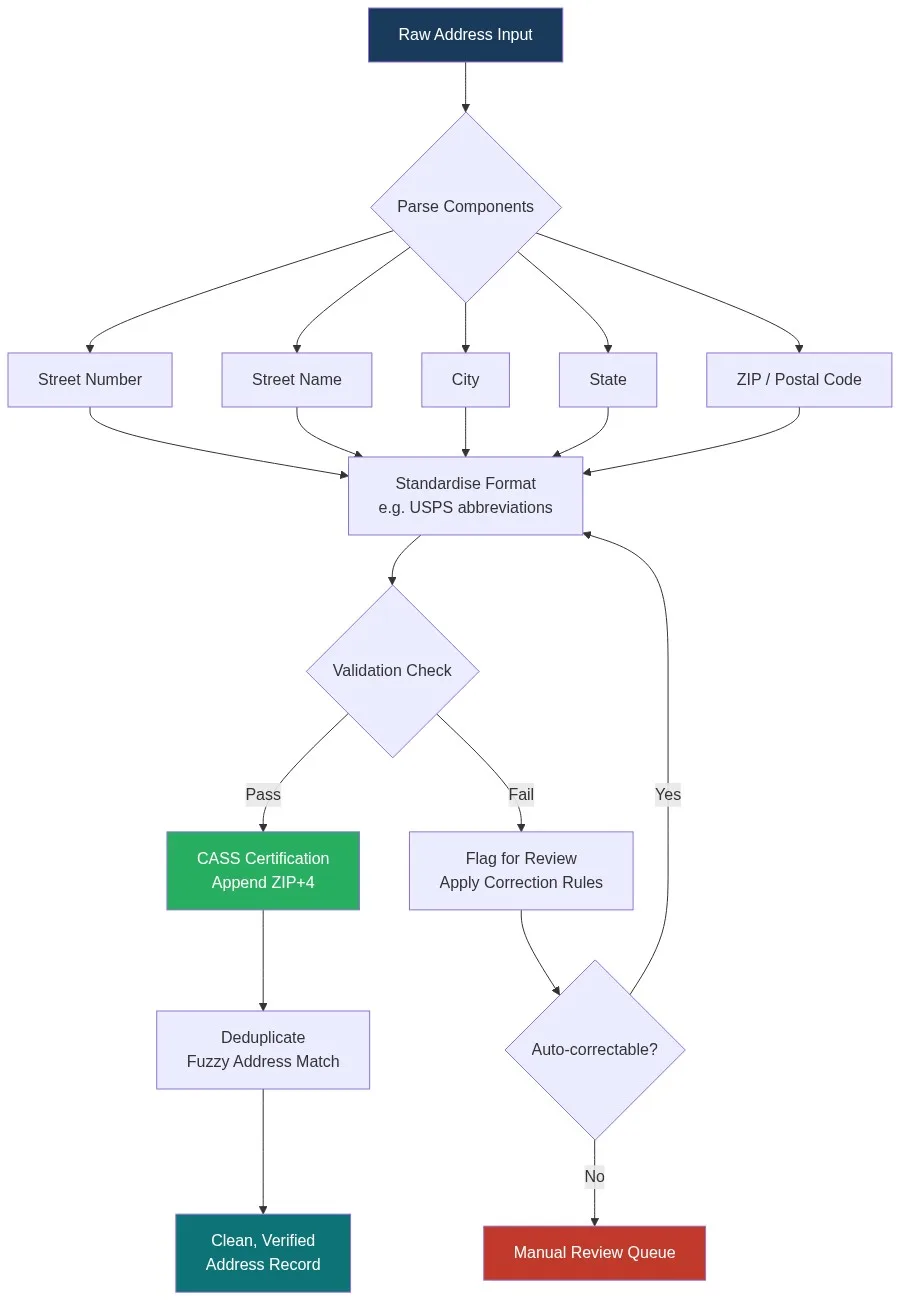
Stage 1: Parsing and Component Extraction
Raw addresses arrive in many forms. The first task is to decompose each record into its constituent components: house/building number, street name, street type (St, Ave, Blvd), directional prefix/suffix (N, SW), secondary address designator (Suite, Apt, Unit), city, state, and ZIP code. Parsing handles both structured (already field-separated) and unstructured (single concatenated string) inputs.
Ejemplo: The raw string "123 S Main St Suite 400, Springfield IL 62701" parses to:
- Number: 123
- Pre-directional: S
- Street name: Main
- Street type: St
- Secondary designator: Suite 400
- City: Springfield
- State: IL
- ZIP: 62701
Stage 2: Standardisation
Once parsed, each component is normalised to a canonical format. USPS Publication 28 defines the official abbreviation tables for street types, directionals, and state codes. Standardisation converts “Avenue” → “Ave”, “Northwest” → “NW”, “Illinois” → “IL”, and applies consistent capitalisation rules. This step is critical because fuzzy matching and CASS lookup both perform significantly better on standardised input than on raw free-text.
Stage 3: Validation
Validation checks that the parsed and standardised record conforms to known postal geography. Key validation checks include:
- ZIP code exists and matches the city/state combination
- State code is a valid USPS state abbreviation
- Street type is a recognised USPS abbreviation
- Secondary designator (if present) uses a valid range value
Records that fail validation are flagged with a specific error code and routed to an automated correction step before proceeding to certification.
Stage 4: CASS Certification and ZIP+4 Appension
CASS (Coding Accuracy Support System) is the USPS framework for verifying that a given address resolves to a real, deliverable postal delivery point. A CASS-certified engine cross-references the parsed address against the USPS AMS (Address Management System) database and either confirms a match or returns a standardised error code. For confirmed matches, the engine appends the ZIP+4 suffix and a Delivery Point Barcode (DPB) — the 12-digit postal code that enables automated mail sorting.
For a detailed breakdown of how ZIP+4 appension works within address verification, see our guide: What Is the ZIP+4 Code Extension? CASS Verification & Address Data Quality Guide.
Stage 5: Automated Correction and Remediation
Not every address fails validation permanently. Many failures are correctable through pattern-based rules or probabilistic matching against known postal data. Common automated corrections include:
- Transposition correction: “62710” → “62701” when only one plausible ZIP exists for that street/city pair.
- Street type inference: “123 Main” → “123 Main St” when the street database confirms a single type for that name.
- City/state fill: Derive city and state from ZIP when they are blank.
- Secondary address normalisation: “Apt. 4B” → “APT 4B” per USPS format.
Records that cannot be auto-corrected are queued for manual review, with all attempted corrections documented in an audit trail.
Stage 6: Fuzzy Deduplication
Validation and CASS confirm that each address is real — but multiple records may reference the same real address under different spellings. The final stage applies fuzzy matching to collapse address variants into a single canonical master record. This is where techniques like Jaro-Winkler distance, token-based matching, and phonetic encoding (Soundex/Metaphone) operate across parsed components to surface near-duplicates that exact matching misses.
For a deep dive into the algorithms that power this stage, see: What Is Fuzzy Matching? Algorithms, Examples & Thresholds.
Address Cleansing Techniques Compared
Different address cleansing techniques are suited to different data quality problems. The table below maps each technique to its use case, strength, and typical accuracy ceiling:
| Technique | Lo mejor para | Strength | Limitation |
|---|---|---|---|
| Rule-based standardisation | Format normalisation | Fast, deterministic, auditable | Cannot handle novel abbreviations or patterns |
| CASS certification | Deliverability verification | Authoritative USPS source data | US addresses only; requires licensed engine |
| Fuzzy string matching | Near-duplicate detection | Catches typos and abbreviation variants | Threshold tuning required; can produce false positives |
| Probabilistic matching | Multi-source record linkage | Handles partial records and missing fields | Computationally intensive at scale |
| AI/ML entity resolution | Cross-system identity matching | Learns address patterns, high recall | Requires training data; black-box risk |
| Geocoding + reverse validation | Spatial accuracy confirmation | Confirms physical coordinates | Coverage gaps in rural areas; API cost |
In practice, production pipelines layer these techniques sequentially: rule-based standardisation first, then CASS, then fuzzy dedup, with AI entity resolution applied at the cross-system merge layer.
Common Address Data Quality Errors and How to Fix Them
Directional Omission
Many cities have mirrored street grids where “123 N Main St” and “123 S Main St” are distinct physical locations blocks apart. When the directional is omitted from the raw record, CASS may still match to one of the options, but the wrong one. Fix: validate directionals during parsing; flag records with no directional against street segments known to require one.
Secondary Address Unit Mismatch
Suite numbers, apartment numbers, and unit designators are frequently entered inconsistently: “Ste 400”, “Suite 400”, “#400”, “4th Floor”. CASS will fail to verify records where the secondary address doesn’t match the delivery point database. Fix: normalise secondary designators using USPS-standard formats before CASS lookup.
ZIP/City/State Conflict
A record reads “Austin, TX 90210” — the ZIP belongs to Beverly Hills, CA. These conflicts reveal either a data entry error or a data migration artefact. Fix: validate ZIP-to-city-to-state consistency using a postal database reference table; correct or flag all conflicts.
PO Box vs. Physical Address Mixing
Mixing PO Box addresses with physical delivery addresses causes CASS failures and geocoding errors. Fix: parse for “PO BOX” as a distinct address type during Stage 1 and route to a separate verification path.
Address Data Cleansing in Practice: A CRM Integration Workflow
Consider a typical RevOps scenario: a company merges its Salesforce CRM with a legacy ERP system, producing a combined customer file of 2.4 million records. Before the merge, neither system had enforced address validation. The combined file contains:
- 340,000 records with no ZIP code
- 180,000 records where ZIP does not match city/state
- 95,000 records with free-text secondary address values
- 220,000 near-duplicate address records across both systems
Running the 6-stage pipeline against this dataset — using Match Data Pro’s address cleansing module — produces the following outcomes:
- Parsing + standardisation: 100% of records normalised to USPS format within minutes via batch job.
- CASS certification: 1.87 million records (78%) verified and ZIP+4 appended on first pass.
- Automated correction: 340,000 records corrected and re-verified; net CASS pass rate rises to 91%.
- Manual review queue: 216,000 records flagged for human review — exportable with error codes and suggested corrections.
- Fuzzy deduplication: 187,000 near-duplicate address variants collapsed to 94,000 canonical master records.
The result: a 2.4M-record file reduced to 2.21M verified, deliverable, deduplicated address records — ready for segmentation, geo-analytics, and campaign execution.
This workflow is closely related to broader data cleansing pipeline design, and the address layer is typically one stage within a wider data matching and merging workflow when consolidating records from multiple systems.
How Match Data Pro Handles Address Data Cleansing
Match Data Pro provides an end-to-end address data cleansing capability that covers every stage of the pipeline described above — without requiring custom scripting or external ETL tooling.
CASS Address Verification
MDP’s CASS-certified address verification engine runs against the current USPS AMS dataset and returns standardised address output, ZIP+4 codes, delivery point barcodes, and DPQ (Delivery Point Quality) codes for every record. Batch processing handles millions of records via scheduled job automation.
AI-Powered Fuzzy Address Matching
MDP’s configurable fuzzy matching engine applies field-level match weights to address components — street name, number, city, state, ZIP — and scores each pair using composite algorithms. Teams can tune thresholds per field to optimise for precision or recall depending on use case. For cross-system address entity resolution, MDP integrates Senzing entity resolution to link address records across sources that share no common identifier.
Address Matching at Resident, Household, and Individual Level
Beyond simple deduplication, MDP supports hierarchical address matching: the same physical address matched at resident (person), household (all occupants), and individual (unique person regardless of address) levels. This is essential for financial services, insurance, and healthcare where the same address appears across multiple accounts. See our detailed breakdown: Address Matching: Resident, Household & Individual.
Data Profiling Before Cleansing
Before running any cleansing pipeline, MDP’s AI data profiling module analyses address field distributions, detects null rates, format inconsistencies, and spatial anomalies — giving engineering teams a precise picture of the scope of cleansing work before committing pipeline resources.
Deployment Options
MDP deploys as SaaS (cloud-hosted, no infrastructure required) or on-premise / private cloud for organisations with data residency or security requirements. Both deployment modes support the same address cleansing feature set, including batch job automation, API access, and import/export connectors for Salesforce, HubSpot, Snowflake, and SQL-based sources.
For a broader comparison of address and data quality tooling, see our Data Quality Software Comparison 2026.
FAQ: Address Data Cleansing
What is address data cleansing?
Address data cleansing is the process of parsing, standardising, validating, correcting, and deduplicating postal address records to ensure they are accurate, consistently formatted, and resolve to real, deliverable delivery points. It typically involves CASS certification for US addresses and fuzzy matching to collapse near-duplicate variants into a single master record.
How often should address data be cleansed?
Address data should be cleansed at minimum quarterly, and in real time for any new record entering the system via web form, CRM input, or data import. With approximately 40 million address changes in the US per year, a database cleansed once annually will drift significantly out of date. Organisations with active direct mail or field sales operations typically run monthly batch cleansing jobs supplemented by real-time API validation at the point of capture.
What is the difference between address validation and address cleansing?
Address validation confirms that a given address exists in the postal database and is deliverable — it answers the binary question “is this a real address?” Address cleansing is a broader pipeline that includes validation but also standardises format inconsistencies, corrects typographic errors, appends missing components (ZIP+4, secondary designator), and deduplicates variants of the same address across your dataset. Validation is one stage within cleansing, not a substitute for it.
Can fuzzy matching be used for address deduplication?
Yes — fuzzy matching is the standard technique for address deduplication. Algorithms such as Jaro-Winkler, Levenshtein distance, and token-set ratio score the similarity between address strings, while field-weighted matching applies different confidence levels to house number vs. street name vs. ZIP. A properly configured fuzzy match engine can identify “123 Main Street NW Suite 4” and “123 N Main St #4” as the same address even when no field matches exactly.
What is CASS certification and why does it matter for address data cleansing?
CASS (Coding Accuracy Support System) is a USPS program that certifies address-matching software against a standardised set of test addresses to verify accuracy. CASS-certified processing validates addresses against the current USPS AMS database, appends ZIP+4 codes and delivery point barcodes, and qualifies mailings for postal discounts. For data quality purposes, CASS certification is the gold standard for confirming that a US address is real and deliverable — making it an essential component of any production address cleansing pipeline.
Start Cleansing Your Address Data Today
Dirty address data compounds silently — inflating CRM costs, breaking campaign targeting, and corrupting downstream analytics. A structured cleansing pipeline, deployed once and automated on a schedule, eliminates those errors at source.
Match Data Pro provides CASS address verification, AI-powered fuzzy address matching, configurable deduplication, and full pipeline automation — available as SaaS or on-premise, with no contract required.
- Start a free trial — clean your first address dataset in minutes.
- Book a demo — walk through the address cleansing pipeline with a data quality engineer.
- Contact sales — discuss volume pricing, on-premise deployment, or custom integration requirements.