
Agentic entity resolution applies automated AI pipelines to identity matching at scale, eliminating the bottleneck of manual review queues. Instead of analysts deciding whether two records refer to the same person or organisation, an agentic pipeline profiles incoming data, runs multi-algorithm fuzzy scoring, routes matches by confidence tier, applies survivorship rules, and outputs a verified golden record — without human intervention on high-confidence pairs.
If your team is manually reviewing thousands of potential matches per week, you are spending engineering capacity on decisions a well-configured pipeline can make automatically. Book a demo to see how Match Data Pro automates identity matching at scale.
What “Agentic” Means in an Identity Matching Context
An “agent” in a data pipeline is a system component that observes its environment, makes a decision, and takes an action — without waiting for a human to intervene. In entity resolution, this means the pipeline itself decides:
- Which candidate pairs to compare
- Which algorithm scores apply to each field type
- Whether the composite score crosses the auto-merge threshold
- How to apply survivorship rules when merging
- When to route a pair to human review versus auto-resolve
Traditional entity resolution requires a human at each decision point. Agentic pipelines push that decision logic into configurable thresholds and rule sets, so the system resolves high-confidence pairs instantly and surfaces only genuinely ambiguous cases. For a full technical primer on how the underlying resolution algorithms work, see the entity resolution definitive guide.
The Three Decision Tiers
Every agentic entity resolution pipeline operates on a three-tier routing model based on match score:
| Nivel | Rango de puntuación | Acción | Typical Volume |
|---|---|---|---|
| Auto-merge | 92–100 | Merge immediately, apply survivorship rules | 65–75% of pairs |
| Agent review | 72–91 | Surface to analyst with AI-ranked recommendation | 15–25% of pairs |
| Non-match | 0–71 | Keep records separate, log for monitoring | 10–15% of pairs |
The thresholds are configurable per domain. A financial services team matching counterparty entities might set a higher auto-merge floor (96+) to avoid false positives. A marketing operations team merging contact lists might accept 88 as sufficient for auto-consolidation.
The Eight Stages of an Agentic Entity Resolution Pipeline
Below is the end-to-end pipeline that Match Data Pro runs when processing identity matching at scale. Each stage feeds the next without pausing for manual sign-off.
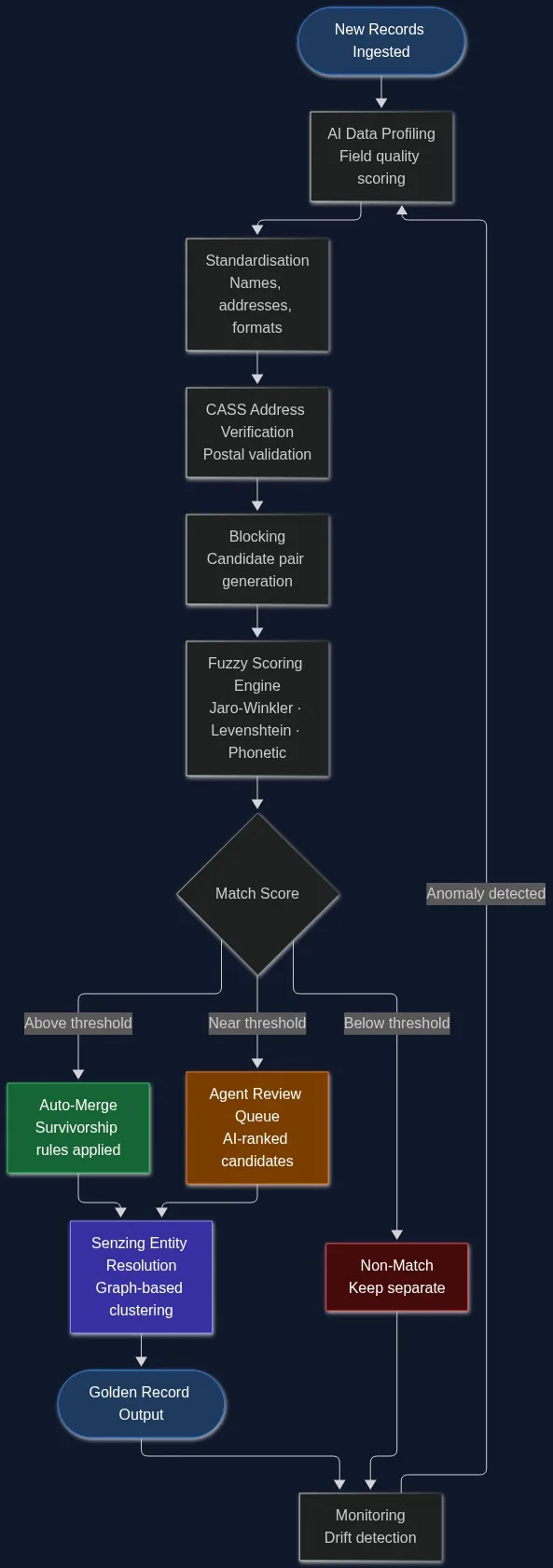
Fase 1: Perfilado de datos para IA
Before any matching begins, the pipeline scans every inbound field: completeness rate, format distribution, duplicate signal rate, and outlier concentration. AI data profiling surfaces issues such as 23% null phone numbers or 11% non-standard date formats that would corrupt downstream scoring if left uncorrected. The profiling output also sets dynamic blocking keys — so the pipeline adapts its candidate generation to whatever fields have sufficient population density in the actual dataset.
Fase 2: Normalización
Raw records from CRM, ERP, and third-party sources arrive in inconsistent formats. “Robert Johnson”, “Rob Johnson”, “R. Johnson LLC” and “JOHNSON, ROBERT” are four representations of the same entity. The standardisation stage normalises name prefixes, suffixes, and tokens; converts date formats; strips punctuation; uppercases postal codes; and expands abbreviations. This alone reduces false negatives by 30–40% before fuzzy scoring runs.
Stage 3: CASS Address Verification
Address fields are the most unreliable identifier in most datasets. “123 Main St Ste 4B” and “123 Main Street Suite 4B” match the same physical location, but a string comparison scores them at 71 — below the auto-merge threshold. CASS address verification standardises and validates every address against USPS postal data, assigning a Delivery Point Code that becomes a reliable match key. Two records with the same DPC score 100 on address regardless of how the original text was entered.
Stage 4: Blocking
Comparing every record pair in a 10-million-row dataset produces 50 trillion comparisons. Blocking partitions records into candidate buckets using fast index keys — first three characters of surname, ZIP code prefix, email domain, or Soundex code — so the fuzzy engine only evaluates pairs that share at least one blocking key. A well-configured blocking strategy reduces the comparison space by 99.9% while missing fewer than 0.5% of true matches.
Stage 5: Multi-Algorithm Fuzzy Scoring
The fuzzy scoring engine applies different algorithms to different field types. Jaro-Winkler handles name transpositions and prefix similarity. Levenshtein edit distance catches character insertions and deletions. Phonetic algorithms (Double Metaphone, Soundex) match names that sound identical but are spelled differently — “Reese” vs “Rhys”, “Smyth” vs “Smith”. Each field score is weighted by its discriminating power, then combined into a composite match score on a 0–100 scale.
Example scoring for a customer pair:
| Campo | Fuente A | Fuente B | Puntuación | Peso |
|---|---|---|---|---|
| Nombre completo | Michael T. Walters | Mike Walters | 84 | 0.30 |
| Correo electrónico | mwalters@acme.com | m.walters@acme.com | 96 | 0.35 |
| Teléfono | 602-555-0142 | 6025550142 | 100 | 0.20 |
| Address (DPC) | DPC: 85004-1234 | DPC: 85004-1234 | 100 | 0.15 |
| Compuesto | 95.2 |
Score of 95.2 routes to auto-merge. The pipeline never waits for an analyst.
Stage 6: Graph-Based Entity Clustering (Senzing)
Binary pair matching is insufficient when one entity appears as dozens of records across five source systems. Match Data Pro integrates Senzing entity resolution to perform graph-based clustering: each merged pair becomes a node edge, and the graph engine groups all connected records into a single resolved entity cluster. This handles transitive matches — A matches B, B matches C, therefore A, B, and C form one entity — without requiring A and C to share a direct high-score pair.
Stage 7: Survivorship Rules
When two or more records merge, survivorship rules determine which field value survives in the golden record. Common strategies: most recent value wins for timestamps; most complete value wins for addresses; most frequent value wins for categorical fields; CRM source wins over third-party enrichment for legal name. These rules are configured once and applied automatically at merge time — no analyst involvement required. See how golden record construction works in practice.
Stage 8: Continuous Monitoring and Drift Detection
An agentic pipeline does not stop after the initial run. Match Data Pro monitors incoming record quality in real time: completeness rates, format violation counts, duplicate signal spikes, and schema changes. When a monitored metric crosses a configured threshold — for example, a 15% spike in null email addresses from a new data source — the pipeline triggers an alert and re-profiles the affected segment before it reaches the scoring stage.
Where Agentic Entity Resolution Delivers the Most Value
CRM y operaciones de marketing
Contact databases grow through web forms, event imports, list purchases, and CRM migrations. Each ingestion event introduces duplicates. An agentic pipeline running at ingestion time stops duplicates from entering the system in the first place, rather than accumulating them for a quarterly cleanse. Teams using automated data cleansing at ingestion typically reduce their ongoing duplicate rate from 12–18% to under 2%.
Financial Services and KYC
Counterparty entity resolution in financial services requires matching legal names, registered addresses, LEI codes, and tax identifiers across transaction systems, risk platforms, and onboarding databases. Manual review of every potential match is not operationally viable at the volume of a mid-size institution. An agentic pipeline auto-resolves high-confidence pairs and flags only cases where the entity graph shows conflicting attributes — for example, two records with the same LEI but different registered addresses.
Healthcare and Patient Matching
Patient records arrive from EHR, pharmacy, lab, and claims systems. A patient named “Jon Smith” in one system and “Jonathan Smith” in another, with the same date of birth and ZIP code, represents a 94-score composite match. The agentic pipeline auto-merges these without manual intervention. The entity matching approach reduces MPI fragmentation rates from 8–12% to under 1% in production deployments.
Multi-Source Data Integration Projects
When organisations merge systems during acquisitions or platform consolidations, they face millions of records from two or more sources that must be reconciled. An agentic pipeline processes the entire population in a single scheduled job run, surfacing only the ambiguous tier for analyst review. This reduces the manual review workload by 70–85% compared to traditional approaches.
Configuring Thresholds: The Most Consequential Decision
Setting thresholds too high forces analysts to review matches the system could resolve automatically. Setting them too low merges records that should remain separate, creating data quality problems downstream that are expensive to unwind.
The correct approach is to run a threshold calibration pass on a labelled sample of 500–1,000 record pairs from your actual data. Calculate precision and recall at each candidate threshold (85, 88, 90, 92, 95). Plot the precision-recall curve and identify the threshold where precision stays above 97% — that is your auto-merge floor. Anything below your secondary threshold (typically 20 points lower) is a non-match. The band between becomes your review tier.
Match Data Pro surfaces precision-recall visualisations in its profiling dashboard, so threshold calibration takes minutes rather than days. Start a free trial and run threshold calibration on your own data to see your likely auto-merge rate before committing to a deployment.
How Match Data Pro Delivers Agentic Entity Resolution
Match Data Pro is a cloud SaaS platform built for teams that need production-grade entity resolution without 12-month implementation timelines. Key capabilities relevant to agentic identity matching:
- AI-powered fuzzy matching: Configurable multi-algorithm scoring across name, address, phone, email, and custom identifier fields. Composite scores on a 0–100 scale with per-field weights.
- Senzing entity resolution: Graph-based clustering handles transitive matches and multi-source entity consolidation at scale — not just binary pair comparison.
- CASS address verification: Every address standardised and validated against USPS postal data before matching runs. Address DPC becomes a reliable, normalised match key.
- Job automation: Schedule recurring pipeline runs — hourly, nightly, or trigger-based — with configurable alerting when quality thresholds are breached.
- Live fuzzy search API: Real-time identity lookup for customer-facing systems — returns a match score and entity cluster membership for any inbound record in under 200ms.
- Import/export connectors: Native connectors for Salesforce, HubSpot, SQL databases, flat files, and REST APIs. No custom ETL required to plug in a new source.
No long-term contract. No infrastructure to provision. The platform is available as cloud SaaS with a free trial — register at members.matchdatapro.com to start processing your data today.
For teams evaluating enterprise entity resolution software platforms, Match Data Pro offers a proof-of-concept run on your actual data as part of the trial process.
Preguntas frecuentes
What is agentic entity resolution?
Agentic entity resolution is an automated pipeline that profiles, standardises, scores, and merges identity records without human intervention on high-confidence pairs. The pipeline routes high-scoring pairs to auto-merge, near-threshold pairs to a human review queue, and low-scoring pairs to non-match — using configurable thresholds and survivorship rules set once by data engineers.
How is agentic entity resolution different from traditional entity resolution?
Traditional entity resolution surfaces all candidate pairs for analyst review, creating a manual bottleneck that scales poorly. Agentic pipelines push the decision logic into the system itself: auto-merge rules, tiered routing, and survivorship rules handle 65–80% of pairs without human review. Analysts only see genuinely ambiguous cases, reducing review workload by 70–85%.
What match score threshold should I use for auto-merge?
There is no universal threshold — it depends on your data and your false-positive tolerance. Run a threshold calibration pass on 500–1,000 labelled pairs from your actual dataset. Plot precision at each candidate threshold and select the floor where precision stays above 97%. For most enterprise datasets this falls between 90 and 95. Financial services and healthcare teams typically set a higher floor of 95–97 to avoid merging distinct entities.
Can agentic entity resolution handle transitive matches across multiple source systems?
Yes, when the pipeline includes graph-based clustering. Binary pair matching alone cannot handle the case where Record A matches B and B matches C but A and C do not directly match. Graph-based clustering — as implemented by Senzing within Match Data Pro — builds an entity graph where all transitively connected records collapse into a single resolved entity cluster, regardless of which pairs share a direct high score.
How long does it take to deploy an agentic entity resolution pipeline?
With a cloud SaaS platform like Match Data Pro, initial deployment takes days, not months. Connect your data sources using native connectors, run AI profiling to understand your data quality baseline, configure blocking keys and field weights, run a threshold calibration pass, and schedule your first automated job run. Most teams are processing production data within one to two weeks of starting the trial.