
AI governance starts with clean data. Without accurate, deduplicated, and standardised records, every AI model you build inherits the errors baked into its training set. The result is confident predictions built on corrupt foundations. This guide explains why data quality is the non-negotiable prerequisite for effective AI governance and how to implement a pipeline that satisfies both.
After you finish profiling your first dataset, register for a free trial of Match Data Pro and see exactly where your data quality gaps are.
Why AI Governance Cannot Be Separated from Data Quality
AI governance frameworks define the rules for how AI systems are built, monitored, and audited. Most frameworks cover model explainability, bias detection, and output accountability. But nearly every AI governance failure traces back one level deeper: the training data was wrong.
Consider a credit-scoring model trained on a CRM with 18% duplicate customer records. The model learns from ghost entities. Two customers named “J. Smith” and “John Smith” appear as separate training examples with conflicting credit histories. The model generalises from noise, not signal. No amount of post-hoc explainability tooling fixes that problem after the fact.
Three data quality failures drive the majority of AI governance risk:
- Duplicates: The same entity appears multiple times with inconsistent field values, skewing feature distributions.
- Unstandardised formats: “New York”, “NY”, “N.Y.” map to three different tokens. The model treats them as three cities.
- Missing or fabricated values: Null imputation errors and placeholder values (“999-999-9999”) become real features in training.
Effective AI governance requires you to resolve these problems before any model touches the data. That means building a repeatable data quality pipeline that runs continuously, not just at project start.
The Six-Stage Clean Data Pipeline for AI Governance
The diagram below shows the full pipeline from raw data ingestion to trusted AI output. Each stage is a quality gate. Data that fails the threshold loops back for remediation before proceeding.
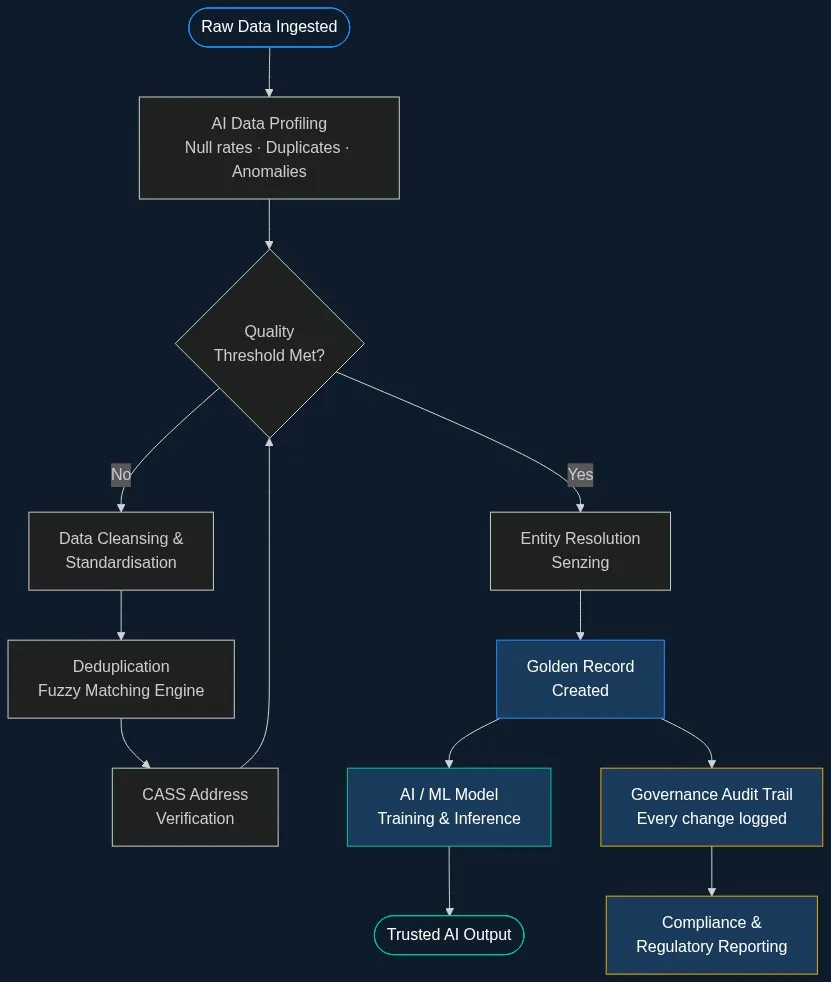
Fase 1: Perfilado de datos para IA
Before any cleansing runs, you need a complete inventory of your data’s defects. AI data profiling scans every field for null rates, format violations, value distributions, and duplicate candidate pairs. A profiling run on a 500,000-row customer table typically surfaces 12,000 to 40,000 anomalies that were invisible in the source system. That number becomes your governance baseline — the metric you track over time to prove improvement.
Fase 2: Limpieza y estandarización
Profiling identifies the problems. Cleansing fixes them. This stage strips illegal characters, normalises case and punctuation, expands abbreviations, and enforces field-level formatting rules. Data standardisation best practices matter here because unstandardised records defeat every downstream matching step. “St.” and “Street” must resolve to the same token before a fuzzy matcher sees them. Match Data Pro’s cleansing engine applies configurable REGEX rules and transformation templates in bulk, processing millions of records without manual intervention.
Stage 3: Deduplication via Fuzzy Matching
Exact-match deduplication misses the majority of real-world duplicates. “Robert Johnson, 42 Main St” and “Bob Johnson, 42 Main Street, Apt B” share the same identity but fail every exact comparison. Fuzzy data matching scores similarity across name, address, phone, and email fields simultaneously, returning a composite match score. Records above a configurable threshold (typically 85 to 92 on a 100-point scale) are flagged for merge.
For a concrete example: training a churn prediction model on a dataset with 15% duplicates artificially inflates the “retained” class by counting the same customer multiple times. Remove the duplicates first, and the class distribution shifts. The model’s predictions change accordingly. Deduplication is not a data hygiene task — it is a model accuracy task.
Learn more about the full pipeline in our data deduplication guide.
Stage 4: CASS Address Verification
Address fields require postal verification, not just string cleaning. Match Data Pro’s CASS-certified address verification validates every US address against the USPS database, corrects street abbreviations, appends ZIP+4 codes, and flags undeliverable records. For AI use cases, verified addresses matter because location-based models — fraud detection, market analysis, logistics optimisation — produce unreliable outputs when 8 to 12% of addresses are undeliverable or misformatted.
Etapa 5: Resolución de entidades
After deduplication within a single dataset, you need to resolve identities across multiple source systems. Entity resolution using Senzing’s graph-based engine links records from CRM, ERP, marketing, and support systems that refer to the same real-world person or organisation. The result is a golden record: one authoritative entity per customer, with every source record attached and traceable.
A financial services firm with customers spread across four legacy systems may have the same individual appearing as “Catherine Mills”, “C. Mills”, and “Cath Mills” in three different databases. Senzing’s probabilistic engine resolves all three to a single entity with a confidence score and a reason code — the explainability that AI governance frameworks require.
Stage 6: Governance Audit Trail
Every change made during the pipeline must be logged. Who changed what record, when, and why? A robust data audit trail records every insert, update, merge, and deletion with a timestamp, a user ID, and the specific rule that triggered the change. This log is what you present to a regulator when they ask how a model was trained. It is also the mechanism that lets you roll back a merge decision if a false positive surfaces six months later.
What Governance Frameworks Expect from Your Data
The EU AI Act, NIST AI RMF, and ISO/IEC 42001 all reference data quality as a precondition for responsible AI. Each framework uses different language but converges on three requirements:
- Traceability: Every training record must be traceable to its source. Merged or enriched records must carry provenance metadata.
- Accuracy: Data used to train or evaluate AI must be representative, correct, and free of systematic errors.
- Consistency: The same entity must be represented identically across all datasets used in a model pipeline.
A stage-by-stage data quality framework maps directly onto these three requirements. Traceability comes from the audit trail. Accuracy comes from profiling and cleansing. Consistency comes from entity resolution and standardisation.
Organisations that skip the data quality step and move straight to model governance are essentially putting a compliance wrapper around a broken process. Regulators are increasingly aware of this gap.
Continuous Monitoring: Keeping Data Clean After Training
A one-time cleansing run is not sufficient. Enterprise data decays at approximately 2 to 3% per month through contact changes, company mergers, and data entry errors. A model trained on clean data in January is working with progressively dirtier features by Q3. AI governance requires ongoing data quality monitoring, not a point-in-time project.
Match Data Pro’s data quality dashboards give teams real-time visibility into completeness, duplication rates, and format compliance across every dataset. Automated job scheduling runs the full cleansing and deduplication pipeline on a configurable cadence — daily, weekly, or triggered by source system updates. When a quality threshold is breached, the platform fires an alert before dirty data reaches any downstream model.
The modern data cleansing guide covers how to structure ongoing cleansing workflows that integrate with existing ETL pipelines.
Practical Steps to Start Today
Building an AI governance data foundation does not require a multi-year MDM program. The fastest path to clean, governed data for AI uses the following sequence:
- Run a full AI data profiling scan to quantify current defects across every dataset that feeds your AI pipeline.
- Apply automated cleansing rules: case normalisation, REGEX standardisation, null handling.
- Run fuzzy deduplication with a threshold calibrated to your acceptable false-positive rate.
- Verify addresses with CASS certification.
- Execute entity resolution across all source systems to produce golden records.
- Activate the audit trail and schedule recurring pipeline jobs.
Match Data Pro delivers all six steps in one platform. No long-term contract. No infrastructure setup. Start your free trial today and run your first profiling scan in under an hour. Or book a demo to see the full pipeline against your own data.
Preguntas frecuentes
Why does AI governance require clean data?
AI governance frameworks require clean data because model outputs are only as reliable as the data used to train and evaluate them. Duplicates skew feature distributions, unstandardised formats create false distinctions between identical values, and missing data forces unreliable imputation. Clean data is the precondition for explainable, auditable, and accurate AI.
What is the first step in building a clean data pipeline for AI?
The first step is data profiling. Profiling scans every field for null rates, format violations, duplicate candidates, and value distribution anomalies. It produces a quality baseline that guides every subsequent cleansing and deduplication step. Without profiling, you are cleaning blind.
How does entity resolution support AI governance?
Entity resolution consolidates records from multiple source systems into a single golden record per entity. For AI governance, this eliminates training examples where the same customer or supplier appears as multiple distinct entities with conflicting values. It also generates the provenance metadata that traceability requirements demand.
How often should the clean data pipeline run?
Enterprise data decays at 2 to 3% per month, so a point-in-time cleansing run is insufficient for production AI systems. The pipeline should run on a scheduled cadence — daily for high-velocity operational data, weekly for slower-changing reference data — with threshold alerts that fire when quality metrics drop below defined minimums.
What audit trail information is required for AI governance compliance?
AI governance compliance typically requires that every change to training data is logged with: the record identifier, the field changed, the before and after values, the timestamp, the user or system that made the change, and the rule or reason code that triggered it. This log must be immutable and queryable for regulatory review.