
Clean data is the foundation of every digital transformation initiative. Without it, cloud migrations stall, AI models produce wrong outputs, and customer-facing systems deliver inconsistent experiences. Organisations that build a data quality pipeline first — profiling, cleansing, deduplicating, and resolving entities before integrating systems — complete transformation programmes faster and with fewer rework cycles.
Ready to build your data foundation? Start a free trial of Match Data Pro and profile your first dataset in minutes.
Why Digital Transformation Fails at the Data Layer
Most digital transformation failures are not technology failures. They are data failures. A McKinsey analysis of large-scale transformation programmes found that less than one-third achieve their stated goals — and poor data quality consistently ranks among the top contributing factors. The pattern is consistent: organisations invest in cloud platforms, CRM replacements, or AI tooling, then discover that the data feeding those systems is duplicated, inconsistently formatted, or missing key fields.
Three failure modes appear repeatedly in failed transformations:
- Duplicated records inflate operational costs. When the same customer exists as three separate records across CRM, ERP, and billing systems, every downstream process — campaign targeting, revenue reporting, support ticket routing — operates on inflated or incorrect counts.
- Inconsistent formats break integrations. A date stored as “Nov 6 2026” in one system and “2026-11-06” in another will not join without a transformation layer. At scale, thousands of format variants across millions of records create cascading pipeline failures.
- Unresolved entities corrupt analytics. If “Acme Corp”, “Acme Corporation”, and “ACME, Inc.” are treated as three separate accounts, revenue attribution, territory planning, and churn analysis all produce wrong numbers. No dashboard can fix a data identity problem.
The fix is not to pause the transformation and “clean everything first.” That approach takes too long and often results in cleaning data that is immediately re-dirtied by live systems. The fix is to embed data quality into the transformation pipeline itself, so clean data flows into every new system from day one.
The Six-Stage Data Quality Pipeline for Digital Transformation
The diagram below shows the pipeline that connects raw source data to the clean, unified data layer that transformation initiatives depend on.
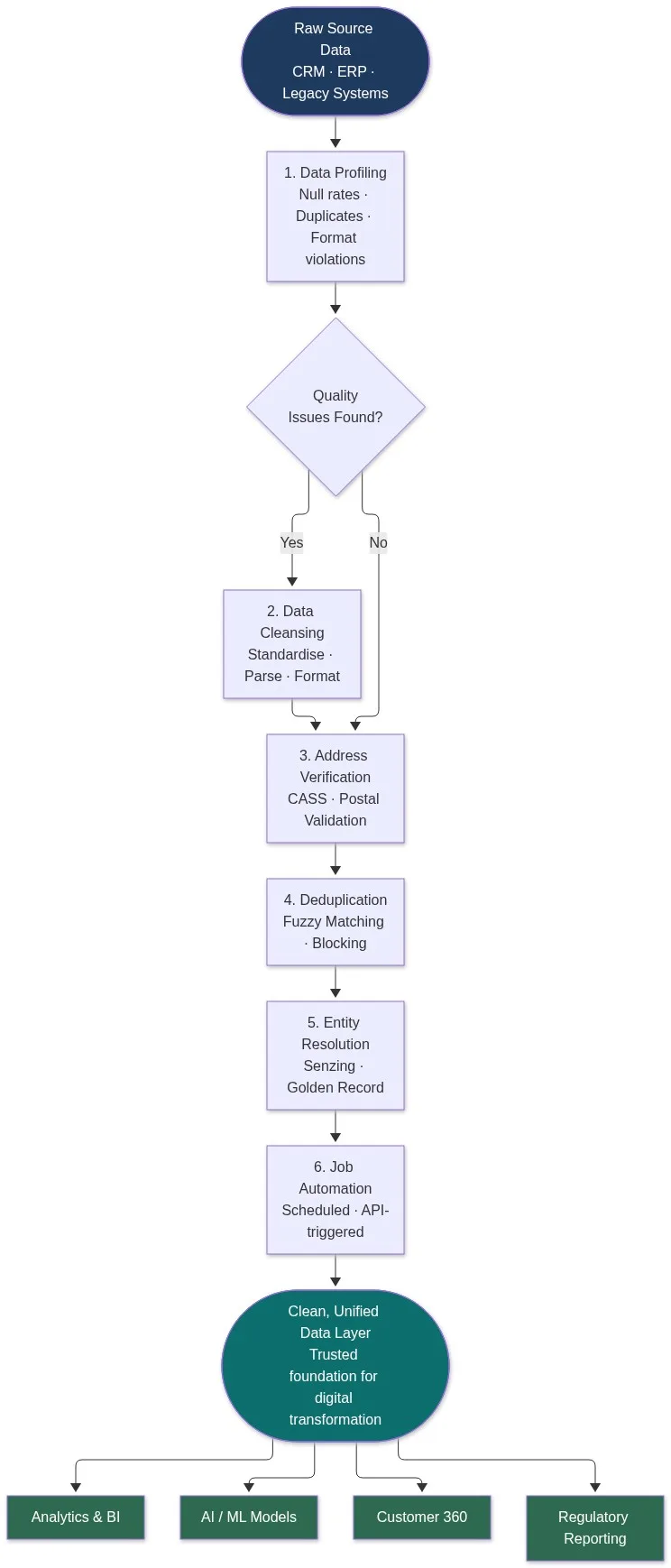
Fase 1: Perfilado de datos
Profiling scans every field for null rates, format violations, value distribution anomalies, and duplicate patterns before any migration or integration starts. Without profiling, teams discover data problems after go-live — when fixing them costs 10 to 100 times more than fixing them before. Match Data Pro’s AI data profiling automatically classifies field types, scores completeness and consistency, and generates an actionable quality report. A typical profiling run on a 2-million-record CRM export identifies 15 to 30 distinct quality issues that must be resolved before the data is transformation-ready.
Fase 2: Limpieza y estandarización de datos
Cleansing corrects identified errors. Standardisation converts inconsistent formats into a canonical form that every downstream system can consume. For a typical enterprise dataset this means: normalising name formats (title case, prefix handling), standardising phone numbers to E.164 format, converting dates to ISO 8601, and parsing free-text fields into structured components. Data standardisation alone reduces downstream matching errors by 40 to 60 percent. The rule of thumb: standardise before you match, not after.
Stage 3: Address Verification
Address data degrades at approximately 10 to 15 percent per year as people move, businesses relocate, and postal data changes. CASS-certified address verification corrects and standardises postal records against the USPS database, appends ZIP+4 codes, and flags undeliverable addresses before they enter the new system. This matters beyond mailing — address fields are also used as a matching key when no shared ID exists across source systems. See our full guide on address cleansing and verification for the complete pipeline.
Fase 4: Desduplicación
After standardisation, data deduplication identifies records that refer to the same entity. Exact matching catches obvious duplicates — same email, same phone. Fuzzy matching catches the rest: “Jon Smith at 123 Main St” and “Jonathan Smith at 123 Main Street” are the same person. A production deduplication pipeline uses blocking to partition the dataset into candidate pairs, then applies field-weighted composite scoring across name, address, phone, and email. Records scoring above a configured threshold are merged; records in the review band go to a human queue. For a 500,000-record customer database, expect 8 to 18 percent duplicate rates in CRM data migrated without prior cleansing.
Etapa 5: Resolución de entidades
Entity resolution goes beyond deduplication within a single dataset. It links records across multiple source systems — CRM, ERP, billing, support — that refer to the same real-world entity, even when no shared key exists. Match Data Pro integrates Senzing entity resolution, a graph-based probabilistic engine pre-trained on real-world entity patterns. Senzing resolves identities across systems at millions of records per hour, flagging relationships and clusters that deterministic rules would miss. The output is a golden record for each entity, persisted with full lineage back to every contributing source.
Etapa 6: Automatización de tareas
A one-time clean is not enough. Data re-dirties within weeks as new records enter through web forms, integrations, and manual entry. Job automation and data quality monitoring schedule recurring profiling, cleansing, and deduplication runs — daily, weekly, or triggered by API events — so data quality is maintained continuously rather than managed as a periodic project. Match Data Pro’s job automation engine supports scheduled batch runs and real-time API-triggered processing, so the pipeline runs automatically whether the trigger is a nightly batch export or a new record submitted through a web form.
Where Clean Data Directly Enables Transformation Outcomes
AI and Machine Learning
AI models inherit the quality of their training data. A model trained on duplicated, inconsistently formatted, or entity-confused records will learn the wrong patterns and produce confident wrong outputs. This is not a model architecture problem — it is a data quality problem. Before connecting any dataset to an AI pipeline, it must pass the same six-stage quality process described above. Teams that invest in a structured data quality program before training AI models consistently report lower hallucination rates and higher prediction accuracy than teams that do not.
Customer 360 and Personalisation
A customer 360 view requires that every interaction — purchase, support ticket, marketing engagement, payment — is linked to the same entity. If a customer exists as three records across your systems, their 360 view is actually three incomplete 60-degree views. Entity resolution is what closes the gap. Once every touchpoint is resolved to a single golden customer record, personalisation engines, churn models, and support routing tools all operate with complete information rather than fragments.
Cloud Migration
Cloud migrations that move dirty data into new infrastructure accelerate the downstream cost of dirty data — faster pipelines and more scalable infrastructure just process bad records more quickly. The correct sequence is: profile the source data, cleanse and deduplicate it, verify addresses, resolve entities, then migrate to the target system. Teams that follow this sequence report significantly fewer post-migration remediation cycles. Teams that migrate first and clean later typically spend 30 to 50 percent of their post-migration budget on data remediation work they expected to avoid. See our guide on data integration for data quality for the full pipeline architecture.
Regulatory and Compliance Reporting
Regulatory reporting — GDPR subject access requests, AML transaction screening, financial services reporting — requires data that is accurate, complete, and traceable. Duplicate records mean a subject access request may return incomplete data. Unresolved entity identities mean AML screening may miss matches. The same data quality pipeline that serves transformation initiatives also serves compliance: clean, unified, entity-resolved data with a full audit trail from source to output.
Building a Sustainable Data Quality Practice
Digital transformation is not a project — it is an ongoing state. The same applies to data quality. Organisations that treat data cleansing as a one-time pre-migration exercise find that data quality degrades within months as new records enter through integrations and manual processes. A sustainable data quality practice has three components:
- Automated monitoring. Profile your key datasets on a schedule. Track duplicate rates, null rates, and format violation rates as operational metrics — not as one-off audit findings. Set thresholds and alert when quality drops below acceptable levels.
- Point-of-entry validation. Use the Match Data Pro REST API to validate new records at the point of entry — web forms, CRM integrations, batch imports. Catching a duplicate or format error at entry is 100 times cheaper than finding it six months later in a downstream report.
- Governed survivorship rules. When records merge, survivorship rules determine which field value wins — most recent, most complete, most trusted source. Document and automate these rules so merges are consistent and auditable, not ad hoc.
Match Data Pro supports all three components in a single cloud SaaS platform: automated profiling and monitoring, real-time API validation, configurable survivorship rules, and job automation for recurring pipeline execution. No long-term contract required — start with a free trial and scale as your data volumes grow.
Before/After: What Clean Data Looks Like in Practice
Consider a mid-market retailer migrating from a legacy ERP to a cloud commerce platform. Their source data: 650,000 customer records across two regional systems. Before the data quality pipeline:
| Métrico | Antes | After Pipeline |
|---|---|---|
| Índice de duplicados | 21% | 0.4% |
| Address deliverability | 74% | 97% |
| Standardised phone format | 41% | 99% |
| Resolved entity count | 650,000 | 512,000 golden records |
| Post-migration remediation cycles | Projected: 4 | Actual: 0 |
The retailer completed the migration on schedule. Their personalisation engine launched on day one with complete, entity-resolved customer profiles — not fragmented records patched together post-launch.
How Match Data Pro Supports Digital Transformation
Match Data Pro is a cloud SaaS data quality platform built for the entire pipeline described above. Key capabilities relevant to transformation initiatives:
- AI-powered fuzzy matching across name, address, phone, email, and custom fields — configurable algorithms, not black-box scoring.
- Senzing entity resolution for cross-system identity linking at scale, with graph clustering and full audit trail.
- CASS-certified address verification for US postal records, with ZIP+4 appending and deliverability scoring.
- Import/export connectors for CSV, Excel, SQL, Salesforce, and more — so data moves in and out without manual reformatting.
- Job automation for scheduled and API-triggered pipeline execution — no manual intervention required for recurring runs.
- No long-term contract. Month-to-month SaaS with a free trial. Scale up or down as your project demands change.
Want to see how the pipeline performs on your data? Book a demo and we will walk through your specific use case with a live environment.
Preguntas frecuentes
What is the role of data quality in digital transformation?
Data quality is the foundation of digital transformation. Cloud platforms, AI models, and customer-facing systems all depend on accurate, deduplicated, and entity-resolved data to produce correct outputs. Without data quality upstream, transformation initiatives produce faster pipelines that process wrong data — accelerating the downstream cost of bad records rather than eliminating it.
Should we clean our data before or during a migration?
Before. Teams that migrate first and clean later consistently spend 30 to 50 percent of their post-migration budget on remediation work they expected to avoid. The correct sequence is: profile the source data, cleanse and deduplicate, verify addresses, resolve entities, then migrate. This sequence prevents dirty data from entering the new system and corrupting its foundational records.
How does entity resolution support digital transformation?
Entity resolution links records across multiple source systems — CRM, ERP, billing, support — that refer to the same real-world entity, even when no shared ID exists. For digital transformation this means every downstream system receives a unified golden record per entity rather than fragmented views. Customer 360, AI personalisation, and cross-system analytics all depend on accurate entity resolution to produce meaningful results.
How often should we run data quality checks during a transformation programme?
At minimum, profile key datasets weekly during active transformation phases and daily during the 90 days before and after go-live. Post-migration, automated monitoring with threshold alerts is more effective than periodic manual audits. Duplicate rates, null rates, and format violation rates should be tracked as operational metrics with defined acceptable ranges and automatic alerts when thresholds are breached.
Can a data quality platform integrate with our existing cloud migration toolchain?
Yes. Match Data Pro provides import/export connectors for common data formats and CRM/ERP systems, plus a REST API for real-time and batch processing. The platform sits as a data quality layer within your existing pipeline — receiving data from source systems, running the quality pipeline, and passing clean records to target systems — without requiring changes to your migration architecture.