
Address cleansing is the process of parsing, standardising, and verifying postal records against an authoritative reference database so that every address in your system is deliverable, correctly formatted, and deduplicated. Dirty address data costs businesses more than $20 billion per year in undeliverable mail alone, according to USPS estimates — and that figure excludes failed deliveries, CRM duplicates, and analytics errors caused by mismatched location fields. A properly implemented address cleansing pipeline eliminates these problems before they cascade downstream.
Whether you are cleansing a legacy CRM, preparing for a system migration, or running routine hygiene on a marketing database, this guide covers every stage: parsing, standardisation, CASS verification, DPV coding, deduplication, and ongoing monitoring.
Start validating your address data today. Try Match Data Pro free — no contract, instant access.
Por qué se deterioran los datos de direcciones y cuánto cuesta ello
Address data is among the fastest-decaying fields in any enterprise database. People move. Businesses relocate. Street names get renamed. ZIP code boundaries change. Historical move data trends show that roughly 13% of a typical mailing file contains bad or outdated address information — meaning more than one in ten records may never reach its intended recipient.
The downstream effects are wide-ranging:
- Undeliverable mail and packages: wasted postage and fulfilment costs on every failed shipment.
- CRM and ERP record fragmentation: the same customer appears as multiple records because “123 Main St” and “123 Main Street” do not match.
- Inaccurate analytics: geographic segmentation, territory mapping, and revenue reporting all break when address fields are inconsistent.
- Compliance risk: regulated industries require accurate address data for KYC, HIPAA, and sanctions screening.
- Failed entity resolution: address is one of the strongest matching signals in entity resolution pipelines — dirty addresses degrade match precision directly.
Poor automated data cleansing practices let these errors compound over time. A single bad import can introduce thousands of malformed records, and without a structured correction pipeline, each subsequent integration carries the error forward.
The 6-Stage Address Cleansing Pipeline
Address cleansing is not a single operation. It is a sequential pipeline in which each stage prepares the data for the next. Skipping or reordering stages produces lower accuracy and more false positives in the verification step.
Etapa 1: Análisis sintáctico y segmentación en tokens
Raw address strings arrive in dozens of formats. The first task is structural decomposition: split the input into discrete tokens — house number, street name, unit designator, city, state, and ZIP/postal code. This stage must handle edge cases including:
- Unit suffixes in the primary line: “Apt 4B”, “#4B”, “Suite 200”, “Ste. 200”, “Unit 4-B”
- Directional prefixes and suffixes: “NW”, “N.W.”, “North West”
- Street type abbreviations: “St”, “St.”, “Street”, “Str”
- ZIP+4 formats: “90210”, “90210-3456”, “90210 3456”
A parser that cannot handle unit suffixes will routinely create mismatches: “400 Oak Ave Apt 3” and “400 Oak Ave” will look like the same address when they are not — or the same address split across lines will look like two different records.
Stage 2: Standardise to Postal Convention
Once tokenised, each component must be mapped to the canonical postal authority format. For US addresses, this means USPS Publication 28 conventions: “Street” becomes “ST”, “Avenue” becomes “AVE”, “Northwest” becomes “NW”. State names expand to two-letter codes. ZIP codes are zero-padded to five digits. For international addresses, ISO 19160 defines the equivalent framework.
This stage is where data standardisation best practices apply most directly. Standardisation is not optional — it is the prerequisite for accurate CASS verification. A verification engine matching against a postal authority database will fail if it receives “Ave.” when the database stores “AVE”.
Fase 3: Verificación CASS
CASS (Coding Accuracy Support System) is the USPS certification program for address validation software. A CASS-certified engine matches each standardised address against the USPS Delivery Sequence File (DSF2) — a database of every known deliverable address in the United States. The engine returns:
- A corrected, standardised address if the input can be matched
- The full ZIP+4 code, carrier route, and delivery point barcode
- A DPV (Delivery Point Validation) confirmation code
Match Data Pro’s address verification module is CASS-certified and processes addresses in batch or via real-time API, returning standardised output with full DPV coding on every record.
Stage 4: Interpret DPV Codes
The DPV response code determines what action to take on each address. The four primary codes are:
| DPV Code | Significado | Acción |
|---|---|---|
| Y | Full match — primary and secondary components verified | Accept. Write to golden record. |
| S | Primary component matches; secondary (unit) not found in database | Flag for review. The building exists but unit is unverified. |
| D | Primary component matches; secondary component missing from input | Request unit number from source. |
| N | No match — address not found in postal database | Suppress or route to manual correction queue. |
DPV S-coded records are one of the most common sources of confusion in address cleansing projects. The building exists and is deliverable — but the specific unit has not been verified. For high-value customer records, these should be flagged for outreach to confirm the correct unit, not silently accepted.
Stage 5: Geocode and Append Reference Data
CASS-verified addresses can be enriched with geographic reference data: latitude and longitude coordinates, county FIPS codes, census tract identifiers, and carrier route assignments. This step is optional for organisations that only need deliverability, but essential for those using address data in territory mapping, logistics routing, or regulatory jurisdiction assignment.
Geocoding at this stage also supports downstream fuzzy matching — when two records share identical geocoordinates but have slightly different street address strings, the match score can be boosted accordingly.
Stage 6: Write to Golden Record Store
The final stage writes the cleansed, verified, enriched address back to the master record. In a full single source of truth architecture, this means updating the canonical entity record with the corrected address components, DPV code, and geocoordinates — while preserving the original input in an audit field for traceability.
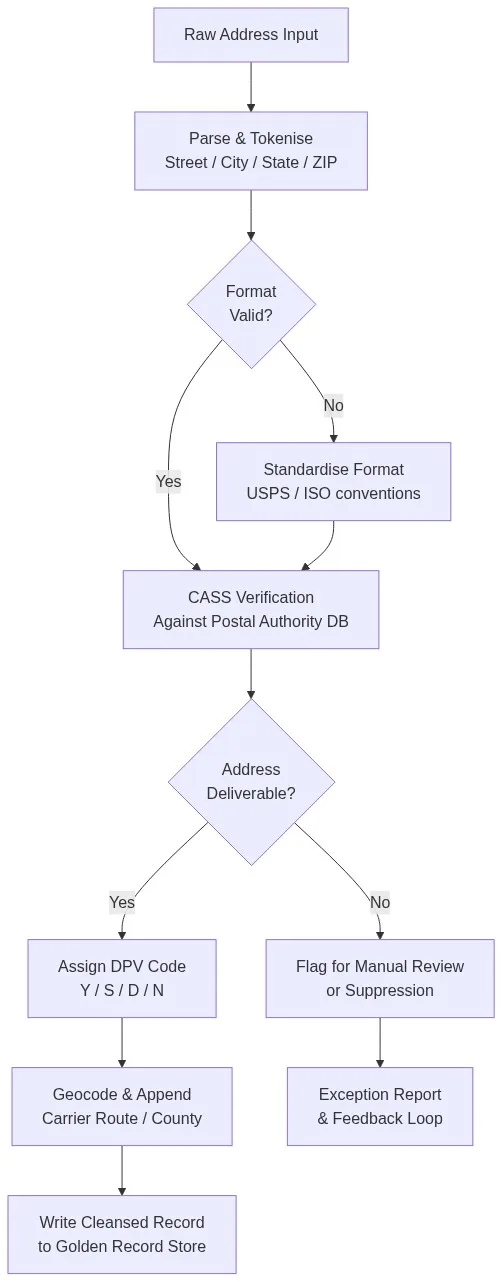
Address Cleansing Pipeline: Flowchart
The diagram below illustrates the full decision flow from raw address input through CASS verification and DPV routing to golden record output.
Common Address Cleansing Edge Cases
Transposed Street Numbers
Consider these two records from a CRM import:
| Datos sin procesar | After Parse + Standardise | Resultados del CASS | DPV Code |
|---|---|---|---|
| 1234 Elm Street, Springfield IL 62701 | 1234 ELM ST, SPRINGFIELD IL 62701-1234 | 1234 ELM ST | Y |
| 1243 Elm Street, Springfield IL 62701 | 1243 ELM ST, SPRINGFIELD IL 62701 | No hay resultados | N |
The transposed digits (1234 vs 1243) produce a DPV-N result. Without address cleansing, this record would ship to a non-existent address. With cleansing, it is routed to the exception queue for manual correction or suppression.
Abbreviated vs. Full Street Names
A database populated via multiple input channels will commonly hold all three of these variants for the same address:
- “400 Saint Mary’s Ave, Boston MA 02101”
- “400 St Marys Ave Boston MA 02101”
- “400 St. Mary’s Avenue, Boston, MA 02101”
Post-standardisation, all three resolve to the same canonical form: 400 SAINT MARYS AVE, BOSTON MA 02101-4512. This is critical for data deduplication: without standardisation, address-based blocking produces no candidate pairs across these variants, and the duplicates survive.
PO Boxes vs. Physical Addresses
A PO Box is valid for mail delivery but cannot be used for geocoding or physical delivery. Organisations that need both should store address components in separate fields: a mailing address (accepting PO Box) and a physical/service address (requiring a verified street address). Address cleansing pipelines should flag records where only a PO Box is present if the business process requires a physical address.
Integrating Address Cleansing Into a Broader Data Quality Pipeline
Address cleansing rarely runs in isolation. In production, it sits inside a multi-stage data matching and quality pipeline with the following order of operations:
- Profile: measure completeness, format consistency, and duplication rate on address fields before transformation.
- Standardise: normalise street type, directional, and unit designator formats.
- Verify (CASS): validate against the postal authority database; assign DPV codes.
- Deduplicate: use the verified, standardised address as a blocking and scoring key in the deduplication pass.
- Resolve entities: after deduplication, feed verified addresses into the entity resolution engine as a high-confidence matching signal.
- Monitor: set a scheduled job to re-verify addresses on a quarterly cycle, since approximately 13% of address data decays annually.
Match Data Pro supports all six stages in a single configurable job. You connect your source (CSV, database, CRM connector), configure the address verification step, set your DPV routing rules, and schedule the job to run on a defined cadence — no custom scripts required.
Address Cleansing vs. Address Verification: What Is the Difference?
These terms are often used interchangeably, but they describe different scopes of work:
| Capacidad | Verificación de la dirección | Limpieza de direcciones |
|---|---|---|
| Confirms address is deliverable | Sí | Yes (includes verification) |
| Standardises format to postal convention | Parcial | Sí |
| Parses and decomposes raw strings | No | Sí |
| Handles unit suffixes and edge cases | Limitado | Sí |
| Deduplicates address-based records | No | Yes (as part of pipeline) |
| Geocodes and appends reference data | A veces | Sí |
| Generates exception reports | No | Sí |
Verification is a subset of cleansing. If your goal is simply to confirm that addresses entered at a web form are deliverable, a standalone verification API call is sufficient. If your goal is to repair an existing database of hundreds of thousands of records, you need the full cleansing pipeline.
Preguntas frecuentes
What is address cleansing and why do I need it?
Address cleansing is a multi-stage data quality process that parses, standardises, and verifies postal address records against an authoritative postal database. You need it because address data degrades at roughly 13% per year through moves, relocations, and format inconsistencies. Unverified address data causes failed deliveries, CRM duplicates, geographic analytics errors, and entity resolution failures downstream.
What is CASS certification and does it matter?
CASS (Coding Accuracy Support System) is the USPS certification program for address validation software. A CASS-certified engine matches addresses against the USPS Delivery Sequence File and returns a DPV code confirming whether an address is deliverable. It matters because CASS certification guarantees the engine is validated against the most current postal database — uncertified tools may use stale or incomplete address reference data.
How often should I run address cleansing on my database?
At minimum, run a full address cleansing pass quarterly. Approximately 13% of address data in a typical database is outdated or incorrect within 12 months. For high-frequency transaction databases — CRM, ERP, or marketing platforms with continuous data ingestion — implement real-time verification at the point of entry and schedule batch re-verification every 90 days on the existing record set.
Can address cleansing fix international addresses?
Yes, but the approach differs by country. US address cleansing uses CASS against the USPS DSF2. International cleansing relies on country-specific postal authority databases and ISO 19160 address format standards. Match Data Pro’s pipeline supports both US CASS verification and international address standardisation, with configurable routing rules per country code.
What happens to addresses that fail CASS verification?
Addresses that receive a DPV-N code (no match) are routed to an exception queue rather than silently written to the golden record. From the exception queue, your team can review them manually, trigger an outreach workflow to request a corrected address from the customer, or suppress them from mailing lists. Match Data Pro logs every exception with the original input, the attempted standardised form, and the DPV response code for full traceability.
Start Cleansing Your Address Data Today
Address data errors are predictable, measurable, and fixable. A structured cleansing pipeline — parse, standardise, CASS-verify, DPV-route, geocode, and monitor — eliminates the downstream failures caused by dirty address records and gives your deduplication and entity resolution passes a reliable location signal to work with.
Match Data Pro delivers CASS-certified address verification, automated standardisation, and full pipeline orchestration in a single platform. No contract. No per-seat licence. Instant access.
- Start your free trial — validate your first dataset in minutes.
- Book a demo — walk through the address cleansing pipeline with a Match Data Pro engineer.
- ¿Tienes alguna pregunta? Envía un correo electrónico a sales@matchdatapro.com.