
A data quality program is a structured, repeatable system for profiling, cleansing, deduplicating, and governing data across every source system your organisation uses. Most teams get the first step right but skip governance, which is why data quality degrades within 12 months of a clean-up project. This guide covers the strategy, pipeline stages, governance model, and tool selection criteria you need to build a program that holds.
Schedule a demo to see how Match Data Pro handles all six pipeline stages in one platform.
Why Most Data Quality Initiatives Fail
The average organisation loses $12.9 million per year to poor data quality, according to Gartner. Yet most initiatives fail before they deliver lasting value. The reasons are predictable.
First, teams treat data quality as a one-time project. They run a deduplication pass, clean up addresses, and declare success. Within six months, new duplicates have accumulated, address decay has introduced errors (USPS estimates 17% of US addresses change each year), and the CRM is back to its original state.
Second, there is no ownership. Nobody is responsible for maintaining quality standards after the initial clean-up. A data quality program fixes this by assigning accountability at the field, dataset, and system level.
Third, tools are fragmented. Teams use one tool for deduplication, another for address verification, a script for standardisation, and a spreadsheet for monitoring. A unified data quality framework replaces that stack with a single pipeline.
The Six Stages of a Production Data Quality Pipeline
A well-designed data quality program runs six sequential stages. Each stage feeds the next. Skipping any stage degrades the accuracy of every stage that follows.
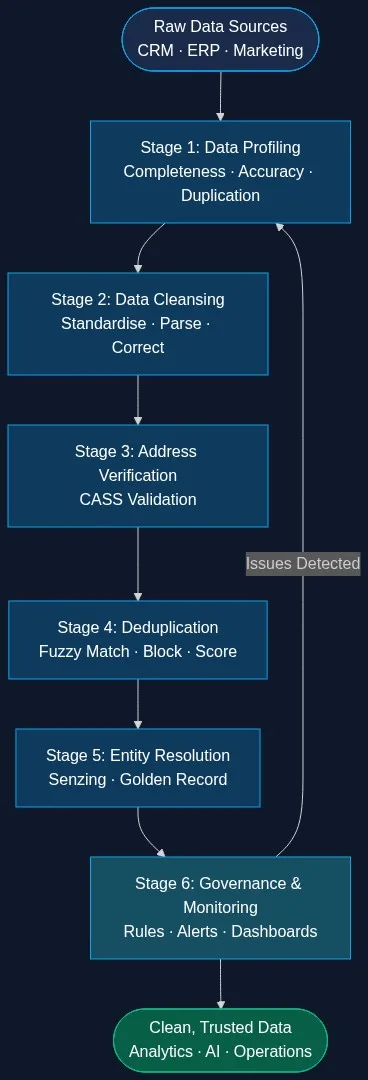
Fase 1: Perfilado de datos
AI data profiling scans every field in your dataset and returns completeness scores, format distributions, duplicate rates, and outlier counts. For a 500,000-record CRM, this surfaces facts like: 22% of phone numbers are blank, 8% of company names contain non-standard characters, and 4.3% of records are probable duplicates. Without this baseline, you cannot measure improvement or set cleaning thresholds.
Match Data Pro’s profiling engine classifies each field automatically, detects data type mismatches, and generates a quality score per column and per record. Run profiling before every major pipeline job and after every source system update.
Stage 2: Standardisation and Cleansing
Data standardisation normalises formats so downstream matching produces accurate scores. Common transformations include:
- Company name: strip legal suffixes (LLC, Inc., Ltd.) and normalise capitalisation
- Phone: convert to E.164 format (+15555551234)
- Date of birth: convert all formats to ISO 8601 (YYYY-MM-DD)
- State/country: expand abbreviations to full names or ISO codes
Before standardisation, “ACME Inc” and “Acme Incorporated” score 61% similar. After stripping suffixes and normalising case, they score 96%. That 35-point gap is the difference between a missed match and a correct merge. Full data cleansing also handles null imputation, encoding fixes, and removal of test or placeholder records.
Stage 3: Address Verification
Address errors corrupt downstream matching, inflate mailing costs, and trigger regulatory flags. The right approach is CASS (Coding Accuracy Support System) verification, which validates every address against the USPS postal database, corrects ZIP+4 codes, and standardises street abbreviations.
Match Data Pro’s address cleansing runs CASS verification as part of the automated pipeline. A record like “123 Main St, Springfield, IL 62701” is validated, corrected to “123 Main Street, Springfield, IL 62701-1234”, and flagged if the address is undeliverable. Address verification reduces downstream deduplication false-positives because records that share a verified address carry much higher match confidence.
Fase 4: Desduplicación
Deduplication identifies records that refer to the same real-world entity despite differences in spelling, formatting, or completeness. Exact matching alone catches only about 60% of duplicates. The remaining 40% require fuzzy scoring.
Match Data Pro’s fuzzy matching engine applies multiple algorithms — Jaro-Winkler for names, Levenshtein for short codes, token-set ratio for company names — and combines scores using configurable field weights. A record pair like:
- Record A: Jon Smith | ACME Corp | 555-123-4567 | 100 Main St
- Record B: John Smyth | Acme Corporation | (555) 123-4567 | 100 Main Street
…scores 94% composite similarity after standardisation, triggering an automatic merge at an 85% threshold. Below 75%, the pair routes to a manual review queue.
Etapa 5: Resolución de entidades
Entity resolution extends deduplication beyond single-dataset matching. It links records across multiple source systems — CRM, ERP, marketing platform, support database — into a single golden record per entity.
Match Data Pro embeds Senzing entity resolution, which uses a graph-based probabilistic model pre-trained on millions of real-world records. It handles relationship traversal: if Record A matches Record B, and Record B matches Record C, all three collapse into one entity cluster. This handles the post-merger scenario where two companies each had their own CRM and the combined dataset has three representations of the same customer.
Stage 6: Governance and Continuous Monitoring
A program without monitoring is a project. Data quality dashboards track completeness, accuracy, duplication rate, and address validity over time. Set threshold alerts: if the duplicate rate in a dataset rises above 2%, trigger an automated deduplication job. If address validity drops below 95%, flag for review.
Match Data Pro’s job automation layer runs scheduled pipeline jobs — nightly, weekly, or event-triggered — without manual intervention. Every job produces an audit log: records processed, rules applied, merges performed, and survivorship decisions made. This log supports GDPR, CCPA, and HIPAA compliance reviews.
Building a Data Governance Structure Around the Pipeline
Technology alone does not sustain data quality. You need a governance structure that defines who owns what.
Data Stewardship Model
Assign a data steward to each major domain: customer, vendor, product, and financial. The steward is responsible for approving survivorship rules, reviewing the manual match queue, and signing off on golden record definitions. This is typically a business analyst or operations lead, not an engineer.
Survivorship Rules
When two records merge, survivorship rules determine which field value survives. Common rule patterns:
- Most recently updated value wins for contact fields (email, phone)
- Most complete value wins for address fields
- Source system hierarchy wins for identifiers (ERP record ID overrides CRM record ID)
- Longest non-null string wins for company name
Document every rule in a survivorship specification. Match Data Pro stores these rules in the platform, applies them automatically at merge time, and records the decision in the audit log.
Data Quality SLAs
Define measurable quality targets by domain. Examples:
- Customer records: 98% address validity, less than 1% duplicate rate, 95% email completeness
- Vendor records: 100% tax ID present, 99% address verified, less than 0.5% duplicate rate
- Product records: 100% SKU populated, 98% category assigned
Review SLA compliance monthly. If a domain consistently misses targets, the root cause is usually an upstream data entry process, not the pipeline.
Tool Selection: What a Production Data Quality Platform Needs
When evaluating platforms, test against six capabilities:
1. Coincidencia difusa con múltiples algoritmos
A single algorithm does not cover all field types. You need Jaro-Winkler for names, Levenshtein for codes, phonetic algorithms for spoken names, and token-based scoring for company names. Evaluate data matching software by running your actual dirty data through the scoring engine before committing.
2. Configurable Survivorship
Off-the-shelf survivorship rules break on domain-specific edge cases. The platform must allow custom rule authoring per field, per domain, and per source system.
3. Verificación de direcciones certificada por CASS
Address verification must be CASS-certified and updated on the USPS release cycle (quarterly). Any platform that verifies addresses against a static lookup table will decay within months.
4. Entity Resolution at Scale
Entity resolution must handle millions of records across multiple source systems without requiring hand-crafted rules for every new data source. Senzing-based resolution, as used in Match Data Pro, uses a pre-trained probabilistic model that adapts to new sources automatically.
5. Job Automation and Scheduling
Manual pipeline runs do not scale. The platform needs native job scheduling, event-triggered pipeline execution, and alerting on job failure or quality threshold breaches.
6. Audit Trail and Reporting
Every merge, survivorship decision, and quality rule application must be logged with timestamp, user or system actor, and before/after field values. This is non-negotiable for regulated industries.
How Match Data Pro Covers the Full Program
Match Data Pro is a cloud SaaS platform that covers all six pipeline stages in a single environment. No separate tools for profiling, cleansing, deduplication, and entity resolution. No stitching together vendor APIs.
The platform includes: AI-powered data profiling, configurable fuzzy matching across 12 algorithms, CASS-certified address verification, Senzing entity resolution, survivorship rule authoring, job automation with full scheduling, a live fuzzy search API for real-time deduplication at point of entry, and import/export connectors for CRM, ERP, and flat file sources.
There is no long-term contract. You can start a free trial today, run your data through the pipeline, and measure match rates before committing. Start your free trial or book a demo to see the full pipeline in action.
Preguntas frecuentes
What is a data quality program?
A data quality program is a structured, repeatable system that profiles, cleanses, deduplicates, resolves entities, and monitors data continuously across source systems. It differs from a one-time clean-up project because it operates as an ongoing pipeline with governance roles, SLA targets, and automated job scheduling to prevent quality degradation over time.
How long does it take to build a data quality program?
With a platform like Match Data Pro, the technical pipeline can be operational in two to four weeks. Governance structures — stewardship roles, survivorship rules, and SLA definitions — typically take four to eight additional weeks to formalise. Enterprise rollouts across multiple source systems average 60 to 90 days end-to-end.
¿Cuál es la diferencia entre la limpieza de datos y la gestión de la calidad de los datos?
Data cleansing is one stage in a data quality program — it corrects formatting errors, removes noise, and standardises field values. Data quality management is the broader program: it includes profiling, cleansing, deduplication, entity resolution, address verification, governance, and continuous monitoring. Cleansing without the rest of the program does not prevent recurrence.
How do you measure data quality?
Measure data quality across five dimensions: completeness (% of required fields populated), accuracy (% of records verified against a reference), consistency (% of records formatted to standard), timeliness (age of the most recent update), and uniqueness (duplicate rate per domain). Track all five in a data quality dashboard with threshold alerts to catch degradation early.
Do you need enterprise MDM to run a data quality program?
No. Enterprise MDM is a governance layer for defining data ownership policies across the organisation. A data quality program focuses on the operational pipeline — profiling, cleansing, matching, and resolving records. Most teams get 80% of the value from a dedicated data quality platform like Match Data Pro without the 12-18 month MDM implementation timeline or $200K-$1M annual cost.