
Cloud outages expose a problem that existed long before the outage started: dirty data. When a provider goes down and you switch to a secondary system or restore from backup, corrupted records, unresolved duplicates, and unstandardised fields follow you there. Data resilience means your data is clean, verified, and consistent before disruption occurs — so recovery is fast and trustworthy regardless of where your data lives.
See how Match Data Pro makes your data outage-proof. Start a free trial today and run your first profiling and cleansing job in minutes.
What Cloud Outages Actually Reveal About Your Data
A service disruption rarely creates data problems. It reveals them. When teams scramble to restore operations, they discover that their backup copy contains the same 12% duplicate rate as the primary. The fallback system exposes records where the same customer appears as “Acme Corp”, “ACME Corporation”, and “Acme Co.” — three entries, one entity, no consolidation. Address fields are unverified. Phone numbers are formatted three different ways. The outage lasts four hours. The data cleanup takes weeks.
This pattern repeats across industries. The root cause is not the cloud provider. It is the absence of a systematic data quality program that makes data clean, standardised, and deduplicated at rest — not just in transit.
The Three Data Failure Modes Outages Expose
- Structural corruption: NULL fields where values should exist, mixed date formats (MM/DD/YYYY vs YYYY-MM-DD), truncated strings from schema mismatches. These silently accumulate over months until failover forces a schema migration.
- Duplicate proliferation: Every partial outage that triggers an insert retry creates potential duplicate records. A five-minute outage on an e-commerce platform processing 1,000 orders per minute can generate thousands of unresolved duplicate entries.
- Entity fragmentation: Records for the same customer or vendor drift across systems as engineers work around downed services. Post-recovery, the same person exists in three systems with slightly different names and no shared identifier.
Why Data Quality Is a Deployment-Independent Discipline
Whether your data lives in a hyperscale cloud, an on-premise data warehouse, or a hybrid architecture, the data quality requirements are identical. Deployment changes where processing happens. It does not change what good data looks like.
Teams that conflate “cloud reliability” with “data reliability” make a category error. A cloud provider guarantees uptime and hardware redundancy. It does not guarantee that your records are free of duplicates, correctly formatted, or linked across your CRM and ERP. That is your responsibility. The decision between cloud and on-premise deployment should be driven by security, latency, and cost requirements — not by the belief that one architecture inherently produces cleaner data.
What Deployment Architecture Cannot Fix
| Data Problem | Fixed by Cloud Architecture? | Fixed by Data Quality Pipeline? |
|---|---|---|
| Registros de clientes duplicados | No | Yes — fuzzy matching + deduplication |
| Inconsistent name/address formats | No | Yes — standardisation + CASS verification |
| Cross-system entity fragmentation | No | Yes — entity resolution (Senzing) |
| Missing fields / NULL values | No | Yes — profiling + cleansing rules |
| Stale or unverified addresses | No | Yes — CASS address verification |
| No audit history of changes | No | Yes — immutable audit trail |
Building a Data Resilience Pipeline: The Six Stages
Data resilience is built before an outage, not during recovery. The pipeline below runs continuously — in cloud, on-premise, or hybrid environments — and produces clean, verifiable records at every stage.
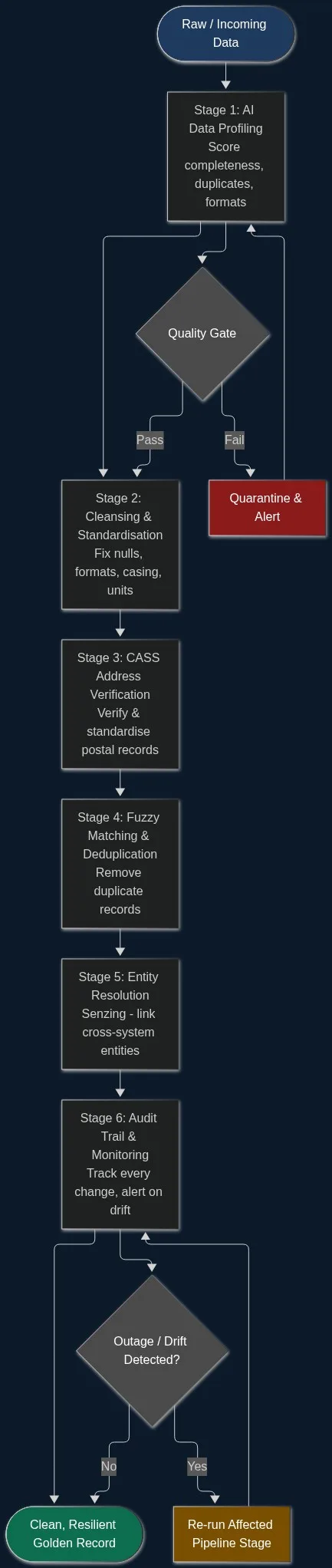
Fase 1: Perfilado de datos para IA
AI data profiling scans every field in every dataset and returns completeness rates, format distribution, duplicate density, and anomaly flags. Run profiling on a schedule — daily or on every data load — not just at migration time. A profiling job on a 10-million-row customer table will typically surface: 7–15% null rates in phone fields, 3–8% duplicate key density, and 2–5% address records that fail postal validation. These numbers define the scope of your quality problem before any cleaning starts.
Fase 2: Limpieza y estandarización
Cleansing fixes what profiling identifies. Automated data cleansing applies rules to strip whitespace, normalise casing, expand abbreviations, coerce date formats, and fill nulls from related fields. Standardisation enforces consistent output: every company name follows title case, every phone number follows E.164, every state uses the two-letter USPS abbreviation. This step is the prerequisite for accurate matching. Unstandardised input produces false negatives — the same entity fails to match because “St.” was not expanded to “Street”.
Stage 3: CASS Address Verification
Addresses degrade at roughly 11% per year as people move and businesses relocate. CASS certification verifies each address against the USPS delivery file, appends ZIP+4, corrects street suffixes, and flags undeliverables. An address field that passes CASS verification is authoritative. One that fails is flagged for review or quarantine. This matters during recovery: when restoring from backup, verified addresses remain consistent across data versions. Unverified addresses diverge.
Stage 4: Fuzzy Matching and Deduplication
Once records are standardised, deduplication identifies records that refer to the same real-world entity. Fuzzy matching scores pairs on name similarity (Jaro-Winkler, Levenshtein), address distance, phone, and email. A composite score above the configured threshold triggers a merge. Example: “Johnson Medical LLC” (CRM) and “Johnson Medical, LLC” (ERP) score 97/100 on name, identical on address — merged. The surviving record is the golden record. All source IDs are retained in an ID mapping table so the merge can be traced back.
Etapa 5: Resolución de entidades
Entity resolution extends deduplication to cross-system matching using graph-based probabilistic scoring (Match Data Pro uses the Senzing engine). Where deduplication collapses duplicates within one dataset, entity resolution links the same entity across CRM, ERP, marketing platform, and support ticketing — building a persistent identity graph. Post-outage, when records re-enter from different systems at different times, the entity graph re-links them without manual intervention.
Stage 6: Audit Trail and Continuous Monitoring
Every merge, cleanse, and address correction should produce an immutable audit trail entry: what changed, when, by which rule, and what the previous value was. Combined with continuous data quality monitoring, this gives you two things: a governance-grade record for compliance teams, and an operational alert system that flags when duplicate rates spike (a signal that an outage or integration failure has occurred). Configure alerts for: null rate increases above 5%, duplicate density spikes above 2%, format violation rates above 1%.
Data Resilience in Practice: What Recovery Looks Like With and Without a Pipeline
Consider a mid-market logistics company with 800,000 shipment records across two systems. After a four-hour regional cloud outage, records re-enter from the secondary system. Here is what the recovery looks like:
| Recovery Scenario | Without Data Quality Pipeline | With Match Data Pro Pipeline |
|---|---|---|
| Duplicate detection | Manual — 3 to 5 days | Automated — 2 to 4 hours |
| Verificación de la dirección | Not run — unknown error rate | CASS verified — 0 unverified records |
| Entity reconciliation | Spreadsheet comparison — error-prone | Senzing entity resolution — automated |
| Registro de auditoría | None — changes untracked | Full change log — compliance-ready |
| Time to trusted data | 5 to 10 business days | 4 to 8 hours |
The difference is not the cloud provider. It is whether a data quality pipeline was running before the outage started.
How Match Data Pro Delivers Data Resilience
Match Data Pro is a cloud SaaS platform built for teams that need data to stay clean and consistent regardless of what happens at the infrastructure layer. The platform covers every stage of the resilience pipeline:
- AI-powered data profiling — automated field-level quality scoring on every dataset load
- Configurable cleansing and standardisation rules — applied automatically without manual scripting
- CASS-certified address verification — USPS delivery file matching with ZIP+4 append
- Fuzzy matching and deduplication — multi-algorithm composite scoring with configurable thresholds
- Senzing entity resolution — graph-based cross-system identity linking with no hand-crafted rules
- Immutable audit trails — governance-grade change history on every record
- Job automation and scheduling — run the pipeline on a cron schedule or trigger it via API
No long-term contracts. No infrastructure to manage. Start your free trial at members.matchdatapro.com and have your first deduplication job running within the hour. Or book a demo to see the full resilience pipeline with your own data.
Preguntas frecuentes
Does moving to a more reliable cloud provider solve data quality problems?
No. Cloud reliability refers to infrastructure uptime — hardware redundancy, failover routing, and SLA guarantees. It does not address duplicate records, unstandardised formats, or unverified addresses. Data quality problems exist independently of deployment architecture and require a dedicated profiling, cleansing, and deduplication pipeline to resolve.
How quickly can a data quality pipeline restore clean data after a cloud outage?
With an automated pipeline already in place, post-outage reconciliation typically takes 4 to 8 hours for datasets under one million records. The pipeline re-profiles incoming data, identifies duplicates introduced during the outage window, re-runs entity resolution, and flags records that need review — without manual intervention at each stage.
What is the difference between data resilience and data backup?
Data backup preserves a copy of your data at a point in time. Data resilience ensures that copy is clean, deduplicated, and verifiable enough to actually use in recovery. A backup of dirty data produces dirty recovery. Resilience means running profiling, cleansing, deduplication, and entity resolution continuously so every snapshot is production-quality.
How does entity resolution help during post-outage data reconciliation?
Entity resolution re-links records that re-entered from different systems during the outage window using probabilistic graph matching. If a customer record was created in the secondary system during the outage, entity resolution recognises it as the same entity as the primary system record and merges them into a single golden record — without requiring a shared primary key.
Can I run a data quality pipeline on-premise if I do not want to send data to the cloud?
Yes. Data quality pipelines can run in cloud SaaS, private cloud, or on-premise environments. The algorithms — fuzzy matching, entity resolution, CASS verification, and audit logging — are deployment-independent. The choice of deployment model should be driven by your security and compliance requirements, not by the data quality tooling itself. Match Data Pro operates as a cloud SaaS platform with no long-term contract.