
Data deduplication identifies and removes duplicate customer records from your databases, consolidating them into a single verified golden record. In practice, a CRM holding 500,000 contacts may carry 8–15% duplicates — 40,000 to 75,000 wasted records inflating costs, skewing analytics, and corrupting segmentation. This guide walks through a proven seven-stage pipeline for consolidating duplicate customer records at scale.
Running duplicate-laden data through analytics or into a campaign tool is not just inefficient — it produces wrong results. Start with a data profiling pass to quantify your problem before you clean it.
Why Duplicate Customer Records Are a Structural Problem
Duplicates rarely appear as obvious copies. The same customer enters your CRM as “Jon Smith” from an inbound form and “Jonathan Smith” from a sales rep’s import. The same company appears as “Acme Inc.” in your ERP and “ACME Incorporated” in your marketing platform. These are not data entry errors that a spell-checker fixes. They require fuzzy matching algorithms that measure similarity rather than requiring identical strings.
The downstream effects compound quickly:
- Duplicate contacts inflate suppression lists, increase email costs, and trigger spam complaints when the same person receives the same message twice.
- Revenue forecasts double-count deals linked to split customer records.
- Compliance teams cannot respond correctly to a GDPR deletion request if the customer exists under three separate IDs.
- Customer service reps see incomplete history because prior interactions are attached to a different record for the same person.
Industry benchmarks put the average cost of a single bad record at $1 to $10 per year in wasted operational spend. At 50,000 duplicates, that is $50,000 to $500,000 in annual cost from one problem alone.
The Seven-Stage Data Deduplication Pipeline
The diagram below shows the full deduplication flow from raw source data through to a clean golden record ready for downstream systems.
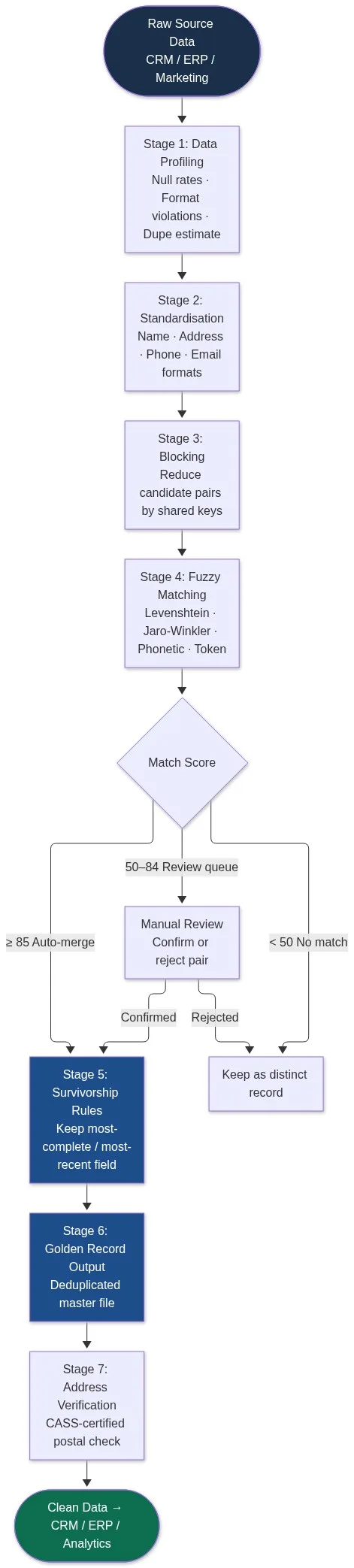
Fase 1: Perfilado de datos
Before any cleaning starts, profile every field across every source dataset. AI-powered data profiling measures null rates, format violations, value distributions, and an estimated duplicate rate. A typical output: 12% of email fields are blank, 8% of phone numbers fail format validation, and a preview blocking pass estimates 11% duplicate rate by name and address. This baseline drives every configuration decision that follows.
Fase 2: Normalización
Raw data from multiple sources uses inconsistent formats. “John” vs “JOHN” vs “john”. “(602) 555-1234” vs “6025551234” vs “+1-602-555-1234”. “St.” vs “Street” vs “ST”. Standardisation converts all values to a canonical form before matching begins. Data standardisation pipelines handle name casing, phone number normalisation, company name expansion (removing “Inc.”, “LLC”, “Ltd” for matching purposes), and date format unification. Without this stage, identical records score below the match threshold because their raw strings differ.
Etapa 3: Bloqueo
Comparing every record against every other record in a 500,000-row dataset produces 125 billion comparisons. Blocking partitions records into candidate buckets using a shared key — the first three characters of the last name, a postal code, or the domain of an email address. Only records within the same block are compared. This cuts comparisons by 95–99% with minimal loss of recall when blocking keys are well chosen.
Etapa 4: Coincidencia aproximada
Within each block, the platform scores every candidate pair using multiple algorithms applied to the right fields:
| Campo | Algoritmo | ¿Por qué? |
|---|---|---|
| First / Last name | Jaro-Winkler | Handles transpositions and prefix matches |
| Nombre de empresa | Índice de clasificación de fichas | Word-order independent (“Acme Corp” vs “Corp Acme”) |
| Número de teléfono | Exact after normalisation | Post-standardisation digits match deterministically |
| Correo electrónico | Exacto + difuso por dominio | Catches typos like “@gmial.com” |
| DIRECCIÓN | Levenshtein + CASS tokens | Handles “Ave” / “Avenue”, unit suffix variants |
Field scores are combined into a composite weighted score. A typical weighting: last name 30%, first name 20%, email 25%, phone 15%, address 10%. Choosing the right fuzzy matching algorithm for each field type is the single most impactful configuration decision in the pipeline.
Etapa 5: Normas para los supervivientes
Once two records are confirmed as duplicates, survivorship rules decide which field values survive in the golden record. Common rules:
- Most complete wins: prefer the record with more non-null fields.
- Most recent wins: prefer the field value with the latest modification date.
- Source priority wins: trust CRM over spreadsheet import for name fields; trust ERP over CRM for account IDs.
- Longest wins: for free-text notes fields, preserve the most detailed entry.
Survivorship is the most organisation-specific stage. It encodes business rules about which system is the system of record for each data domain. Data merging and survivorship rules must be agreed with data owners before the pipeline runs — not retrofitted after.
Etapa 6: Producción del «Disco de Oro»
The output is a deduplicated master file: one record per real-world customer, with the best available field values drawn from across all source records. Each golden record retains a cross-reference table mapping back to its source IDs — critical for audit trails and system synchronisation. Golden records in MDM form the persistent identity anchor that downstream systems rely on for consistent, trustworthy customer data.
Stage 7: Address Verification
Even a perfectly deduplicated record is useless for direct mail or geographic analysis if the address is invalid. CASS-certified address verification standardises street suffixes, corrects ZIP codes, appends ZIP+4, and flags undeliverable addresses before the golden record is loaded into the target system. Organisations running this step typically find 6–10% of their addresses are undeliverable — a problem invisible until the first mailing campaign returns.
Configuring Match Thresholds: Precision vs. Recall
Every deduplication pipeline involves a threshold trade-off. Set the auto-merge threshold too high (e.g., 95) and you miss genuine duplicates that differ by one character. Set it too low (e.g., 60) and you create false merges that destroy valid distinct records.
A practical three-tier configuration:
- Score 85–100: Auto-merge. Confidence is high enough that human review adds no value. These pairs share the same name, same email domain, and same address block. Trust the algorithm.
- Score 50–84: Review queue. A human reviewer sees both records side-by-side and confirms or rejects. At this range, context matters — “J. Smith at 100 Main St” and “James Smith at 100 Main Street” are probably the same person, but “J. Smith at 100 Main St” and “J. Smith at 101 Main St” are probably not.
- Score below 50: Distinct. No match. The records stand as separate entities.
Running a deduplication proof-of-concept on a 10,000-record sample before full production deployment lets you validate thresholds against known duplicates and tune weights without risk. Data deduplication in practice always starts small and validates before scale.
Handling Edge Cases in Customer Data
Real customer data surfaces edge cases that generic configurations miss.
Apodos y variantes del nombre
“Robert Johnson” and “Bob Johnson” are the same person. Without a nickname lookup table, Jaro-Winkler scores “Robert” vs “Bob” at 0.57 — below most auto-merge thresholds. A pre-processing step that expands nicknames to their canonical forms (“Bob” → “Robert”, “Bill” → “William”) before matching closes this gap.
Dígitos invertidos en los números de teléfono
A data entry error transposes two digits: “602-555-1234” becomes “602-555-1243”. Post-normalisation, Levenshtein distance is 2 characters. A phonetic algorithm misses this entirely because the sounds are different. Use edit-distance scoring on normalised digit strings for phone fields — not phonetic.
Unit and Suite Suffixes in Addresses
“100 Main St Suite 400” and “100 Main Street Ste 400” and “100 Main St #400” all refer to the same location. CASS parsing tokenises and standardises these components before scoring, ensuring the building-level match succeeds even when the unit format differs.
Shared Addresses (Families, Businesses)
Two different people at the same address — a couple, two employees at the same company — will score high on address fields alone. Weights must reflect this: address alone is not sufficient to auto-merge. Requiring a name component score above 70 as a condition for auto-merge prevents false family/business merges.
Automating Deduplication With Match Data Pro
Match Data Pro provides the complete seven-stage pipeline in a single cloud SaaS platform. Upload your data via import/export connectors or push records through the live fuzzy search API for real-time deduplication at point of entry. The platform supports:
- AI-powered data profiling that estimates your duplicate rate before the first match runs.
- Configurable multi-algorithm fuzzy matching with per-field algorithm selection and weight assignment.
- Senzing entity resolution for graph-based clustering of complex multi-system identity problems.
- CASS-certified address verification integrated into the golden record workflow.
- Job automation for scheduled batch deduplication runs — daily, weekly, or triggered by data load events.
- No long-term contract. Month-to-month SaaS with a free trial to validate accuracy on your own data first.
Want to see the pipeline run on your actual records? Start a free trial and upload a sample dataset — the profiling report alone will show you exactly how many duplicates you are carrying before you spend a dollar.
Prefer a walkthrough with your team? Book a demo and we will configure a proof-of-concept against your data.
Preguntas frecuentes
What is data deduplication and how does it work?
Data deduplication identifies records that refer to the same real-world entity and merges them into a single golden record. It works by profiling the dataset, standardising field formats, using blocking to reduce comparison volume, scoring candidate pairs with fuzzy matching algorithms, and applying survivorship rules to build the best composite record from the duplicates found.
How do I know how many duplicates are in my CRM?
Run a data profiling pass. AI profiling tools scan your dataset and produce an estimated duplicate rate based on name, email, and address similarity across all records — without running the full match. Most CRM datasets carry between 5% and 20% duplicates, depending on how data is ingested and whether duplicate prevention rules are enforced at point of entry.
¿Cuál es la diferencia entre la deduplicación y la resolución de entidades?
Deduplication removes duplicate records within a single dataset or system. Entity resolution links records across multiple systems that refer to the same entity — even when no shared ID exists. Deduplication is a step inside the entity resolution pipeline. When a customer exists in both your CRM and your ERP under different IDs, entity resolution is the technique that connects them.
What match score threshold should I use for auto-merging duplicates?
An auto-merge threshold of 85 or above works well for most customer datasets when composite scoring covers name, email, phone, and address fields. Scores between 50 and 84 should route to a human review queue. The correct threshold for your data depends on its completeness and consistency — always validate thresholds on a labelled sample before running against your full production dataset.
Can deduplication run automatically on a schedule?
Yes. Modern deduplication platforms support job automation that runs the full pipeline on a configured schedule — daily, weekly, or triggered by a data load event. This prevents duplicate accumulation between manual cleansing passes. For real-time prevention, a live API endpoint can score and reject incoming records against the existing master before they are written to the database.